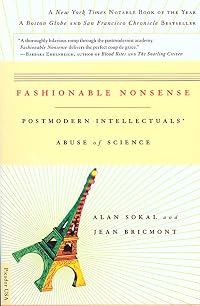
Fashionable Nonsense: Postmodern Intellectuals' Abuse of Science
by Alan Sokal, Jean Bricmont
On This Page
Description
"In 1996, Alan Sokal Published an Essay in the hip intellectual magazine Social Text parodying the scientific but impenetrable lingo of contemporary theorists. On the heels of the fierce academic debate that followed the hoax, Sokal teams up with Jean Bricmont to expose the abuse of scientific concepts in the writings of today's most fashionable postmodern thinkers. From Jacques Lacan and Julia Kristeva to Luce Irigaray and Jean Baudrillard, the authors document the errors made by some show more postmodernists using science to bolster their arguments and theories. Witty and closely reasoned, Fashionable Nonsense dispels the notion that scientific theories are mere "narratives" or social constructions, and explores the abilities and the limits of science to describe the conditions of existence. Book jacket."--Jacket. show lessTags
Recommendations







Member Reviews
One will never be grateful enough to Sokal and Bricmont for pointing fingers towards a naked Emperor.
Being French, I know far too well how postmodernism/poststructuralism/social constructivism (or whatever other stupid name a certain intelligentsia wants to call itself) damaged a whole field of academics, and, as such, modern intellectual life and debate.
Stemming from the likes of Lacan, Deleuze, Kristeva, Baudrillard, Irigaray, Latour, Virilio and co (to name just the ones targeted here) there is indeed a vague intellectual Zeitgeist, corrupting a whole part of modern societies, and, based on subjectivism, relativism, and all in all a reject of the rationalism of the Enlightenment, that needed to be addressed.
If the impact of these show more intellectuals upon political issues, especially via their influence on part of the Left, is well known (cultural relativism, multiculturalism, political correctness etc.) politics however is not what Sokal and Bricmont are here interested in. Both scientists by trade, specialists in mathematics and physics, they are in fact coming back on their now famous hoax (the so-called 'Sokal Affair') to better expose how fallacious such philosophies are.
Analysing the texts of some of these 'thinkers' that they quote at large (and, oh gosh! What an heavy and pompous nausea their prose is!) they show that, their extensive use of scientific terminology (drawn from topology, chaos theory, quantum mechanics, relativity etc.) applied to fields of social sciences (psychoanalysis, linguistics, political philosophy etc.) is not only irrelevant but, more often than not, based upon a complete ignorance and/or misunderstanding of the hard sciences involved!
Hence, nonsensical verbiage, demonstrating that such philosophies are nothing more than 'mystification, deliberately obscure language, confused thinking, and the misuse of scientific concepts', the authors dismiss them for what they are: intellectual imposture and frauds.
Of course, this is NOT an attack on Humanities as a whole, or, against French academias, or, against the political Left (Sokal, deliciously, even actually defines himself as 'an old Leftist who never quite understood how deconstruction was supposed to help the working class')! Such reading, beyond its denunciation of ignorant and incompetent nonsense, serves on the contrary as a warning against that so called 'postmodern Zeitgeist', a dangerous and irresponsible way of thinking in a world prey to obscurantism, fanaticism and superstition. In fact, even the campaigns these philosophical stances are supposed to help (feminism, gay rights, anti racism) would be far better off without such imbecilities...
This book is thus a pure delight for anyone fed up and annoyed by pompous and farcical 'philosophers' being, dangerously enough, taken seriously among some pedantic leftist circles. Point fingers and laugh: the Emperor, at long last, has been revealed naked. show less
Being French, I know far too well how postmodernism/poststructuralism/social constructivism (or whatever other stupid name a certain intelligentsia wants to call itself) damaged a whole field of academics, and, as such, modern intellectual life and debate.
Stemming from the likes of Lacan, Deleuze, Kristeva, Baudrillard, Irigaray, Latour, Virilio and co (to name just the ones targeted here) there is indeed a vague intellectual Zeitgeist, corrupting a whole part of modern societies, and, based on subjectivism, relativism, and all in all a reject of the rationalism of the Enlightenment, that needed to be addressed.
If the impact of these show more intellectuals upon political issues, especially via their influence on part of the Left, is well known (cultural relativism, multiculturalism, political correctness etc.) politics however is not what Sokal and Bricmont are here interested in. Both scientists by trade, specialists in mathematics and physics, they are in fact coming back on their now famous hoax (the so-called 'Sokal Affair') to better expose how fallacious such philosophies are.
Analysing the texts of some of these 'thinkers' that they quote at large (and, oh gosh! What an heavy and pompous nausea their prose is!) they show that, their extensive use of scientific terminology (drawn from topology, chaos theory, quantum mechanics, relativity etc.) applied to fields of social sciences (psychoanalysis, linguistics, political philosophy etc.) is not only irrelevant but, more often than not, based upon a complete ignorance and/or misunderstanding of the hard sciences involved!
Hence, nonsensical verbiage, demonstrating that such philosophies are nothing more than 'mystification, deliberately obscure language, confused thinking, and the misuse of scientific concepts', the authors dismiss them for what they are: intellectual imposture and frauds.
Of course, this is NOT an attack on Humanities as a whole, or, against French academias, or, against the political Left (Sokal, deliciously, even actually defines himself as 'an old Leftist who never quite understood how deconstruction was supposed to help the working class')! Such reading, beyond its denunciation of ignorant and incompetent nonsense, serves on the contrary as a warning against that so called 'postmodern Zeitgeist', a dangerous and irresponsible way of thinking in a world prey to obscurantism, fanaticism and superstition. In fact, even the campaigns these philosophical stances are supposed to help (feminism, gay rights, anti racism) would be far better off without such imbecilities...
This book is thus a pure delight for anyone fed up and annoyed by pompous and farcical 'philosophers' being, dangerously enough, taken seriously among some pedantic leftist circles. Point fingers and laugh: the Emperor, at long last, has been revealed naked. show less
Battle vs. Nonsense Makes Strange Bedfellows
My political and social views are very, very different from Sokal's and Bricmont's (and I really don't care how much postmodernism damages the Left), but I have to appreciate their attempt to call on the carpet those who have misappropriated the terminology, ideas, and results of math and physics in their work.
The lengthy quotes from French intellectuals that Sokal and Bricmont present in their book remind me of a weird combination of Mad Libs, the nonsense-talking inmate Damon Wayans played on "In Living Color", and a Babelfish translation attempt gone awry. (But, of course, translators can't be blamed for the nutty things these French(wo)men say, because their words apparently don't make any show more more sense in the original. _Fashionable Nonsense_ itself was originally published in France as _Impostures Intellectuelles_.) If my math students wrote like this, I'd probably not only fail them but also arrange for them to receive psychiatric treatment.
Why only 4 stars? While the book starts out fun, after a couple hundred pages it gets a little bit tiresome. You only have to read so many page-long excerpts of gibberish followed by commentary on the order of "Well, that didn't make any sense" to get the point. Sokal and Bricmont's attempt to be patient, fair, and scholarly is understandable and laudable, but I have to say I that I found myself longing for the poison-pen approach that Norman Levitt took in _Prometheus Bedeviled_. show less
My political and social views are very, very different from Sokal's and Bricmont's (and I really don't care how much postmodernism damages the Left), but I have to appreciate their attempt to call on the carpet those who have misappropriated the terminology, ideas, and results of math and physics in their work.
The lengthy quotes from French intellectuals that Sokal and Bricmont present in their book remind me of a weird combination of Mad Libs, the nonsense-talking inmate Damon Wayans played on "In Living Color", and a Babelfish translation attempt gone awry. (But, of course, translators can't be blamed for the nutty things these French(wo)men say, because their words apparently don't make any show more more sense in the original. _Fashionable Nonsense_ itself was originally published in France as _Impostures Intellectuelles_.) If my math students wrote like this, I'd probably not only fail them but also arrange for them to receive psychiatric treatment.
Why only 4 stars? While the book starts out fun, after a couple hundred pages it gets a little bit tiresome. You only have to read so many page-long excerpts of gibberish followed by commentary on the order of "Well, that didn't make any sense" to get the point. Sokal and Bricmont's attempt to be patient, fair, and scholarly is understandable and laudable, but I have to say I that I found myself longing for the poison-pen approach that Norman Levitt took in _Prometheus Bedeviled_. show less
Before I start, let me nail my colours to the mast: I'm pro-science, I'm pro-evolution, I really like the idea of rational enquiry and I'm a sceptic bordering on the cynical. I'm *not* some lentil-munching, kaftan-wearing, feng-shui-hugging hippie with airbrushed unicorns and a yin-yang sign on the side of my Kombi. Honestly.
Now we've got that cleared up, let me say it straight: This book takes on some big arguments, but, other than humorously swatting some flies, loses hands down. All it succeeds in doing is illustrating that there are fakers, losers, charlatans and wankers to be found in the Social Sciences departments of any given University. Anyone who's been to university and didn't know that deserves a clip around the ear and to show more be sent to the back of the class. Now either Sokal didn't know that ( - ~clip~ -), or he's spent half his book shooting fish in a barrel. That might seem like good sport, but before long it becomes obvious it's a cheap thrill.
Having said that, I sincerely doubt that the titillation of seeing dumb French Feminists taken apart is what made this book such a splash: I think it's because of Sokal's purported intent: to undermine the notion of cognitive relativism, especially as it associated with modern philosophy of science, in particular the work of Thomas Kuhn and Paul Feyerabend. This is the battle: Sokal aligns with those who say scientists are the exclusive purveyors of a shining light called truth; the Barbarians at the gate are these simpering postmodernists who want to tear the temple down.
While the poseurs cited in this book are certainly (for the most part) phoneys or idiots, I think Thomas Kuhn was neither, and while Paul Feyerabend overplayed the court jester hand, he had some important things to say too.
So, to the first point: Proving that one writer (or a hundred, or a thousand) who purports to adhere to relativism is a charlatan doesn't establish anything about *the idea* of relativism. All you have established is that you have a found yourself a charlatan. Give yourself a star.
But while you're pinning it on, remember that postmodernists do not have a monopoly on illogical, bamboozling, balderdash:
Example: Sir Roger Penrose (Emeritus Rouse Ball professor of mathematics at Oxford University, no less) and his dreadful, lumpen-headed, and deliberately bamboozling anti-AI tract "The Emperor's New Mind". The very point of the (no doubt correct but nonetheless entirely irrelevant) science deluged on the reader in that book is to obscure the fact that the real emperor was Roger Penrose and his arguments on AI really blow the kumara.
Example: Noam Chomsky and Steven Pinker's Linguistic Nativism, which has held sway for a good thirty years in many linguistics departments, and is anything but post-modern: nativism holds that humans have an innate understanding of grammar hard wired into their biology. From my paltry readings in linguistics and the philosophy of language, my impression is that Pinker's and Chomsky's arguments are seriously flawed. (See: Sampson: "The Language Instinct Debate" for a thorough linguistic critique of nativism; see Rorty: "Contingency Irony, and Solidarity" for a philosophical perspective on the contingency of language). Make note of this example, as it becomes relevant later on.
Secondly, Sokal and Bricmont (quite deliberately) refuse to engage on certain topics, in particular on cultural or aesthetic relativism, which they say (without providing a reason) "raise very different issues". Take that star away, for this statement betrays a fundamental misunderstanding about relativism. Actually, ethical, aesthetic and cognitive relativisms raise different manifestations of *exactly* the same issue: Cognitive relativism, in that it relates to "epistemic" truth (as opposed to "moral" truth or "aesthetic" truth - both of which seem intuitively more questionable ideas) is simply a cut closer to the quick: indeed, the aesthetic and moral brands of relativism rely for their plausibility on cognitive relativism anyway (i.e. if the truths we understand about the physical universe are contingent on our language, then it follows that ideals of right and wrong and beauty must be similarly contingent on our language).
Thirdly, Sokal provides the following account of cognitive relativism:
"While scientists ... try to obtain an objective view ... of the world, relativist thinkers tell them that they are wasting their time and that such an enterprise is, in principle, an illusion"
Now that, to put it mildly, is a *very* punchy version of relativism, and not one that any credible relativist philosopher I know of (and certainly not Thomas Kuhn, who spent a whole book explaining how and why the process scientific discovery works) subscribes to.
That is, in the trade, known as a straw-man argument: You set it up to knock it over. Here goes:
P1: Relativists say science is a waste of time
P2: Science helps us reliably predict and react coherently to phenomena occurring in the world
P3: Things which help to predict and react to such phenomena have genuine utility
C1: Therefore, science has genuine utility
C2: Ergo, science is not a waste of time
Case closed. Is relativism dead? No: the problem is, most relativists I know would completely agree with all of the above argument except for premise 1. The cat is most definitely still out of the bag. (In a nutshell, all reasonably stated relativism says is that you can't know that your theory actually maps onto the actual configuration of the outside world; it may, it may not: logically there will always be some other possible explanation for the same set of data, however implausible or difficult to imagine, and in part that difficulty in imagination may be a function of the historical contingency of our belief in, and description of the world in terms of, the current "paradigm". Relativism simply says the best you can do is to know that, for now, your theory works, not that it is *true*. Though Sokal and Bricmont may disagree, I don't think this is controversial amongst philosophers nor, really, scientists.)
Lastly, in criticising an admittedly utterly ludicrous passage bestowed on the world by that splendidly silly feminist philosopher Julia Kristeva, Sokal makes the following footnote:
"...Kristeva seems to be appealing ... to the 'Sapir-Whorf thesis' in linguistics that is ...that our language radically conditions our view of the world. This thesis nowadays is sharply criticised by some linguists: see, for example Pinker ..."
Hold the phone. The implication is that the Sapir-Whorf thesis (as to the contingency of language) has been discredited, but by none other than Steven Pinker in his "The Language Instinct" which, as per the above, is at the very least a controversial piece of writing. This is an extremely important point, since it's utterly central to the credibility of the anti-relativist cause, and if one takes Geoffrey Sampson's book (cited above) at face value the nativist claims themselves are built on very suspect reasoning and scientific research. It seems to me (and to writers like Richard Rorty) that language must radically condition our view of the world, because that's the only basis on which we can even describe it.
At the end of the day, properly stated cognitive relativism is no a threat to modern scientific discourse, except that it relegates the scientist from "truth knower" or "person through whom you may have exclusive access to the truth" (sounds a bit like a grand high pooh-bah or - dare I say it - high priest, doesn't it?) to "person whose theory works the best for now" and who may be in competition for that status with other people in the community whether or not they're scientists.
If science *does* work better than feng shui or healing crystals (and I, for one, think it does) then this shouldn't be a particularly troubling way of looking at the world for a scientist who is at ease with his views and his value to the community. So it makes the knee-jerk reactions against relativism, from the likes of Sokal and elsewhere Richard Dawkins, all the more mystifying. show less
Now we've got that cleared up, let me say it straight: This book takes on some big arguments, but, other than humorously swatting some flies, loses hands down. All it succeeds in doing is illustrating that there are fakers, losers, charlatans and wankers to be found in the Social Sciences departments of any given University. Anyone who's been to university and didn't know that deserves a clip around the ear and to show more be sent to the back of the class. Now either Sokal didn't know that ( - ~clip~ -), or he's spent half his book shooting fish in a barrel. That might seem like good sport, but before long it becomes obvious it's a cheap thrill.
Having said that, I sincerely doubt that the titillation of seeing dumb French Feminists taken apart is what made this book such a splash: I think it's because of Sokal's purported intent: to undermine the notion of cognitive relativism, especially as it associated with modern philosophy of science, in particular the work of Thomas Kuhn and Paul Feyerabend. This is the battle: Sokal aligns with those who say scientists are the exclusive purveyors of a shining light called truth; the Barbarians at the gate are these simpering postmodernists who want to tear the temple down.
While the poseurs cited in this book are certainly (for the most part) phoneys or idiots, I think Thomas Kuhn was neither, and while Paul Feyerabend overplayed the court jester hand, he had some important things to say too.
So, to the first point: Proving that one writer (or a hundred, or a thousand) who purports to adhere to relativism is a charlatan doesn't establish anything about *the idea* of relativism. All you have established is that you have a found yourself a charlatan. Give yourself a star.
But while you're pinning it on, remember that postmodernists do not have a monopoly on illogical, bamboozling, balderdash:
Example: Sir Roger Penrose (Emeritus Rouse Ball professor of mathematics at Oxford University, no less) and his dreadful, lumpen-headed, and deliberately bamboozling anti-AI tract "The Emperor's New Mind". The very point of the (no doubt correct but nonetheless entirely irrelevant) science deluged on the reader in that book is to obscure the fact that the real emperor was Roger Penrose and his arguments on AI really blow the kumara.
Example: Noam Chomsky and Steven Pinker's Linguistic Nativism, which has held sway for a good thirty years in many linguistics departments, and is anything but post-modern: nativism holds that humans have an innate understanding of grammar hard wired into their biology. From my paltry readings in linguistics and the philosophy of language, my impression is that Pinker's and Chomsky's arguments are seriously flawed. (See: Sampson: "The Language Instinct Debate" for a thorough linguistic critique of nativism; see Rorty: "Contingency Irony, and Solidarity" for a philosophical perspective on the contingency of language). Make note of this example, as it becomes relevant later on.
Secondly, Sokal and Bricmont (quite deliberately) refuse to engage on certain topics, in particular on cultural or aesthetic relativism, which they say (without providing a reason) "raise very different issues". Take that star away, for this statement betrays a fundamental misunderstanding about relativism. Actually, ethical, aesthetic and cognitive relativisms raise different manifestations of *exactly* the same issue: Cognitive relativism, in that it relates to "epistemic" truth (as opposed to "moral" truth or "aesthetic" truth - both of which seem intuitively more questionable ideas) is simply a cut closer to the quick: indeed, the aesthetic and moral brands of relativism rely for their plausibility on cognitive relativism anyway (i.e. if the truths we understand about the physical universe are contingent on our language, then it follows that ideals of right and wrong and beauty must be similarly contingent on our language).
Thirdly, Sokal provides the following account of cognitive relativism:
"While scientists ... try to obtain an objective view ... of the world, relativist thinkers tell them that they are wasting their time and that such an enterprise is, in principle, an illusion"
Now that, to put it mildly, is a *very* punchy version of relativism, and not one that any credible relativist philosopher I know of (and certainly not Thomas Kuhn, who spent a whole book explaining how and why the process scientific discovery works) subscribes to.
That is, in the trade, known as a straw-man argument: You set it up to knock it over. Here goes:
P1: Relativists say science is a waste of time
P2: Science helps us reliably predict and react coherently to phenomena occurring in the world
P3: Things which help to predict and react to such phenomena have genuine utility
C1: Therefore, science has genuine utility
C2: Ergo, science is not a waste of time
Case closed. Is relativism dead? No: the problem is, most relativists I know would completely agree with all of the above argument except for premise 1. The cat is most definitely still out of the bag. (In a nutshell, all reasonably stated relativism says is that you can't know that your theory actually maps onto the actual configuration of the outside world; it may, it may not: logically there will always be some other possible explanation for the same set of data, however implausible or difficult to imagine, and in part that difficulty in imagination may be a function of the historical contingency of our belief in, and description of the world in terms of, the current "paradigm". Relativism simply says the best you can do is to know that, for now, your theory works, not that it is *true*. Though Sokal and Bricmont may disagree, I don't think this is controversial amongst philosophers nor, really, scientists.)
Lastly, in criticising an admittedly utterly ludicrous passage bestowed on the world by that splendidly silly feminist philosopher Julia Kristeva, Sokal makes the following footnote:
"...Kristeva seems to be appealing ... to the 'Sapir-Whorf thesis' in linguistics that is ...that our language radically conditions our view of the world. This thesis nowadays is sharply criticised by some linguists: see, for example Pinker ..."
Hold the phone. The implication is that the Sapir-Whorf thesis (as to the contingency of language) has been discredited, but by none other than Steven Pinker in his "The Language Instinct" which, as per the above, is at the very least a controversial piece of writing. This is an extremely important point, since it's utterly central to the credibility of the anti-relativist cause, and if one takes Geoffrey Sampson's book (cited above) at face value the nativist claims themselves are built on very suspect reasoning and scientific research. It seems to me (and to writers like Richard Rorty) that language must radically condition our view of the world, because that's the only basis on which we can even describe it.
At the end of the day, properly stated cognitive relativism is no a threat to modern scientific discourse, except that it relegates the scientist from "truth knower" or "person through whom you may have exclusive access to the truth" (sounds a bit like a grand high pooh-bah or - dare I say it - high priest, doesn't it?) to "person whose theory works the best for now" and who may be in competition for that status with other people in the community whether or not they're scientists.
If science *does* work better than feng shui or healing crystals (and I, for one, think it does) then this shouldn't be a particularly troubling way of looking at the world for a scientist who is at ease with his views and his value to the community. So it makes the knee-jerk reactions against relativism, from the likes of Sokal and elsewhere Richard Dawkins, all the more mystifying. show less
In 1996, Alan Sokal submitted an article to Social Text entitled "Transgressing the Boundaries: Toward a Transformative Hermeneutics of Quantum Gravity." If that title means little to you, that's OK because the article was, in fact, nonsense. It was part of an elaborate hoax and parody that Sokal was perpetrating on those who subscribe to "epistemic relativism," i.e., the belief that modern science is nothing more than myth, a "social construction."
This philosophy is particularly endemic to modern French philosophers who have attempted to appropriate the language of science in order to validate some of their thinking without understanding the science itself. Sokal, a renowned physicist, by filling his article with scientific balderdash show more and liberally citing the editors of Social Text (David Lodge's Law of Academic Life says "It is impossible to be excessive in flattery of one's peers.") had his article gleefully accepted, revealing the ignorance and vacuity of the pseudo-thinkers.
Fashionable Nonsense expands the revelations behind the parody and thoroughly reveals the emperor's nakedness. The authors, by analysis of several postmodernist French philosophers, show how they misuse, misrepresent, and misunderstand basic science. Sokal and Bricmont disclose how "deliberately obscure language" is used to hide confused thinking, that often if something is difficult to understand in the writings of these philosophers it's because they aren't saying anything.
Postmodernism, a trend fashionable in some social science and humanist circles, adopts the view that rejects the rationalism of the enlightenment and proposes that science is a "social construction" or "narration" and that there is no need to look for empirical evidence.
Unfortunately, much of postmodernist "thinking" has become associated with the left, a linkage Sokal abhors. He wants to defend the Left from a trendy segment of itself. As Michael Albert, wrote for Z Magazine, "There is nothing truthful, wise, human, or strategic about confusing hostility with injustice and oppression, which is leftist, with hostility to science and rationality, which is nonsense."
A follow-up article, published as an appendix to the book, was submitted to Social Text but was rejected as not meeting their intellectual standards! It must have been understandable and made sense. In it Sokal wrote, "I confess that I am an unabashed Old Leftist who never quite understood how deconstruction was supposed to help the working class. And I'm a stodgy old scientist who believes, naively, that there exists an external world, that there exist objective truths about that world, and that my job is to discover some of them."
This book is a delightful attack on intellectual confusion and a ringing call to obfuscate obfuscation.
reposted with minor editing 1/15/10 show less
This philosophy is particularly endemic to modern French philosophers who have attempted to appropriate the language of science in order to validate some of their thinking without understanding the science itself. Sokal, a renowned physicist, by filling his article with scientific balderdash show more and liberally citing the editors of Social Text (David Lodge's Law of Academic Life says "It is impossible to be excessive in flattery of one's peers.") had his article gleefully accepted, revealing the ignorance and vacuity of the pseudo-thinkers.
Fashionable Nonsense expands the revelations behind the parody and thoroughly reveals the emperor's nakedness. The authors, by analysis of several postmodernist French philosophers, show how they misuse, misrepresent, and misunderstand basic science. Sokal and Bricmont disclose how "deliberately obscure language" is used to hide confused thinking, that often if something is difficult to understand in the writings of these philosophers it's because they aren't saying anything.
Postmodernism, a trend fashionable in some social science and humanist circles, adopts the view that rejects the rationalism of the enlightenment and proposes that science is a "social construction" or "narration" and that there is no need to look for empirical evidence.
Unfortunately, much of postmodernist "thinking" has become associated with the left, a linkage Sokal abhors. He wants to defend the Left from a trendy segment of itself. As Michael Albert, wrote for Z Magazine, "There is nothing truthful, wise, human, or strategic about confusing hostility with injustice and oppression, which is leftist, with hostility to science and rationality, which is nonsense."
A follow-up article, published as an appendix to the book, was submitted to Social Text but was rejected as not meeting their intellectual standards! It must have been understandable and made sense. In it Sokal wrote, "I confess that I am an unabashed Old Leftist who never quite understood how deconstruction was supposed to help the working class. And I'm a stodgy old scientist who believes, naively, that there exists an external world, that there exist objective truths about that world, and that my job is to discover some of them."
This book is a delightful attack on intellectual confusion and a ringing call to obfuscate obfuscation.
reposted with minor editing 1/15/10 show less
تيار ما بعد الحداثة هو اتجاه فكري بدأ في الظهور أواخر القرن العشرين وما زال آخذاً في الانتشار، خصوصاً بين مدعي العلم والثقافة في الجامعات ومراكز السلطة في جميع أنحاء العالم.
تقول هذه الحركة في أساسها أن كل أشكال المعرفة هي تصور وتركيب مجتمعي، ولا وجود لحقائق موضوعية أو نظريات مثبتة، بل يمكن لأي معتقد أو وجهة نظر أن تصحّ.
يستخدم بعض فلاسفة ما بعد الحداثة المؤثرين والمشهورين تكتيكات مريبة تسيء استخدام الحقائق show more العلمية وتعمل على طيّها، وهنا تكمن خطورتها على العلم والمجتمع.
من وسائل مدّعي العلم والثقافة من أتباع هذا التيار هو استخدام اللغة الغامضة المنمقة المحشوة بالكلمات البليغة والمصطلحات الفخمة، وهي في حقيقتها كلام فارغ خالٍ من أي معنى أو دلالة، فيصفّق لهم من يخافون الاعتراف بعدم الفهم ومن يرغبون بالظهور بمظهر الأذكياء، ويعملون على تقليدهم.
في محاولة لكشف هراء ما بعد الحداثة وأثرها على البحث العلمي، عمد المؤلف إلى كتابة ورقة بحثية مستخدماً ذات الأسلوب، مستعيناً بأسماء واقتباسات معروفة في الوسط العلمي ليعطي بحثه مصداقية وهمية، وقدم الورقة لمجلة علمية ذات أهمية. بعد قبول ورقته ونشرها في المجلة صرّح المؤلف أنه ليس لما كتبه أي قيمة علمية أو معنى، وما هو إلا رطانة خالصة وهراء مستتر تحت غطاء من التكلّف اللفظي والتنميق الإنشائي.
وهكذا، يسلط الكتاب الضوء على مخاطر فكر ما بعد الحداثة على الطريقة العلمية بشكل خاص، مورداً عدة أمثلة في هذا السياق.
أمتعني جداً وزادني اطلاعاً على ظاهرة ألاحظ تفشيها منذ زمن. show less
تقول هذه الحركة في أساسها أن كل أشكال المعرفة هي تصور وتركيب مجتمعي، ولا وجود لحقائق موضوعية أو نظريات مثبتة، بل يمكن لأي معتقد أو وجهة نظر أن تصحّ.
يستخدم بعض فلاسفة ما بعد الحداثة المؤثرين والمشهورين تكتيكات مريبة تسيء استخدام الحقائق show more العلمية وتعمل على طيّها، وهنا تكمن خطورتها على العلم والمجتمع.
من وسائل مدّعي العلم والثقافة من أتباع هذا التيار هو استخدام اللغة الغامضة المنمقة المحشوة بالكلمات البليغة والمصطلحات الفخمة، وهي في حقيقتها كلام فارغ خالٍ من أي معنى أو دلالة، فيصفّق لهم من يخافون الاعتراف بعدم الفهم ومن يرغبون بالظهور بمظهر الأذكياء، ويعملون على تقليدهم.
في محاولة لكشف هراء ما بعد الحداثة وأثرها على البحث العلمي، عمد المؤلف إلى كتابة ورقة بحثية مستخدماً ذات الأسلوب، مستعيناً بأسماء واقتباسات معروفة في الوسط العلمي ليعطي بحثه مصداقية وهمية، وقدم الورقة لمجلة علمية ذات أهمية. بعد قبول ورقته ونشرها في المجلة صرّح المؤلف أنه ليس لما كتبه أي قيمة علمية أو معنى، وما هو إلا رطانة خالصة وهراء مستتر تحت غطاء من التكلّف اللفظي والتنميق الإنشائي.
وهكذا، يسلط الكتاب الضوء على مخاطر فكر ما بعد الحداثة على الطريقة العلمية بشكل خاص، مورداً عدة أمثلة في هذا السياق.
أمتعني جداً وزادني اطلاعاً على ظاهرة ألاحظ تفشيها منذ زمن. show less
Although this is an important book, it is not a very enjoyable one to read, for the simple fact that the authors felt compelled to quote at length from some of the most disfigured and meaningless jumbles of words that I have ever seen sewn together in the guise of sentences.
A major portion of the book is given over to reproductions of original 'postmodernist' sources that ramble for pages on end, with trifling comments by the authors on how the different scientific concepts have been misinterpreted or misused. However, the long barrage of academic verbiage is such manifest nonsense to begin with that there is little left for the sagacity of Sokal and Bricmont to say.
If a reader is not convinced of the absurdity of the postmodern show more examples within the first two sentences of a quotation, they probably so completely lack of the discriminating facility that another twenty pages will not do them any more good.
There are only so many ways to call a fraud a fraud, so many ways to point to a syntactic confusion of adjectives and say, 'this is gibberish.'
Much more instructive were the sections between the criticisms of the individual postmodern authors, that dealt more broadly with the roles of science and reason in the humanities and politics. Despite what other reviewers have said, there is nothing in these parts which does not seem to me to be thoroughly reasonable and correct.
Most incomprehensible is how anyone could have ever taken these postmodernist authors seriously in the first place - how entire segments of the academic world could have so completely taken leave of their senses as to give even one of these imposters an academic post - let alone legions of them spanning several generations.
By sheer chance, I recently ran into this comment by Jonathan Swift which seems to have some bearing on the situation:
"There are certain common Privileges of a Writer,
the Benefit whereof, I hope, there will be no Reason to doubt;
Particularly, that where I am not understood, it shall be concluded,
that something very useful and profound is coucht underneath." (1704) show less
A major portion of the book is given over to reproductions of original 'postmodernist' sources that ramble for pages on end, with trifling comments by the authors on how the different scientific concepts have been misinterpreted or misused. However, the long barrage of academic verbiage is such manifest nonsense to begin with that there is little left for the sagacity of Sokal and Bricmont to say.
If a reader is not convinced of the absurdity of the postmodern show more examples within the first two sentences of a quotation, they probably so completely lack of the discriminating facility that another twenty pages will not do them any more good.
There are only so many ways to call a fraud a fraud, so many ways to point to a syntactic confusion of adjectives and say, 'this is gibberish.'
Much more instructive were the sections between the criticisms of the individual postmodern authors, that dealt more broadly with the roles of science and reason in the humanities and politics. Despite what other reviewers have said, there is nothing in these parts which does not seem to me to be thoroughly reasonable and correct.
Most incomprehensible is how anyone could have ever taken these postmodernist authors seriously in the first place - how entire segments of the academic world could have so completely taken leave of their senses as to give even one of these imposters an academic post - let alone legions of them spanning several generations.
By sheer chance, I recently ran into this comment by Jonathan Swift which seems to have some bearing on the situation:
"There are certain common Privileges of a Writer,
the Benefit whereof, I hope, there will be no Reason to doubt;
Particularly, that where I am not understood, it shall be concluded,
that something very useful and profound is coucht underneath." (1704) show less
Alan Sokal (PhD in Physics) achieved his goal by poking fun at so-called intellectuals misusing science when he published a paper “Transgressing the Boundaries: Towards a Transformative Hermeneutics of Quantum Gravity” with on purpose many pseudo-scientific statements in their journal. They were first delighted with all their deconstruction and the like.
After getting his article with all the gibberish and nonsense published, he angered those pseudo-intellectuals by exposing all the mistakes he on purpose wrote in the article.
Giving a flair or perfume of science does not make a text anything reliable.
In fact, he showed that what they were writing is sheer nonsense or even worse fraud.
Priceless by trashing all postmodern nonsense and show more pseudo-science. show less
After getting his article with all the gibberish and nonsense published, he angered those pseudo-intellectuals by exposing all the mistakes he on purpose wrote in the article.
Giving a flair or perfume of science does not make a text anything reliable.
In fact, he showed that what they were writing is sheer nonsense or even worse fraud.
Priceless by trashing all postmodern nonsense and show more pseudo-science. show less
Members
- Recently Added By
Published Reviews
Zweifellos, die rabiate Aufforderung der Naturwissenschaftler, die Geisteswissenschaften sollten sich gefälligst um ihre eigenen Dinge kümmern und nicht Chaostheorie und Quantenmechanik für vage Vermutungen über Texte bemühen, tut gut. Der autoritäre Ton ist wunderbar; endlich schafft jemand Ordnung. Natürlich fragt man sich nach einer Weile aber doch, was die Physiker wohl mit Goethe show more angestellt hätten. Hätten sie die Chemie-Metapher in Goethes "Wahlverwandtschaften" wohl geduldet? Hätten sie nicht Goethes "Farbenlehre" im Namen Newtons verdammt? Gewiß, und zwar um so mehr, als sich Goethe ja hier ausdrücklich als Wissenschaftler verstand. Ist aber so das Mißtrauen in die Attacke erst einmal geweckt, wächst es begierig show less
added by Indy133
Lists

Non-Fiction Worth Reading
1,025 works; 264 members

Pants on fire
27 works; 4 members
Author Information

8+ Works 1,440 Members

14+ Works 1,398 Members
Jean Bricmont is professor of theoretical physics at the University of Louvain, Belgium.
Common Knowledge
- Canonical title
- Fashionable Nonsense: Postmodern Intellectuals' Abuse of Science
- Original title
- Impostures Intellectuelles
- Original publication date
- 1997
- People/Characters
- Jacques Lacan; Julia Kristeva; Luce Irigaray; Bruno Latour; Jean Baudrillard; Gilles Deleuze (show all 8); Félix Guattari; Paul Virilio
- Dedication
- To Marina; To Claire, Thomas and Antoine
- First words
- The story of this book begins with a hoax.
- Last words
- (Click to show. Warning: May contain spoilers.)One sign is that the challenge comes nowadays not only from the rearguard, but also from people who are neither die-hard positivists nor old-fashioned Marxists, and who understand the problems encountered by science, rationality and traditional leftist politics—but who believe that criticism of the past should enlighten the future, not lead to contemplation of the ashes.
Classifications
Statistics
- Members
- 1,209
- Popularity
- 20,613
- Reviews
- 19
- Rating
- (3.88)
- Languages
- 12 — Chinese, Dutch, English, French, German, Hungarian, Italian, Japanese, Polish, Portuguese, Spanish, Turkish
- Media
- Paper, Ebook
- ISBNs
- 24
- ASINs
- 8