On This Page
Description
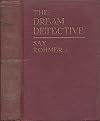
Ten stories featuring perhaps the most fantastic sleuth of them all: Moris Klaw, the Dream Detective. Accompanied by his beautiful daughter Isis, Klaw's mysterious abilities lead him to clues and answers concerning occult occurrances far beyond the ken of ordinary minds. Moris Klaw is a gifted eccentric in the Holmesian mode. The proprietor of a ramshackle antique shop in Wapping, Klaw is a tall, stoop-shouldered man, of indeterminate age and unidentifiable foreign acccent, with skin the show more color of ""dirty vellum."" He wears gold pince-nez, a flat bowler hat, and an old black cape, and is not only an expert in the legends and lore of valuable historical objects, but also a master of disguise. show lessTags
Recommendations
























Member Reviews
Sax Rohmer's version of Sherlock Holmes is classic early pulp, including the racism. Unlike his yellow perils Fu Manchu stories, though, racism isn't essecial to the plots of this set of connected stories. Moris Klaw is the Dream Detective, because one of his methods is to sleep in the room where a crime occurred, on a special pillow, so that his brain will absorb the "odic" vibrations of the thoughts of the victim or perpetrator at the time of the crime. Rohmer is smart enough not to have this solve the crime. It simply provides a clue not otherwise available. Despite the fact that the crimes frequently appear to involve hauntings and curses, all (but perhaps one) turn out, in good Scooby-Do form, to be be definitely non-occult. show more happened.
Other than oddity and colorfulness, there is little to recommend these stories. Though the mysteries have a locked room flavor to them, all are resolved by revealed background information, not by piecing together clues scattered around. Klaw, and his incredibly beautiful (as we're told repeatedly) daughter Iris are never given any backstory, or reason to exist other than to further the plot. show less
Other than oddity and colorfulness, there is little to recommend these stories. Though the mysteries have a locked room flavor to them, all are resolved by revealed background information, not by piecing together clues scattered around. Klaw, and his incredibly beautiful (as we're told repeatedly) daughter Iris are never given any backstory, or reason to exist other than to further the plot. show less
A small but satisfying collection of mysteries with an occult tinge featuring Sax Rohmer's fictional detective Moris Klaw. I first came across Moris Klaw in my grandfather's copy of 'Fifty Famous Detectives of Fiction', containing the story "The Tragedies in the Greek Room" and it is fully as good as I remembered it.
Moris Klaw is no Simon Ark, but the Rohmer stories still make for enjoyable reading.
My very favorite Rohmer. This guy sleeps in the same room as the person who has been murdered and thereby solves the crime.
Moris Klaw is an antique dealer, student of the occult, and detective. His cases often involve ancient relics, and sometimes genuinely occult forces, but not always. He solves them at times by dreaming to pick up the thoughts surrounding the crime. He is assisted by his beautiful daughter Isis.
Ratings
Members
- Recently Added By
Lists

Books mentioned in Julian Symons’ Bloody Murder
438 works; 6 members
Author Information

189+ Works 6,117 Members
Sax Rohmer was born in Birmingham, Warwickshire. At the age of 18, he adopted the name Sarsfield, the name of a famous Irish general admired by Rohmer's mother. He married Rose Elizabeth Knox in 1909 and, at his wife's insistence, began using the name Sax Rohmer for his fiction, eventually employing the pseudonym as his actual name. Rohmer was show more basically a self-taught scholar. He started writing as a journalist; his beat was the Limehouse underworld in London. Rohmer had a difficult time breaking into the professional fiction markets, but once he did, he became a household name for exotic adventure both in England and in America. Although his writing brought Rohmer success and money, he was never much of a businessman, and most of his wealth was squandered because of his extravagance and through financial mismanagement. Rohmer eventually moved to New York City. One of Rohmer's great intellectual interests was the occult and supernatural, and these elements frequently appeared as motifs in his fiction. His most famous creation was the evil oriental mastermind, Dr. Fu Manchu, first presented in the novel The Mystery of Fu Manchu in 1913 (later retitled The Insidious Dr. Fu Manchu for its American publication, also in 1913). Most espionage or adventure fiction exploits the social paranoias of its time, and Rohmer himself effectively tapped the Westerner's fear of the stereotyped "yellow peril" threat---the negatively perceived belief that Orientals will conquer the world. The Fu Manchu adventures were patterned, in part, after Arthur Conan Doyle's Sherlock Holmes stories. Rohmer's protagonists in these adventures, Sir Denis Nayland Smith and his companion Dr. Petrie, look very much like Doyle's Holmes and Watson, but, whereas Doyle centered his narratives on the heroes and specifically on the elaborate process of detection, Rohmer focused his attention on the villain and on slam-bang action. Fu Manchu was a master of both Western science and Eastern mysticism, and his efforts at world domination caused no end of problems for Smith and Petrie. In Fu Manchu, Rohmer had created the most famous villain in popular fiction (although Rohmer maintained that Fu Manchu was based on an actual Limehouse criminal). Despite Rohmer's use of outrageous racial stereotyping, many of his novels hold up well today and provide superior examples of how to create narrative pacing and suspense. (Bowker Author Biography) show less
Some Editions
Awards and Honors
Notable Lists
Series

Belongs to Publisher Series
Work Relationships
Common Knowledge
- Canonical title
- The dream detective
- Original publication date
- 1920
- People/Characters
- Isis Klaw; Moris Klaw
- Important places
- London, England, UK
- First words
- When did Moris Klaw first appear in London?
- Last words
- (Click to show. Warning: May contain spoilers.)"And that is the sign of Isis!"
- Disambiguation notice
- Originally serialized in the New Magazine, April, 1913-January, 1914.
Classifications
- Genres
- Fiction and Literature, Mystery, Horror, Fantasy
- DDC/MDS
- 823.912 — Literature & rhetoric English & Old English literatures English fiction 1900- 1901-1999 1901-1945
- LCC
- PZ3 .W21 .D — Language and Literature Fiction and juvenile belles lettres Fiction and juvenile belles lettres Fiction in English
- BISAC
Statistics
- Members
- 123
- Popularity
- 264,320
- Reviews
- 5
- Rating
- (3.67)
- Languages
- English, Norwegian (Bokmål)
- Media
- Paper
- ISBNs
- 4
- ASINs
- 5