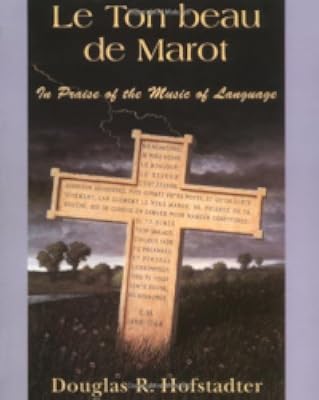
Le Ton Beau De Marot: In Praise of the Music of Language
by Douglas Hofstadter
On This Page
Description
Not Merely a set of translations of one poem, Le Ton beau de Marot is an autobiographical essay, a love letter to the French language, a series of musings on life, loss, and death, a sweet bouquet of stirring poetry - but most of all, it celebrates the limitless creativity fired by a passion for the music of words. Dozens of literary themes and creations are woven into the picture, including Pushkin's Eugene Onegin, Dante's Inferno, Salinger's Catcher in the Rye. Villon's ballades, Nabokov's show more essays, Georges Perec's La disparition, Vikram Seth's Golden Gate. Horace's odes, and more. Rife with stunning form-content interplay, crammed with creative linguistic experiments yet always crystal-clear, this book is meant not only for lovers of literature, but also for people who wish to be brought into contact with current ideas about how creativity works, and who wish to see how today's computational models of language and thought stack. Up next to the human mind. show lessTags
Recommendations








Member Reviews
In Disparagement of the Monotony of Language
Dearest Doug,
Please don't bug
Us with rhyme
One more time.
Reading through
Sev'nty-two
Poems built on
"Ma Mignonne"
Is real tough.
Nuff's enough!
And no line
For Will Quine
When you ask
If the task
To create
A translate
Can be done?
It's no fun,
Also rude,
To conclude
Douglas Hof-
Stadter's off
Of his game.
All the same,
We can see
G-E-B
This is not.
Thanks a lot!
Dearest Doug,
Please don't bug
Us with rhyme
One more time.
Reading through
Sev'nty-two
Poems built on
"Ma Mignonne"
Is real tough.
Nuff's enough!
And no line
For Will Quine
When you ask
If the task
To create
A translate
Can be done?
It's no fun,
Also rude,
To conclude
Douglas Hof-
Stadter's off
Of his game.
All the same,
We can see
G-E-B
This is not.
Thanks a lot!
A mind-blowing book that covers language, cognition, translation, and feeling. It weaves the language of love into how we interpret meaning from words. How language influences meaning. And it's just plain fun! One of the few books I've ever glossed. When I loan this book out, I always make sure to get it back.
I think that the reviewers who panned this book either brought something different to their reading of it, or just missed some of the points. The author builds on the work of Marshall McLuhan and others as he examines how the medium of language influences meaning. What's great about this book is how he also weaves in how the individual affects the communication process by how something is sent and received. Maybe you have to be show more into communications and linguistics to like this book. All I know is that everyone I've loaned it to (3 persons) absolutely loved it and used terms like "mind-blowing" when they gave it back. show less
I think that the reviewers who panned this book either brought something different to their reading of it, or just missed some of the points. The author builds on the work of Marshall McLuhan and others as he examines how the medium of language influences meaning. What's great about this book is how he also weaves in how the individual affects the communication process by how something is sent and received. Maybe you have to be show more into communications and linguistics to like this book. All I know is that everyone I've loaned it to (3 persons) absolutely loved it and used terms like "mind-blowing" when they gave it back. show less
Hofstadter is the ultimate DIY author, except that he is much more handy with words and ideas than most carpenters are with wood. This is a book (like Goedel, Escher and Bach) that you can read and reread, and still come away slightly enlightened each time.
A really fun book and, having read all/most of Hofstadter's books, I'm still partial to GEB. All of these books are fascinating in their own way: this one with all the poems (although, there does come a point where you feel like the poems are just baggage he uses because he spent so much time on them). None of them capture the magic of the math theorems he went into with GEB
Still, he's one of my favorite authors (and, after seeing the care he puts into the aesthetics of his book, I wish other authors had his drive)
Still, he's one of my favorite authors (and, after seeing the care he puts into the aesthetics of his book, I wish other authors had his drive)
I found the book a little disappointing. After reading GEB and hearing people praise Le Ton Beau, I had expected more of it. Hofstadter is arrogant about his mastering of foreign languages. If his mastery of languages is as he says it is, he's a genius.
There are of course brilliant concepts in this book. One example is his questioning of translations. If a work has been translated, what do you read, what do you appreciate? Is it the original writer who gets the credit, although this writer has written none of the language you read? Or is it the translator, who contributed almost nothing to the ideas in the book? Tough question.
Every other chapter is about various translations of a beautiful poem by Marot. Hofstadter asked all his show more friends and relatives to provide one or more translations, which all turn out to be very different. Unfortunately, of the examples he gives almost half are his own. I think it would have been more interesting to provide translations of different translators, for every person providing the best translation they have provided. show less
There are of course brilliant concepts in this book. One example is his questioning of translations. If a work has been translated, what do you read, what do you appreciate? Is it the original writer who gets the credit, although this writer has written none of the language you read? Or is it the translator, who contributed almost nothing to the ideas in the book? Tough question.
Every other chapter is about various translations of a beautiful poem by Marot. Hofstadter asked all his show more friends and relatives to provide one or more translations, which all turn out to be very different. Unfortunately, of the examples he gives almost half are his own. I think it would have been more interesting to provide translations of different translators, for every person providing the best translation they have provided. show less
The main theme of this book is translation of poetry and the various difficulties of respecting both form and content, illustrated by a series of translations of a single short poem ('Ma Mignonne' by Clement Marot). However, it also includes discussion of machine translation, wordplay, artificial intelligence research, and episodes from the author's life with his (now deceased) wife. On the whole, it was an interesting and enjoyable read, but I could have done without some of the rants about rock music and how the phrase "you guys" is horribly sexist.
I spotted this book using some 6th sense in a warehouse-like used bookstore in Newtown, Sydney from a long distance in the wrong section without its dust jacket and with my poor eyesight. The layout and typesetting are exceptionally fine. As for the content, I would not recommend trying to read this from cover to cover but it is a joy to pick up and read a random few pages. Always gives me something to think about. But I'm much more interested in translation than in poetry.
Members
- Recently Added By
Lists

Great Books About Language
73 works; 48 members

Mind Expanding Books by hackerkid
581 works; 8 members

Books We'd Want on a Desert Island
203 works; 131 members

Non-Fiction Worth Reading
1,015 works; 254 members
Author Information

28+ Works 23,009 Members
Douglas Hofstadter is College of Arts and Sciences Professor of Cognitive Science at Indiana University
All Editions
Common Knowledge
- Canonical title
- Le Ton Beau De Marot: In Praise of the Music of Language
- Original publication date
- 1997
- Dedication
- To M. & D.,
living sparks of their
Mommy's loving soul - First words
- Picture Holden Caulfield all grown up, now a university professor, writing a book about translation.
- Last words
- (Click to show. Warning: May contain spoilers.)Ti diranno,
Che bel fior.
Classifications
- Genres
- Nonfiction, Philosophy, Literature Studies and Criticism, Science & Nature
- DDC/MDS
- 418.02 — Language Linguistics Applied linguistics modified standard subdivisions and translating Translating
- LCC
- P306 .H63 — Language and Literature Philology. Linguistics Language. Linguistic theory. Comparative grammar Translating and interpreting
- BISAC
Statistics
- Members
- 977
- Popularity
- 26,882
- Reviews
- 13
- Rating
- (3.98)
- Languages
- English, Finnish, French
- Media
- Paper
- ISBNs
- 4
- ASINs
- 1