On This Page
Description
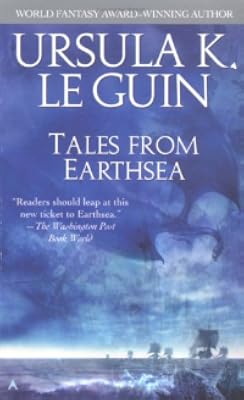
Explores further the magical world of Earthsea through five tales of events which occur before or after the time of the original novels, as well as an essay on the people, languages, history and magic of the place.Tags
Recommendations












Member Reviews
The penultimate book of the Earthsea cycle is a collection of five stories rather than a novel. In principle, it could be a point of entry to the series, since most of the stories take place earlier than the events of the first four books. But I think that having those novels for background and context colored and enhanced my experience of reading each of the stories here.
The first and longest of the Tales is a significant novella "The Finder," set in the earliest history of the wizards' school of Roke, centuries before Ged's time. It involves a secret society, the Hand, with a manual sign of recognition and the object of recovering and managing magical knowledge.
The second story "Darkrose and Diamond" most excellently stumps quite a show more few narrative tropes for fantasy bildungsroman. Le Guin doesn't admit as much in her foreword or afterword, but I can imagine it being her exploration of some characterizations, motives, and outcomes almost in opposition to those she had developed at greater length for Ged and Tenar.
"The Bones of the Earth" concerns wizardry on Gont before Ged's time. In this shortest story of the set, there is an important character who is known from the other Earthsea books, but who is introduced under another name. I realized who it really was just a few paragraphs before the story made it clear, and I was impressed with the artistry of the writing in affording me that experience.
"On the High Marsh" is a story set during the time when Ged was Archmage. In a way, it is a bookend to the love story of "Darkrose and Diamond," dealing with an older and more careworn pair of central characters.
The final story "Dragonfly" Is another novella. It follows directly on the events of Tehanu, and Le Guin characterized it as a "bridge" to the final book of the cycle. It mirrors "The Finder," with both tales concerning someone who comes to Roke at a time of its radical transformation. Where "The Finder" was before the era of Archmages, "Dragonfly" is after it. So the five stories have a sort of mirrored arrangement, folded across the fault in "The Bones of the Earth" at the book's center.
There is also an expository appendix "A Description of Earthsea," which gives some ethnographic and historical information about the setting that had been developed over the course of five books. There are few details in this forty-page set of short essays that hadn't already been offered in the novels and stories, and there are some redundancies and repetitions within the "Description." It began as author's notes for her own orientation in writing the tales, and she published it with an understanding that it might be "of real interest to some readers." It is reminiscent of Tolkien's apparatus in The Lord of the Rings.
I enjoyed each of the stories in this book, and I'm already a little sad that there's only one tale of Earthsea left that I haven't yet read: I will be reading The Other Wind soon. show less
The first and longest of the Tales is a significant novella "The Finder," set in the earliest history of the wizards' school of Roke, centuries before Ged's time. It involves a secret society, the Hand, with a manual sign of recognition and the object of recovering and managing magical knowledge.
The second story "Darkrose and Diamond" most excellently stumps quite a show more few narrative tropes for fantasy bildungsroman. Le Guin doesn't admit as much in her foreword or afterword, but I can imagine it being her exploration of some characterizations, motives, and outcomes almost in opposition to those she had developed at greater length for Ged and Tenar.
"The Bones of the Earth" concerns wizardry on Gont before Ged's time. In this shortest story of the set, there is an important character who is known from the other Earthsea books, but who is introduced under another name. I realized who it really was just a few paragraphs before the story made it clear, and I was impressed with the artistry of the writing in affording me that experience.
"On the High Marsh" is a story set during the time when Ged was Archmage. In a way, it is a bookend to the love story of "Darkrose and Diamond," dealing with an older and more careworn pair of central characters.
The final story "Dragonfly" Is another novella. It follows directly on the events of Tehanu, and Le Guin characterized it as a "bridge" to the final book of the cycle. It mirrors "The Finder," with both tales concerning someone who comes to Roke at a time of its radical transformation. Where "The Finder" was before the era of Archmages, "Dragonfly" is after it. So the five stories have a sort of mirrored arrangement, folded across the fault in "The Bones of the Earth" at the book's center.
There is also an expository appendix "A Description of Earthsea," which gives some ethnographic and historical information about the setting that had been developed over the course of five books. There are few details in this forty-page set of short essays that hadn't already been offered in the novels and stories, and there are some redundancies and repetitions within the "Description." It began as author's notes for her own orientation in writing the tales, and she published it with an understanding that it might be "of real interest to some readers." It is reminiscent of Tolkien's apparatus in The Lord of the Rings.
I enjoyed each of the stories in this book, and I'm already a little sad that there's only one tale of Earthsea left that I haven't yet read: I will be reading The Other Wind soon. show less
After Tehanu was published in 1990, Le Guin declared the Earthsea series complete, but later in the decade had a change of heart. This volume includes five short stories, the last of which is Dragonfly, which serves as a bridge between Tehanu and The Other Wind, which truly would end the series.
My favorite story was The Finder, which takes place centuries before the main series and describes a humble boy with a special talent who is enslaved by a wicked king and wizard acting in tandem. Le Guin’s understanding of human nature and power demonstrated through her characters is highly relevant to the real world, and it was remarkable how she didn’t settle for a possible simple ending after the first half of the story. The young man show more eventually makes his way out to Roke, where he meets those who will ultimately found the school of magic, but is pursued. “The lords of war despise scholars and schoolmasters,” one character observes. Indeed. As in other stories, Le Guin’s climactic ‘battle’ is not maudlin or drawn-out, and I loved the maturity in her concision.
Another strong story was Darkrose and Diamond, which of them all seemed geared most towards younger readers, dealing as it did with choices in life and young love. I also liked On the High Marsh, which has a wizard with healing powers over cattle show up on a rugged island. Through this character, who is an enigma to the locals, we see a spectrum of human behavior: mercy, jealousy, avarice, and cruelty. Ged, the main protagonist from the earlier novels, makes an appearance and explains the young man’s backstory, something which seemed rather convenient, but even here Le Guin provides a satisfying wrinkle in the story’s resolution.
I was less enamored with The Bones of the Earth, the shortest of the stories. It tells of a wizard and his apprentice who deal with an earthquake, and it seemed the most obvious, or any event, the least developed. The final story, Dragonfly, is better, but perhaps not on a par with the best in this bunch. I loved the feminism in the story and how it illustrated that even on the wise island of Roke, progress was necessary. It started strong, but then seemed as if Le Guin was searching for a way to end the story, maybe because The Other Wind was already being developed. She then includes A Description of Earthsea, which outlines the culture and history of her imagined world – probably something that readers heavily into the series lapped up like ice cream, but for me, more of a convenient reference.
All in all, an enjoyable read, reflecting Le Guin’s sharp eye, maturity, and excellent prose. show less
My favorite story was The Finder, which takes place centuries before the main series and describes a humble boy with a special talent who is enslaved by a wicked king and wizard acting in tandem. Le Guin’s understanding of human nature and power demonstrated through her characters is highly relevant to the real world, and it was remarkable how she didn’t settle for a possible simple ending after the first half of the story. The young man show more eventually makes his way out to Roke, where he meets those who will ultimately found the school of magic, but is pursued. “The lords of war despise scholars and schoolmasters,” one character observes. Indeed. As in other stories, Le Guin’s climactic ‘battle’ is not maudlin or drawn-out, and I loved the maturity in her concision.
Another strong story was Darkrose and Diamond, which of them all seemed geared most towards younger readers, dealing as it did with choices in life and young love. I also liked On the High Marsh, which has a wizard with healing powers over cattle show up on a rugged island. Through this character, who is an enigma to the locals, we see a spectrum of human behavior: mercy, jealousy, avarice, and cruelty. Ged, the main protagonist from the earlier novels, makes an appearance and explains the young man’s backstory, something which seemed rather convenient, but even here Le Guin provides a satisfying wrinkle in the story’s resolution.
I was less enamored with The Bones of the Earth, the shortest of the stories. It tells of a wizard and his apprentice who deal with an earthquake, and it seemed the most obvious, or any event, the least developed. The final story, Dragonfly, is better, but perhaps not on a par with the best in this bunch. I loved the feminism in the story and how it illustrated that even on the wise island of Roke, progress was necessary. It started strong, but then seemed as if Le Guin was searching for a way to end the story, maybe because The Other Wind was already being developed. She then includes A Description of Earthsea, which outlines the culture and history of her imagined world – probably something that readers heavily into the series lapped up like ice cream, but for me, more of a convenient reference.
All in all, an enjoyable read, reflecting Le Guin’s sharp eye, maturity, and excellent prose. show less
This is Le Guin's attempt to create a history for Earthsea in the vein of Middle-earth, and it falls quite flat. I have a confession to make: I don't care very much for the world of Earthsea beyond what's been shown to us in the previous stories. This is because they were stories that didn't need a complex, highly detailed world in order to succeed at capturing one's imagination. Given that this was never meant to be a series, Le Guin hadn't even seen Earthsea as a construction in need of heavy worldbuilding and lots of exposition. Doing so would've spoiled the magic.
Le Guin also leans too far into a historian narrative voice, resulting in woefully dry writing that lacks the spark of an excited storyteller. She rushes through the show more worldbuilding process, revealing details directly instead of in ways that are more natural and subtle. Additionally, she makes too many didactic judgments on Earthsea's inhabitants for there to be much left for readers to chew on. I don't know about you, but I don't enjoy books that spell everything out for me. Where's the satisfaction in that?
These stories are also very disconnected from the original trilogy, both in tone and philosophy. In her attempt to further define and redefine the lands and societies of Earthsea, Le Guin's efforts backfire, resulting in the unravelling of the careful illusion of the world. If the world had originally been planned out, there wouldn't be much of a problem, but it's all too clear that the world's history was rushed into creation after the fact. In the afterword, Le Guin sheds some light on her decision to expand the world of Earthsea:
While it may be true that the increasing immediacy of electronic media has us focusing more on the present than the past, it seems wrong to bring that sort of anti-mythology idea to a series like Earthsea. It could work for a modern or futuristic story, but Earthsea? A mythology would've been a better fit. What makes a fantasy world interesting is not that it and its magic can be fully studied and understood, but that it's full of strangeness and unknowns. There can be a history to it, and a fair amount of worldbuilding, sure, but it shouldn't override the "mythical" nature of that world. This book isn't totally devoid of good magical moments, but they are few and far between the bulk of exposition and bland new worldbuilding.
There's also the whole matter of retroactive continuity. I understand that Le Guin wanted to bring Earthsea up to speed on ideas of gender, classism, tradition, and especially on the sexist ideas we might take for granted regarding wizards and witches, but in Tales of Earthsea it's all rather forced and awkward. Like I mentioned earlier, these stories lack subtlety, so while they may make decent points about social issues, they are points that are too obvious and artificial; they ring hollow and are ultimately incongruous with the earlier half of Earthsea. Sometimes the stories here are even incongruous within themselves, which further adds to my theory that this book was a rush job. As is mentioned in the foreward, Le Guin was approached to write this book, so it's unlikely that it was a work of passion. Yet I'm not sure why she walked back her initial storytelling ethos and opted for the construction of a more solid world that, for all its definition and detail, fails to be as magical or intriguing as the older, murkier Earthsea was. show less
Le Guin also leans too far into a historian narrative voice, resulting in woefully dry writing that lacks the spark of an excited storyteller. She rushes through the show more worldbuilding process, revealing details directly instead of in ways that are more natural and subtle. Additionally, she makes too many didactic judgments on Earthsea's inhabitants for there to be much left for readers to chew on. I don't know about you, but I don't enjoy books that spell everything out for me. Where's the satisfaction in that?
These stories are also very disconnected from the original trilogy, both in tone and philosophy. In her attempt to further define and redefine the lands and societies of Earthsea, Le Guin's efforts backfire, resulting in the unravelling of the careful illusion of the world. If the world had originally been planned out, there wouldn't be much of a problem, but it's all too clear that the world's history was rushed into creation after the fact. In the afterword, Le Guin sheds some light on her decision to expand the world of Earthsea:
"For the whole story of Earthsea to have weight and make sense in my own mind so that I could take it to its end, so that I could build the bridge to true closure, not only did I have to find out what was going on now, but I had to go back in time to find out what had gone wrong, and when, and how. Why had the wise teaching of the Balance been getting increasingly out of balance?
People who live immersed in the ceaseless present tense of electronic media may have no interest in the past, letting mythology replace history, as pre-literate peoples did. But as I grew up with the un-rearrangeable, implacable durability of print, my education gave me the sense of the past that perceives the present as only the bright restless surface of an ocean. So, paradoxical as it may seem, I didn’t want a mythology of my mythical world, but the history of it—the facts of the fiction, its time depths. Which of course meant, yet more paradoxically, that I had to make it up. To grope, blunder, see if it worked."
While it may be true that the increasing immediacy of electronic media has us focusing more on the present than the past, it seems wrong to bring that sort of anti-mythology idea to a series like Earthsea. It could work for a modern or futuristic story, but Earthsea? A mythology would've been a better fit. What makes a fantasy world interesting is not that it and its magic can be fully studied and understood, but that it's full of strangeness and unknowns. There can be a history to it, and a fair amount of worldbuilding, sure, but it shouldn't override the "mythical" nature of that world. This book isn't totally devoid of good magical moments, but they are few and far between the bulk of exposition and bland new worldbuilding.
There's also the whole matter of retroactive continuity. I understand that Le Guin wanted to bring Earthsea up to speed on ideas of gender, classism, tradition, and especially on the sexist ideas we might take for granted regarding wizards and witches, but in Tales of Earthsea it's all rather forced and awkward. Like I mentioned earlier, these stories lack subtlety, so while they may make decent points about social issues, they are points that are too obvious and artificial; they ring hollow and are ultimately incongruous with the earlier half of Earthsea. Sometimes the stories here are even incongruous within themselves, which further adds to my theory that this book was a rush job. As is mentioned in the foreward, Le Guin was approached to write this book, so it's unlikely that it was a work of passion. Yet I'm not sure why she walked back her initial storytelling ethos and opted for the construction of a more solid world that, for all its definition and detail, fails to be as magical or intriguing as the older, murkier Earthsea was. show less
Banchan.
Banchan are small, shared side dishes that accompany rice and entrees in a Korean meal. Colorful, tasty, and meant to broaden the meal's range and appeal, banchan delight by themselves but are meant to satisfy as part of a whole. "Tales From Earthsea" is a collection of banchan that enrich the whole Earthsea experience in delightful and tangy little ways, and Earthsea would be poorer without them.
"Dragonfly" is the necessary segue from Tehanu into The Other Wind, and both "The Finder" and "The Bones of the Earth" (my favorite) provide historical backstory in heartwarming tellings. The other two stories are pleasant confections. All are well-built and presented, in typical Le Guin fashion; this small anthology is well worth the show more time to read it. show less
Banchan are small, shared side dishes that accompany rice and entrees in a Korean meal. Colorful, tasty, and meant to broaden the meal's range and appeal, banchan delight by themselves but are meant to satisfy as part of a whole. "Tales From Earthsea" is a collection of banchan that enrich the whole Earthsea experience in delightful and tangy little ways, and Earthsea would be poorer without them.
"Dragonfly" is the necessary segue from Tehanu into The Other Wind, and both "The Finder" and "The Bones of the Earth" (my favorite) provide historical backstory in heartwarming tellings. The other two stories are pleasant confections. All are well-built and presented, in typical Le Guin fashion; this small anthology is well worth the show more time to read it. show less
The previous novel, Tehanu, was labeled "The Last Earthsea Novel". LeGuin begins this collection acknowledging how silly it was to label anything "last". She failed to realize that the books had stopped, but Earthsea hadn't. This would suggest a continuation of the original stories, but this is not that. For the most part, the stories are not what happened next, but what happened before and/or elsewhere. What this collection really continues is LeGuin's questioning of her original world building, specifically the male-dominated system of wizard magic. The most important stories are the first and last. The Finder tells the story of Otter and, eventually, the formation of the school of wizardry on Roke Island. A key point is that Roke show more began as wizards and witches together blending knowledge and power. The final story, Dragonfly, returns to the question raised at the end of Tehanu: who should become the next archmage of Roke Island, and what was the import of the cryptic message to find the woman on Gont? Dragonfly, a young woman close to Ged's age, comes to Roke to learn. She stays in Otter's long abandoned hut. Her presence violates the no-woman rule that we now know is not true to Roke's origins. The three stories between The Finder and Dragonfly are all fine stories, but these bookends are what you remember because of how they encapsulate the paradox of Earthsea.
I am a bit disappointed. I feel that LeGuin, with all her intelligence and skills and repeated wrestling with questions of gender and power, failed to go beyond the obvious here. The book concludes with "A description of Earthsea" that summarizes the geography, peoples, and history of Earthsea, going well beyond what the novels and stories cover. This summary reinforces the idea that power shifts constantly, but it also sticks to a single narrative where men with narrow views take power from women. LeGuin's stories never ask why some men keep doing this and why they succeed.
Highly recommended. show less
I am a bit disappointed. I feel that LeGuin, with all her intelligence and skills and repeated wrestling with questions of gender and power, failed to go beyond the obvious here. The book concludes with "A description of Earthsea" that summarizes the geography, peoples, and history of Earthsea, going well beyond what the novels and stories cover. This summary reinforces the idea that power shifts constantly, but it also sticks to a single narrative where men with narrow views take power from women. LeGuin's stories never ask why some men keep doing this and why they succeed.
Highly recommended. show less
Terrific stories from an absolute mistress, all set in Earthsea, all more or less addressing the various aspects of wizardry and gender suggested by preceding volume, Tehanu. I particularly liked the first one, about the founding of Roke, and the last one (bar the sketch of Earthsea) about a young woman trying to enter the school on Roke in the aftermath of Ged's departure back to Gont on the dragon. But the other stories are very good, too, the moving (heh) story of Ogion and the earthquake, a bittersweet love story and the tale of a broken wizard. Wonderful.
“I don’t care what’s ‘allowed,’” he said, with a frown she had never seen on his face. “The Archmage himself said, Rules are made to be broken. Injustice makes the rules, and courage breaks them. I have the courage, if you do!” – “Dragonfly"
I’ve never read any of LeGuin’s work. The Left Hand of Darkness sounds familiar, but I went into this book not knowing anything about the series. Very fortunately, this particular book is a source: it doesn’t interrupt or rely the rest of her series for its foundations. It acts as the foundation. And what’s great is LeGuin has created this entire world, so there’s no attempt to compare it with the world we live in, in terms of confirming facts or dates or events. We rely show more solely on LeGuin for the validity of her stories.
I compare it to the way that Brian Jacques’ Martin the Warrior acts as a source, a reference, for the novels that take place later in Redwall's and Mossflower’s history. I was able to relate more to it, actually, by comparing it to Jacques’ series. It’s pretty interesting when you think about it, the way LeGuin’s characters rely on the magic, on the religion of wizardry while in Jacques’ world they rely on the history and the nature around them in a very agnostic fashion.
LeGuin’s world is beautifully crafted. I especially appreciated her ending the piece with her “Description of Earthsea” (which perhaps I should have read first) that made me even more interested to read the series. Both her male and female characters are painted with bright bold strokes that keep the reader engaged the whole way through, and her mysterious land of the archipelago is so well established, that I sometimes actually believe it exists.
I think between Narnia and Harry Potter, I had come to the conclusion that I was over the magical end of science fiction that relies solely on the magic without foundation in science. But this lit the spark again. Just another example of librarything.com knows best, I guess.
The most poignant of her included stories, for me, was “Dragonfly” in which a young girl harassed by her drunken father (who rules over a dying society) chooses to seek out her true name for herself. When she finds it, she is dissatisfied and ends up on the island of Roke where wizards are bound by their rules to only instruct men. Half of the mages side with her, though, and her quest for her true identity becomes the mages’ path toward change, revision, rebellion and truth.
Her journey toward finding, understanding and knowing her true self is so relatable. True, we women don’t all turn into dragons and fly into the West once we find ourselves, but she really embodies the strength and pride of womanhood to me. It was moving, and it made me appreciate LeGuin way more than I hadn't anticipated: as a model for social change.
Laced throughout LeGuin's are markers of social inequity: child labor, slavery, subjugation of women, anti-feminist behavior, disparagement of youth and an ignorance of truth. Every one of these themes is easily related to our real world. We'd like to believe that our time does not still enslave children or submit to the belief in inequalities. But these things still exist. These characters overcoming the trials that we still suffer through, is pretty inspiring. In no way does LeGuin's world pretend to be a Utopia; it only seeks to give us the guidance needed to build the keys to one. Perhaps, as the mages discover once Irian has defeated their powerful fellow mage, a "pure" and "chaste" religion is not what we need. Perhaps what we need is a return to nature. Perhaps the mysticism from LeGuin is not so different from Jacques after all.
Lauren Cartelli
www.theliterarygothamite.com show less
I’ve never read any of LeGuin’s work. The Left Hand of Darkness sounds familiar, but I went into this book not knowing anything about the series. Very fortunately, this particular book is a source: it doesn’t interrupt or rely the rest of her series for its foundations. It acts as the foundation. And what’s great is LeGuin has created this entire world, so there’s no attempt to compare it with the world we live in, in terms of confirming facts or dates or events. We rely show more solely on LeGuin for the validity of her stories.
I compare it to the way that Brian Jacques’ Martin the Warrior acts as a source, a reference, for the novels that take place later in Redwall's and Mossflower’s history. I was able to relate more to it, actually, by comparing it to Jacques’ series. It’s pretty interesting when you think about it, the way LeGuin’s characters rely on the magic, on the religion of wizardry while in Jacques’ world they rely on the history and the nature around them in a very agnostic fashion.
LeGuin’s world is beautifully crafted. I especially appreciated her ending the piece with her “Description of Earthsea” (which perhaps I should have read first) that made me even more interested to read the series. Both her male and female characters are painted with bright bold strokes that keep the reader engaged the whole way through, and her mysterious land of the archipelago is so well established, that I sometimes actually believe it exists.
I think between Narnia and Harry Potter, I had come to the conclusion that I was over the magical end of science fiction that relies solely on the magic without foundation in science. But this lit the spark again. Just another example of librarything.com knows best, I guess.
The most poignant of her included stories, for me, was “Dragonfly” in which a young girl harassed by her drunken father (who rules over a dying society) chooses to seek out her true name for herself. When she finds it, she is dissatisfied and ends up on the island of Roke where wizards are bound by their rules to only instruct men. Half of the mages side with her, though, and her quest for her true identity becomes the mages’ path toward change, revision, rebellion and truth.
Her journey toward finding, understanding and knowing her true self is so relatable. True, we women don’t all turn into dragons and fly into the West once we find ourselves, but she really embodies the strength and pride of womanhood to me. It was moving, and it made me appreciate LeGuin way more than I hadn't anticipated: as a model for social change.
Laced throughout LeGuin's are markers of social inequity: child labor, slavery, subjugation of women, anti-feminist behavior, disparagement of youth and an ignorance of truth. Every one of these themes is easily related to our real world. We'd like to believe that our time does not still enslave children or submit to the belief in inequalities. But these things still exist. These characters overcoming the trials that we still suffer through, is pretty inspiring. In no way does LeGuin's world pretend to be a Utopia; it only seeks to give us the guidance needed to build the keys to one. Perhaps, as the mages discover once Irian has defeated their powerful fellow mage, a "pure" and "chaste" religion is not what we need. Perhaps what we need is a return to nature. Perhaps the mysticism from LeGuin is not so different from Jacques after all.
Lauren Cartelli
www.theliterarygothamite.com show less
This review was written for LibraryThing Member Giveaways.
Members
- Recently Added By
Lists

Favourite High Fantasy Books
113 works; 23 members

Favourite Fantasy Books of the 21st Century
51 works; 6 members

Bibliography for Among Others
159 works; 15 members
Here There Be Dragons
143 works; 23 members

Female Author
1,235 works; 67 members

Favourite Books
1,819 works; 316 members

Recommended Speculative Fiction by Women and People of Color
298 works; 45 members
Speculative Fiction to Read
706 works; 32 members

um actually
76 works; 3 members

books that have been adapted for film or stage
27 works; 1 member

Epic Fantasy of the 90s
111 works; 4 members
Science Fiction and Fantasy
63 works; 4 members

Unread books
1,063 works; 87 members

Books Read in 2022
5,166 works; 112 members

Books Read in 2015
3,299 works; 126 members

Short Story Collections and Anthologies
261 works; 42 members

Books Read in 2026
1,913 works; 66 members
Best Children's Books You've Read
197 works; 75 members

Favorite Childhood Books
1,646 works; 514 members
Author Information

496+ Works 167,155 Members
Ursula K. Le Guin was born Ursula Kroeber in Berkeley, California on October 21, 1929. She received a bachelor's degree from Radcliffe College in 1951 and a master's degree in romance literature of the Middle Ages and Renaissance from Columbia University in 1952. She won a Fulbright fellowship in 1953 to study in Paris, where she met and married show more Charles Le Guin. Her first science-fiction novel, Rocannon's World, was published in 1966. Her other books included the Earthsea series, The Left Hand of Darkness, The Dispossessed: An Ambiguous Utopia, The Lathe of Heaven, Four Ways to Forgiveness, and The Telling. A Wizard of Earthsea received an American Library Association Notable Book citation, a Horn Book Honor List citation, and the Lewis Carroll Shelf Award in 1979. She received the Medal for Distinguished Contribution to American Letters in 2014. She also received the Nebula Award and the Hugo Award. She also wrote books of poetry, short stories collections, collections of essays, children's books, a guide for writers, and volumes of translation including the Tao Te Ching of Lao Tzu and selected poems by Gabriela Mistral. She died on January 22, 2018 at the age of 88. (Bowker Author Biography) show less
Some Editions
Awards and Honors
Awards
Notable Lists
Series

Belongs to Publisher Series
Urania - Fantasy [Mondadori] (2° serie, 5)
Piper Fantasy (8541)
Work Relationships
Is contained in
Common Knowledge
- Canonical title
- Tales from Earthsea
- Original title
- Tales from Earthsea
- Alternate titles*
- Geschichten von Erdsee
- Original publication date
- 2001
- People/Characters
- Ged; Otter; Anieb; Diamond; Dulse; Ogion (show all 8); Irioth; Irian (Dragonfly)
- Important places
- Earthsea
- Related movies
- Gedo senki (2006 | IMDb)
- Epigraph*
- Tylko w milczeniu słowo, tylko w ciemności światło, tylko w umieraniu życie: na pustym niebie jasny jest lot sokoła. - Pieśń o stworzeniu Ea
- Dedication*
- Dla moich braci: Cliftona, Teda, Karla
- First words
- This is the first page of the Book of the Dark, written some six hundred years ago in Berila, on Enlad: "After Elfarran and Morred perished and the Isle of Soléa sank beneath the sea, the Council of the Wise governed ... (show all)for the child Serriadh until he took the throne."
- Quotations
- People who have a secret name that holds their power the way a diamond holds light may well like their public name to be ordinary, common, like other people's names.
- Last words
- (Click to show. Warning: May contain spoilers.)He said, "I think we should go to our house, and open its doors."
- Blurbers
- Gaiman, Neil; Norton, Andre; Hopkinson, Nalo; Elgin, Suzette Haden; Hoffman, Nina Kiriki
- Original language
- English
- Canonical DDC/MDS
- 813.087661
- Disambiguation notice
- Short story collection; not to be confused (or combined) with omnibus editions of the NOVELS, or with the animated film of the same title. Contains "The Finder", "Darkrose and Diamond", "The Bones of the Earth", "On the High ... (show all)Marsh", and "Dragonfly".
*Some information comes from Common Knowledge in other languages. Click "Edit" for more information.
Classifications
- Genres
- Fiction and Literature, Fantasy, Teen
- DDC/MDS
- 813.087661 — Literature & rhetoric American literature in English American fiction in English By type Genre fiction Adventure fiction Speculative fiction Fantasy High fantasy
- LCC
- PZ7 .L5215 .T — Language and Literature Fiction and juvenile belles lettres Fiction and juvenile belles lettres Juvenile belles lettres
- BISAC
Statistics
- Members
- 4,143
- Popularity
- 3,709
- Reviews
- 65
- Rating
- (3.92)
- Languages
- 17 — Catalan, Czech, Dutch, English, Estonian, Finnish, French, German, Greek, Italian, Japanese, Polish, Russian, Spanish, Swedish, Turkish, Chinese, traditional
- Media
- Paper, Audiobook, Ebook
- ISBNs
- 59
- ASINs
- 13