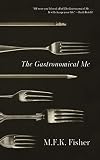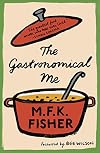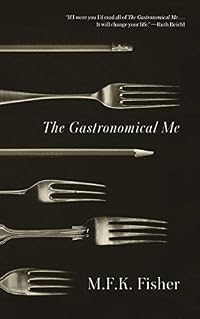
The Gastronomical Me
by M. F. K. Fisher 
On This Page
Description
In 1929, a newly married M.F.K. Fisher said goodbye to a milquetoast American culinary upbringing and sailed with her husband to Dijon, where she tasted real French cooking for the first time. The Gastronomical Me is a chronicle of her passionate embrace of a whole new way of eating, drinking, and celebrating the senses. As she recounts memorable meals shared with an assortment of eccentric and fascinating characters, set against a backdrop of mounting pre-war tensions, we witness the show more formation not only of her taste but of her character and her prodigious talent. show lessTags
Recommendations















Member Reviews
Fischer has been criticized for focusing her book on food. At a time when the world was at the brink of a generalized war and she was living personal strife, she chose joy: the joy of a simple meal, of the miracle of tasting a new food, of discovering an expected gem in a village restaurant, of finding comfort and stamina in knowing one's own preference. Fischer reminds us of the many ways meals bring us together, from love to camaraderie to family. Food nourishes much more that the body and I really enjoyed following her across the US, the Atlantic, Europe and Mexico as she experienced new people, places and, of course, dishes. This is a book that reunites us with our senses and the pleasures of the table.
Really great book. The first few chapters and the last few, especially, were absolutely wonderful. Which is not to say that it drug in the middle—it really didn't. If it had all been as good as those chapters on either end, it would have been a nearly perfect book. Still, I loved it as it was.
The book is a memoir, told almost exclusively through descriptions of food, eating, etc. In case you're not familiar with MFK Fisher, that's the kind of writing she does—it's about food, but it's about so much more. I guess you could say (and in fact she does say at several points) that she's speaking also about metaphorical hunger. True enough, but still it doesn't at all capture the work. She's talking about what it means to grow up, to show more become yourself, to fall in love and back out again (and back one more time), to be a woman, to travel, to survive a spouse, even what it means to live in a world on the brink of war (the memoir covers her life from 1912–1941). And other things besides, but those are the ones that come to mind at the moment. And along the way, she has plenty to say about the food.
I loved the book. I've also found myself quite a bit hungrier as I've read it, of course. :) That part's not going to go away. I read it for an online book group, alongside Ruth Reichl's Garlic & Sapphires (which I also enjoyed, though not as much as this one). show less
The book is a memoir, told almost exclusively through descriptions of food, eating, etc. In case you're not familiar with MFK Fisher, that's the kind of writing she does—it's about food, but it's about so much more. I guess you could say (and in fact she does say at several points) that she's speaking also about metaphorical hunger. True enough, but still it doesn't at all capture the work. She's talking about what it means to grow up, to show more become yourself, to fall in love and back out again (and back one more time), to be a woman, to travel, to survive a spouse, even what it means to live in a world on the brink of war (the memoir covers her life from 1912–1941). And other things besides, but those are the ones that come to mind at the moment. And along the way, she has plenty to say about the food.
I loved the book. I've also found myself quite a bit hungrier as I've read it, of course. :) That part's not going to go away. I read it for an online book group, alongside Ruth Reichl's Garlic & Sapphires (which I also enjoyed, though not as much as this one). show less
I have loved several of M. F. K. Fisher's other books, (Consider the Oyster and How to Cook a Wolf for instance), and treated myself to the Folio Society edition of this classic. As usual, the food was wonderful, from Fisher's childhood realization that there was more to food than boring, unappetizing sustenance; to her first experience with The Oyster; to the delights of French food eaten in France and the excellence of simplicity. The autobiographical bits I found would have been slightly mystifying if I had not educated myself about Fisher's life and loves already. Most puzzling, I feel, is the fact that she wrote about living happily in a Swiss villa with her first husband, Al Fisher, and without any explanation at all, was suddenly show more writing about living in the same place with someone referred to only as "Chexbres" (her second husband, Dillwyn Parrish, as it turns out). Similarly, she brings in Parrish's illness, disability and death in such an offhanded fashion that rather than merely taking a back seat to the main point of her writing, these sketchy references distract the reader with unanswered questions. I realize this was not written as an entity, but composed of individual essays, so the lack of continuity and coherence shouldn't be considered a failing on the author's part. And overall, I really enjoyed this paean to glorious, simple, elegant, sensuous appreciation of food. show less
This is the way food writing should be done. In her careful, spare, elegant way, Fisher uses food to write about everything else that means anything in life: love, war, death, and second chances. One of the most beautiful works of modern English.
M.F.K. Fisher was perhaps the 20th century's best food writer, although food, per se, was not her subject; her subject was all the things that happen while you are getting your food, eating it, and thinking about it: life, in other words. An amazingly good prose stylist, but I find that she hid as much as she revealed in her seemingly-personal accounts. I had to do a little research to get the basic facts about her life just to keep myself oriented. I found I could read this book best if I took it in small mouthfuls, like extra-rich ice cream. Could anyone have lived a life like hers? Maybe, maybe not--but read her anyway.
This is a series of essays written about Fisher's life between 1912 and 1941. She covers a wide range of topics; from the first time food became significant to her as a teenager in boarding school to her adventures as a newly married wife living in France. When she said goodbye to her Californian-American palate and encountered French cuisine it was like having an epiphany for Fisher. Her ears (and taste buds) were open to a whole new way of experiencing food and drink. Sprinkled throughout the stories are glimpses of Fisher's personal history. Her relationship with sister Norah and brother David, the demise of her first marriage with Al, the slow death of her second love, Chexbres, and her awakening to a different culture in Mexico.
For many years this was "my favorite book" whenever I had to come up with one. It is still one of my favorites. This is memoir at its finest; if a description of something like cauliflower and cream casserole can make your mouth water, you know the author has talent. I always recommend this title for people who are in the midst of a slow food/local food/the-horrors-of-fast-food reading jag, and who isn't these days? I think of MFK Fisher every time I sit down at a restaurant table by myself.
Members
- Recently Added By
Lists

Read This Next
120 works; 3 members

Food Memoirs
97 works; 9 members

Short Nonfiction Collections
51 works; 4 members
Author Information

272+ Works 9,372 Members
Born July 3, 1908, in Albion, Michigan, M.F.K Fisher was raised primarily in Whittier, California, where she enjoyed cooking meals for her family. Encouraged in literary pursuits by her parents, she combined her favorite pastimes-cooking and writing-and began writing about cooking as early as 1929 when she moved to Dijon, France, with her first show more husband, Alfred Fisher. Fisher was educated at Illinois College, Occidental College, the University of California at Los Angeles, and the University of Dijon. She has written under the names Mary Frances Parrish, Victoria Bern, and Victoria Berne. A prolific author, her work is primarily autobiography and memoir. Her long list of publications includes Dubious Honors (1988) and Stay Me, Oh Comfort Me: Journals and Stories, 1933-1945, (1993). She also contributed articles to widely known magazines, including the New Yorker, Vanity Fair, and Gourmet. Fisher died of Parkinson's disease on June 22, 1992, in Glen Ellen, California. (Bowker Author Biography) show less
M. F. K. Fisher has a Legacy Library. Legacy libraries are the personal libraries of famous readers, entered by LibraryThing members from the Legacy Libraries group.
Some Editions
Awards and Honors
Distinctions
The Guardian Book of the Day (2017-05-25)
Notable Lists
Work Relationships
Is contained in
Common Knowledge
- First words
- The first thing I remember tasting and then wanting to taste again is the grayish-pink fuzz my grandmother skimmed from a spitting kettle of strawberry jam.
- Last words
- (Click to show. Warning: May contain spoilers.)And for myself, as Juanito sang the last bars to us and the weeping voices rose against hers over the rhythm, I felt a kind of humility and thankfulness that we were leaving. Juanito would be free again, as much as anyone can be who has once known hunger and gone unfed....
- Blurbers
- Auden, W. H.
- Original language
- English
Classifications
- Genres
- Nonfiction, Food & Cooking, Biography & Memoir, General Nonfiction
- DDC/MDS
- 641.013 — Technology Home economics & family management Food and drink standard subdivisions Philosophy and theory [formerly: Epicurism]
- LCC
- TX633 .F518 — Technology Home economics Home economics Nutrition. Foods and food supply
- BISAC
Statistics
- Members
- 683
- Popularity
- 41,702
- Reviews
- 19
- Rating
- (4.15)
- Languages
- Catalan, Chinese, English, French
- Media
- Paper, Ebook
- ISBNs
- 6
- ASINs
- 9