
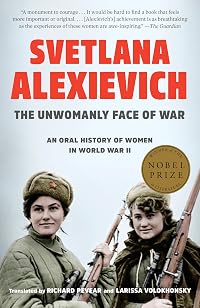
The Unwomanly Face of War: An Oral History of Women in World War II
by Svetlana Alexievich
On This Page
Description
"Bringing together dozens of voices in her distinctive style, War's Unwomanly Face is Svetlana Alexievich's collection of stories of women's experiences in World War II, both on the front lines, on the home front, and in occupied territories. This is a new, distinct version of the war we're so familiar with. Alexievich gives voice to women whose stories are lost in the official narratives, creating a powerful alternative history from the personal and private stories of individuals. show more Collectively, these women's voices provide a kaleidoscopic portrait of the human side of the war. When the Swedish Academy awarded Svetlana Alexievich the Nobel Prize in Literature, they praised her "polyphonic writings, a monument to suffering and courage in our time," and cited her for inventing "a new kind of literary genre." Sara Danius, the permanent secretary of the Swedish Academy, added that her work comprises "a history of emotions -- a history of the soul."--Provided by publisher. show lessTags
Recommendations




















Member Recommendations

Member Reviews
Remembering is not a passionate or dispassionate retelling of a reality that is no more, but a new birth of the past, when time goes in reverse. Above all it is creativity. As they narrate, people create, they "write" their life.
It is truly amazing how Alexievich has created her own distinct polyphonic style of historical non-fiction, this hauntingly beautiful mix of facts and feelings, challenging traditional ideas of what history is and how it should be remembered and recorded.
Here, she presents a more rounded picture of the roles that Russian women had held in WWII, young idealistic women - some still girls - who fought for their country as snipers, sappers, nurses, launderers, underground partisans, and more. It offers a show more complementary counterpoint to the oft-told stories of idealistic young men who joins the fight due to patriotism or for the sense of adventure or even under the false impression of the invincibility of youth, and end up disillusioned by the senselessness and horror of the daily war they witness then and afterwards. The book itself places the women and their stories as the focus, and in doing so, makes it more than about the war, but also about that very specific Russian ideal, that strong bond to the Motherland and the ingrained belief in self-sacrifice for the greater good, and Russian history that produced it.
Near the end, Alexievich touches on what could be a fascinating standalone topic for another book, the dark aftermath of Victory: how to rebuild lives that have been put on hold for years after such a life-changing event; the constant reminders of the war - in hidden unexploded mines destroying post-Victory lives and morale, the crippled survivors, the PTSD, the destroyed landscape -; the stigma of being a woman at the frontline and the double-standards of people in wartime and peacetime; the continuation of Stalinism that questioned the very survival of decorated heroes and sent them to the gulags.
Truly an important oral history of Russian women in WWII.
Aside: It's difficult to reconcile the enormity of the physical efforts involved in wars with the ideals and abstractions that create and sustain the very same wars. How intense the physical and mental hardships were, made endurable by simple morale boosts, be it letters from home, a clean shirt, or even a soft peal of laughter or music. Somehow an ongoing battle can suddenly cease, all because both sides received words of Victory for one. In the split second before and after the victory/defeat was announced, nothing physical on that battlefield has changed except the whole mentality and yet that's what ultimately decides wars. And what about the aftermath of these wars. The horrors can be glossed over with clinical accounts of major and decisive battles, the dead collectively memorialised as brave statistics, and the survivors' entire wartime experiences reduced to little medals. show less
It is truly amazing how Alexievich has created her own distinct polyphonic style of historical non-fiction, this hauntingly beautiful mix of facts and feelings, challenging traditional ideas of what history is and how it should be remembered and recorded.
Here, she presents a more rounded picture of the roles that Russian women had held in WWII, young idealistic women - some still girls - who fought for their country as snipers, sappers, nurses, launderers, underground partisans, and more. It offers a show more complementary counterpoint to the oft-told stories of idealistic young men who joins the fight due to patriotism or for the sense of adventure or even under the false impression of the invincibility of youth, and end up disillusioned by the senselessness and horror of the daily war they witness then and afterwards. The book itself places the women and their stories as the focus, and in doing so, makes it more than about the war, but also about that very specific Russian ideal, that strong bond to the Motherland and the ingrained belief in self-sacrifice for the greater good, and Russian history that produced it.
Near the end, Alexievich touches on what could be a fascinating standalone topic for another book, the dark aftermath of Victory: how to rebuild lives that have been put on hold for years after such a life-changing event; the constant reminders of the war - in hidden unexploded mines destroying post-Victory lives and morale, the crippled survivors, the PTSD, the destroyed landscape -; the stigma of being a woman at the frontline and the double-standards of people in wartime and peacetime; the continuation of Stalinism that questioned the very survival of decorated heroes and sent them to the gulags.
Truly an important oral history of Russian women in WWII.
Aside: It's difficult to reconcile the enormity of the physical efforts involved in wars with the ideals and abstractions that create and sustain the very same wars. How intense the physical and mental hardships were, made endurable by simple morale boosts, be it letters from home, a clean shirt, or even a soft peal of laughter or music. Somehow an ongoing battle can suddenly cease, all because both sides received words of Victory for one. In the split second before and after the victory/defeat was announced, nothing physical on that battlefield has changed except the whole mentality and yet that's what ultimately decides wars. And what about the aftermath of these wars. The horrors can be glossed over with clinical accounts of major and decisive battles, the dead collectively memorialised as brave statistics, and the survivors' entire wartime experiences reduced to little medals. show less
“No two persons ever read the same book.” Literary critic Edmund Wilson's observation should preface every review and critique written since an author's efforts create only half the experience of consuming a book, the other half being quite dependent upon the reader's background, preexisting knowledge, and expectations. That said, I cannot extol Svetlana Alexievich's The Unwomanly Face of War too highly. This “oral history of women in World War II” is among the most memorable books that I have read within recent memory. It is, by the way, the third book by Alexievich that I have read, and, while the first two were excellent, this one surpasses them.
As with the author's other works, this one was written in Russian, and I can show more comprehend only the English translation, this one by Richard Pevear and Larissa Volokhonsky. A translation, obviously, puts the reader at two removes from the topic. First, we never touch a topic itself in a book; rather, we have the author's recounting, interpretation, and perhaps even analysis of it. Next, we have the translator's interpretation of the author's intent. A competent translator will accurately capture the nuances and connotations intended by the author and will create syntax and vocabulary that is natural to the English language while retaining the atmosphere intended by the author. Since I am not competent to compare this translation with the original, I must take on faith that it is an accurate rendering of Alexievich's words, tones, and emotions. Too often, translators of published books remain maddeningly anonymous, but not so here. The book includes a brief professional biography of both translators, and the works on which they have collaborated comprise an impressive list indeed. That the translators are so thoroughly identified reassures the reader that the original work is well and accurately presented.
The content of the book is “typical Alexievich.” As with her other books, she is not concerned with the great events of the German invasion of the Soviet Union in World War II. Those are recounted in countless history texts and need no additional repetition. Rather, her focus is on the personal experiences, the feelings, the thoughts, and the lasting impressions and impacts of the war on the Soviet women that participated in it. Her method is to interview these women, to record their stories, and then to turn those stories into readable vignettes.
Through these numerous first-person accounts, the reader is often transported to the “front” in 1941 and for the four years following until the “Victory” in 1945. So what did Soviet women –women!--have to do with front line war? With their land invaded and occupied by Hitler's troops, Soviet women frequently volunteered for military duty, many demanding to be sent to the front. Unlike the United States, which did not permit female soldiers to train in combat specialties until 2015, the Red Army saw women serving as snipers, pilots, foot soldiers, sappers, antiaircraft gunners, commanders of machine gun platoons, as well as doctors, nurses, and medical assistants in tank companies. Several women were in the fighting forces that even reached Berlin as the German war machine collapsed.
The experiences recounted by Alexievich's interviewees are sometimes shocking, sad, maddening, surprising, happy, remorseful—indeed, the entire gamut of human emotions. The book is, in a word, powerful. Once begun, it is difficult to put down and tempts readers to stay up long after their bedtimes. This not a book that one will easily or quickly forget, and it is one that will fascinate any reader who is interested by human natures and how those natures react when confronted with the horror of war on their doorsteps! show less
As with the author's other works, this one was written in Russian, and I can show more comprehend only the English translation, this one by Richard Pevear and Larissa Volokhonsky. A translation, obviously, puts the reader at two removes from the topic. First, we never touch a topic itself in a book; rather, we have the author's recounting, interpretation, and perhaps even analysis of it. Next, we have the translator's interpretation of the author's intent. A competent translator will accurately capture the nuances and connotations intended by the author and will create syntax and vocabulary that is natural to the English language while retaining the atmosphere intended by the author. Since I am not competent to compare this translation with the original, I must take on faith that it is an accurate rendering of Alexievich's words, tones, and emotions. Too often, translators of published books remain maddeningly anonymous, but not so here. The book includes a brief professional biography of both translators, and the works on which they have collaborated comprise an impressive list indeed. That the translators are so thoroughly identified reassures the reader that the original work is well and accurately presented.
The content of the book is “typical Alexievich.” As with her other books, she is not concerned with the great events of the German invasion of the Soviet Union in World War II. Those are recounted in countless history texts and need no additional repetition. Rather, her focus is on the personal experiences, the feelings, the thoughts, and the lasting impressions and impacts of the war on the Soviet women that participated in it. Her method is to interview these women, to record their stories, and then to turn those stories into readable vignettes.
Through these numerous first-person accounts, the reader is often transported to the “front” in 1941 and for the four years following until the “Victory” in 1945. So what did Soviet women –women!--have to do with front line war? With their land invaded and occupied by Hitler's troops, Soviet women frequently volunteered for military duty, many demanding to be sent to the front. Unlike the United States, which did not permit female soldiers to train in combat specialties until 2015, the Red Army saw women serving as snipers, pilots, foot soldiers, sappers, antiaircraft gunners, commanders of machine gun platoons, as well as doctors, nurses, and medical assistants in tank companies. Several women were in the fighting forces that even reached Berlin as the German war machine collapsed.
The experiences recounted by Alexievich's interviewees are sometimes shocking, sad, maddening, surprising, happy, remorseful—indeed, the entire gamut of human emotions. The book is, in a word, powerful. Once begun, it is difficult to put down and tempts readers to stay up long after their bedtimes. This not a book that one will easily or quickly forget, and it is one that will fascinate any reader who is interested by human natures and how those natures react when confronted with the horror of war on their doorsteps! show less
Reports of the devastating effect of war on people is felt more closely when the story-tellers have the freedom to speak openly and honestly. Alexievich published this many years after the war on discovering how many women were at the front in her home of Belarus. Alexievich captured these women at the right time, when they were willing to open up. Some women are disheartened by it all, some disturbed at the re-telling, some able to capture beautiful warm moments of camaraderie. Many of the women, girls at the time had this mission to fight for the motherland. Russian had been invaded, simple as that. The enemy had to be repulsed. Something I didn’t expect to read in this book.
Tough book to read. But like the WW1 poets who gave us show more the harrowing accounts of war, these stories leave an indelible impression of war’s horror. And its the hope I have when I read it that we’ve learned something. Of course I’m wrong, since no one learns from the devastation of war. There is always a vested interest willing to let loose its blood-thirsty energy.
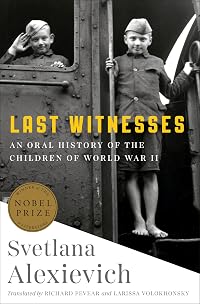
I have another of Alexievich’ books on my bedside, ready to read, Last Witnesses, the accounts of children who survived the war. I am yet to read it. Partly because both my parents and almost every adult Greek immigrant to Australia lived under occupation and in wartime. I had heard their stories first hand. And like the Unwomanly Face of War, I allowed myself to absorb some of the experiences contained in the book that I recognise my parents and their generation witnessed. I want to go over stories that will remind me and yet, I feel unready too.
Recently, Kantemir Balagov made the film Beanpole using the theme of Russian women as returned soldiers ironically working in a male repatriation hospital in run down St Petersburg (Leningrad). Seventy five years on, the damage of war is still in the minds of Russian film makers. show less
Tough book to read. But like the WW1 poets who gave us show more the harrowing accounts of war, these stories leave an indelible impression of war’s horror. And its the hope I have when I read it that we’ve learned something. Of course I’m wrong, since no one learns from the devastation of war. There is always a vested interest willing to let loose its blood-thirsty energy.
I have another of Alexievich’ books on my bedside, ready to read, Last Witnesses, the accounts of children who survived the war. I am yet to read it. Partly because both my parents and almost every adult Greek immigrant to Australia lived under occupation and in wartime. I had heard their stories first hand. And like the Unwomanly Face of War, I allowed myself to absorb some of the experiences contained in the book that I recognise my parents and their generation witnessed. I want to go over stories that will remind me and yet, I feel unready too.
Recently, Kantemir Balagov made the film Beanpole using the theme of Russian women as returned soldiers ironically working in a male repatriation hospital in run down St Petersburg (Leningrad). Seventy five years on, the damage of war is still in the minds of Russian film makers. show less
This book is a gut punch. Millions of women served in the Soviet Armed Forces, and unlike other militaries, which tried to keep women in auxiliary roles like nurse, clerk, or ferry pilot, Soviet women were on the front lines as snipers, machine gunners, pilots, field medics, and partisans, as well as behind the lines. And once Victory, glorious Victory was achieved, these Soviet women soldiers were asked to forget their role, their heroism, their trauma, and return to being wives and mothers. The official narrative of collective sacrifice didn't easily allow for women soldiers.
Alexievich spent decades conducting an oral history project, no easy thing in the Soviet Union, when going against the official narrative didn't just have the show more weight of Greatest Generation social pressure, but also could provoke official censorship. This book is stitched together out of hundreds of interviews, a quilt torn full of holes, yet big enough to cover the entire front.
The experience is harrowing. Themes stick out, volunteering in the first flush of patriotism, losing womanhood to become a soldier, seeing such intense death and destruction, the privation of life in the trenches, attempting to seize some form of normalcy (these were after all young women), and then coping with the aftermath.
I thought I was handling it well, but one story hit me like a lightning bolt. This woman fought with a partisan band near her village. The Nazis would gather the women who remained (the men were dead or in the army) and have them walk ahead of their patrols to set off mines. As the partisans lay in ambush, they would see their family members pass by, "There goes my mother. That's my sister," and pray that in the firefight no their family members would survive. That's the stuff of nightmares. show less
Alexievich spent decades conducting an oral history project, no easy thing in the Soviet Union, when going against the official narrative didn't just have the show more weight of Greatest Generation social pressure, but also could provoke official censorship. This book is stitched together out of hundreds of interviews, a quilt torn full of holes, yet big enough to cover the entire front.
The experience is harrowing. Themes stick out, volunteering in the first flush of patriotism, losing womanhood to become a soldier, seeing such intense death and destruction, the privation of life in the trenches, attempting to seize some form of normalcy (these were after all young women), and then coping with the aftermath.
I thought I was handling it well, but one story hit me like a lightning bolt. This woman fought with a partisan band near her village. The Nazis would gather the women who remained (the men were dead or in the army) and have them walk ahead of their patrols to set off mines. As the partisans lay in ambush, they would see their family members pass by, "There goes my mother. That's my sister," and pray that in the firefight no their family members would survive. That's the stuff of nightmares. show less
Reading the entirety of this book on a long train journey was probably not a good idea, but I simply could not put it down. ‘The Unwomanly Face of War’ is one of the most devastating books I’ve ever read and it was an effort not to cry throughout. At several points I didn’t succeed in not crying, despite hating to show emotion on trains (a flagrant violation of the Public Transport Social Contract). Between 1978 and 1985 Svetlana Alexievich collected the testimonies of Soviet women who fought in the Second World War. She presents them with very little commentary, as the women’s own words are absolutely compelling. Ridiculous as it sounds, I felt like I was experiencing this book rather than reading it. Being told in show more unvarnished first person recollections, it is much more powerful than [b:Ivan's War: Life and Death in the Red Army, 1939-1945|84571|Ivan's War Life and Death in the Red Army, 1939-1945|Catherine Merridale|https://images.gr-assets.com/books/1317793153s/84571.jpg|81633]. That was a very good book, while this is an exceptional one that reaches the same heights as [a:Vasily Grossman|19595|Vasily Grossman|https://images.gr-assets.com/authors/1391607075p2/19595.jpg].
The women that Alexievich interviewed took many different roles in the war and had a wide range of horrific experiences. Some offer more detail, others a vignette or brief comment. Together, their voices convey the incredible contribution that Soviet women made to the defeat of the Nazis on the Eastern front. History has largely forgotten them and popular culture would have us believe that handsome white American and British men beat Hitler by themselves. These women suffered unbelievable physical and mental trauma. Almost all lost loved ones to the war. Many went to war as children, at the age of sixteen or younger! Understanding the scale of death and destruction on the Eastern front of WWII is very difficult, as such horrors defy human understanding. Individual stories collected together are easier for the mind to grasp. ‘The Unwomanly Face of War’ is terrifying, heart-rending, and stunning. An unforgettable book, one of the best things I have read this year and one of the best books about war that I’ve ever read.
Since I can’t adequately describe its impact myself, here are a few quotes:
Finally, the new Penguin edition is beautifully presented. I read almost exclusively library and charity shop books, buying maybe two or three new books a year; this was one of them. show less
The women that Alexievich interviewed took many different roles in the war and had a wide range of horrific experiences. Some offer more detail, others a vignette or brief comment. Together, their voices convey the incredible contribution that Soviet women made to the defeat of the Nazis on the Eastern front. History has largely forgotten them and popular culture would have us believe that handsome white American and British men beat Hitler by themselves. These women suffered unbelievable physical and mental trauma. Almost all lost loved ones to the war. Many went to war as children, at the age of sixteen or younger! Understanding the scale of death and destruction on the Eastern front of WWII is very difficult, as such horrors defy human understanding. Individual stories collected together are easier for the mind to grasp. ‘The Unwomanly Face of War’ is terrifying, heart-rending, and stunning. An unforgettable book, one of the best things I have read this year and one of the best books about war that I’ve ever read.
Since I can’t adequately describe its impact myself, here are a few quotes:
We went to die for life, without knowing what life was. We had only read about it in books. I liked movies about love…
Medical assistants in tank units died quickly. There was no room provided for us in a tank; you had to hang on to the armour plating, and the only thought was to avoid having your legs drawn into the caterpillar tread. And we had to watch for burning tanks… To jump down and run or crawl there… We were five girlfriends at the front: Liuba Yasinskaya, Shura Kiseleva, Tonya Bobkova, Zina Latysh, and me. The tank soldiers called us the Konakovo girls. And all the girls were killed...
[...]
In the morning the whole battalion lined up, those cowards were brought and placed before us. The order that they be shot was read. Seven men were needed to carry out the sentence… Three man stepped forward; the rest stood there. I took a submachine gun and stepped forward. Once I stepped forward… a young girl… everybody followed me… Those two could not be forgiven. Because of them such brave boys were killed!
And we carried out the sentence… I lowered the submachine gun, and became frightened. I went up to them… they lay there… One had a living smile on his face.
I don’t know, would I have forgiven them now? I can’t tell… I don’t want to lie.
[...]
We clothed the soldiers, laundered, ironed for them - that was our heroism. We rode on horseback, less often by train. Our horses were exhausted, you could say we got to Berlin on foot. And since we’re remembering like this, we did everything that was necessary: helped to carry the wounded, delivered shells by hand at the Dnieper, because it was impossible to transport them. We carried them from several miles away. We made dugouts, built bridges…
We fell into an encirclement, I ran, I shot, like everybody else. Whether I killed or not, I can’t say. I ran and shot, like everybody else.
[...]
There was another woman, Zajarskaya. She had a daughter, Valeria; the girl was seven years old. We had to blow up the mess hall. We decided to plant a mine in the stove, but it had to be carried there. And the mother said her daughter would bring the mine. She put the mine in a basket and covered it with a couple of children’s outfits, a stuffed toy, two dozen eggs, and some butter. And so the girl brought the mine to the mess hall. People say that maternal instinct is stronger than anything. No, ideas are stronger! And faith is stronger! I think… I’m certain that if it wasn’t for such a mama and such a girl, and they hadn’t carried that mine, we wouldn’t have been victorious. Yes, life - it’s a good thing. Excellent! But there are things that are dearer…
[...]
And everybody was waiting for that moment… Now we’ll understand… Now we’ll see… Where do [Nazis] come from? What is their land like, their houses? Could it be that they are ordinary people? That they lived ordinary lives? At the front, I couldn’t imagine ever being able to read Heine’s poems again. My beloved Goethe. I could never listen to Wagner… Before the war, I grew up in a family of musicians, I loved German music - Bach, Beethoven. The great Bach! I crossed all this out of my world. Then we saw, they showed us the crematoriums… Auschwitz… Heaps of women’s clothing, children’s shoes… Gray ash… They spread it on the fields, under the cabbage. Under the lettuce… I couldn’t listen to German music anymore… A long time passed before I went back to Bach. Began to play Mozart.
Finally, the new Penguin edition is beautifully presented. I read almost exclusively library and charity shop books, buying maybe two or three new books a year; this was one of them. show less
Memories of World War II by Soviet female veterans. A typical (but very good) history of the war like Max Hastings’ Inferno covers different levels: high level national politics, military strategy, statistics to contextualize the scope, descriptions of battles and weapons, along with scattered anecdotes to bring the history down to human scale. The anecdotes will focus primarily on combat as experienced by male officers and soldiers. Vassily Grossman’s Life and Fate does the Russian face of the war from top to bottom, but fiction allows him to imagine the history of the war entirely from the perspective of the participants (and its victims): General Zhukov, Moscow intellectuals, tank commanders, partisans, persecuted Jews. Both male show more and female have roles to play.
Svetlana Alexievich’s work is somewhere between history and fiction. A work of “non-fiction,” it weaves together the memories of Soviet female participants in what the Soviets called the Great Patriotic War. Alexievich is like Penelope weaving a tapestry of recollections that originate in actual events but are transformed as memory-stories, not of the deeds of men, but by women in their old age. Researched in the 1980’s, most of the narrators have probably passed on by now.
The book, even more than her Voices from Chernobyl, affected me emotionally, very much. Strategy, combat, weapons, statistics, context are pretty much ignored. It is probably the author’s thesis that the women’s memories emphasize emotions; emotions are the content of their memories, and these emotions rarely touch on the emotions associated with battles and combat. If you empathize with these emotions you are likely to have insight into some of the emotions of men as well.
The actual combat work is described matter-of-factly. An unusually detailed story in Alexievich’s collection – even my summary has to omit some of the anecdotes -- is told by Appolina Nikonovna Litskevich-Bairak, 2nd lieutenant, commander of a sapper-miner platoon. Sappers were assigned the harrowing job of disarming mines and IEDs. Probably in her 60s when her memories were recorded, the youthful tone of her voice is unusual. Brief anecdotes about her childhood – she was originally from Siberia. She’s punished during training and ordered to clean the floors of the barracks – she explains the best way to polish floors: “I’ll explain at once … In detail… […] After lights out you take your boots off, so you don’t muck them up with mastic, wrap your feet in pieces of an old overcoat, making a sort of peasant shoe tied with string. […] You have to polish it so it shines like a mirror. [etc.].” Another anecdote about her embarrassment when she saluted with the wrong hand.
Following training, new lieutenant of a platoon at the front. Her troops simply ignore their 20 year old commander; she is forced to give the command “As you were.” And immediately an artillery barrage begins; she dives for a snowbank so she won’t stain her new overcoat in the mud to the amusement of her troops.
The job is described. At night she and a unit commander crawl into a trench in no man’s land. Camouflaged, they observe in the daytime looking for irregularities that may betray newly laid German mines. In freezing cold. Later on, “Before our troops advanced, we worked during the night. We felt the ground inch by inch. Made corridors in the mine fields. All the work was done crawling … On your belly… I shuttled from one unit to another. There were always more of ‘my’ mines.”
Stories: Invited to officers’ breakfast. “When everybody sat down at the kitchen table, I paid attention to the Russian stove with the closed door. I went over and began to examine the door. The officers poked fun at me: ‘You women imagine mines even in pots and pans.’ I joked back and then noticed at the very bottom, to the left of the door, there was a small hole. I looked closer and saw a thin wire going into the stove … ‘The house is mined, I ask you to quit the premises’ … I set to work with the sappers. First we removed the door. Cut the wires with scissors … In the depths of the stove, two big packages wrapped in black paper. About forty pounds of explosives. There’s pots and pans for you … “
Later her sappers get into a fight with artillery troops when one of the artillery troops shouts “Heads up! What a chassis!” She does not understand the cause of the fight until her subcommander has to explain “that the word ‘chassis’ was very offensive for a woman. Something like ‘whore.’ A frontline obscenity …” [Without editorial comment, Alexievich contrasts the initial disrespect from her platoon with her sappers risking court martial to defend her after she has become a combat veteran, not to mention that she is still too green to have mastered the “frontline obscenit[ies].”]
[As the Red Army advances, somewhere in Czechoslovakia or Poland]. “And there were mines at every step. Many mines. Once we went into a house, and someone saw a pair of calfskin boots standing by a wardrobe. He was already reaching out to take them. ‘Don’t you dare touch them!’ I shouted. When I came up and began to study them, they turned out to be mined. There were mined armchairs, chests of drawers, sideboards, dolls, chandeliers … Peasants asked us to de-mine the rows of tomatoes, potatoes, cabbage.”
“Well, so … I went through Czechoslovakia, Poland, Hungary, Romania, Germany […] Mostly I remember only visual images of the lay of the land. Boulders … Tall grass … Either it was really tall or it only seemed so to us because it was unbelievably difficult to go through it and work with our probes and mine detectors. […] Flowerbeds gone to seed. There were always mines hiding there; the Germans loved flowerbeds.”
In Romania, she’s invited to a dance by a woman friend. “I put on trousers, an army shirt, calfskin boots, and on top of it all the Romanian national costume: a long embroidered linen blouse and a tight checkered skirt. Tied a black belt around my waist, threw a colorful shawl with long fringe over my head. To this should be added that, from crawling in the mountains all summer, I had a dark tan, only blond strands stuck out on my temples, and my nose was peeling – still it was hard to distinguish me from a real Romanian. A Romanian girl. […] When we came, music was already playing, people were dancing. I saw almost all the officers from my battalion. At first I was afraid to be recognized and exposed, and so I sat in a far corner, without attracting attention […] At least I could see everything … From a distance … But after one of our officers invited me several times to dance without recognizing me with my lips and eyebrows painted, I began laughing and having fun. I was having a very good time … I liked to hear that I was beautiful. I heard compliments … I danced and danced …” [Considerably more detail than any of the combat stories. I’m assuming Alexievich isn’t doing too much editorial tilting to make a point about what women remembered.]
“The war ended, but we spent another whole year demining fields, lakes, rivers. […] For the sappers the war ended several years later; they fought longer than anyone else. And what is it to wait for an explosion after the Victory? […] Death after the Victory was the most terrible. A double death.”
She was demobilized in 1946. “On the train I developed a high fever. My face was swollen; I couldn’t open my mouth. My wisdom teeth were growing … I was returning from the war …” By the end of the war she still hadn’t achieved physical maturity.
Memories by other veterans that struck me:
A city girl who worked on a collective farm substituting for the men who left for the war. “And if I was in any way different from the farm girls, it was only in that I knew many poems and could recite them by heart all the long way home from the fields.”
A sergeant in a communication unit. “We slept on branches or on hay. But I had a pair of earrings stashed away; I’d put them on at night and slept with them.”
A medical assistant. “In the end only one fear remains – of being ugly after death. A woman’s fear … Not to be torn to pieces by a shell … I saw it happen … I picked up those pieces.”
A scout. “A whole clearing covered with blue flowers … To perish among such flowers! To lie there … I was a silly goose, seventeen years old … That’s how I imagined death … “
A pilot. “We didn’t have those women’s things … Periods … You know … And after the war not all of us could have children.”
Sergeant major, a medical assistant, infantry. “I never waited for the attack to be over, I crawled around during the combat picking up the wounded. […] I wished for just one thing – to live until my birthday, so as to turn eighteen. […] I got as far as Berlin. I put my signature on the Reichstag: ‘I, Sofya Kuntsevich, came here to kill war.”
A woman whose name was suppressed. “I became a sniper. I could have been a radio operator. […] But they told me they needed people to shoot, so I shot. I did it well. I have two Orders of Glory and four medals. For three years of war. […] How did the Motherland meet us? I can’t speak without sobbing … It was forty years ago, but my cheeks still burn. The men said nothing, but the women … They shouted at us, ‘We know what you did there! You lured our men with your young c----! Army whores … Military bitches’ They insulted us in all possible ways … The Russian vocabulary is rich ...” But she gets married a year after the war. “I have two children … A boy and a girl. First I had a boy. A good, intelligent boy. But the girl … My girl … She began to walk when she was five, said her first word, ‘mama,’ at seven. […] She’s been in an insane asylum … For forty years. Since I retired, I go there every day. It’s my sin […] I’ve been punished … For what? Maybe for having killed people? I sometimes think so […] I don’t have a grudge against my husband, I forgave him long ago. The girl was born … He looked at us … He stayed for a while and left. Left with a reproach: ‘Would a normal woman have gone to war? Learned to shoot? That’s why you’re unable to give birth to a normal child. […] Maybe he’s right? I sometimes think so … it’s my sin […] To my girl … To her alone … I recall the war, and she thinks I’m telling her fairy tales. Children’s fairy tales. Scary children’s fairy tales … “ show less
Svetlana Alexievich’s work is somewhere between history and fiction. A work of “non-fiction,” it weaves together the memories of Soviet female participants in what the Soviets called the Great Patriotic War. Alexievich is like Penelope weaving a tapestry of recollections that originate in actual events but are transformed as memory-stories, not of the deeds of men, but by women in their old age. Researched in the 1980’s, most of the narrators have probably passed on by now.
The book, even more than her Voices from Chernobyl, affected me emotionally, very much. Strategy, combat, weapons, statistics, context are pretty much ignored. It is probably the author’s thesis that the women’s memories emphasize emotions; emotions are the content of their memories, and these emotions rarely touch on the emotions associated with battles and combat. If you empathize with these emotions you are likely to have insight into some of the emotions of men as well.
The actual combat work is described matter-of-factly. An unusually detailed story in Alexievich’s collection – even my summary has to omit some of the anecdotes -- is told by Appolina Nikonovna Litskevich-Bairak, 2nd lieutenant, commander of a sapper-miner platoon. Sappers were assigned the harrowing job of disarming mines and IEDs. Probably in her 60s when her memories were recorded, the youthful tone of her voice is unusual. Brief anecdotes about her childhood – she was originally from Siberia. She’s punished during training and ordered to clean the floors of the barracks – she explains the best way to polish floors: “I’ll explain at once … In detail… […] After lights out you take your boots off, so you don’t muck them up with mastic, wrap your feet in pieces of an old overcoat, making a sort of peasant shoe tied with string. […] You have to polish it so it shines like a mirror. [etc.].” Another anecdote about her embarrassment when she saluted with the wrong hand.
Following training, new lieutenant of a platoon at the front. Her troops simply ignore their 20 year old commander; she is forced to give the command “As you were.” And immediately an artillery barrage begins; she dives for a snowbank so she won’t stain her new overcoat in the mud to the amusement of her troops.
The job is described. At night she and a unit commander crawl into a trench in no man’s land. Camouflaged, they observe in the daytime looking for irregularities that may betray newly laid German mines. In freezing cold. Later on, “Before our troops advanced, we worked during the night. We felt the ground inch by inch. Made corridors in the mine fields. All the work was done crawling … On your belly… I shuttled from one unit to another. There were always more of ‘my’ mines.”
Stories: Invited to officers’ breakfast. “When everybody sat down at the kitchen table, I paid attention to the Russian stove with the closed door. I went over and began to examine the door. The officers poked fun at me: ‘You women imagine mines even in pots and pans.’ I joked back and then noticed at the very bottom, to the left of the door, there was a small hole. I looked closer and saw a thin wire going into the stove … ‘The house is mined, I ask you to quit the premises’ … I set to work with the sappers. First we removed the door. Cut the wires with scissors … In the depths of the stove, two big packages wrapped in black paper. About forty pounds of explosives. There’s pots and pans for you … “
Later her sappers get into a fight with artillery troops when one of the artillery troops shouts “Heads up! What a chassis!” She does not understand the cause of the fight until her subcommander has to explain “that the word ‘chassis’ was very offensive for a woman. Something like ‘whore.’ A frontline obscenity …” [Without editorial comment, Alexievich contrasts the initial disrespect from her platoon with her sappers risking court martial to defend her after she has become a combat veteran, not to mention that she is still too green to have mastered the “frontline obscenit[ies].”]
[As the Red Army advances, somewhere in Czechoslovakia or Poland]. “And there were mines at every step. Many mines. Once we went into a house, and someone saw a pair of calfskin boots standing by a wardrobe. He was already reaching out to take them. ‘Don’t you dare touch them!’ I shouted. When I came up and began to study them, they turned out to be mined. There were mined armchairs, chests of drawers, sideboards, dolls, chandeliers … Peasants asked us to de-mine the rows of tomatoes, potatoes, cabbage.”
“Well, so … I went through Czechoslovakia, Poland, Hungary, Romania, Germany […] Mostly I remember only visual images of the lay of the land. Boulders … Tall grass … Either it was really tall or it only seemed so to us because it was unbelievably difficult to go through it and work with our probes and mine detectors. […] Flowerbeds gone to seed. There were always mines hiding there; the Germans loved flowerbeds.”
In Romania, she’s invited to a dance by a woman friend. “I put on trousers, an army shirt, calfskin boots, and on top of it all the Romanian national costume: a long embroidered linen blouse and a tight checkered skirt. Tied a black belt around my waist, threw a colorful shawl with long fringe over my head. To this should be added that, from crawling in the mountains all summer, I had a dark tan, only blond strands stuck out on my temples, and my nose was peeling – still it was hard to distinguish me from a real Romanian. A Romanian girl. […] When we came, music was already playing, people were dancing. I saw almost all the officers from my battalion. At first I was afraid to be recognized and exposed, and so I sat in a far corner, without attracting attention […] At least I could see everything … From a distance … But after one of our officers invited me several times to dance without recognizing me with my lips and eyebrows painted, I began laughing and having fun. I was having a very good time … I liked to hear that I was beautiful. I heard compliments … I danced and danced …” [Considerably more detail than any of the combat stories. I’m assuming Alexievich isn’t doing too much editorial tilting to make a point about what women remembered.]
“The war ended, but we spent another whole year demining fields, lakes, rivers. […] For the sappers the war ended several years later; they fought longer than anyone else. And what is it to wait for an explosion after the Victory? […] Death after the Victory was the most terrible. A double death.”
She was demobilized in 1946. “On the train I developed a high fever. My face was swollen; I couldn’t open my mouth. My wisdom teeth were growing … I was returning from the war …” By the end of the war she still hadn’t achieved physical maturity.
Memories by other veterans that struck me:
A city girl who worked on a collective farm substituting for the men who left for the war. “And if I was in any way different from the farm girls, it was only in that I knew many poems and could recite them by heart all the long way home from the fields.”
A sergeant in a communication unit. “We slept on branches or on hay. But I had a pair of earrings stashed away; I’d put them on at night and slept with them.”
A medical assistant. “In the end only one fear remains – of being ugly after death. A woman’s fear … Not to be torn to pieces by a shell … I saw it happen … I picked up those pieces.”
A scout. “A whole clearing covered with blue flowers … To perish among such flowers! To lie there … I was a silly goose, seventeen years old … That’s how I imagined death … “
A pilot. “We didn’t have those women’s things … Periods … You know … And after the war not all of us could have children.”
Sergeant major, a medical assistant, infantry. “I never waited for the attack to be over, I crawled around during the combat picking up the wounded. […] I wished for just one thing – to live until my birthday, so as to turn eighteen. […] I got as far as Berlin. I put my signature on the Reichstag: ‘I, Sofya Kuntsevich, came here to kill war.”
A woman whose name was suppressed. “I became a sniper. I could have been a radio operator. […] But they told me they needed people to shoot, so I shot. I did it well. I have two Orders of Glory and four medals. For three years of war. […] How did the Motherland meet us? I can’t speak without sobbing … It was forty years ago, but my cheeks still burn. The men said nothing, but the women … They shouted at us, ‘We know what you did there! You lured our men with your young c----! Army whores … Military bitches’ They insulted us in all possible ways … The Russian vocabulary is rich ...” But she gets married a year after the war. “I have two children … A boy and a girl. First I had a boy. A good, intelligent boy. But the girl … My girl … She began to walk when she was five, said her first word, ‘mama,’ at seven. […] She’s been in an insane asylum … For forty years. Since I retired, I go there every day. It’s my sin […] I’ve been punished … For what? Maybe for having killed people? I sometimes think so […] I don’t have a grudge against my husband, I forgave him long ago. The girl was born … He looked at us … He stayed for a while and left. Left with a reproach: ‘Would a normal woman have gone to war? Learned to shoot? That’s why you’re unable to give birth to a normal child. […] Maybe he’s right? I sometimes think so … it’s my sin […] To my girl … To her alone … I recall the war, and she thinks I’m telling her fairy tales. Children’s fairy tales. Scary children’s fairy tales … “ show less
„Megpróbálom a nagy történelmet emberléptékűvé kicsinyíteni, hogy valamit is megértsek. Megleljem a szavakat. De ezen a látszólag kicsiny és könnyen áttekinthető terepen – az emberi lélekben – még érthetetlenebb, még kevésbé megjósolható minden, mint a történelemben. Azért, mert valós könnyekkel, érzésekkel kerülök szembe. Valós emberi arccal, amelyen beszélgetés közben végigsuhannak a fájdalom és rettenet árnyai. Néha még meg is kísért az eretnek sejtés az emberi szenvedés alig felfogható szépségéről. Ilyenkor megrémülök magamtól.” (228. oldal)
Az első ötven oldal páros lábbal ugrik bele az emberbe. A többi pedig nyitva tartja a sebet. Alekszijevics nagy író, aki a show more más mondataival ír, de úgy, hogy végig érezni a jelenlétét a szavak mögött. Pedig riportalanyai gyakran érezhetően mítoszt teremtenek, foszlányokból összeeszkábált emlékképeket adnak el koherens valóság gyanánt, elhallgatnak, sőt: egyesek bizonyosan fabulálnak is. De ezzel is érzéseikről tanúskodnak, arról a vágyukról, hogy valami értelmet leljenek abban, amiben (ezt Alekszijeviccsel együtt hiszem) nincsen értelem – így egy monumentális kollázs részeként ők is segítenek, hogy közelebb jussunk az igazsághoz: hogy felismerjük bennük az embert. Ezeket a nőket arra nevelték, hogy nőként viselkedjenek, női szerepeket töltsenek be, női vágyaik legyenek, de egyszeriben egy olyan világban találják magukat, amire nem lehet felkészülni. Ez a világ (a háború) mindenkinek idegen, de a nők szemével nézve még erősebb a kontraszt. Nem az ő háborújuk – ha már valakié, akkor a politikusoké, akik ekkoriban szinte kivétel nélkül férfiak („karaktergyilkos szakma”, ahogy valaki mondta volt). Ha van értelme az egésznek, az az, hogy megmutatják, kilépve a nekik rendelt szerepekből is helyt tudnak állni. És ezt nem lehet visszacsinálni.
Ez a könyv irgalmatlanul közel hozza a háborút. Olyan közel, hogy émelyegni kell tőle – a vértől éppúgy, mint a hazugságoktól. Aki pedig ezektől nincs hányingere, az alighanem bolond vagy senkiházi. show less
Az első ötven oldal páros lábbal ugrik bele az emberbe. A többi pedig nyitva tartja a sebet. Alekszijevics nagy író, aki a show more más mondataival ír, de úgy, hogy végig érezni a jelenlétét a szavak mögött. Pedig riportalanyai gyakran érezhetően mítoszt teremtenek, foszlányokból összeeszkábált emlékképeket adnak el koherens valóság gyanánt, elhallgatnak, sőt: egyesek bizonyosan fabulálnak is. De ezzel is érzéseikről tanúskodnak, arról a vágyukról, hogy valami értelmet leljenek abban, amiben (ezt Alekszijeviccsel együtt hiszem) nincsen értelem – így egy monumentális kollázs részeként ők is segítenek, hogy közelebb jussunk az igazsághoz: hogy felismerjük bennük az embert. Ezeket a nőket arra nevelték, hogy nőként viselkedjenek, női szerepeket töltsenek be, női vágyaik legyenek, de egyszeriben egy olyan világban találják magukat, amire nem lehet felkészülni. Ez a világ (a háború) mindenkinek idegen, de a nők szemével nézve még erősebb a kontraszt. Nem az ő háborújuk – ha már valakié, akkor a politikusoké, akik ekkoriban szinte kivétel nélkül férfiak („karaktergyilkos szakma”, ahogy valaki mondta volt). Ha van értelme az egésznek, az az, hogy megmutatják, kilépve a nekik rendelt szerepekből is helyt tudnak állni. És ezt nem lehet visszacsinálni.
Ez a könyv irgalmatlanul közel hozza a háborút. Olyan közel, hogy émelyegni kell tőle – a vértől éppúgy, mint a hazugságoktól. Aki pedig ezektől nincs hányingere, az alighanem bolond vagy senkiházi. show less
Members
- Recently Added By
Lists

Women in War
148 works; 28 members

Stories of War and Revolution
143 works; 54 members

Top Five Books of 2018
802 works; 265 members
Top Five Books of 2017
757 works; 231 members

Books Read in 2016
4,666 works; 199 members

Books Read in 2018
4,360 works; 110 members

Five star books
1,755 works; 107 members

1980s
356 works; 23 members
THE WAR ROOM
813 works; 24 members

Club Read's Recommended Nonfiction Written by Women
618 works; 30 members

Hakim's Marxist Book List
46 works; 3 members

Biblioteca esencial de mujeres (100 libros 100)
53 works; 1 member

Top Five Books of 2025
954 works; 303 members
Author Information

30+ Works 8,331 Members
Svetlana Alexievich was born in Stanislav, Ukraine, Soviet Union on May 31, 1948. She became a journalist and wrote narratives from interviews with witnesses to events such as World War II, the Soviet-Afghan war, the fall of the Soviet Union, and the Chernobyl disaster. Her books include Zinky Boys: Soviet Voices from the Afghanistan War and War's show more Unwomanly Face. She won the National Book Critics Circle Award in 2005 for Voices from Chernobyl: The Oral History of a Nuclear Disaster and the 2015 Nobel Prize in Literature. (Bowker Author Biography) show less
Some Editions
Awards and Honors
Awards
Distinctions
Notable Lists
Series
Belongs to Publisher Series
Common Knowledge
- Canonical title
- The Unwomanly Face of War: An Oral History of Women in World War II
- Original title
- U vojny ne zjenskoje litso; У войны не женское лицо
- Original publication date
- 1985; 1988 (English translation) (English translation)
- Important places
- Russia; USSR
- Important events
- World War II
- First words
- At what time in history did women first appear in the army?
--From A Conversation with a Historian - Last words
- (Click to show. Warning: May contain spoilers.)The birds quickly forgot the war ...
- Original language
- Russian
- Canonical DDC/MDS
- 940.53
- Canonical LCC
- D810.W7
Classifications
Statistics
- Members
- 1,749
- Popularity
- 12,574
- Reviews
- 56
- Rating
- (4.36)
- Languages
- 18 — Basque, Catalan, Danish, Dutch, English, Estonian, Finnish, French, German, Hungarian, Italian, Korean, Norwegian (Bokmål), Polish, Portuguese, Russian, Spanish, Swedish
- Media
- Paper, Audiobook, Ebook
- ISBNs
- 69
- ASINs
- 18