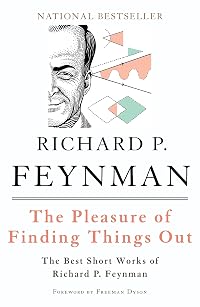
The Pleasure of Finding Things Out
by Richard Feynman
On This Page
Description
The Pleasure of Finding Things Out is a magnificent treasury of the best short works of Richard P. Feynman-from interviews and speeches to lectures and printed articles. A sweeping, wide-ranging collection, it presents an intimate and fascinating view of a life in science-a life like no other. From his ruminations on science in our culture to his Nobel Prize acceptance speech, this book will fascinate anyone interested in the world of ideas.Tags
Recommendations





Member Recommendations
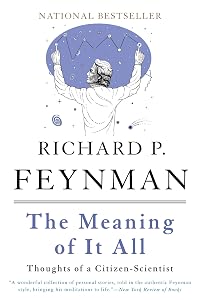
themulhern Feynman and Postman shared a great wariness and dislike of pseudoscience, which Postman called Scientism.
Member Reviews
It may be a pleasure to find things out but it wasn't a pleasure to find out that the title of this book made me expect something that wasn't delivered. I was looking forward to discovering a collection of ideas that would titillate my mind, but I got something quite different. The texts are transcripts of talks given by Richard Feynman and were minimally edited. And that's a pity because spoken language is completely different from written language. I realize that Richard Feynman was one of the great scientists of his time, but this book does not encourage me to read another one about him. I probably should, because there are bound to be better books explaining Feynman's ideas. But I think some time will pass before I do that.
Feynman's popular works are written so well, you will probably read them cover to cover without putting down the book. He has an infective joy in exploring and relating to others the universe around him. This book truly attempts to communicate that rare pleasure of finding things out.
For those not certain why it could be worth your time to read writings by a dead physicist, this is a great start. His questing mind and ability to convey complicated principles has affected everything from nanotechnology to the results of the inquiry to the cause of the Challenger disaster. I was surprised at how many occurrences in his life were familiar to me from science lore. Fascinating guy.
Feynman has such a sense of whimsy, as we find out as we learn about his pranks at Los Alamos and his fondness for the art of safe-cracking, and that is what this book of short essays and lectures shows. He is someone who loved to learn, loved to figure things out, and his passion is so infectious. I want to convert my garage into a personal laboratory after reading this book. Also, it's interesting to read some of his older works as he predicts many of the technological advances that we are enjoying today. Definitely an enjoyable read that I would recommend for all, even if you are not very scientifically inclined.
This book was a pleasure to read. The topics ranged from nanotechnology to covert pranks in the Manhattan Project! On every page, Feynman’s sense of humor and love for truth and discovery shine through.
It might sound odd hearing a devout Christian recommend the collected works of a devout atheist—but we share something in common: a love for finding things out. I obviously don’t agree with his conclusions when it comes to the meeting of science and religion, but I respect his curiosity.
If you’re at all interested in science, biographies, or humour, this book is worth the read.
It might sound odd hearing a devout Christian recommend the collected works of a devout atheist—but we share something in common: a love for finding things out. I obviously don’t agree with his conclusions when it comes to the meeting of science and religion, but I respect his curiosity.
If you’re at all interested in science, biographies, or humour, this book is worth the read.
For those who might not know, Richard Feynman was a Nobel Prize winning theoretical physicist, canny self-promoter and renowned teacher who worked on the Manhatten Project before he had even finished his Doctoral Thesis. Many books by and about him have been published and he has become a kind of miniature industry since his death; almost anybody who attended one of his lectures and scribbled some notes has tried to get them published, there are biographies and a volume of letters, CDs of impromtu drumming - the list goes on...
I was put off reading this book for several years by the fact that "all but one" chapter had been published elsewhere; I was figuring I already owned most of its contents.
That turned out to be wrong; although show more published, most of these essays, anecdotes and lectures had not seen the mainstream and fewer than 6 of them had I read before. Unfortunately some of the material covers territory that is widely available elsewhere and hence adds nothing in terms of ideas or anecdotes for the Feynman fan of long standing.
The material that was entirely new to me was interesting and made the book worthwhile on its own, but a characteristic of this book is that Feynman's own voice comes through strongly, unfiltered through editors and that made even familiar stories interesting. Feynman's voice comes through because many of the pieces are transcriptions of talks or interviews he gave. The book also covers a wide range from the silly stories to the serious science to the discussions on the nature and ethics of science.
Feynman fans should read it and people who want to know what the Feynman Fuss is about could do worse than start here. show less
I was put off reading this book for several years by the fact that "all but one" chapter had been published elsewhere; I was figuring I already owned most of its contents.
That turned out to be wrong; although show more published, most of these essays, anecdotes and lectures had not seen the mainstream and fewer than 6 of them had I read before. Unfortunately some of the material covers territory that is widely available elsewhere and hence adds nothing in terms of ideas or anecdotes for the Feynman fan of long standing.
The material that was entirely new to me was interesting and made the book worthwhile on its own, but a characteristic of this book is that Feynman's own voice comes through strongly, unfiltered through editors and that made even familiar stories interesting. Feynman's voice comes through because many of the pieces are transcriptions of talks or interviews he gave. The book also covers a wide range from the silly stories to the serious science to the discussions on the nature and ethics of science.
Feynman fans should read it and people who want to know what the Feynman Fuss is about could do worse than start here. show less
I can't say I read every page of this book, a compilation of material by, and about, Mr. Feynman's life in science. I'm not a science guy, but I 'discovered' Feynman a couple years ago and love his approach to his life's work. He's like (or was..... he died awhile ago) the brightest guy you ever would think about meeting, but is entirely normal otherwise and has a wealth of stories to prove it.
You don't need to know much science to get through this, and even if you're a complete neophyte you can appreciate most of it. The key takeaway I had had was that it's entirely possible to be both a Nobel prize winner as well as a regular guy. That's pretty cool!
You don't need to know much science to get through this, and even if you're a complete neophyte you can appreciate most of it. The key takeaway I had had was that it's entirely possible to be both a Nobel prize winner as well as a regular guy. That's pretty cool!
Members
- Recently Added By
Lists

Author Information

Some Editions
Series
Belongs to Publisher Series
Work Relationships
Common Knowledge
- Canonical title
- The Pleasure of Finding Things Out
- Original title
- The Pleasure of Finding Things Out: The Best Short Works of Richard P. Feynman
- Original publication date
- 1999; 2000 (1st British edition) (1st British edition)
- People/Characters
- Richard Feynman
- First words
- [Foreword]
"I did love the man this side idolatry as much as any," wrote Elizabethan dramatist Ben Johnson.
[Editor's Introduction]
Recently I was present at a lecture at Harvard University's venerable Jefferson Lab.
This is the edited transcript of an interview with Feynman made for the BBC television program Horizon in 1981, shown in the United States as an episode of Nova. - Quotations
- For a successful technology, reality must take precedence over public relations, for nature cannot be fooled.
You see, one thing is, I can live with the doubt and uncertainty and not knowing. I think it's much more interesting to live not knowing than to have answers which might be wrong. I have approximate answers and possible belie... (show all)fs and different degrees of certainty about different things, but I'm not absolutely sure of anything and there are many things I don't know anything about, such as whether it means anything to ask why we're here.
I don't have to know an answer. I don't feel frightened by not knowing things, by being lost in a mysterious universe without any purpose, which is the way it really is as far as I can tell. It doesn't frighten me.
There is an infinite amount of crazy stuff, which, put another way, is the environment is actively, intensely unscientific. There is talk about telepathy still, altough it's dying out. There is faith-healing galore, all over.... (show all) There is a whole religion of faith-healing. There's a miracle at Lourdes where healing goes on. Now, it might be true that astrology is right. It might be true that if you go to the dentist on the day that Mars is at right angles to Venus, that it is better than if you go on a different day. It might be true that you can be cured by the miracle of Lourdes. But if it is true, it ought to be investigated. Why? To improve it. If it is true then maybe we can find out if the stars do influence life; that we could make the system more powerful by investigating statistically, scientifically judging the evidence objectively, more carefully. If the healing process works at Lourdes, the question is, how far from the site of the miracle can the person, who is ill, stand? Have they in fact made a mistake and the back row is really not working? Or is it working so well that there is plenty of room for more people to be arranged near the place of the miracle? Or is it possible, as it is with the saints which have recently been created in the United States - there is a saint who has cured leukemia apparently indirectly - that ribbons that are touched to the sheet of the sick person (the ribbon having previously touched some relic of the saint) increase the cure of leukemia - the question is, is it gradually being diluted? You may laugh, but if you believe in the truth of the healing, than you are responsible to investigate it, to improve its efficiency and to make it satisfactory instead of cheating. For example, it may turn out that after a hundred touches it doesn't work anymore. Now it's also possible that the results of this investigation have other consequences, namely, that nothing is there.
So I wish to you -- I have no more time, so I have just one wish for you -- the good luck to be somewhere where you are free to maintain the kind of integrity I have described, and where you do not feel forced by a need to ma... (show all)intain your position in the organization, or financial support, or so on, to lose your integrity. May you have that freedom.
The 1974 Caltech Commencement Address, p. 216
In other words, what happens is that you get all kinds of statements of fact about education, about sociology, even psychology - all kinds of things which are, I'd say, pseudoscience. They've done statistics which they say th... (show all)ey've done very carefully. They've done experiments which are not really controlled experiments. ... And they report all this stuff. Because science which is done carefully has been successful; by doing something like that, they think that they get some honor.
...
The science of education, for example, is no science at all. It's a lot of work....But it doesn't mean that they are actually finding out something....It just isn't working, to discover things about these things by using the scientific method in the type of imitation which they are using now. Now whether the scientific method would work in these fields if we knew how to do it, I don't know. It's particularly weak in this way. There may be some other method. For example, to listen to the ideas of the past and the experience of people for a long time might be a good idea. It's only a good idea not to pay attention to the past when you have another independent source of information that you've decided to follow. But you've got to watch out who it is you're following if you're going to ignore the wisdom of the people who've looked at this thing and thought about it and unscientifically came to a conclusion. They have no less right to be right than you have to be right in modern times; to equally unscientifically come to a conclusion.
Richard Feynman Builds a Universe, (pp.242 - 243)
It is very dangerous to have such a policy in teaching - to teach students only how to get certain results, rather than how to do an experiment with scientific integrity.
The 1974 Caltech Commencement Address, p. 216
Omni: Maybe it's the way the textbooks are written, but few people outside science appear to know just how quickly real, complicated problems get out of hand as far as theory is concerned.
The Smartest Man in the World... (show all) (1979), p.202
Now energy is a very subtle concept. It is very, very difficult to get right. What I mean by that is that it is not easy to understand energy well enough to use it right, so that you can deduce something correctly using the e... (show all)nergy idea.
What is Science?(April, 1966), p.178
Another of the qualities of science is that it teaches the value of rational thought, as well as the importance of freedom of thought; the positive results that come from doubting that the lessons are all true. You must here ... (show all)distinguish - especially in teaching - the science from the forms or procedures that are sometimes used in developing science. It is easy to say, "We write, experiment, and observe, and do this or that." You can copy that form exactly. ... it is possible to follow form and call it science but it is pseudoscience. In this way we all suffer from the kind of tyranny we have today in the many institutions that have come under the influence of pseudoscientific advisers.
We have many studies in teaching, for example, in which people make observations and they make lists and they do statistics, but they do not thereby become established science, established knowledge. They are merely an imitative form of science - .... maybe you can doubt the experts once in a while. Learn from science that you must doubt the experts.
What is Science? (April, 1966), p.187- 188
If they say to you science has shown such and such, you might ask, "How does science show it - how did the scientists find out - how, what, where?" Not science has shown, but this experiment, this effect, has shown. And you h... (show all)ave as much right as anyone else, upon hearing about the experiments (but we must listen to all the evidence), to judge whether a reusable conclusion has been arrived at.
What is Science? (April, 1966), p.187
To decide upon the answer is not scientific. In order to make progress one must leave the door to the unknown ajar - ajar only. ... It is our responsibility not to give the answer today as to what is all about, to drive every... (show all)body down in that direction and to say: "This is a solution to it all." ... I believe, therefore, that although it is not the case today, that there may some day come a time, I should hope, when it will be fully appreciated that the power of government should be limited; that governments ought not to be empowered to decide the validity of scientific theories, that that is a ridiculous thing for them to try to do; that they are not to decide the various descriptions of history or of economic theory or of philosophy. Only in this way can the real possibilities of the future human race be ultimately developed.
The Role of Scientific Culture in Modern Society, p.115 - Last words
- (Click to show. Warning: May contain spoilers.)I put it up to the panel for discussion.
- Blurbers
- Kolb, Rocky; Horgan, John; Guth, Alan; Brown, Laurie
- Original language
- English
Classifications
Statistics
- Members
- 2,999
- Popularity
- 5,971
- Reviews
- 34
- Rating
- (4.01)
- Languages
- 8 — Czech, Dutch, English, German, Hungarian, Italian, Portuguese, Spanish
- Media
- Paper, Audiobook, Ebook
- ISBNs
- 33
- ASINs
- 16