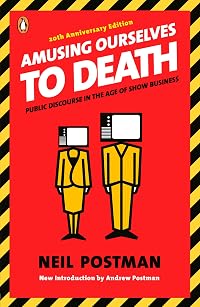
Amusing Ourselves to Death: Public Discourse in the Age of Show Business
by Neil Postman
On This Page
Description
In this eloquent and persuasive book, Neil Postman examines the deep and broad effects of television culture on the manner in which we conduct our public affairs, and how "entertainment values" have corrupted the very way we think. As politics, news, religion, education, and commerce are given less and less expression in the form of the printed word, they are rapidly being reshaped to suit the requirements of television. And because television is a visual medium, whose images are most show more pleasurably apprehended when they are fast-moving and dynamic, discourse on television has little tolerance for argument, hypothesis, or explanation. Postman argues that public discourse-the advancing of arguments in logical order for the public good, once a hallmark of American culture-is being converted from exposition and explanation to entertainment. show lessTags
Recommendations











Member Recommendations
chiudrele Explains how today's world of internet is different from the old world of television. Society is not merely consuming information and culture, it can also participate in creation of it.
themulhern Stephenson himself remarked that Anathem was a book about how people don't read books anymore. Moreover, there is a delightfully satirical sequence in which the characters are discussing serious things over food at a rest stop, and the narrator is repeatedly distracted by images on the speelies that are incoherent yet commanding. Later, the protagonist realizes that one of these images was relevant, and there is another bit of satire.
themulhern There is a surprising amount of overlap between the views of the news that both books have.
11

themulhern Neil Postman's book is so much better, but Matt Taibibi's is so much more recent. Neil Postman is more interesting, more educated, and avoids the wierd cheap shots and obscenities directed at person's I've never heard of that Matt Taibibi enjoys. I guess Taibibi's is worth it for the supporting facts, which apparently he has the inside scoop on.
themulhern Feynman and Postman shared a great wariness and dislike of pseudoscience, which Postman called Scientism.
Member Reviews
This book, originally published in 1985, warns against the proliferation of television media replacing printed texts. Much of Postman’s case comes across as a tome against television and cites renowned authors like Aldous Huxley and Marshall McLuhan in support of his thesis. However, 35-40 years after its original publishing, it’s easy to see how digital media (i.e., the computer and the Internet) have continued to revolutionize America’s information intake. Our goal now is simply to keep up with the “fire hydrant” of information output instead of merely choosing one technology over another. Yes, the goal is simply to learn and retain from all media instead of to privilege one over the other. In this sense, the book falls show more sorely short of anticipating future conundrums.
Postman rightly observes how television media tends to put us to sleep instead of making us engaged learners. That’s why I am still a passionate advocate of book learning. His emphasis on understanding the forms of media is likewise appreciated. However, Postman idealizes a past age (in the 1800s) when books and newspapers were the main/only form of educational technology. He sees this as a golden age that we need to return to. He forgets how much rote memorization was required then in education and how social inequities like slavery, discrimination, and a lack of women’s suffrage persisted in that age. Technology also has its benefits – say, speeding up social economies, which produces greater wealth.
Postman’s basic premise is that television is bad and traditional reading is good. This is a false dichotomy, I suggest. While I wholeheartedly support becoming aware of pro’s and con’s of various forms of media, the challenge becomes to learn to learn from all forms of media. When learning itself becomes a passion, it ultimately selects between forms of media appropriately. A “culture war” against one form of media – which is what Postman seems to suggest – distracts from the point. I’m not sure how his thesis would have been received in 1985, but in 2022, “the age of show business” has become the “information age.” New challenges of a hyper-connected world confront us. This book, for all its timeliness in the 1980s, does not predict these future challenges. I still suggest reading McLuhan (an author Postman relies upon) instead of this work for a more universal paradigm of media. show less
Postman rightly observes how television media tends to put us to sleep instead of making us engaged learners. That’s why I am still a passionate advocate of book learning. His emphasis on understanding the forms of media is likewise appreciated. However, Postman idealizes a past age (in the 1800s) when books and newspapers were the main/only form of educational technology. He sees this as a golden age that we need to return to. He forgets how much rote memorization was required then in education and how social inequities like slavery, discrimination, and a lack of women’s suffrage persisted in that age. Technology also has its benefits – say, speeding up social economies, which produces greater wealth.
Postman’s basic premise is that television is bad and traditional reading is good. This is a false dichotomy, I suggest. While I wholeheartedly support becoming aware of pro’s and con’s of various forms of media, the challenge becomes to learn to learn from all forms of media. When learning itself becomes a passion, it ultimately selects between forms of media appropriately. A “culture war” against one form of media – which is what Postman seems to suggest – distracts from the point. I’m not sure how his thesis would have been received in 1985, but in 2022, “the age of show business” has become the “information age.” New challenges of a hyper-connected world confront us. This book, for all its timeliness in the 1980s, does not predict these future challenges. I still suggest reading McLuhan (an author Postman relies upon) instead of this work for a more universal paradigm of media. show less
Dated in a chilling way. Postman's central thesis that television is/was the dominant medium of the late 20th century is quaint because it's half right: literacy and engagement through the written word are dead; but television's reign would be a short one.
But the issues he predicted: demogauguery, disinformation, and detachment are absolutely the central problems of the modern age that tv helped build.
But the issues he predicted: demogauguery, disinformation, and detachment are absolutely the central problems of the modern age that tv helped build.
I can't believe this was published almost 40 years ago. The introduction said it better than I could: "This is a 21st-century book published in the 20th century." Amusing Ourselves to Death is a clarion call to the inherent civic dangers when the written word is no longer the primary medium of expression. Postman argues that when we turn towards the segmented and corporate television set, not only is our society's conversational and debate ability suffer, it changes the literal makeup of thought. It's eerily prescient in a day of all-consuming social media and a sizable amount of the country addicted to TikTok, somehow an even more dystopian iteration of the moving image.
I didn't think this book would be as good as it was: it's show more coherently structured, based on strong historical reasoning, and generally very well-written. Not only that, but it's comfortable to read. While a bit dense, it feels like eating your grandmother's kitchen-sink stew: not always easy to get down, but so, so good for you. show less
I didn't think this book would be as good as it was: it's show more coherently structured, based on strong historical reasoning, and generally very well-written. Not only that, but it's comfortable to read. While a bit dense, it feels like eating your grandmother's kitchen-sink stew: not always easy to get down, but so, so good for you. show less
Great book, amazingly prescient for its time (written in the mid-1980s).
Touches on lots of different ideas and themes around public discourse. My favorite is how the age of the telegraph and beyond basically created what we call "news"... information that doesn't affect our daily lives and that we have nothing we can do about it/with it, but is delivered to us anyways because that's what the medium does.
It's basically a more in-depth version of "Society of the Spectacle".
My one complaint is that the first part of the book is devoted to a mythologized "age of reason" which was during the height of the printing press, just pre-telegraph. Back then, public discourse was based on the written word rather than on image, and the author argues show more this makes for better public discourse.
I disagree. This was the height of colonialism, with elaborate-reasoned justifications around the world for mass-scale atrocities. Having well-reasoned arguments does not make them better than, say, compelling visual arguments. You can create a well-reasoned document justifying the Vietnam war, and can counter with 3 minutes of real-life war footage and have the latter be better than the former. I think the only difference is that we've been taught the ins-and-outs of reasoned discourse in school, so we can understand, critique and deconstruct it better. We generally haven't been taught the ins-and-outs of visual media (like TV), so we can't talk about it in the same way.
In the end, the best way to deal with new media (TV, Twitter, YouTube) is with better media literacy, which is actually the exact thing the author advocates show less
Touches on lots of different ideas and themes around public discourse. My favorite is how the age of the telegraph and beyond basically created what we call "news"... information that doesn't affect our daily lives and that we have nothing we can do about it/with it, but is delivered to us anyways because that's what the medium does.
It's basically a more in-depth version of "Society of the Spectacle".
My one complaint is that the first part of the book is devoted to a mythologized "age of reason" which was during the height of the printing press, just pre-telegraph. Back then, public discourse was based on the written word rather than on image, and the author argues show more this makes for better public discourse.
I disagree. This was the height of colonialism, with elaborate-reasoned justifications around the world for mass-scale atrocities. Having well-reasoned arguments does not make them better than, say, compelling visual arguments. You can create a well-reasoned document justifying the Vietnam war, and can counter with 3 minutes of real-life war footage and have the latter be better than the former. I think the only difference is that we've been taught the ins-and-outs of reasoned discourse in school, so we can understand, critique and deconstruct it better. We generally haven't been taught the ins-and-outs of visual media (like TV), so we can't talk about it in the same way.
In the end, the best way to deal with new media (TV, Twitter, YouTube) is with better media literacy, which is actually the exact thing the author advocates show less
This book makes two good points: the media used to communicate affects the nature of the communication, and much of modern communication on serious matters is frivolous.
That covers the first part of the book. The rest is a tiresome rant about how TV is ruining us all. The details of the rant are not worth covering, but I do think that Postman misses some important points. First, he never looks to see if there is any good in a visual based communication style. It is true, as he states, that a medium such as television emphasizes emotional impact over rational argument, but emotion can be a powerful motivator. An image of the damage from an earthquake or a hurricane can inspire someone to help when a description of the damage may not. show more Even on a rational level, a picture can be worth a thousand words as anyone who has ever tried to learn knitting can tell you.
Postman only gives the slightest of nods to the fact that textual communication can also be banal. See your favorite social network for more details.
A better approach than Postman's, which declares that TV is bad and text is good, is to realize that different communication mediums have different strengths and weaknesses. Television is excellent at providing entertainment, but that is not the only thing it is good for. No media should be the only mode of discourse. Ideally, they should be used to support and reinforce each other. show less
That covers the first part of the book. The rest is a tiresome rant about how TV is ruining us all. The details of the rant are not worth covering, but I do think that Postman misses some important points. First, he never looks to see if there is any good in a visual based communication style. It is true, as he states, that a medium such as television emphasizes emotional impact over rational argument, but emotion can be a powerful motivator. An image of the damage from an earthquake or a hurricane can inspire someone to help when a description of the damage may not. show more Even on a rational level, a picture can be worth a thousand words as anyone who has ever tried to learn knitting can tell you.
Postman only gives the slightest of nods to the fact that textual communication can also be banal. See your favorite social network for more details.
A better approach than Postman's, which declares that TV is bad and text is good, is to realize that different communication mediums have different strengths and weaknesses. Television is excellent at providing entertainment, but that is not the only thing it is good for. No media should be the only mode of discourse. Ideally, they should be used to support and reinforce each other. show less
A perceptive look at US popular media - predominantly television - dating from 1985, though still relevant more than thirty years later. It takes only a very small adjustment of the imagination to add social media to the analysis, and that analysis still comes up strong.
We are more fortunate in the UK (in that we have the BBC, which by not taking advertising does not have to chase the ratings and the eight-minute attention span to the same degree), but we cannot afford complacency. Much of what is in this book I can see in our own media.
Equally, there are other voices in America who are aware of this problem and work against it. But they are a minority.
Interestingly, I'm re-watching 'Battlestar Galactica' (the re-boot) at the moment. It show more is a well-crafted show, with good plots (at least, until it got to the point where the show-runners ran out of ideas and began making stuff - especially mystical stuff - up as they went along), an interesting premise and a range of issues. But I notice two things about it: 1) episodes are shorter than their equivalents for 'Star Trek' or 'Babylon 5', reflecting longer advert breaks; and (perhaps more importantly), 2) by the story being set in a non-Earth society, the cultural references that the other shows inserted in the scripts - because Roddenberry and Straczinski are/were themselves educated people who wanted to share that education - are not present. The earlier shows 'sneaked' references into their stories that would take the inquisitive viewer into a wider world of cultural exposure; but by the opening of the 21st century, a science fiction show like 'Galactica' that was complex and demanding in terms of its narrative no longer felt a need to expand its viewers' consciousnesses as well. Postman's hypothesis wins out in the end, it seems.
We see the eight-minute attention span reflected in documentaries in the UK as well - sometimes even in BBC documentaries that are intended to be sold abroad, as they have to conform to a commercial tv pattern (watching popular BBC documentary shows, I can often pick out where the adverts will go when the show is re-broadcast on a commercial channel). On completely commercially-originated documentaries, this is reflected in the recapitulation of "the story so far" when the show comes back after the commercial break.
I found the chapter on US tele-evangelism very interesting. It suggests one reason why Islam is mis-represented so much in mainstream media, because (on my reading), the messages of Islam do not suggest ways of making yourself feel good, but in doing the right thing. And that can't be reduced to an eight-minute sound-bite that reinforces other, less spiritual messages that the medium wants to promote at the same time.
I'd like to think that UK audiences are sufficiently sophisticated to spot these sort of issues. (Perhaps one reason why there are segments of the UK political world who decry college and university 'media studies' courses, because those courses enable those who have done them to analyse and deconstruct what they are seeing.) (Hopefully.) In a way, the book has told me nothing I didn't already know, but it put it in a context of the development of US television media. The lessons it gives us are equally important for the digital media age. I see just the same forces working in social media to say "Look over here at THIS" so as to direct attention away from THAT. My one concern is that the book preaches somewhat to the converted, though by spreading the word, the message can sometimes get to new ears.
Otherwise, we shall end up in the world of 'Fahrenheit 451'; and occasionally, I see the underlying ideology of that world - "books are dangerous because they make you feel your own reactions to what you see, rather than what you are required to feel and think' - trying very hard to break through into our reality. show less
We are more fortunate in the UK (in that we have the BBC, which by not taking advertising does not have to chase the ratings and the eight-minute attention span to the same degree), but we cannot afford complacency. Much of what is in this book I can see in our own media.
Equally, there are other voices in America who are aware of this problem and work against it. But they are a minority.
Interestingly, I'm re-watching 'Battlestar Galactica' (the re-boot) at the moment. It show more is a well-crafted show, with good plots (at least, until it got to the point where the show-runners ran out of ideas and began making stuff - especially mystical stuff - up as they went along), an interesting premise and a range of issues. But I notice two things about it: 1) episodes are shorter than their equivalents for 'Star Trek' or 'Babylon 5', reflecting longer advert breaks; and (perhaps more importantly), 2) by the story being set in a non-Earth society, the cultural references that the other shows inserted in the scripts - because Roddenberry and Straczinski are/were themselves educated people who wanted to share that education - are not present. The earlier shows 'sneaked' references into their stories that would take the inquisitive viewer into a wider world of cultural exposure; but by the opening of the 21st century, a science fiction show like 'Galactica' that was complex and demanding in terms of its narrative no longer felt a need to expand its viewers' consciousnesses as well. Postman's hypothesis wins out in the end, it seems.
We see the eight-minute attention span reflected in documentaries in the UK as well - sometimes even in BBC documentaries that are intended to be sold abroad, as they have to conform to a commercial tv pattern (watching popular BBC documentary shows, I can often pick out where the adverts will go when the show is re-broadcast on a commercial channel). On completely commercially-originated documentaries, this is reflected in the recapitulation of "the story so far" when the show comes back after the commercial break.
I found the chapter on US tele-evangelism very interesting. It suggests one reason why Islam is mis-represented so much in mainstream media, because (on my reading), the messages of Islam do not suggest ways of making yourself feel good, but in doing the right thing. And that can't be reduced to an eight-minute sound-bite that reinforces other, less spiritual messages that the medium wants to promote at the same time.
I'd like to think that UK audiences are sufficiently sophisticated to spot these sort of issues. (Perhaps one reason why there are segments of the UK political world who decry college and university 'media studies' courses, because those courses enable those who have done them to analyse and deconstruct what they are seeing.) (Hopefully.) In a way, the book has told me nothing I didn't already know, but it put it in a context of the development of US television media. The lessons it gives us are equally important for the digital media age. I see just the same forces working in social media to say "Look over here at THIS" so as to direct attention away from THAT. My one concern is that the book preaches somewhat to the converted, though by spreading the word, the message can sometimes get to new ears.
Otherwise, we shall end up in the world of 'Fahrenheit 451'; and occasionally, I see the underlying ideology of that world - "books are dangerous because they make you feel your own reactions to what you see, rather than what you are required to feel and think' - trying very hard to break through into our reality. show less
Distraction & Media
Postman’s warnings from over 30 years ago seem even more relevant today. He predicted that society would succumb not to censorship but to distraction. The current media landscape proves him right, as viral trends and 24-hour news cycles overshadow critical issues.
Take the ongoing climate crisis, for example. Discussions about long-term solutions often take a backseat to fleeting controversies or celebrity-driven headlines. During the COVID-19 pandemic, essential public health messages competed with sensationalized political conflicts, creating confusion and mistrust. Audiences struggled to separate credible information from spin and fragmented messaging, eroding public trust.
Postman also warned that distraction show more could be as dangerous as suppression. Today, our media environment prioritizes immediacy over accuracy, leaving audiences overwhelmed and under-informed. show less
Postman’s warnings from over 30 years ago seem even more relevant today. He predicted that society would succumb not to censorship but to distraction. The current media landscape proves him right, as viral trends and 24-hour news cycles overshadow critical issues.
Take the ongoing climate crisis, for example. Discussions about long-term solutions often take a backseat to fleeting controversies or celebrity-driven headlines. During the COVID-19 pandemic, essential public health messages competed with sensationalized political conflicts, creating confusion and mistrust. Audiences struggled to separate credible information from spin and fragmented messaging, eroding public trust.
Postman also warned that distraction show more could be as dangerous as suppression. Today, our media environment prioritizes immediacy over accuracy, leaving audiences overwhelmed and under-informed. show less
Members
- Recently Added By
Published Reviews
ThingScore 75
A lucid and very funny jeremiad about how public discourse has been degraded.
added by ArrowStead
He starts where Marshall McLuhan left off, constructing his arguments with the resources of a scholar and the wit of a raconteur.
added by ArrowStead
A brilliant, powerful and important book...This is a brutal indictment Postman has laid down and, so far as I can see, an irrefutable one.
added by ArrowStead
Lists

why the internet makes us dumb
7 works; 1 member

Bret Victor's Five-Star List
46 works; 5 members

Alan Kay's Reading List
103 works; 3 members

Books worth rereading
21 works; 1 member

Book wishlist
78 works; 1 member

Read For Your Life
157 works; 1 member

2024-2025 Ezra Klein Guest Recommendations
213 works; 6 members

Books That Changed Our Perspective
423 works; 168 members

Blindpill
20 works; 2 members

Books Read in 2010
631 works; 11 members
Books Incorrectly Categorized by Libraries as YA Books
1 work; 1 member

Shaykh Hamza's Book Recommendations
439 works; 3 members
Recommended Non-Fiction Books
26 works; 2 members
culture
320 works; 1 member

Books I've Read
40 works; 2 members

The Joe Rogan Experience Library
254 works; 3 members

History is a Weapon Recommended Reading List
43 works; 3 members

GreatBooks Worldview Academy Lists
133 works; 4 members
Sycamore Baptist Church Book Study Reading List
156 works; 5 members

The Five Books That Represent Us
391 works; 148 members
Author Information

32+ Works 12,872 Members
Born in Brooklyn, New York, and educated at the State University of New York and Columbia University, Neil Postman is a communications theorist, educator, and writer who has been deeply involved with the issue of the impact of the media and advanced communications technology on American culture. In his many books, Postman has strongly opposed the show more idea that technology will "save" humanity. In fact, he has focused on the negative ways in which television and computers alter social behavior. In his book Technopoly, Postman argues that the uncontrolled growth of technology destroys humanity by creating a culture with no moral structure. Thus, technology can be a dangerous enemy as well as a good friend. Postman, who is married and has three children, currently is a professor of media ecology at New York University and editor of Et Cetera, the journal of general semantics. In addition to his books, he has contributed to various magazines and periodicals, including Atlantic and The Nation. He has also appeared on the television program Sunrise Semester. Postman is the holder of the Christian Lindback Award for Excellence in Teaching from New YorkUniversity. (Bowker Author Biography) show less
Some Editions
Awards and Honors
Series
Belongs to Publisher Series
Common Knowledge
- Canonical title
- Amusing Ourselves to Death: Public Discourse in the Age of Show Business
- Original title
- Amusing Ourselves to Death
- Alternate titles*
- 娛樂至死:追求表象、歡笑和激情的電視時代
- Original publication date
- 1985
- First words
- We were keeping our eye on 1984.
- Quotations
- You may get a sense of what is meant by context-free information by asking yourself the following question: How often does it occur that information provided you on morning radio or television, or in the morning newspaper, ca... (show all)uses you to alter your plans for the day, or to take some action you would not otherwise have taken, or provides insight into some problem you are required to solve?
Contrary to common belief even among the educated, Huxley and Orwell did not prophesy the same thing. Orwell warns that we will be overcome by an externally imposed oppression. But in Huxley's vision, no Big Brother is requir... (show all)ed to deprive people of their autonomy, maturity, and history. As he saw it, people will come to love their oppression, to adore the technologies that undo their capacity to think.
American businessmen discovered, long before the rest of us, that the quality and usefulness of their goods are subordinate to the artifice of their display; that, in fact, half the principles of capitalism as praised by Adam... (show all) Smith or condemned by Karl Marx are irrelevant.
We are all, as Huxley says someplace, Great Abbreviators, meaning that none of us has the wit to know the whole truth, the time to tell it if we believed we did, or an audience so gullible as to accept it.
The news of the day is a figment of our technological imagination. It is, quite precisely, a media event.
Voting, we might even say, is the next to last refuge of the politically impotent. The last refuge is, of course, giving your opinion to a pollster, who will get a version of it through a desiccated question, and then will su... (show all)bmerge it in a Niagara of similar opinions, and convert them into—what else?—another piece of news. Thus, we have here a great loop of impotence: The news elicits from you a variety of opinions about which you can do nothing except to offer them as more news, about which you can do nothing. - Last words
- (Click to show. Warning: May contain spoilers.)For in the end, he was trying to tell us that what afflicted the people in Brave New World was not that they were laughing instead of thinking, but that they did not know what they were laughing about and why they had stopped thinking.
- Canonical DDC/MDS
- 302.234
- Canonical LCC
- P94.P63
*Some information comes from Common Knowledge in other languages. Click "Edit" for more information.
Classifications
- Genres
- Sociology, General Nonfiction, Nonfiction, Technology
- DDC/MDS
- 302.234 — Society, government, & culture Social sciences, sociology & anthropology Mass Communication & Media Communication Media (Means of communication) Motion pictures, radio, television
- LCC
- P94 .P63 — Language and Literature Philology. Linguistics Communication. Mass media Interpersonal communication
- BISAC
Statistics
- Members
- 6,479
- Popularity
- 1,885
- Reviews
- 92
- Rating
- (4.12)
- Languages
- 17 — Catalan, Czech, Danish, Dutch, English, Finnish, French, German, Italian, Norwegian (Bokmål), Norwegian, Polish, Romanian, Spanish, Swedish, Turkish, Chinese, traditional
- Media
- Paper, Audiobook, Ebook
- ISBNs
- 44
- ASINs
- 21