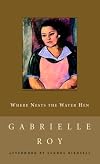
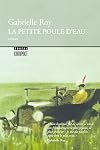
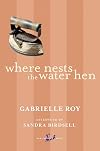
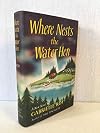
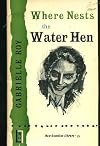
Where Nests the Water Hen
by Gabrielle Roy
On This Page
Description
The story of Where Nests the Water Hen is as pure as the lives of the people in it – and as unforgettable. Set in the remote wilderness of northern Manitoba, this sunny, tender idyll of daily frontier life captures, as few novels ever have, the spirit and the surroundings of the pioneers – not the adventurers and trailblazers who make the headlines, but rather the humble folk who follow after and remain, living out their lives in obscurity to keep the trails open. Where Nests the Water show more Hen, Gabrielle Roy’s second novel, is a sensitive and sympathetic tale that captures both the innocence and the vitality of a sparsely populated frontier. show lessTags
Recommendations























Member Recommendations

Member Reviews
Roy's love for this remote (at least at her time) corner of Manitoba shines through this little book. She spent one summer teaching there in the 1930s and it must have made a profound impression on her.
The Tousignants lived on an island on the Little Waterhen River. M. Tousignant managed a ranch for a Rorketon businessman. They were the sole human inhabitants of the island but their number increased almost every year when Mme Tousignant had another baby. She travelled to Ste. Rose du Lac to have the child each time and she referred to this trip as her holiday. She was concerned that her children were growing up without any education. At her husband's suggestion she wrote to the Department of Education and they replied that they would show more pay for a teacher to come from May through October providing there were at least 6 school age children and that there was a school house. The Tousignants could provide the requisite number of children and they built the school house. As promised Mlle Côté showed up one day having taken the train to Dauphin, changed to the local train to Rorketon making sure to arrive on a Thursday so she could get a ride with the postman who travelled from Rorketon to Portage des Prés. From there she would had to journey with another postman to a spot where she could be ferried across the Big Waterhen and Little Waterhen Rivers. Under her tutelage the young Tousignants quickly learned their lessons. She made such an impression that many of the Tousignant youngsters went away to continue their education as teachers and nurses and doctors. Their mother was proud of them but missed them as well. Life on the island in the Little Waterhen River was very secluded especially in the harsh winter months. During the better summer weather there might be a few visitors. The best time was when the Capuchin monk made his annual visit to say mass and hear confession. One chapter of this book is devoted to the Capuchin monk and it is fascinating in itself.
It is amazing that less than 80 years ago life in Manitoba could be so constrained by the elements and geography. Roy did a great service to capture this time and place for all to read. show less
The Tousignants lived on an island on the Little Waterhen River. M. Tousignant managed a ranch for a Rorketon businessman. They were the sole human inhabitants of the island but their number increased almost every year when Mme Tousignant had another baby. She travelled to Ste. Rose du Lac to have the child each time and she referred to this trip as her holiday. She was concerned that her children were growing up without any education. At her husband's suggestion she wrote to the Department of Education and they replied that they would show more pay for a teacher to come from May through October providing there were at least 6 school age children and that there was a school house. The Tousignants could provide the requisite number of children and they built the school house. As promised Mlle Côté showed up one day having taken the train to Dauphin, changed to the local train to Rorketon making sure to arrive on a Thursday so she could get a ride with the postman who travelled from Rorketon to Portage des Prés. From there she would had to journey with another postman to a spot where she could be ferried across the Big Waterhen and Little Waterhen Rivers. Under her tutelage the young Tousignants quickly learned their lessons. She made such an impression that many of the Tousignant youngsters went away to continue their education as teachers and nurses and doctors. Their mother was proud of them but missed them as well. Life on the island in the Little Waterhen River was very secluded especially in the harsh winter months. During the better summer weather there might be a few visitors. The best time was when the Capuchin monk made his annual visit to say mass and hear confession. One chapter of this book is devoted to the Capuchin monk and it is fascinating in itself.
It is amazing that less than 80 years ago life in Manitoba could be so constrained by the elements and geography. Roy did a great service to capture this time and place for all to read. show less
Set in Northern Manitoba, a quiet and evocative book. This is the only book by Gabrielle Roy I've read--she's perhaps best known for 'The Tin Flute'. I rarely see her books here in the US, but if you walk into a Canadian bookstore, you'll see a long shelf. Makes you realize how many authors we miss out on!
Obviously - only three stars - I did not like this book nearly as much as I did Roy's first novel, THE TIN FLUTE. It started out well enough, with its colorful description of life on the Manitoba muskeg frontier and the large French-Canadian brood of heroine Luzina Tousignant and her stolid workhorse husband Hippolyte. But then, about two-thirds of the way through WHERE NESTS THE WATER HEN, Roy seems to lose focus, makes a 180-degree turn, and begins to tell the story of the old itinerant Capuchin missionary priest. This abrupt change of protagonist never quite worked for me, even when Roy brings the priest finally around to the Tousignant outpost, throwing in too a flashback to earlier times in the family story. While the priest was an show more interesting enough character, I would have preferred to hear the rest of Luzina's story, because she was what really held it all together - or should have. While I still wouldn't hesitate to recommend THE TIN FLUTE, this second book was something of a disappointment, so I probably won't bother to read any more of Roy's stuff, famous though she may have been in Canada. show less
First published in 1951 as La Petite Poule d’Eau, this is Roy’s beautiful evocation of frontier life in Northern Manitoba. Partially autobiographical, the story features a young woman sent to home-school a family in a remote district of the province. Often compared to Willa Cather, Roy takes a compassionate, non-judgmental view of her characters.
Luzina lives in a small community in Northern Manitoba in the 1930s(?). She has 10 children (by the end of the book, anyway). Her husband builds a school, but it is mostly their children who are of the age and close enough to attend, but there are enough of the kids to be able to bring in a teacher – at least for a few years. It is a new teacher each year, but Luzina’s kids are enjoying learning.
This was slow moving, but ok. I don’t like super-long paragraphs, though, and unfortunately, there were many of those (mass market paperback size and some of the paragraphs came close to a full page!). There was a section just past the middle of the book (maybe one chapter or so? But I didn’t know if it would continue to the end or not) show more that focused on the priest, whom they called the Capuchin. I didn’t find that part as interesting, but it did bring in a few more characters. Luzina and her family are French-speaking, but there were also “Indians” and “halfbreeds” closeby, as well as Ukrainians and English people. Apparently the book was based on the author teaching in that area of Manitoba (as mentioned in the afterword by another Canadian author, also from Manitoba, I believe). show less
This was slow moving, but ok. I don’t like super-long paragraphs, though, and unfortunately, there were many of those (mass market paperback size and some of the paragraphs came close to a full page!). There was a section just past the middle of the book (maybe one chapter or so? But I didn’t know if it would continue to the end or not) show more that focused on the priest, whom they called the Capuchin. I didn’t find that part as interesting, but it did bring in a few more characters. Luzina and her family are French-speaking, but there were also “Indians” and “halfbreeds” closeby, as well as Ukrainians and English people. Apparently the book was based on the author teaching in that area of Manitoba (as mentioned in the afterword by another Canadian author, also from Manitoba, I believe). show less
What a joy. Now I wish to reread it in its proper language--French.
Ratings
Members
- Recently Added By
Lists

New Canadian Library
191 works; 7 members

Books Set in Canada
57 works; 10 members

Best Books set in Manitoba
85 works; 2 members

Books With the Most Memorable Titles
478 works; 158 members

Top Five Books of 2023
767 works; 317 members

Books We Love to Reread
695 works; 298 members

Favorite Books in Translation
320 works; 133 members

Our Favorite Comfort Reads
334 works; 200 members

Canadian Historical Fiction 🇨🇦
157 works; 8 members

Fiction With Familiar Settings
280 works; 94 members
Author Information

33+ Works 2,045 Members
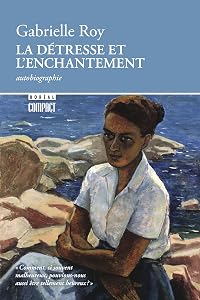
Gabrielle Roy was born on March 22, 1909 in St. Boniface, Manitoba, Canada. She attended the Winnipeg Normal Institute, where she earned top honors in both her English and French classes. After she completed her schooling, she spent a month teaching in the summer before accepting a job at a school for a year. In 1930, after that first year of show more teaching, she was offered a permanent position in St. Boniface. Roy decided that she wanted to go to Europe for a year with the meagre savings she had managed to accumulate throughout her seven years teaching in St. Boniface. When asked, she would tell people that she was going to France and England to study Drama. She had been a member of a drama troupe, Le Cercle Molière, throughout her teaching years. Once there, she took a teaching post in the summer of 1937 to gain enough to survive in Europe. She had planned to only stay a year, but that turned into two, and would have been longer if not for the outbreak of World War II. It was here that Roy began to write, and published a few articles in a French journal. Roy returned to Canada and made her home in Montreal where for six years she earned a living as a freelance reporter. Her first novel, Bonheur d'Occasion started out as a newspaper article and turned into a novel over 800 pages long. It was published in 1945. In 1947, she won the Prix Fémina from France for Bonheur d'Occasion, and the Governor General's award for the English translation, The Tin Flute. She returned to France, to the place that had originally inspired her writing and in 1950 published La Petite Poule d'Eau (Where Nests the Water Hen), after her return to Canada. 1957 also brought Roy her second Governor General's award, this time for the English translation of Rue Deschambault (Street of Riches), a novel she published in 1955. For the next several years, Roy received many awards as well as critical success, but it was not until 1978 that she won her third and final Governor General's award for Ces Enfants de Ma Vie (Children of My Heart). This was her final novel, although a compilation of some of her work as a journalist, and several children's books followed this last book. Roy's autobiography La Détresse et l'Enchantement (Enchantment and Sorrow) was not published until 1984, a year after her death. Gabrielle Roy died on July 13, 1983 of heart failure. (Bowker Author Biography) show less
Some Editions
Series
Belongs to Publisher Series
New Canadian Library (25)
Common Knowledge
- Canonical title
- Where Nests the Water Hen
- Original title
- La petite poule d'eau : roman
- Original publication date
- 1950
- Important places
- Québec, Canada; Canada; Manitoba, Canada
Classifications
Statistics
- Members
- 154
- Popularity
- 213,544
- Reviews
- 6
- Rating
- (4.14)
- Languages
- English, French
- Media
- Paper, Ebook
- ISBNs
- 11
- ASINs
- 13