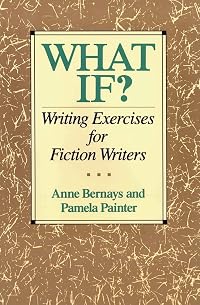
What If? Writing Exercises for Fiction Writers
by Anne Bernays, Pamela Painter
On This Page
Description
Organized by the elements of fiction and comprised primarily of writing exercises, this text helps students hone and refine their craft with a practical, hands-on approach to writing fiction.Tags
Recommendations

Member Reviews
Different from most writing books, this is - basically - nothing but writing exercises, intended to help with particular parts of writing. I like the layout, organised roughly into categories, and it’s intended to be something to dip into, for inspiration and ideas. I thought I’d work through this one and began, six months ago, by doing some of the exercises. However I didn't feel able to make the time and abandoned it for a while, then recently read the rest of the book, looking at the exercises and thinking that I might get back to them one day.
There are lots of good points made in the book to illustrate what the exercises are about. The writing prompts encourage the reader to be creative and without necessarily leading to show more anything longer. There are exercises for honing stories that exist already, for picking out features of other people’s writing, and for trying new techniques. In many of the sections there examples given of student responses to the exercises, done in writing workshops.
The authors are themselves writing coaches as well as writers, and I thought this was an excellent resource, even though I didn't make full use of it. I hope to return to it, however, and dip into it in the future.
Recommended. show less
There are lots of good points made in the book to illustrate what the exercises are about. The writing prompts encourage the reader to be creative and without necessarily leading to show more anything longer. There are exercises for honing stories that exist already, for picking out features of other people’s writing, and for trying new techniques. In many of the sections there examples given of student responses to the exercises, done in writing workshops.
The authors are themselves writing coaches as well as writers, and I thought this was an excellent resource, even though I didn't make full use of it. I hope to return to it, however, and dip into it in the future.
Recommended. show less
I haven’t finished this in its entirety, but it will remain a great resource on my shelf for getting me out of a rut, considering problems with my writing, generating fresh material. I can open it to any page and be handed some thoughtful concepts, useful exercises, and inspiring quotes from established authors.
I haven’t finished this in its entirety, but it will remain a great resource on my shelf for getting me out of a rut, considering problems with my writing, generating fresh material. I can open it to any page and be handed some thoughtful concepts, useful exercises, and inspiring quotes from established authors.
In 83 lessons organized into 12 section Bernays and Painter offer advice and suggest activities designed for students and beginning writers. More experienced writers will benefit from the review materials in this book as well.
Readers will find the sections differ in their importance. How to begin a story (Beginnings) and the usefulness of Notebooks, Journals, and Memory will most likely be informative only to those early in their writing career. Beginning writers may also find the inclusion of games and the instruction to learn from the greats to be useful. For more advanced writers the reviews provided by topics such as characterization, perspective and point of view, dialogue, plot and (the potpourri included under the heading) show more mechanics are likely to be useful despite.
The coverage of each topic generally begins with a short explanation of the essential point. That is followed with an exercise that allows readers to practice the skills and techniques just described. This is the weakest part of the book and I was not moved to attempt most of them. Greater thought in crafting more interesting and practical exercises would improve “What If?” greatly. Most of the chapters conclude with examples that depict student’s responses to the exercise. Reading these examples was the most interesting and fun part of the book.
I found this “What If?” to be useful despite my many years of experience as a writer. show less
Readers will find the sections differ in their importance. How to begin a story (Beginnings) and the usefulness of Notebooks, Journals, and Memory will most likely be informative only to those early in their writing career. Beginning writers may also find the inclusion of games and the instruction to learn from the greats to be useful. For more advanced writers the reviews provided by topics such as characterization, perspective and point of view, dialogue, plot and (the potpourri included under the heading) show more mechanics are likely to be useful despite.
The coverage of each topic generally begins with a short explanation of the essential point. That is followed with an exercise that allows readers to practice the skills and techniques just described. This is the weakest part of the book and I was not moved to attempt most of them. Greater thought in crafting more interesting and practical exercises would improve “What If?” greatly. Most of the chapters conclude with examples that depict student’s responses to the exercise. Reading these examples was the most interesting and fun part of the book.
I found this “What If?” to be useful despite my many years of experience as a writer. show less
While I found the prompts interesting, the sample exercises were all from student work, which I didn't find inspiring to read. Almost all of the exercises were aimed at realistic fiction or personal essays, so if you're writing genre fiction you have to rethink them to make them helpful.
Wonderful book for the "stuck" fiction writer who needs help curing chronic or acute writer's block. The prompts are divers and creative.
This book is organized somewhat thematically and includes both exercises and responses to the exercises so you can get inspiration from what others have written. I recommend it for those looking to sharpen their skills with regard to particular aspects of writing. Larger-scale writing issues like plotting or novel organization aren't really addressed, but as a whole, this is a good tool to keep around for when inspiration is lacking.
Members
- Recently Added By
Lists

Best Books on Writing for Writers
36 works; 19 members

Creativity and the Creative Process
20 works; 4 members
Author Information

6+ Works 1,136 Members
Pamela Painter teaches in the Writing, Literature, and Publishing Program at Emerson College.
Common Knowledge
- Canonical title
- What If? Writing Exercises for Fiction Writers
- Original publication date
- 1990
- Dedication
- To Our Students
- First words
- ANNE BERNAYS: To be a good writer you must know how to do two very different things--write like a writer and think like one.
Classifications
- DDC/MDS
- 808.066813 — Literature & rhetoric Literature, rhetoric & criticism Rhetoric and collections of literary texts from more than two literatures Rhetoric and anthologies By Type Of Writing Writing non-fiction (by topic) Writing about literature
- LCC
- PE1413 .B47 — Language and Literature English language English Modern English
- BISAC
Statistics
- Members
- 1,116
- Popularity
- 22,667
- Reviews
- 10
- Rating
- (3.81)
- Languages
- Czech, English, German
- Media
- Paper
- ISBNs
- 10
- ASINs
- 11
