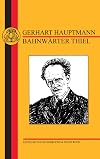
Flagman Thiel
by Gerhart Hauptmann
On This Page
Description
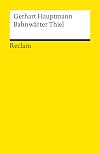
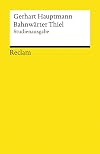
"Bahnw¿rter Thiel" (1988), by far the best story ever written by Gerhart Hauptmann, follows the principles of the Naturalist movement in its detailed study of the life and milieu of a humble and apparently unexceptional Prussian railwayman. Yet in its exploitation of symbolism, of techniques sometimes close to Impressionism, and in its subtle use of a changing narrative perspective, this Novelle goes beyond the essentially 'scientific' Naturalist approach: Hauptmann thus succeeds in show more exploring the complex interaction of suppressed social, psychological, physiological, and religious impulses far better than in any other work of this era. This new edition has been prepared with the changing needs of the today's learners and students of German in mind. The late S.D. Stirk's scholarly edition of 1952, which also included "Fasching", has seen sterling service, and we are greatly indebted to it. However, by concentrating on just one story, we have been able to offer more linguistic help in the notes and vocabulary, as well as devoting considerably more space in the introduction to detailed comments on characterisation and technique. References to other works and to other periods of Hauptmann's long career as a writer have been kept to a minimum. show lessTags
Recommendations



































Member Recommendations

Member Reviews
Hauptmann was the 1912 Nobel Prize winner and probably the most celebrated writer in Germany around the time of the first world war. Like a lot of European writers around the turn of the century, he was interested in movements like Socialism and Naturalism. The novella Bahnwärter Thiel was his first published work.
Thiel is a railwayman who is responsible for operating a remote and little-used level crossing in the depths of the Spree forest (not far from Berlin), a posting that suits his gentle, solitary character. Nonetheless, he surprises his neighbours by getting married. His first wife unfortunately dies giving birth to their son, and as widowers tend to do in such situations, he soon marries again. The second wife soon produces a show more baby as well, and when she starts doing the evil stepmother thing we already know we're heading for tragedy, and it's a safe bet that someone is going to end up under a train.
It isn't quite as much fun as it is in a Zola novel to watch the headlights of the express heading towards us from page one onwards, but there are some interesting elements to the story: the detail of Thiel's everyday working life and his relationship with the solitude of the signal cabin is very well done. For a story published in the 1880s, it's also remarkably explicit about the way Lene uses her sexuality to keep control of Thiel. But of course it's also a remarkably misogynistic story... show less
Thiel is a railwayman who is responsible for operating a remote and little-used level crossing in the depths of the Spree forest (not far from Berlin), a posting that suits his gentle, solitary character. Nonetheless, he surprises his neighbours by getting married. His first wife unfortunately dies giving birth to their son, and as widowers tend to do in such situations, he soon marries again. The second wife soon produces a show more baby as well, and when she starts doing the evil stepmother thing we already know we're heading for tragedy, and it's a safe bet that someone is going to end up under a train.
It isn't quite as much fun as it is in a Zola novel to watch the headlights of the express heading towards us from page one onwards, but there are some interesting elements to the story: the detail of Thiel's everyday working life and his relationship with the solitude of the signal cabin is very well done. For a story published in the 1880s, it's also remarkably explicit about the way Lene uses her sexuality to keep control of Thiel. But of course it's also a remarkably misogynistic story... show less
Bahnwärter Thiel war eines der Bücher, die ich in der Schule wirklich gehasst habe, bei denen ich aber nachvollziehen kann, weshalb sie literarischen Wert besitzen. Die Atmosphäre ist mir als sehr depressiv in Erinnerung geblieben, wobei das dem Buch aufgrund seiner düsteren Themen gerecht wird. Dennoch denke ich, dass es für Schüler der achten oder neunten Klasse andere Bücher gibt, die wesentlich besser geeignet sind, und dass es sich hierbei um kein Buch handelt, das unbedingt gelesen werden müsste.
2.5 stars
"Mit der Toten kann ich nicht wirtschaften, Herr Prediger" (3)!
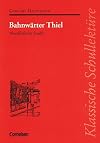
Schullektüre
Ratings
Members
- Recently Added By
Lists

German Literature
518 works; 56 members

Short and Sweet
246 works; 24 members

Nobel Price Winners
222 works; 20 members

Books Read in 2016
4,666 works; 199 members

Best public-transport fiction
72 works; 17 members
Author Information

Hauptmann, Germany's outstanding playwright of the naturalist school, was by nature an experimenter. He was a strange mixture: sometimes a revolutionary, as in his greatest play, The Weavers (1892); sometimes the compassionate creator, as in Hannele (1893), about a beggar girl dreaming of heaven. The Sunken Bell (1897), his most famous drama, is show more an allegorical verse play on the quest for an ideal, similar in theme to Ibsen's Peer Gynt. Hauptmann won the Nobel Prize in 1912 and was given an honorary degree by Columbia University in 1932, at which occasion he delivered an oration on Goethe. Hauptmann is one of the most widely performed German playwrights. He stands as a landmark between the classic and the modern theater. "The heroes of his plays were not from either the ruling class or the bourgeoisie, but almost always from the masses... .By 1913, Hauptmann's naturalism was known throughout the world" (N.Y. Times). Hauptmann deserves no less fame as a writer of prose. His earlier works, such as Thiel the Crossing Keeper (1888), show him at his strongest in the naturalistic mode. His characters are enslaved by their environment and by their own drives, especially the sex drive. In the Heretic of Soana (1918) Hauptmann concentrates on the power of the sexual urge in man in the story of the priest who gave up his church for the love of a woman, but he has moved away from the brooding excesses of naturalism. Frowned upon by the Nazis for having been a prominent figure under the Republic, which once favored nominating him for the presidency, Hauptmann never spoke out against Nazi tyranny but shook hands with Goebbels and accepted a medal. Yet when he died at his home in the Silesian Mountains, he had been about to move to East Berlin at the invitation of the Soviet Military Government. These events were forgotten or ignored during the 1962 centennial celebrations of his birth in the two Germanys. (Bowker Author Biography) show less
Some Editions
Awards and Honors
Awards
Notable Lists
Series
Belongs to Publisher Series
Work Relationships
Is contained in
German Novellas of Realism II : Ebner-Eschenbach, Heyse, Raabe, Storm, Meyer, Hauptmann by Jeffrey L. Sammons
Gesammelte Werke in Acht Bänden: Bd. Bahnwärter Thiel. Der Apostel. Der Narr in Christo Emanuel Quint (German Edition) by Gerhart Hauptmann
Hamburger Lesehefte plus Königs Materialien : Gerhart Hauptmann : Bahnwärter Thiel by Rüdiger Bernhardt (indirect)
Has as a commentary on the text
Has as a student's study guide
Has as a teacher's guide
Common Knowledge
- Canonical title
- Flagman Thiel
- Original title
- Bahnwärter Thiel
- Original publication date
- 1888
- People/Characters*
- Bahnwärter Thiel; Tobias; Lene
- Important places
- Brandenburg, Germany; Berlin, Germany; German Empire
- Related movies
- Bahnwärter Thiel (1968 | IMDb); Bahnwärter Thiel (1982 | IMDb)
- First words
- Allsonntäglich saß der Bahnwärter Thiel in der Kirche zu Neu-Zittau, ausgenommen die Tage, an denen er Dienst hatte oder krank war und zu Bette lag.
- Last words
- (Click to show. Warning: May contain spoilers.)Noch bei der Einlieferung hielt er das braune Mützchen in Händen und bewachte es mit eifersüchtiger Sorgfalt und Zärtlichkeit.
- Original language*
- Deutsch
*Some information comes from Common Knowledge in other languages. Click "Edit" for more information.
Classifications
Statistics
- Members
- 498
- Popularity
- 60,799
- Reviews
- 5
- Rating
- (3.57)
- Languages
- 6 — Dutch, English, German, Norwegian (Bokmål), Swedish, Turkish
- Media
- Paper, Audiobook, Ebook
- ISBNs
- 22
- ASINs
- 16