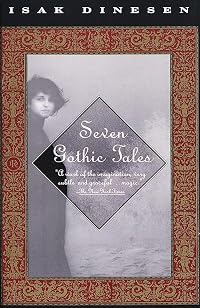
Seven Gothic Tales
by Isak Dinesen 
On This Page
Description
Originally published in 1934, Seven Gothic Tales, the first book by "one of the finest and most singular artists of our time" (The Atlantic), is a modern classic. Here are seven exquisite tales combining the keen psychological insight characteristic of the modern short story with the haunting mystery of the nineteenth-century Gothic tale, in the tradition of writers such as Goethe, Hoffmann, and Poe.Tags
Recommendations













Member Recommendations

Member Reviews
Isak Dinesen was nearly fifty when she published her first book, written in her second language. It was a masterpiece of storytelling. I’m impressed.
These intricate tales are richly imaginative, structured like a series of boxes within boxes. The writing style, slightly old-fashioned, matches the fact that she wrote them more than a century after the gothic fad in literature was passing out of fashion (which is when most of the tales are set). The scenes shift from Dinesen’s native Denmark (Elsinore is often mentioned, evoking the fate of Hamlet) to Paris and Rome, where Dinesen studied as a young woman, and points beyond.
The stories are loosely interconnected, with a character from one tale on the sidelines of another. The show more characters are, for the most part, aristocrats—unfashionable in the 1930s. But as the saying goes, write what you know; this is the milieu Dinesen belonged to. More importantly, populating the tales with aristocrats adds to the archaic flavor. But in most of the tales, some characters seem to partake of a supernatural existence, either divine or demonic.
Whether in forest settings, palatial ruins, storms, moonlight, or doomed love, and death—Dinesen ticks every item on the gothic romance checklist. Yet she deploys these elements imaginatively. If I had picked this book up in a different mood, I might not have gotten far before putting it aside. But book and reader met at the right time. show less
These intricate tales are richly imaginative, structured like a series of boxes within boxes. The writing style, slightly old-fashioned, matches the fact that she wrote them more than a century after the gothic fad in literature was passing out of fashion (which is when most of the tales are set). The scenes shift from Dinesen’s native Denmark (Elsinore is often mentioned, evoking the fate of Hamlet) to Paris and Rome, where Dinesen studied as a young woman, and points beyond.
The stories are loosely interconnected, with a character from one tale on the sidelines of another. The show more characters are, for the most part, aristocrats—unfashionable in the 1930s. But as the saying goes, write what you know; this is the milieu Dinesen belonged to. More importantly, populating the tales with aristocrats adds to the archaic flavor. But in most of the tales, some characters seem to partake of a supernatural existence, either divine or demonic.
Whether in forest settings, palatial ruins, storms, moonlight, or doomed love, and death—Dinesen ticks every item on the gothic romance checklist. Yet she deploys these elements imaginatively. If I had picked this book up in a different mood, I might not have gotten far before putting it aside. But book and reader met at the right time. show less
The stories grouped together in Syv fantastiske fortælliger are cleverly barbed, often male-centric narratives that deliver a usually female voice at the centre, filtered through various genres, anecdotes, and lengthy monologues. The stories seem uninterested in sticking with a single perspective, or narrative thread -- characters tell, overhear or imagine each other their adventures at the drop of a hat. They manage to feel slightly picaresque while maintaining a clear view of their own coherent goal. That goal may not always be clear to the reader until very late in the story, but even with all the weird digressions, I never lost the feeling that I was in the hands of a capable author who knew what they were doing, and I was only too show more happy to cut Blixen all the slack she needed.
An unusual reading experience, but one I was glad to be along for. show less
An unusual reading experience, but one I was glad to be along for. show less
These tales are like nothing I have read before. Isak Dinessen’s – nom de plume of Karen Blixen – narration feels like a walk through a labyrinth, where the unfolding story thread makes sharp turns, leads us into dead ends and dark corners, until finally we emerge on the other side a bit unsure of the place we have been. Like in a dream, one story merges into another, taking us along into deeper realms. And, with hypnotic powers, the narrator’s voice enchants and enslaves us.
I absolutely loved this book – or the reading experience of it. There is something primal in Blixen’s story telling that transports the reader back to the shaman beside the fire, or the medieval jongleur in a country fair, or yet the bedtime fairy tales show more we were read as children.
Beautiful and riveting, I feel intoxicated by it right now, and crave more and more of it. show less
I absolutely loved this book – or the reading experience of it. There is something primal in Blixen’s story telling that transports the reader back to the shaman beside the fire, or the medieval jongleur in a country fair, or yet the bedtime fairy tales show more we were read as children.
Beautiful and riveting, I feel intoxicated by it right now, and crave more and more of it. show less
READ THIS BOOK. It's one of the best books I read this year. I have to get that off my chest first.
This was another book I picked up at the rotary book sale for all of 25 cents, browsing books while Jen was doing her second round of the furniture. I had only picked it out because, well, Isak Dinesen is someone I was on my way to reading before I couldn't for a while, and the gothic is always appealing, and it just seemed the right size and shape and leaving it behind somehow was not an option. Then it stayed on my bookshelf in another house altogether, and then one night at my aunt's Jeopardy was playing in the background and the question was gothic literature and it asked the author of this book and I answered and Bianca asked how I show more even knew all these answers and I shrugged and mostly just thought how I really ought to read it. And then Isak Dinesen was mentioned in a show I was watching, and then when I was exchanging read books for unread books I picked up this one.
It's magical. It's beautiful. It's a dark and rich jewel. Superbly gothic, superbly imagined, superbly written. Why isn't this book more often talked about! Why isn't this book never on any top fiction lists? It was enchanting, and it's changed me, really. It's changed the way I'll write. It's opened up gates, new underworlds of imagination, that I never knew I hadn't reached.
The way so many of the stories play with unconventional gender and sexuality really surprised me, given when it came out, and given it's Book-of-the-month status back in 1934. It is such an odd choice for book-of-the-month, for publishing in the first place, except for the fact that it is one of the most beautiful and wonderful books I've ever read. show less
This was another book I picked up at the rotary book sale for all of 25 cents, browsing books while Jen was doing her second round of the furniture. I had only picked it out because, well, Isak Dinesen is someone I was on my way to reading before I couldn't for a while, and the gothic is always appealing, and it just seemed the right size and shape and leaving it behind somehow was not an option. Then it stayed on my bookshelf in another house altogether, and then one night at my aunt's Jeopardy was playing in the background and the question was gothic literature and it asked the author of this book and I answered and Bianca asked how I show more even knew all these answers and I shrugged and mostly just thought how I really ought to read it. And then Isak Dinesen was mentioned in a show I was watching, and then when I was exchanging read books for unread books I picked up this one.
It's magical. It's beautiful. It's a dark and rich jewel. Superbly gothic, superbly imagined, superbly written. Why isn't this book more often talked about! Why isn't this book never on any top fiction lists? It was enchanting, and it's changed me, really. It's changed the way I'll write. It's opened up gates, new underworlds of imagination, that I never knew I hadn't reached.
The way so many of the stories play with unconventional gender and sexuality really surprised me, given when it came out, and given it's Book-of-the-month status back in 1934. It is such an odd choice for book-of-the-month, for publishing in the first place, except for the fact that it is one of the most beautiful and wonderful books I've ever read. show less
A mixture of gothic themes with 1930s style. The supernatural is present but doesn't often strongly feature. Dinesen is artful and playing at subterfuge, demanding an effort to interpret. A common theme across these stories is bravely facing impending death. Masks, disguises and mistaken identities abound. Stories within the stories result in many more tales than seven.
The Deluge at Norderney - this first story directly addresses the gothic in its opening page. The characters themselves are fans of gothic sensibility, finding the romantic in the ocean's power and thus making them susceptible to its darker side, in both a physical and notional sense.
The Old Chevalier - It is strange that a story ostensibly about the value of making moral show more choices at the expense of one's pleasures should feature a character who appears to make no choices at all. But then, that is also a kind of choice.
The Monkey - I was deeply engaged by this, but a little thrown off by its ending when the supernatural element suddenly intrudes. Dinesen is playing with gothic conventions here, and it takes some familiarity to appreciate it.
The Roads Round Pisa - I didn't grasp all the plot of this one without help; the secret is in the nested stories. I was also stumped by Augustus' decision at the end, but I suppose he'd learned something about secrets being part of one's identity.
The Supper at Elsinore - Two sisters deny themselves all intimate relationships, keeping everyone at arms' length. Their consolation in later years, when regret threatens, is that they have one another. Then one discovers that the other has something more.
The Dreamers - Several elements from earlier stories (disguises, nested stories, etc.) get a remix here, with a central mystery that is generously unravelled.
The Poet - A man's sense of order is influenced by his love of poetry. Some fantastic metaphors here. This and the previous story bring out the theme of losing one's sense of pleasure, and compensating with artificial stimulation through others' envy. show less
The Deluge at Norderney - this first story directly addresses the gothic in its opening page. The characters themselves are fans of gothic sensibility, finding the romantic in the ocean's power and thus making them susceptible to its darker side, in both a physical and notional sense.
The Old Chevalier - It is strange that a story ostensibly about the value of making moral show more choices at the expense of one's pleasures should feature a character who appears to make no choices at all. But then, that is also a kind of choice.
The Monkey - I was deeply engaged by this, but a little thrown off by its ending when the supernatural element suddenly intrudes. Dinesen is playing with gothic conventions here, and it takes some familiarity to appreciate it.
The Roads Round Pisa - I didn't grasp all the plot of this one without help; the secret is in the nested stories. I was also stumped by Augustus' decision at the end, but I suppose he'd learned something about secrets being part of one's identity.
The Supper at Elsinore - Two sisters deny themselves all intimate relationships, keeping everyone at arms' length. Their consolation in later years, when regret threatens, is that they have one another. Then one discovers that the other has something more.
The Dreamers - Several elements from earlier stories (disguises, nested stories, etc.) get a remix here, with a central mystery that is generously unravelled.
The Poet - A man's sense of order is influenced by his love of poetry. Some fantastic metaphors here. This and the previous story bring out the theme of losing one's sense of pleasure, and compensating with artificial stimulation through others' envy. show less
Long ago I read Out of Africa and loved it. This is nothing like that. Which is not to say that it doesn't have enjoyable moments. Dinesen can make beautiful images with her words. She has and uses insight into human nature to draw compelling characters, then she discards them without a look back. She can write moments of philosophy that go straight to the heart. What she doesn't do in most of these stories is worry about the story having a discernable plot. Most of the stories left me saying, "WTF?"
Finally, after five tales (yes, her writing is so good that I kept reading) I realized, stop looking for a beginning, middle and end or reason. That's not what she is doing here. We are to enjoy each moment along the way, wake up when we show more finish a tale and settle into the next one, appreciating the scenery, the characters and the emotions along the way. show less
Finally, after five tales (yes, her writing is so good that I kept reading) I realized, stop looking for a beginning, middle and end or reason. That's not what she is doing here. We are to enjoy each moment along the way, wake up when we show more finish a tale and settle into the next one, appreciating the scenery, the characters and the emotions along the way. show less
It's almost unbelievable that this book was written in the thirties; Blixen's voice belongs to a hundred years prior - or more. Seven Gothic Tales represents a type of literature - drawn from continental Europe - that is all but non-existent today, a fascinating road less travelled for lovers of the unusual. Be warned, however, this unfamiliar terrain can be demanding at times.
Blixen's theme is primarily masks - and what they reveal of the wearer. Her protagonists are often thrown together in situations outside of their usual experience: A drunken chevalier decides to take a prostitute home; a exiled Englishman reminisces about his strange first love; a motley collection of people weather the night in the loft of a flooded barn. Every show more tale has a twist in it, but not in the facile ironic sense we have come to expect. Blixen's twists are more akin to rotating an object so - viewed from a different angle - it takes on an entirely new, and oft-times confounding aspect.
The stories themselves are also masked. Framing devices such as we almost never see today are employed with a wonderful adroitness. Characters will stop, seemingly mid-stream to share a story, other stories will surface; stories within stories and more. Readers of Lucas' The Priest, or Anne Radcliffe, or even the Decameron will instantly recognise and respond to this grand tradition of storytelling. Which is the primary narrative? Sometimes it's easy to ascertain, and at other times not so clear; the shorter story may contain the true heart.
The characters - wise old men, mysterious Jews, and beautiful, beautiful young people - come straight from the gothic tradition. The young people are especially voluble, philosophers and raconteurs all; by turns impassioned, cynical, confused, in love and more. This kind of drama is rarely seen any more, and it's gothic in the true sense: heady, emotive, romantic, and truly counter-enlightenment.
Blixen's prose is equally anachronistic. The closest 20th Century analogue I can think of is someone like Thomas Mann. Descriptive, dialogue-heavy and constructed like Georgian furniture: this stuff is built to last. But it can be heavy-going at times. Like a true gothic, Blixen is interested in emotion above all, and the intensity and canorous prose of Seven Gothic Tales can feel like the literary equivalent of gauvage at times - you are being stuffed full of words, emotions and ideas with no end in sight (the end comes after a dense +500 pages). Also, Blixen absolutely refuses to condescend to her readers. A solid knowledge of classic myths and legends will serve the reader well, as will basic French, German, Italian and Latin (!). I confess, I think of myself as quite well read, but there were moments in every tale where I was simply at sea with the references, allusions, quotes or languages being tossed about so very casually by the stricken protagonists.
But don't let this put you off. A polyglot's knowledge will certainly enrich your experience of Seven Gothic Tales, but it's by no means required. Anyone with a hankering for the unusual, for carriages in the moonlight, for duels, for lovers who aren't what they say, for erudite young men and women, for a tour of European locales that puts Kon Tiki to shame, for a fascinating byway in 20th century & European literature, for something that reminds them of The Priest, or The Mysteries of Udolpho, or The Castle of Otranto - will find something in this book at least worth their consideration. A very interesting read, and one that would reward multiple visits, I feel. show less
Blixen's theme is primarily masks - and what they reveal of the wearer. Her protagonists are often thrown together in situations outside of their usual experience: A drunken chevalier decides to take a prostitute home; a exiled Englishman reminisces about his strange first love; a motley collection of people weather the night in the loft of a flooded barn. Every show more tale has a twist in it, but not in the facile ironic sense we have come to expect. Blixen's twists are more akin to rotating an object so - viewed from a different angle - it takes on an entirely new, and oft-times confounding aspect.
The stories themselves are also masked. Framing devices such as we almost never see today are employed with a wonderful adroitness. Characters will stop, seemingly mid-stream to share a story, other stories will surface; stories within stories and more. Readers of Lucas' The Priest, or Anne Radcliffe, or even the Decameron will instantly recognise and respond to this grand tradition of storytelling. Which is the primary narrative? Sometimes it's easy to ascertain, and at other times not so clear; the shorter story may contain the true heart.
The characters - wise old men, mysterious Jews, and beautiful, beautiful young people - come straight from the gothic tradition. The young people are especially voluble, philosophers and raconteurs all; by turns impassioned, cynical, confused, in love and more. This kind of drama is rarely seen any more, and it's gothic in the true sense: heady, emotive, romantic, and truly counter-enlightenment.
Blixen's prose is equally anachronistic. The closest 20th Century analogue I can think of is someone like Thomas Mann. Descriptive, dialogue-heavy and constructed like Georgian furniture: this stuff is built to last. But it can be heavy-going at times. Like a true gothic, Blixen is interested in emotion above all, and the intensity and canorous prose of Seven Gothic Tales can feel like the literary equivalent of gauvage at times - you are being stuffed full of words, emotions and ideas with no end in sight (the end comes after a dense +500 pages). Also, Blixen absolutely refuses to condescend to her readers. A solid knowledge of classic myths and legends will serve the reader well, as will basic French, German, Italian and Latin (!). I confess, I think of myself as quite well read, but there were moments in every tale where I was simply at sea with the references, allusions, quotes or languages being tossed about so very casually by the stricken protagonists.
But don't let this put you off. A polyglot's knowledge will certainly enrich your experience of Seven Gothic Tales, but it's by no means required. Anyone with a hankering for the unusual, for carriages in the moonlight, for duels, for lovers who aren't what they say, for erudite young men and women, for a tour of European locales that puts Kon Tiki to shame, for a fascinating byway in 20th century & European literature, for something that reminds them of The Priest, or The Mysteries of Udolpho, or The Castle of Otranto - will find something in this book at least worth their consideration. A very interesting read, and one that would reward multiple visits, I feel. show less
Members
- Recently Added By
Lists

Pre-1969 LGBTQ Literature
182 works; 69 members

Favourite Books
1,820 works; 316 members
Folio Society
831 works; 48 members

Five star books
1,767 works; 110 members

1930s
262 works; 5 members

501 Must-Read Books
529 works; 72 members

Translingualism
191 works; 4 members

Harold Bloom - The Western Canon: D. The Chaotic Age
833 works; 24 members

Trinity College Booklist (1951): Class Ten, English Literature
358 works; 5 members

Jones & Newman: Best Horror Books Further Recommended Reading
577 works; 4 members

Publisher's Weekly Bestsellers Part I - 1895-1939
399 works; 8 members

Recommended Reading : 600 Classics Reviewed, Editors of Salem Press, 2015
634 works; 6 members
Author Information

240+ Works 18,155 Members
Isak Dinesen was born Karen Christentze Dinesen in Rungsted, Denmark on April 17, 1885. She studied English at Oxford University and painting at the Academy of Fine Arts in Copenhagen. During her lifetime, she wrote plays, short stories, novels, poetry, and nonfiction works. Her career as a writer spanned from 1907 to 1962. She was published in show more Danish under the name of Karen Blixen and in English under the pseudonym of Isak Dinesen. Her short story collections include Seven Gothic Tales, Winter Tales, and Last Tales. Her nonfiction book, Out of Africa, was published in 1937 and was adapted into an Oscar-winning film starring Meryl Streep in 1985. She died of emaciation September 7, 1962. (Bowker Author Biography) show less
Isak Dinesen has a Legacy Library. Legacy libraries are the personal libraries of famous readers, entered by LibraryThing members from the Legacy Libraries group.
Some Editions
Awards and Honors
Awards
Distinctions
Series
Belongs to Publisher Series
Modern Library (54.3)
Penguin Modern Classics (1952)
Work Relationships
Is contained in
Common Knowledge
- Canonical title
- Seven Gothic Tales
- Original title
- Seven Gothic Tales
- Original publication date
- 1934
- People/Characters
- Princess of Augustenburg; Baron von Bracked; Pastor Rosenquist; Count Augustuts von Schimmelmann; Adrienne Rosenstand; Said Ben Ahamed (show all 7); Ander Kube
- First words
- During the first quarter of the last century, seaside resorts became the fashion, even in those countries of Northern Europe within the minds of whose people the sea had hitherto held the role of the devil, the cold and vorac... (show all)ious hereditary foe of humanity.
- Quotations
- Coffee, according to the women of Denmark, is to the body what the word of the Lord is to the soul.
The waves looked solid, as if one might safely have walked upon them, while it was into the vertigionus sky that one might sink and fall, into the turbulent and unfathomable depths of silvery worlds, of bright silver or dull ... (show all)and tarnished silver, forever silver reflected within silver, moving and changing, towering up, slowly and weightless.
"It is not a bad thing in a tale that you understand only half of it."
In Egypt Saint Joseph said to Virgin: “Oh, my sweet young dear, could you not just for the moment shut your eyes and make believe that I am the Holy Ghost?” - Last words
- (Click to show. Warning: May contain spoilers.)And meanwhile, from all sides, like an echo in the engulfing darkness, winding and rolling in long caverns, her last words repeated again and again.
- Original language
- English
- Disambiguation notice
- Isak Dinesen is an alias of Karen Blixen.
Classifications
Statistics
- Members
- 2,658
- Popularity
- 7,037
- Reviews
- 35
- Rating
- (3.92)
- Languages
- 18 — Bulgarian, Catalan, Danish, Dutch, English, Estonian, Finnish, French, German, Hungarian, Italian, Latvian, Norwegian (Bokmål), Polish, Portuguese, Russian, Spanish, Swedish
- Media
- Paper, Audiobook, Ebook
- ISBNs
- 67
- ASINs
- 68