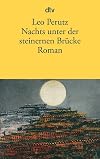
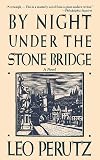
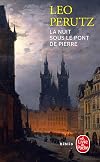
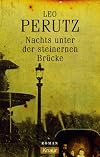
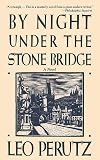
By Night Under the Stone Bridge
by Leo Perutz
On This Page
Description
Rudolf II, king of Bohemia and Holy Roman Emperor, is paranoid, spendthrift, and wayward. In sixteenth-century Prague, seat of Christendom, he rules over an empty treasury and a court of parasites and schemers. Meanwhile in the ghetto, the Great Rabbi, mystic and seer, guides his people in the uneasy cohabitation of Jew and Christian, while the fabulously wealthy financier Mordechai Meisl has a hand in transactions across Europe and is reputed to be sustaining the treasury. His beautiful show more wife, Esther, forms a link of a different sort between the castle and the ghetto: by night under the stone bridge, she and the emperor entwine in their dreams under the guise of a white rosemary bush and a red rose. Only by severing the two plants can the Great Rabbi break the spell of forbidden love and deliver the city from the wrath of God. Perutz brings Old Prague to life with a cast of characters ranging from alchemists to the angel Asael, and including the likes of Johannes Kepler and the outlaw prince Wallenstein. show lessTags
Recommendations

















Member Recommendations
Member Reviews
“They say a deaf man heard a dumb man talking about a blind man who saw a cripple walking the tightrope.”
There are stories that can only be born within a specific place. Within a city whose darkness and spirit are unparalleled, its history an endless source of legends. Prague, the City of a Hundred Spires, the Golden City, the Rome of the North. The capital where mysticism is tangible and the past greets you in every corner.
‘’Your lives’’, said the angel, ‘’are full of worries. Why do you choose to burden yourselves with love that clouds your spirit and saddens your heart?’’
The Jewish Quarter is the beating heart in the body of Prague. Tortured by a plague that takes away their children, home to two poor vagabonds show more who try to find the answer in the spirits of the young ones. A rude Baron dances a strange saraband in the nightly streets of Prague, an artist, a musician, a cook, a forgotten alchemist, a prisoner conversing with two dogs awaiting their execution. A cursed coin, a haunted synagogue where the spirits call on those who will walk the final path, a visitor from Hell. And these are merely the witnesses in the drama of Rudolph II, Mordechai Maisel, a wealthy businessman and benefactor, and his beautiful wife, Esther who is in love with the melancholic Rudolph. The red rose embraces the rosemary in a futile attempt to fight for their union.
Merchants, servants, jesters, criminals, lovers, vagabonds wander the streets of Prague, trying to survive. 15 stories written in a beautifully poetic, haunting language by a writer who knew what it was to live in persecution and exile. Leo Perutz was born in Prague, descending from an Austrian-Jewish family. He moved to Vienna in 1899 but was forced to abandon it in 1938 when the nightmare created by the Nazi monsters and the countries that supported Hitler began. He died in Israel in 1957.
This novel told in 15 different voices, all centered around a doomed love affair and a feverish struggle for survival and gain, is a treasure. Perutz’s voice may remind you of Sweig and Kafka. This is a writer whose elegant humor and sad tenderness match the dark beauty of the most beautiful of cities. He deserves to be read and admired, he deserves to find a place among the great European writers.
“For it’s human nature even in the direst extremity to see a spark of hope and blow it into flames.”
My reviews can also be found on https://theopinionatedreaderblog.wordpress.com/ show less
There are stories that can only be born within a specific place. Within a city whose darkness and spirit are unparalleled, its history an endless source of legends. Prague, the City of a Hundred Spires, the Golden City, the Rome of the North. The capital where mysticism is tangible and the past greets you in every corner.
‘’Your lives’’, said the angel, ‘’are full of worries. Why do you choose to burden yourselves with love that clouds your spirit and saddens your heart?’’
The Jewish Quarter is the beating heart in the body of Prague. Tortured by a plague that takes away their children, home to two poor vagabonds show more who try to find the answer in the spirits of the young ones. A rude Baron dances a strange saraband in the nightly streets of Prague, an artist, a musician, a cook, a forgotten alchemist, a prisoner conversing with two dogs awaiting their execution. A cursed coin, a haunted synagogue where the spirits call on those who will walk the final path, a visitor from Hell. And these are merely the witnesses in the drama of Rudolph II, Mordechai Maisel, a wealthy businessman and benefactor, and his beautiful wife, Esther who is in love with the melancholic Rudolph. The red rose embraces the rosemary in a futile attempt to fight for their union.
Merchants, servants, jesters, criminals, lovers, vagabonds wander the streets of Prague, trying to survive. 15 stories written in a beautifully poetic, haunting language by a writer who knew what it was to live in persecution and exile. Leo Perutz was born in Prague, descending from an Austrian-Jewish family. He moved to Vienna in 1899 but was forced to abandon it in 1938 when the nightmare created by the Nazi monsters and the countries that supported Hitler began. He died in Israel in 1957.
This novel told in 15 different voices, all centered around a doomed love affair and a feverish struggle for survival and gain, is a treasure. Perutz’s voice may remind you of Sweig and Kafka. This is a writer whose elegant humor and sad tenderness match the dark beauty of the most beautiful of cities. He deserves to be read and admired, he deserves to find a place among the great European writers.
“For it’s human nature even in the direst extremity to see a spark of hope and blow it into flames.”
My reviews can also be found on https://theopinionatedreaderblog.wordpress.com/ show less
This book is a series of linked stories. Each can be read on its own (though there are a couple that would leave you hanging if you didn’t know the previously-described relationships) but together they provide the links connecting the central characters – Rudolf II, the continually broke, sometimes crazy, sometimes sharp King of Bohemia and Holy Roman Emperor, Rabbi Loew – the Great Rabbi, he of Golem fame, and Mordechai Meisl, an enigmatic rich Jew. Besides Rudolf and Lowe, other historical characters make an appearance - Johannes Kepler and Wallenstein. The stories vary quite a bit in mood and topic, though they generally stick to the time period of Rudolf’s reign and the period after.
This book has a structure similar to The show more Swedish Cavalier and The Marquis of Bolibar, though those were continuous narratives. At the beginning – the end of the first story – a major plot point is revealed then the author takes his time in filling in all the details. There’s also a focus on the workings of fate – none of Perutz’s characters can escape their destiny. Sometimes “destiny” is a result of character – Kepler reads Wallenstein’s traits accurately and a series of coincidental events set Wallenstein on the road to his history-altering life. In another story – a sad man with a sad, unsuccessful life meets a sad end – he’s already an alchemist and there’s not much luck in that profession but his end is as unnoticed and pathetic as his life. Fate is other times represented by an impersonal force that can’t be denied. In one story, two eavesdroppers hear the names of the dead for that year read out – and the reader is left with the impression of no escape, no matter how much the characters try to laugh it off. In another, Rudolf has to get rid of a stolen coin and, trusting it to fate, simply drops it and follows it to its inevitable end. The third manifestation of inexorable fate involved malevolent or supernatural forces of some sort. Sometimes this is due to the intervention of the Rabbi, but the intertwined fates of Rudolf and Meisl seem to predate his actions. Later on Meisl engineers his end – seeming to defy his destiny - but the outcome leads to generation of strife and Jarndyce-esque obsession in his family.
I enjoyed this as I did the other Perutz novels – he’s very effective at writing historical stories with modern touches in the form of narrative weirdness that’s not overdone (rather than anachronistic characters that seem more appropriate for the 20th/21st century). The stories are varied, interesting and can be tragic or humorous. Also, after reading them, I want more Perutz. show less
This book has a structure similar to The show more Swedish Cavalier and The Marquis of Bolibar, though those were continuous narratives. At the beginning – the end of the first story – a major plot point is revealed then the author takes his time in filling in all the details. There’s also a focus on the workings of fate – none of Perutz’s characters can escape their destiny. Sometimes “destiny” is a result of character – Kepler reads Wallenstein’s traits accurately and a series of coincidental events set Wallenstein on the road to his history-altering life. In another story – a sad man with a sad, unsuccessful life meets a sad end – he’s already an alchemist and there’s not much luck in that profession but his end is as unnoticed and pathetic as his life. Fate is other times represented by an impersonal force that can’t be denied. In one story, two eavesdroppers hear the names of the dead for that year read out – and the reader is left with the impression of no escape, no matter how much the characters try to laugh it off. In another, Rudolf has to get rid of a stolen coin and, trusting it to fate, simply drops it and follows it to its inevitable end. The third manifestation of inexorable fate involved malevolent or supernatural forces of some sort. Sometimes this is due to the intervention of the Rabbi, but the intertwined fates of Rudolf and Meisl seem to predate his actions. Later on Meisl engineers his end – seeming to defy his destiny - but the outcome leads to generation of strife and Jarndyce-esque obsession in his family.
I enjoyed this as I did the other Perutz novels – he’s very effective at writing historical stories with modern touches in the form of narrative weirdness that’s not overdone (rather than anachronistic characters that seem more appropriate for the 20th/21st century). The stories are varied, interesting and can be tragic or humorous. Also, after reading them, I want more Perutz. show less
A masterwork from an, up until recently, underappreciated author of the mid-20th century. The book is constructed as a series of short stories, each self sufficient independently, that, collectively, slowly piece together an overarching narrative that takes over 3 centuries to play itself out. The characters are an amalgam of historical personages, folktale personalities, and fictive inventions. It probably shouldn't be a surprise that the historical characters are the most bizarre (Rudolf II, Holy Roman Emporer; Albrecht von Wallenstein). IF YOU DON'T WANT YOUR PLEASURE SPOILED: Do not, under any circumstances, read the note on the dust jacket before reading the novel. This is one of the most unconscionable examples of blurb abuse I've show more ever encountered. show less
Published in 1953, this book is a series of interrelated short stories set in Prague in the late 1500s to early 1600s. The plot revolves around the attempt to cure the ills of the city, avoiding a perceived curse put upon it. There is no single protagonist, and various characters appear in multiple stories.
They include:
- Rudolf II (1552 – 1612), a real person, King of Bohemia and Holy Roman Emperor
- the Great Rabbi, leader of the Jewish community
- Mordechai Meisl, a moneylender
- Esther, Meisl’s wife, who has a secret link to the castle
- Koppel-the-Bear and Jäckele-the-Fool, a pair of city dwellers who bring levity to the narrative
The stories are portrayals of Bohemian myths and legends. For me, the highlight of the book is show more bringing the old city of Prague to life, replete with alchemists, superstitions, religious differences, methods of making a living, and the dissolute state of affairs at the castle. There is even a cameo appearance by Johannes Kepler. The writing is lyrical. It is creative and the stories are nicely knit together. show less
They include:
- Rudolf II (1552 – 1612), a real person, King of Bohemia and Holy Roman Emperor
- the Great Rabbi, leader of the Jewish community
- Mordechai Meisl, a moneylender
- Esther, Meisl’s wife, who has a secret link to the castle
- Koppel-the-Bear and Jäckele-the-Fool, a pair of city dwellers who bring levity to the narrative
The stories are portrayals of Bohemian myths and legends. For me, the highlight of the book is show more bringing the old city of Prague to life, replete with alchemists, superstitions, religious differences, methods of making a living, and the dissolute state of affairs at the castle. There is even a cameo appearance by Johannes Kepler. The writing is lyrical. It is creative and the stories are nicely knit together. show less
Surprisingly (to me) this is a book with magic and Rabbi Judah Loew and Rudolf II, but no golem. It is also a translation from the German. Harder to translate are Jewish symbols: I guess that "spicy applesauce" is the Charoset---chopped apples, nuts, wine, cinnamon are some possible ingredients---which is served at the Passover seder.
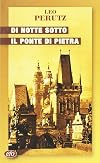
Chiuse gli occhi e si rifugiò col pensiero sulle vette e nelle profondità del misterioso insegnamento di cui si dice che attraverso dieci gradi porta su fino agli angeli di Dio. fece ciò perché sta scritto: "Dedicati ai misteri della sapienza e della conoscenza e potrai superare dentro di te la paura del domani".
(32)
Eppure ora a Brouza riusciva talvolta più facile di prima guadagnarsi una pietanza o il burro sul pane, raccontando storie vere o inventate che avevano per tema Rodolfo II, la sua corte e la sua servitù. I praghesi, infatti, amavano sentire i racconti del tempo passato, dato che il presente era così triste, cupo e pauroso.
(179-80)
(32)
Eppure ora a Brouza riusciva talvolta più facile di prima guadagnarsi una pietanza o il burro sul pane, raccontando storie vere o inventate che avevano per tema Rodolfo II, la sua corte e la sua servitù. I praghesi, infatti, amavano sentire i racconti del tempo passato, dato che il presente era così triste, cupo e pauroso.
(179-80)
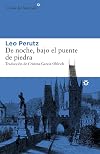
Historia de historias, relato de relatos ambientado en la Praga del siglo XVI, De noche, bajo el puente de piedra nos habla del emperador Rodolfo II, rey de Bohemia y emperador del Sacro Imperio, amante de las artes, manirroto y paranoico; del gran rabino Loew, místico y vidente; y del riquísimo judío Mordejai Meisl y su bella esposa Esther, eslabón entre la corte y el gueto.
El depositario de todos estos relatos es Jakob Meisl, un misterioso estudiante de medicina de Praga dispuesto a demostrarnos que «los profesores de historia que enseñan en los colegios y los señores que escriben los libros de historia no saben ni entienden nada», que el relato histórico suele olvidar la parte humana y mágica de nuestra existencia y que la show more verdadera literatura es, gran parte de las veces, mucho más real que la propia historia.
Publicada por primera vez en 1953, poco antes de la muerte de su autor, De noche, bajo el puente de piedra está considerada unánimemente como la obra maestra de Leo Perutz –uno de los grandes narradores del siglo XX, admirado por escritores tan dispares como Graham Greene, Ian Fleming o Jorge Luis Borges– y como una de las mejores novelas históricas de la literatura universal. show less
El depositario de todos estos relatos es Jakob Meisl, un misterioso estudiante de medicina de Praga dispuesto a demostrarnos que «los profesores de historia que enseñan en los colegios y los señores que escriben los libros de historia no saben ni entienden nada», que el relato histórico suele olvidar la parte humana y mágica de nuestra existencia y que la show more verdadera literatura es, gran parte de las veces, mucho más real que la propia historia.
Publicada por primera vez en 1953, poco antes de la muerte de su autor, De noche, bajo el puente de piedra está considerada unánimemente como la obra maestra de Leo Perutz –uno de los grandes narradores del siglo XX, admirado por escritores tan dispares como Graham Greene, Ian Fleming o Jorge Luis Borges– y como una de las mejores novelas históricas de la literatura universal. show less
Mar 14, 2018Spanish
Members
- Recently Added By
Lists

1001 Books You Must Read Before You Die
1,448 works; 1,134 members

German Literature
518 works; 55 members

Jewish Books
367 works; 24 members
Books set in Prague
40 works; 1 member
Author Information

39+ Works 2,229 Members
Some Editions
Awards and Honors
Notable Lists
Series
Belongs to Publisher Series
Common Knowledge
- Canonical title
- By Night Under the Stone Bridge
- Original title
- Nachts unter der steinernen Brücke
- Original publication date
- 1953
- People/Characters
- Judah Löw (Rabbi); Rudolf II von Habsburg, Holy Roman Emperor; Wallenstein, Herzog zu Friedland, kaiserlicher Generalissimus im Dreißigjährigen Kriege; Johannes Kepler; Mordechai Meisl; Koppel-the-bear (show all 7); Jackele-the-fool
- Important places*
- Prag, Tschechien
- Dedication
- In gratitude to my good comrade G.P.
- First words
- In the autumn of 1589, when the great pestilence was raging in the Prague ghetto and children were dying off like flies, two wretched, greying professional entertainers, who made their living by amusing guests at weddings, wa... (show all)lked down the Belelesgasse that led from the Nicolasplatz to the Jewish cemetery.
- Last words
- (Click to show. Warning: May contain spoilers.)While it hung there it was still Meisl's wealth, and we watched as a gust of wind blew it away and it disappeared.
- Blurbers
- Evans, Leonard M
- Original language*
- Deutsch
*Some information comes from Common Knowledge in other languages. Click "Edit" for more information.
Classifications
- Genres
- Fiction and Literature, General Fiction, Historical Fiction
- DDC/MDS
- 833.912 — Literature & rhetoric German & related literatures German fiction 1900- 1900-1990 1900-1945
- LCC
- PT2631 .E5 .N313 — Language and Literature German, Dutch and Scandinavian literatures German literature Individual authors or works 1860/70-1960
- BISAC
Statistics
- Members
- 370
- Popularity
- 84,838
- Reviews
- 10
- Rating
- (4.01)
- Languages
- 8 — Czech, English, French, German, Italian, Japanese, Spanish, Swedish
- Media
- Paper, Audiobook, Ebook
- ISBNs
- 30
- ASINs
- 11