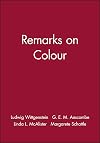
Remarks on Colour
by Ludwig Wittgenstein
On This Page
Description
This book comprises material on colour which was written by Wittgenstein in the last eighteen months of his life. It is one of the few documents which shows him concentratedly at work on a single philosophical issue. The principal theme is the features of different colours, of different kinds of colour (metallic colour, the colours of flames, etc.) and of luminosity--a theme which Wittgenstein treats in such a way as to destroy the traditional idea that colour is a simple and logically show more uniform kind of thing. show lessTags
Recommendations






























Member Reviews
I've had this book for so long (without ever having read it) that the price on it is $2.95. So it's an earlier edition than the one here.
Color had at one time been a kind of standard philosophical topic. The empiricists had deemed color a "secondary quality" of objects, something that arises and is dependent on our perceptual interaction with objects rather than a "primary" quality of objects themselves. Goethe's Theory of Color, in the context of advances in optical theory, had provoked the question of how physical explanations of color relate to the experience of color.
What especially interests Wittgenstein is what always interests him -- what is the status of our color concepts? Is the fact that white is not included among the show more primary colors, or that we never speak of "bluish yellow" reflective of facts in the world, or are they more like the logic of our linguistic behavior? If the latter, are they changeable? The Remarks on Color come from the same time as the remarks in On Certainty, just before Wittgenstein's death from prostate cancer. Those questions about the grounding of apparently empirical statements were very much on his mind.
One of the discussions reading the book stimulated for me goes against the idea that precision is a requirement for "understanding" or for competence, as if the application of concepts (like our color concepts) were governed by rules held up against our experience of reality. People are generally very competent at telling the colors of objects, but very few could give you definitions of colors or say precisely where one color ends and another begins. And even the definitions and boundaries that some could give would be questionable. Defining a color in terms of a wavelength of light, for example hardly captures what is meant by the color. Pointing to a spot along a spectrum and saying, "Here is where orange ends and yellow begins" will always seem declarative, not factual.
Surely some of this is what the empiricist philosophers were getting at by treating color as a "secondary quality" of objects . But it won't do just to say that, well, color is an imprecise thing because it isn't completely objective. Other qualities -- hardness, softness, slickness, . . . we operate confidently with all of these but we can't set boundaries to them or recite confident definitions.
All of this has to do with a kind of autonomy of speech, something overdone in the postmoderns, maybe, but valid nevertheless. The application of terms (or better maybe, the practice of language) isn't bound by objects and their properties in any simple way.
But then some (thank God, only some) will see all of this as a "problem" -- confusion, disorder, imprecision, lack of clarity. And they will propose to solve the problem with precise definitions and strict boundaries. Such things, they say, are needed for clarity and accuracy in our concepts. All that precision and clarity are really needed only in extraordinary circumstances, as when a painter color-matches paints. The extraordinary circumstances don't reveal a flaw in the ordinary circumstances.
Worse yet, others (like traditional AI researchers) will say that, whether we can articulate it or not, we do have an implicit, precise understanding of what colors are and where one color stops and another begins. It's as though it must be that way because they can only imagine it that way. Failures of the imagination are hardly the key to truth.
Wittgenstein also discusses color-blindness, and since I am color-blind, I always get caught up by the topic -- people who are curious about color-blindness often ask me "what do you see?" as if that were a question I could make sense of in a way that would make them understand something. Suppose I ask them "What do you see?" They say, "I see red." So do I . . . when I see red.
Here's one way to explain it, maybe. Suppose you are sitting with an artist, one with a great sensitivity to colors, and you have a bunch of red color samples in front of you. The artist sees many different reds, while you see red in each one. To you they just seem so close together as to be indistinguishable. To her, they seem different. Then imagine it's you and me sitting in front of the color samples, but this time they aren't all red. To you, they seem different. To me, they don't. It's not a matter of seeing something different from color-sighted people; it's a matter of not seeing distinctions that others see, just as you don't see distinctions that the artist sees. Don't know if that works, but . . . wth. show less
Color had at one time been a kind of standard philosophical topic. The empiricists had deemed color a "secondary quality" of objects, something that arises and is dependent on our perceptual interaction with objects rather than a "primary" quality of objects themselves. Goethe's Theory of Color, in the context of advances in optical theory, had provoked the question of how physical explanations of color relate to the experience of color.
What especially interests Wittgenstein is what always interests him -- what is the status of our color concepts? Is the fact that white is not included among the show more primary colors, or that we never speak of "bluish yellow" reflective of facts in the world, or are they more like the logic of our linguistic behavior? If the latter, are they changeable? The Remarks on Color come from the same time as the remarks in On Certainty, just before Wittgenstein's death from prostate cancer. Those questions about the grounding of apparently empirical statements were very much on his mind.
One of the discussions reading the book stimulated for me goes against the idea that precision is a requirement for "understanding" or for competence, as if the application of concepts (like our color concepts) were governed by rules held up against our experience of reality. People are generally very competent at telling the colors of objects, but very few could give you definitions of colors or say precisely where one color ends and another begins. And even the definitions and boundaries that some could give would be questionable. Defining a color in terms of a wavelength of light, for example hardly captures what is meant by the color. Pointing to a spot along a spectrum and saying, "Here is where orange ends and yellow begins" will always seem declarative, not factual.
Surely some of this is what the empiricist philosophers were getting at by treating color as a "secondary quality" of objects . But it won't do just to say that, well, color is an imprecise thing because it isn't completely objective. Other qualities -- hardness, softness, slickness, . . . we operate confidently with all of these but we can't set boundaries to them or recite confident definitions.
All of this has to do with a kind of autonomy of speech, something overdone in the postmoderns, maybe, but valid nevertheless. The application of terms (or better maybe, the practice of language) isn't bound by objects and their properties in any simple way.
But then some (thank God, only some) will see all of this as a "problem" -- confusion, disorder, imprecision, lack of clarity. And they will propose to solve the problem with precise definitions and strict boundaries. Such things, they say, are needed for clarity and accuracy in our concepts. All that precision and clarity are really needed only in extraordinary circumstances, as when a painter color-matches paints. The extraordinary circumstances don't reveal a flaw in the ordinary circumstances.
Worse yet, others (like traditional AI researchers) will say that, whether we can articulate it or not, we do have an implicit, precise understanding of what colors are and where one color stops and another begins. It's as though it must be that way because they can only imagine it that way. Failures of the imagination are hardly the key to truth.
Wittgenstein also discusses color-blindness, and since I am color-blind, I always get caught up by the topic -- people who are curious about color-blindness often ask me "what do you see?" as if that were a question I could make sense of in a way that would make them understand something. Suppose I ask them "What do you see?" They say, "I see red." So do I . . . when I see red.
Here's one way to explain it, maybe. Suppose you are sitting with an artist, one with a great sensitivity to colors, and you have a bunch of red color samples in front of you. The artist sees many different reds, while you see red in each one. To you they just seem so close together as to be indistinguishable. To her, they seem different. Then imagine it's you and me sitting in front of the color samples, but this time they aren't all red. To you, they seem different. To me, they don't. It's not a matter of seeing something different from color-sighted people; it's a matter of not seeing distinctions that others see, just as you don't see distinctions that the artist sees. Don't know if that works, but . . . wth. show less
edição bilíngue alemão - português
Ratings
Members
- Recently Added By
Author Information

164+ Works 17,540 Members
Born in Vienna, Ludwig Josef Johann Wittgenstein was educated at Linz and Berlin University. In 1908 he went to England, registering as a research student in engineering at the University of Manchester. There he studied Bertrand Russell's (see also Vol. 5) Principles of Mathematics by chance and decided to study with Russell at Cambridge show more University. From 1912 to 1913, he studied under Russell's supervision and began to develop the ideas that crystallized in his Tractatus. With the outbreak of World War I, he returned home and volunteered for the Austrian Army. During his military service, he prepared the book published in 1921 as the Tractatus, first translated into English in 1922 by C. K. Ogden. Wittgenstein emerged as a philosopher whose influence spread from Austria to the English-speaking world. Perhaps the most eminent philosopher during the second half of the twentieth century, Wittgenstein had an early impact on the members of the Vienna Circle, with which he was associated. The logical atomism of the Tractatus, with its claims that propositions of logic and mathematics are tautologous and that the cognitive meaning of other sorts of scientific statements is empirical, became the fundamental source of logical positivism, or logical empiricism. Bertrand Russell adopted it as his position, and A. J. Ayer was to accept and profess it 15 years later. From the end of World War I until 1926, Wittgenstein was a schoolteacher in Austria. In 1929 his interest in philosophy renewed, and he returned to Cambridge, where even G. E. Moore came under his spell. At Cambridge Wittgenstein began a new wave in philosophical analysis distinct from the Tractatus, which had inspired the rise of logical positivism. Whereas the earlier Wittgenstein had concentrated on the formal structures of logic and mathematics, the later Wittgenstein attended to the fluidities of ordinary language. His lectures, remarks, conversations, and letters made lasting imprints on the minds of his most brilliant students, who have long since initiated the unending process of publishing them. During his lifetime Wittgenstein himself never published another book after the Tractatus. However, he was explicit that the work disclosing the methods and topics of his later years be published. This work, Philosophical Investigations (1953), is esteemed to be his most mature expression of his philosophical method and thought. (Bowker Author Biography) show less
Some Editions
Series
Belongs to Publisher Series
Taskutieto (157)
Bibliothek Suhrkamp (616)
Work Relationships
Common Knowledge
- Canonical title*
- Huomautuksia väreistä
- Original title
- Bemerkungen über die Farben
- Original publication date
- 1978
*Some information comes from Common Knowledge in other languages. Click "Edit" for more information.
Classifications
Statistics
- Members
- 442
- Popularity
- 69,694
- Reviews
- 2
- Rating
- (4.01)
- Languages
- 17 — Czech, Dutch, English, Finnish, French, German, Italian, Japanese, Lithuanian, Multiple languages, Norwegian (Bokmål), Farsi/Persian, Polish, Portuguese, Spanish, Swedish, Turkish
- Media
- Paper, Ebook
- ISBNs
- 29
- ASINs
- 8