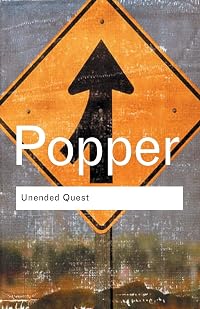
Unended Quest: An Intellectual Autobiography
by Karl R. Popper
On This Page
Description
At the age of eight, Karl Popper was puzzling over the idea of infinity and by fifteen was beginning to take a keen interest in his father's well-stocked library of books. Unended Quest recounts these moments and many others in the life of one of the most influential thinkers of the twentieth century, providing an indispensable account of the ideas that influenced him most. As an introduction to Popper's philosophy, Unended Quest alsonbsp;shines. Popper lucidly explainsnbsp;the central ideas show more in his work, making this book ideal for anyone coming to Popper's life and work for the first time. show lessTags
Recommendations



















Member Reviews
Read it after it was pointed to as a condensed view of Popper's work, but it undershoots and only really functions as a brief, uninviting gloss over some of the major "problems". He even abandons the autobiographical hook about halfway through as an unnecessary conceit, which, to be honest, it is.
The thing that really struck me though was how barren and empty of company the world of philosophy seems through Popper's eyes. Apart from the ever-present spectre of Wittgenstein at his shoulder, the sterility brings to mind Flaubert's observation that "There is not one tree in de Sade, not one animal."
The thing that really struck me though was how barren and empty of company the world of philosophy seems through Popper's eyes. Apart from the ever-present spectre of Wittgenstein at his shoulder, the sterility brings to mind Flaubert's observation that "There is not one tree in de Sade, not one animal."
Ratings
Members
- Recently Added By
Author Information

Although he writes widely in philosophy, Sir Karl Raimund Popper is best known for his thesis that an empirical statement is meaningless unless conditions can be specified that could show it to be false. He was born and educated in Vienna, where he was associated with, although not actually a member of, the Vienna Circle. Two years after the show more German publication of his Logic of Scientific Discovery (1935), he left Austria for New Zealand, where he was senior lecturer at the University of Canterbury. In 1945 he moved to England and began a distinguished career at the London School of Economics and Political Science. According to Popper, there is no "method of discovery" in science. His view holds that science advances by brilliant but unpredictable conjectures that then stand up well against attempts to refute them. This view was roundly criticized by more dogmatic positivists, on the one hand, and by Feyerabend and Kuhn, on the other. In 1945 he published The Open Society and Its Enemies, which condemns Plato, Georg Hegel, and Karl Marx as progenitors of totalitarianism and opponents of freedom. The scholarship that underpins this book remains controversial. Popper's later works continue his interest in philosophy of science and also develop themes in epistemology and philosophy of mind. He is particularly critical of historicism, which he regards as an attitude that fosters a deplorable tendency toward deterministic thinking in the social sciences. (Bowker Author Biography) show less
Series
Belongs to Publisher Series
Common Knowledge
- Canonical title
- Unended Quest: An Intellectual Autobiography
- Original publication date
- 1976
- People/Characters
- Adalbert Pösch; Eric Schiff; Simon Siegmund Carl Popper; Siegmund Karl Pflug; Jenny Popper (née Schiff); Raimund Grübl (show all 82); Emma Goldberger; Arthur Arndt; Rosa Graf (née Freud); Hermann Graf; Philipp Freud; Albert Einstein; Max Elstein; Wilhelm Wirtinger; Philipp Furtwängler; Hans Hahn; Eduard Helly; Kurt Reidemeister; Richard von Mises; Hans Thirring; Konrad Lorenz; Karoline Schiff (née Schlesinger); Bruno Walter (Schlesinger); Rudolf Serkin; Arnold Schoenberg; Erwin Stein; Anton Webern; Alban Berg; Robert Lammer; Karl Bühler; Heinrich Gomperz; Karl Polanyi; Julius Kraft; Moritz Schlick; Otto Neurath; Victor Kraft; Edgar Zilsel; Herbert Feigl; Walter Schiff; Franz Urbach; Fritz Waismann; Philipp Frank; Alfred Tarski; Rudolf Carnap; Bertrand Russell; Carl Gustav Hempel; Hans Reichenbach; Victor Weisskopf; Niels Bohr; Erwin Schrödinger; Annemarie Schrödinger; Kurt Gödel; Abraham Wald; Arthur March; Susan Stebbing; A. J. Ayer; Isaiah Berlin; Gilbert Ryle; Friedrich Hayek; Lionel Robbins; Ernst Gombrich; Walter Adams (economist); A. C. Ewing; R. M. Campbell; Colin Simkin; J. N. Findlay; John Eccles; Alfred Braunthal; Karl Hilferding; John Watkins (philosopher); Ludwig Wittgenstein; R. B. Braithwaite; Peter Munz; Paul Bernays; Evert Willem Beth; L. E. J. Brouwer; Arend Heyting; Peter Medawar; Wolfgang Pauli; William Warren Bartley III; David Miller (philosopher); Karl Popper
- Important places
- Himmelhof, Ober St. Veit, Vienna, Austria; Vienna, Austria; Altaussee, Salzkammergut, Austria; Bad Ischl, Salzkammergut, Austria; Prague, Czech Republic; Copenhagen, Denmark (show all 12); Alpbach, Tyrol, Austria; Volksgarten, Vienna, Austria; Christchurch, New Zealand; London, England, UK; Oxford, Oxfordshire, England, UK; Cambridge, Cambridgeshire, England, UK
- Blurbers
- Magee, Bryan; Burgess, Tyrrell; Gardner, Martin
Classifications
- Genres
- Philosophy, Biography & Memoir, Nonfiction, Science & Nature, General Nonfiction, History
- DDC/MDS
- 192 — Philosophy & psychology Modern western philosophy Philosophy of British Isles
- LCC
- B1649 .P64 .A38 — Philosophy, Psychology and Religion Philosophy (General) By period Modern By region or country
- BISAC
Statistics
- Members
- 530
- Popularity
- 56,410
- Reviews
- 1
- Rating
- (3.89)
- Languages
- 10 — Czech, Dutch, English, French, German, Hungarian, Italian, Portuguese, Spanish, Swedish
- Media
- Paper, Audiobook, Ebook
- ISBNs
- 29
- ASINs
- 4