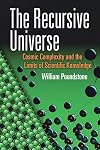
The Recursive Universe: Cosmic Complexity and the Limits of Scientific Knowledge
by William Poundstone
On This Page
Description
This fascinating popular science journey explores key concepts in information theory in terms of Conway's "Game of Life" program. The author explains the application of natural law to a random system and demonstrates the necessity of limits. Other topics include the limits of knowledge, paradox of complexity, Maxwell's demon, Big Bang theory, and much more.Tags
Recommendations











Member Reviews
I read this book many years ago but it remains outstanding in my mind, a book that really changed my outlook.
It's basically about the "game" Life, invented by the mathematician John Horton Conway. It's not really a game in any ordinary sense. It is a cellular automaton. Consider a two dimensional plane on which a square lattice is situated. Each site in the lattice houses a bit of state, a variable that takes on the values 0 or 1 at successive time steps. Each cell in the lattice follows the same rule. It looks at the states of its 8 neighbors in the lattice, along with its own state. It applies the rule then to determine its own state in the next time step. Every cell in the lattice applies the same rule, all cells together in lock show more step. Conway found a particular rule, deceptively simple, that gives rise to especially nice patterns of 0 and 1 appearing and evolving as time proceeds.
The basic shock of the books is to see how this one very simple rule can give rise to stunning complexity. Poundstone does a splendid job of building up patterns from simple to complex. The primitive rule is eminently understandable, but the patterns it can give rise to exceed any possible comprehension. It is not unreasonable to think that our universe is similarly constructed from similarly simple patterns. The conclusion is thus that it is not reasonable to expect the patterns that arise to be comprehensible.
Check out: https://www.youtube.com/watch?v=C2vgICfQawE show less
It's basically about the "game" Life, invented by the mathematician John Horton Conway. It's not really a game in any ordinary sense. It is a cellular automaton. Consider a two dimensional plane on which a square lattice is situated. Each site in the lattice houses a bit of state, a variable that takes on the values 0 or 1 at successive time steps. Each cell in the lattice follows the same rule. It looks at the states of its 8 neighbors in the lattice, along with its own state. It applies the rule then to determine its own state in the next time step. Every cell in the lattice applies the same rule, all cells together in lock show more step. Conway found a particular rule, deceptively simple, that gives rise to especially nice patterns of 0 and 1 appearing and evolving as time proceeds.
The basic shock of the books is to see how this one very simple rule can give rise to stunning complexity. Poundstone does a splendid job of building up patterns from simple to complex. The primitive rule is eminently understandable, but the patterns it can give rise to exceed any possible comprehension. It is not unreasonable to think that our universe is similarly constructed from similarly simple patterns. The conclusion is thus that it is not reasonable to expect the patterns that arise to be comprehensible.
Check out: https://www.youtube.com/watch?v=C2vgICfQawE show less
Ratings
Members
- Recently Added By
Author Information

28 Works 5,983 Members
William Poundstone has been nominated twice for the Pulitzer Prize. Among his seven books are "The Recursive Universe," "Labyrinths of Reason," and "Big Secrets." He has also written extensively for network television and major magazines. He lives in Los Angeles. (Publisher Provided)
Series
Belongs to Publisher Series
Common Knowledge
- Dedication
- To my parents
- First words
- In the early 1950s, the Hungarian-American mathematician John Von Neumann was toying with the idea of machines that make machines.
- Last words
- (Click to show. Warning: May contain spoilers.)Creation can be simple.
- Canonical LCC
- Q325 .P68 1985b
Classifications
Statistics
- Members
- 338
- Popularity
- 93,283
- Reviews
- 1
- Rating
- (4.11)
- Languages
- English
- Media
- Paper, Ebook
- ISBNs
- 5
- UPCs
- 1
- ASINs
- 3