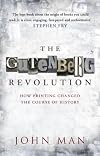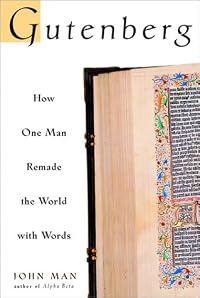
Gutenberg: How One Man Remade the World with Words
by John Man
On This Page
Description
A biography of the fifteenth-century German printer who revolutionized printing with the invention of movable type.Tags
Recommendations

















Member Recommendations
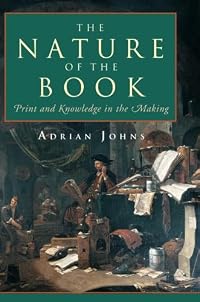
lhungsbe 1517, Printing, and the Making of the Reformation
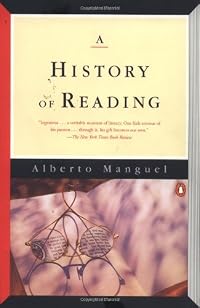
John_Vaughan The history of the (printed) word
Member Reviews
This is my book of the year! If , as I was, you are expecting a standard biography, then you're in for a surprise. Gutenberg is an important, but by no means dominant character. This is the story of printing and its effects upon life, both at the time and to a very real extent, today.
Having read this book, I genuinely feel that I have a greater understanding of the fifteenth and sixteenth centuries and the beginning of the move from a church based, to a secular World.
Having read this book, I genuinely feel that I have a greater understanding of the fifteenth and sixteenth centuries and the beginning of the move from a church based, to a secular World.
Johannes Gutenberg’s life is just tangible enough to warrant a full-length biography, and just sketchy enough to beget a whole society of people who scour archives around Europe trying to find anything they can about him. If it weren’t for his many business dealings (and debts), we wouldn’t have half the information we do now. Born in 1398 to an upper-class merchant family, he grew up around the minting and goldsmithing trades. He is assumed to have studies at the University of Erfurt around 1418. And then he disappears.
John Man’s tale of the machine and its inventor is very good. He understands the shortcomings of the current knowledge of Gutenberg and tries to find avenues (both historical and religious) to explain some of the show more circumstances in his life. The digressions that do exist are fun and, many times, necessary. Anyone with an interest in early bibliography will enjoy this book. show less
John Man’s tale of the machine and its inventor is very good. He understands the shortcomings of the current knowledge of Gutenberg and tries to find avenues (both historical and religious) to explain some of the show more circumstances in his life. The digressions that do exist are fun and, many times, necessary. Anyone with an interest in early bibliography will enjoy this book. show less
This book's title is a little misleading, since there isn't enough known of Gutenberg's life to fill an entire book. In addition to biographical information about Gutenberg, the book also deals with both church and secular politics, including sketches of a couple of other prominent men of the era. Nicholas of Cusa was about the same age as Gutenberg, and the author speculates about how the two men might have crossed paths, and the influence Nicholas might have had on the selection of material for printing. I was more familiar with Martin Luther's story, and how printing technology facilitated the spread of the Protestant Reformation.
This is a solid non-academic overview of the early era of printing. The bibliography demonstrates the show more author's familiarity with scholarly works on this topic. I've read a few of the titles in the list, and I struggled to stay awake through some of them. Staying awake shouldn't be a problem for this book's readers. The author includes plenty of facts, but the facts never get in the way of the story. This book provides a good introduction to the early print era, and I suspect many readers will be inspired to look for additional reading material about some of the people and events mentioned in its pages. show less
This is a solid non-academic overview of the early era of printing. The bibliography demonstrates the show more author's familiarity with scholarly works on this topic. I've read a few of the titles in the list, and I struggled to stay awake through some of them. Staying awake shouldn't be a problem for this book's readers. The author includes plenty of facts, but the facts never get in the way of the story. This book provides a good introduction to the early print era, and I suspect many readers will be inspired to look for additional reading material about some of the people and events mentioned in its pages. show less
Rating: 4* of five
The Publisher Says: A world forever changed...In 1450, all of western Europe's books were hand-copied and amounted to no more than are in a modern public library. By 1500, printed books numbered in the millions. Johann Gutenberg's invention of movable type ignited the explosion of art, literature, and scientific research that accelerated the Renaissance and led directly to the Modern Age. In Gutenberg, you'll meet the genius who fostered this revolution, discover the surprising ambitions that drove him, and learn how a single, obscure artisan changed the course of history.
"His story is one of genius very nearly denied. A few records less, and we would not now be revering the Gutenberg Bible as his. All we would have show more would be the results: an idea that changed the world and a book that is amongst the most astonishing objects ever created?a jewel of art and technology, one that emerged fully formed, of a perfection beyond anything required by its purpose. It is a reminder that the business Gutenberg started . . . contains elements of the sublime?that at the heart of the mountains of printed dross there is gold." --From the Introduction to Gutenberg
My Review: An attempt to write a biography of the man who set in motion the creation of our mutual object of addiction, the book. Lots of research went into the book, the author has reached deep into the documentary evidence, and has built a solid story of the life that gave rise to one important aspect of the modern world.
Delightful book, fun to read, and quite informative.
I don't like Gutenberg very much as a person at the end of this book, but I appreciate more than ever the genius of the man to have brought together so much extant knowledge and synthesized something extraordinary and new from that basis.
Recommended to lovers of books about books, biography fans, and those with a mild, non-professional interest in medieval history. Those who adventure into different genres in search of dry wit are encouraged to read here, too. show less
The Publisher Says: A world forever changed...In 1450, all of western Europe's books were hand-copied and amounted to no more than are in a modern public library. By 1500, printed books numbered in the millions. Johann Gutenberg's invention of movable type ignited the explosion of art, literature, and scientific research that accelerated the Renaissance and led directly to the Modern Age. In Gutenberg, you'll meet the genius who fostered this revolution, discover the surprising ambitions that drove him, and learn how a single, obscure artisan changed the course of history.
"His story is one of genius very nearly denied. A few records less, and we would not now be revering the Gutenberg Bible as his. All we would have show more would be the results: an idea that changed the world and a book that is amongst the most astonishing objects ever created?a jewel of art and technology, one that emerged fully formed, of a perfection beyond anything required by its purpose. It is a reminder that the business Gutenberg started . . . contains elements of the sublime?that at the heart of the mountains of printed dross there is gold." --From the Introduction to Gutenberg
My Review: An attempt to write a biography of the man who set in motion the creation of our mutual object of addiction, the book. Lots of research went into the book, the author has reached deep into the documentary evidence, and has built a solid story of the life that gave rise to one important aspect of the modern world.
Delightful book, fun to read, and quite informative.
I don't like Gutenberg very much as a person at the end of this book, but I appreciate more than ever the genius of the man to have brought together so much extant knowledge and synthesized something extraordinary and new from that basis.
Recommended to lovers of books about books, biography fans, and those with a mild, non-professional interest in medieval history. Those who adventure into different genres in search of dry wit are encouraged to read here, too. show less
This book did what I wanted it to - sorta. I wanted to learn more about Gutenberg and the creation of the printing press. While I do know more, I'm overall dissapointed by the world in general. How can we not have more information on this man!
The reason I've only given this book 3 stars is that I think there is way too much background information and it feels like padding to make up for the lack of available information on Gutenberg himself. I did, however, enjoy the section on important early books.
If you want to learn about the medieval Mainz with a side dish of the infancy of printing this is for you. However, if you want to focus on Gutenberg then I suggest you find a Tardis and travel back in time to meet the man himself. There show more just isn't enough existant information to put together a complete picture. show less
The reason I've only given this book 3 stars is that I think there is way too much background information and it feels like padding to make up for the lack of available information on Gutenberg himself. I did, however, enjoy the section on important early books.
If you want to learn about the medieval Mainz with a side dish of the infancy of printing this is for you. However, if you want to focus on Gutenberg then I suggest you find a Tardis and travel back in time to meet the man himself. There show more just isn't enough existant information to put together a complete picture. show less
A fascinating look at the history of printing, as it evolved from the painfully copied and transposed palimpsest type of books that existed before the invention of movable type.
Man’s careful and scholarly research does not obscure his sheer enthusiasm for the man, history or the period. From the revealing of Gutenberg’s motives – profit and the spread of religion – through to his somewhat overwrought concluding chapter, the author holds our attention with prose that communicates his own delight in the important events, inventions and improving technical enhancements in the world of printing information to expand knowledge.
Man’s careful and scholarly research does not obscure his sheer enthusiasm for the man, history or the period. From the revealing of Gutenberg’s motives – profit and the spread of religion – through to his somewhat overwrought concluding chapter, the author holds our attention with prose that communicates his own delight in the important events, inventions and improving technical enhancements in the world of printing information to expand knowledge.
Interesting, well written account of the invention of the printing press.
Members
- Recently Added By
Published Reviews
Set in the uncommon Poliphilus typeface - spacious, with sharp-cut serifs and tilted hyphens - it has a typographical pedigree originating in Italy at the end of the 15th century, in the lusty Hypnerotomachia Poliphili , described by Man as "one of the craziest, most beautiful books ever printed... the work of a cryptomaniac". His own book is extremely erudite and enormously enthusiastic, show more though sometimes irritatingly chatty. It is worth persisting with, however, for its subject is nothing less than one of the greatest turning points in the development of civilisation show less
added by John_Vaughan
Author Information

60+ Works 4,957 Members
John Man is a historian specializing in the nature of leadership. John's books have been published in over twenty languages around the world and include histories of the Great Wall of China and the Mongolian Empire. He lives in England.
Common Knowledge
- Original publication date
- 2002
- People/Characters
- Johannes Gutenberg (1394/99-c.1468); William Caxton (c.1422-1491); Frederick III the Wise, Elector of Saxony; Johann Fust; Peter Schoeffer
- Important places
- Eltville, Hesse, Germany; Mainz, Rhineland-Palatinate, Germany
- Dedication
- For Dushka
- First words
- INTRODUCTION
The Third Revolution
On a graph of human contact over the last 5,000 years, the line from grunt to e-mail is not a regular curve.
CHAPTER 1
A Golden City, Tarnished
Coming to Mainz in around 1400, you have the best view if you approach along the Rhine. - Quotations
- CHAPTER 5
The Secret Revealed
Printing with movable type was both inspiration and perspiration, an idea and an invention. - Last words
- (Click to show. Warning: May contain spoilers.)For there, in perpetuo, will be Gutenberg's Bible in all its electronic glory, to remind our children's children that this was the thing that started the revolution made by Johannes Gutenberg.
- Blurbers
- Moorhouse, Geoffrey
Classifications
- Genres
- History, Nonfiction, General Nonfiction, Biography & Memoir, Technology
- DDC/MDS
- 686.1092 — Applied Science & Technology Manufacture for specific uses Printing and related activities History of Printing History of Printing: Europe Biography
- LCC
- Z126 .Z7 .M36 — Bibliography, Library Science and Information Resources Book industries and trade History
- BISAC
Statistics
- Members
- 582
- Popularity
- 50,322
- Reviews
- 9
- Rating
- (3.71)
- Languages
- English, French, Portuguese (Portugal), Swedish
- Media
- Paper, Ebook
- ISBNs
- 8
- ASINs
- 2