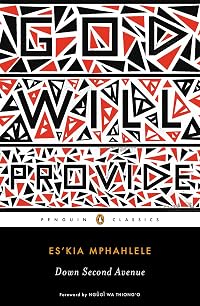
Down Second Avenue
by Es'kia Mphahlele
On This Page
Description
Es'kia Mphahlele's seminal memoir of life in apartheid South Africa--available for the first time in Penguin Classics Nominated for the Nobel Prize in 1969, Es'kia Mphahlele is considered the Dean of African Letters and the father of black South African writing. Down Second Avenue is a landmark book that describes Mphahlele's experience growing up in segregated South Africa. Vivid, graceful, and unapologetic, it details a daily life of severe poverty and brutal police surveillance under the show more subjugation of an apartheid regime. Banned in South Africa after its original 1959 publication for its protest against apartheid, Down Second Avenue is a foundational work of literature that continues to inspire activists today. For more than sixty-five years, Penguin has been the leading publisher of classic literature in the English-speaking world. With more than 1,500 titles, Penguin Classics represents a global bookshelf of the best works throughout history and across genres and disciplines. Readers trust the series to provide authoritative texts enhanced by introductions and notes by distinguished scholars and contemporary authors, as well as up-to-date translations by award-winning translators. show lessTags
Recommendations












Member Reviews
In this memoir, Mphahlele describes the first 38 years of his life, up to the moment when he went into exile in 1957 to teach in Nigeria. He talks about his early childhood living with his father's parents in a village in a "tribal area" of northern Transvaal, then his teens when he lived with his mother in Marabastad township ("Second Avenue") outside Pretoria, the most detailed section of the book, and the part that reads most like a novel. We move on to his difficult struggle to get an education, always haunted by the knowledge of the sacrifices his single mother was making to pay his fees (she works as a domestic servant, does white people's laundry, and brews and sells illegal beer), and his determination not to fail at any point. show more He qualifies as a teacher, and, after a spell in a clerical job at an institution for the blind, goes to teach at Orlando High School just in time to get swept up in the campaign against the Bantu Education Acts of the 1950s. As secretary of the Transvaal Teachers' Association, he is sacked and blacklisted by the Education Department, and eventually finds work on Drum magazine until he can get permission to leave South Africa.
Although this is the story of an ambitious self-improver who is transformed by circumstances into a community activist who comes close to destroying his family's livelihood through the work he is doing for others, Mphahlele's modesty (plus perhaps legitimate concerns for colleagues still in South Africa) means there isn't much emphasis on how this transformation in his character happened, or on the actual political work he was doing. We have to follow his political development indirectly, through the many little descriptions of incidents in his life that make clear the nastiness of the mid-20th century South African system and the way it made internalised racism inevitable for both black and white South Africans.
A wonderfully-written, warm, sympathetic account of growing up in difficult conditions in a lively, dangerous community, but also a chilling, clear-sighted indictment of the racism, self-interest and inequality that underlay that situation. show less
Although this is the story of an ambitious self-improver who is transformed by circumstances into a community activist who comes close to destroying his family's livelihood through the work he is doing for others, Mphahlele's modesty (plus perhaps legitimate concerns for colleagues still in South Africa) means there isn't much emphasis on how this transformation in his character happened, or on the actual political work he was doing. We have to follow his political development indirectly, through the many little descriptions of incidents in his life that make clear the nastiness of the mid-20th century South African system and the way it made internalised racism inevitable for both black and white South Africans.
A wonderfully-written, warm, sympathetic account of growing up in difficult conditions in a lively, dangerous community, but also a chilling, clear-sighted indictment of the racism, self-interest and inequality that underlay that situation. show less
An interesting book. (Auto)biography. The first part I found the most interesting, when Mphahlele was young(er).
For me it added another voice telling me one of the many stories there are to tell about South Africa & apartheid like it used to be.
For me it added another voice telling me one of the many stories there are to tell about South Africa & apartheid like it used to be.
Ratings
Members
- Recently Added By
Lists

Top Five Books of 2020
982 works; 348 members

Black Authors
384 works; 32 members
Author Information
21+ Works 411 Members
Some Editions
Awards and Honors
Series
Belongs to Publisher Series
Seven Seas Books (1962)
Common Knowledge
- Original publication date
- 1959
- Epigraph
- The best lack all conviction, while the worst
Are full of passionate intensity
W. B. Yeats - Dedication
- To
Eva, my late Mother
Grandmother
Aunt Dora
Rebecca
...and Jenny, who bullied me
into telling her about them - First words
- It was in 1963, precisely fifty years ago, that Eskia Mphahlele, then still in exile from the apartheid regime, founded the Chemchemi Creative Council in Nairobi. (Foreword)
I have never known why we - my brother, sister and I - were taken to the country when I was five.
I can never summon enough courage to read a line from any of the stories that were published in 1947 under the title, Man Must Live again. (Epilogue) - Last words
- (Click to show. Warning: May contain spoilers.)Reading it unites us with the spirit of Mphahlele, the exile, who never stopped dreaming of home for all. (Foreword)
(Click to show. Warning: May contain spoilers.)I was highly flattered by the enthusiastic applause and a special word of congratulations from Sire Lewis and Dame Sybil.
(Click to show. Warning: May contain spoilers.)I'm glad that I can at last exercise that right. (Epilogue)
Classifications
Statistics
- Members
- 213
- Popularity
- 153,734
- Reviews
- 2
- Rating
- (3.72)
- Languages
- English, Swedish
- Media
- Paper, Ebook
- ISBNs
- 8
- ASINs
- 5