On This Page
Description
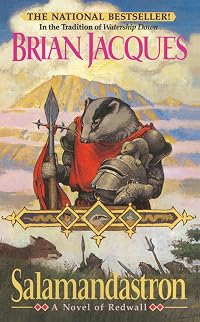
Urthstripe the Strong, a wise old badger, leads the animals of the great fortress of Salamandastron and Redwall Abbey against the weasel Ferahgo the Assassin and his corps of vermin.Tags
Recommendations



Member Reviews
Salamandastron gets more of the focus than Redwall this time, as you'd expect from the title. It's a few decades after the adventures of Mariel in the last book. We get to see the mountain under siege for a change rather than the abbey, defended by its badger lord and the Long Patrol of course, and we learn a lot more about its structure and fortifications. The father-son pair of villains is an interesting dynamic and rivalry, reflecting the father-daughter badger relationship on the other side of the contest.
This fifth Redwall outing features a lot of different things going on, so many that (reading one chapter to my son each day) we kept experiencing the feeling of "oh yes, forgot about those characters" as we cycled through them. It show more feels like more than the usual number of simultaneous quests. If we'd been reading faster this probably would have been okay. I've long been conscious of Brian Jacques gift for description but this time I paid closer attention. Any prospective author could do worse than take him as a model, it's well above the norm for today's YA market. I'm beginning to surrender my critique about his repetitiveness from one volume to the next. He's found the trick of building a fondness for those things in the reader, rather than exasperating them: from the constant eating to the stock villains to the happy reunions, instead of rolling my eyes I find myself looking forward to them each time. The series remains consistently solid. show less
This fifth Redwall outing features a lot of different things going on, so many that (reading one chapter to my son each day) we kept experiencing the feeling of "oh yes, forgot about those characters" as we cycled through them. It show more feels like more than the usual number of simultaneous quests. If we'd been reading faster this probably would have been okay. I've long been conscious of Brian Jacques gift for description but this time I paid closer attention. Any prospective author could do worse than take him as a model, it's well above the norm for today's YA market. I'm beginning to surrender my critique about his repetitiveness from one volume to the next. He's found the trick of building a fondness for those things in the reader, rather than exasperating them: from the constant eating to the stock villains to the happy reunions, instead of rolling my eyes I find myself looking forward to them each time. The series remains consistently solid. show less
Summary: The Badger Lord of the mountain fortress Salamandastron faces the overwheming forces of the Corpsemakers led by Ferahgo the Assassin and his son Klitch while Redwall Abbey is laid low by a deadly fever.
In this fifth book in the Redwall we are faced with the possibility of the fall of the mountain fortress of Salamandastron to evil forces and the extinction of Redwall Abbey to a deadly plague. So much will hinge on the actions of a few creatures we follow through the story.
The story begins with the restlessness of Mara, the young ward of the Badger Lord of Salamandastron, Urthstripe. She chafes under the discipline of the mountain fortress, and wanders off with Pikkle, a rogue hare with a huge appetite. They meet up with a show more couple of weasels who seem friendly enough that Mara invites them to dinner. Hospitality prevails but Urthstripe is suspicious and forces them to leave with the morning. He is right to do so, because they are spying out the fortress for Ferahgo the Assassin, an evil weasel who heads up a large band known as the Corpsemakers. One of them is Klitch, Ferahgo’s son, second in command, itching to take over. Mara resents Urthstripe’s coldness to her new friends and decides to run away. She is joined by Pikkle, they meet up with her weasel “friends” who take them to Ferahgo where they are held captive and questioned about the “treasure” in the mountain. They know nothing of this. Ferahgo sets his sights on conquest, eventually besieging, attacking, and through a secret agent, poisoning the food and water in the mountain.
Meanwhile, two stoats from Ferahgo’s group, unhappy with their lot, go wandering in the forests and find their way to Redwall. The Abbey, hospitable to all, welcomes them and the join a feast. That night, a storm descends, and a lightning strike looses the sword of Martin the Warrior that had been affixed to the weathervane, nearly killing Samkin the squirrel, who has been having dreams about Martin. They place it in the Great Hall by Martin’s Tapestry. The next morning the stoats are fooling with arrows in the hall and accidentally kill a brother. They flee, but before escaping, spy the sword, which they take to present to Ferahgo. Samkin and Arula the molemaid go in pursuit, only to find one dead along the way. They encounter a hermit, Furgle, who tells them it is Dry Ditch fever. They press on while Furgle goes to warn the Abbey. Too late. The sickness is spreading throughout the Abbey. Legend has it only the Flowers of Icetor in the North Mountains can cure the sickness. So Thrugg the otter, accompanied by Dumble the Dormouse set off to find the flowers, braving an attack of crows, only to find the flowers guarded by a majestic golden eagle, King MacPhearsome.
Meanwhile, Mara and Pikkle escape, and through a series of adventures join with an army of shrews. Samkin and Arula eventually join another group of shrews and recapture the sword. The groups face a lake serpent, Deepcoiler and a fearsome white badger who holds a stone sacred to the shrews. Eventually all go to relieve the beseiged forces of Salamandastron. Will they make it in time and defeat such a wily foe? And will Samkin and Arula find anyone alive should they make it back to the Abbey?
Jacques offers a clear contrast throughout the story between good and evil–courage, camraderie, hospitality, and integrity on one side and treachery, backbiting, servitude, and betrayal on the other. Even amid challenges, there is the love of goodness, of friends, and of food. Once again, Jacques creates a strong female character in Mara, as ready and courageous in battle as her guardian Urthstripe. And in a theme that has developed in these stories, the spirit of Martin continues to watch over the Abbey. show less
In this fifth book in the Redwall we are faced with the possibility of the fall of the mountain fortress of Salamandastron to evil forces and the extinction of Redwall Abbey to a deadly plague. So much will hinge on the actions of a few creatures we follow through the story.
The story begins with the restlessness of Mara, the young ward of the Badger Lord of Salamandastron, Urthstripe. She chafes under the discipline of the mountain fortress, and wanders off with Pikkle, a rogue hare with a huge appetite. They meet up with a show more couple of weasels who seem friendly enough that Mara invites them to dinner. Hospitality prevails but Urthstripe is suspicious and forces them to leave with the morning. He is right to do so, because they are spying out the fortress for Ferahgo the Assassin, an evil weasel who heads up a large band known as the Corpsemakers. One of them is Klitch, Ferahgo’s son, second in command, itching to take over. Mara resents Urthstripe’s coldness to her new friends and decides to run away. She is joined by Pikkle, they meet up with her weasel “friends” who take them to Ferahgo where they are held captive and questioned about the “treasure” in the mountain. They know nothing of this. Ferahgo sets his sights on conquest, eventually besieging, attacking, and through a secret agent, poisoning the food and water in the mountain.
Meanwhile, two stoats from Ferahgo’s group, unhappy with their lot, go wandering in the forests and find their way to Redwall. The Abbey, hospitable to all, welcomes them and the join a feast. That night, a storm descends, and a lightning strike looses the sword of Martin the Warrior that had been affixed to the weathervane, nearly killing Samkin the squirrel, who has been having dreams about Martin. They place it in the Great Hall by Martin’s Tapestry. The next morning the stoats are fooling with arrows in the hall and accidentally kill a brother. They flee, but before escaping, spy the sword, which they take to present to Ferahgo. Samkin and Arula the molemaid go in pursuit, only to find one dead along the way. They encounter a hermit, Furgle, who tells them it is Dry Ditch fever. They press on while Furgle goes to warn the Abbey. Too late. The sickness is spreading throughout the Abbey. Legend has it only the Flowers of Icetor in the North Mountains can cure the sickness. So Thrugg the otter, accompanied by Dumble the Dormouse set off to find the flowers, braving an attack of crows, only to find the flowers guarded by a majestic golden eagle, King MacPhearsome.
Meanwhile, Mara and Pikkle escape, and through a series of adventures join with an army of shrews. Samkin and Arula eventually join another group of shrews and recapture the sword. The groups face a lake serpent, Deepcoiler and a fearsome white badger who holds a stone sacred to the shrews. Eventually all go to relieve the beseiged forces of Salamandastron. Will they make it in time and defeat such a wily foe? And will Samkin and Arula find anyone alive should they make it back to the Abbey?
Jacques offers a clear contrast throughout the story between good and evil–courage, camraderie, hospitality, and integrity on one side and treachery, backbiting, servitude, and betrayal on the other. Even amid challenges, there is the love of goodness, of friends, and of food. Once again, Jacques creates a strong female character in Mara, as ready and courageous in battle as her guardian Urthstripe. And in a theme that has developed in these stories, the spirit of Martin continues to watch over the Abbey. show less
(I finished this a month ago and should have reviewed it back then, but I was more interested in diving into my next book than writing a review.)
Salamandastron follows multiple groups of characters whose paths eventually converge. The primary storyline starts at Salamandastron. Ferahgo, a blue-eyed assassin weasel, has set his sights on that place and is convinced that there is great treasure to be found there. He knows it’ll all belong to him if he and his band can manage to defeat Urthstripe, the great badger Lord, and his skilled warrior hares. Urthstripe, meanwhile, is distracted by family problems: Mara, his adopted daughter, has been growing increasingly rebellious and restless.
The secondary storyline starts at Redwall show more Abbey. Everything there is good food and celebrations, with occasional light punishments for scamps like Samkim the squirrel and his best friend Arula the molemaid, until a couple stoats accidentally do something horrible. Suddenly Samkim finds himself suspected of killing someone. As if that wasn’t bad enough, many of Redwall Abbey’s residents then fall ill with the dreaded Dryditch Fever.
This is the first Redwall book I’ve ever read. I had planned to start with Redwall, the very first book in the series, but my copy was used and fell apart in my hands when I opened it up. After a little searching online, I determined that I should be able to start with Salamandastron, the one other Redwall book I owned, without becoming too confused.
Salamandastron was given to me by a friend back when I was, I think, in middle school. If I had read it back then, I might have liked it more. Despite its copious amounts of (not explicitly described) violence and death, Salamandastron definitely read like it was meant for a younger audience - I’m guessing either the high end of the Middle Grade age range or the low end of the Young Adult.
Then again, who knows? Maybe the various accents in Salamandastron would have annoyed Younger Me too. The moles were definitely the worst, although the falcons and eagle occasionally gave me trouble too. Here’s an example that made me laugh bitterly - a mole saying he had trouble understanding an eagle:
Oh really. And how do you think I felt every time one of the moles opened their mouths? There were times I just gave up and skimmed certain characters’ dialogue. Why did Samkim’s best friend have to be a mole? ::sob::
I can totally see younger readers being drawn in by the anthropomorphized animals and action scenes. And food descriptions! This book was chock full of delicious-sounding food. Unfortunately, sometimes all that food and eating detracted from the story. For example, at one point Mara’s friend Pikkle took part in an eating contest. This was after he and Mara had nearly been eaten by carnivorous toads. Not to mention, Mara and Pikkle should still have been worried sick about what Ferahgo and his band might be doing to their friends and family back at Salamandastron. But no, figuring out who could eat the most hot spiced apple pudding was suddenly the most important thing.
This was part of the reason why the book read so young: serious stuff happened, but it didn’t seem to have as much emotional impact as it should. Several good characters died! At least one of them senselessly! And one villain’s fate was saved from being gruesome only because most of it happened off-page and none of it was described in detail. If the other Redwall books have body counts similar to this one, I don’t think it’d be too out of line to say that Brian Jacques is the George R.R. Martin of Middle Grade fantasy.
But, again, those deaths didn’t have much emotional impact. Beloved friends and family died, and characters moved on within a page or two and were soon back to happily gorging themselves on delicious festival foods.
Meh. I had hoped to fall in love with this series, but Salamandastron has left me with no desire to try more.
Additional Comments:
I couldn’t figure out how to fit it into the body of my review, but I wanted to mention it anyway: I have never seen so many characters practice such terrible weapons safety in a single book. Samkim liked to shoot arrows wherever, just for fun, and all the adults around him did was ground him and then worry they were being too harsh. And one character, an adult who should have known better, straight up stabbed himself (not fatally, but still) because he’d been playing around with a sword like it was a toy.
(Original review posted on A Library Girl's Familiar Diversions.) show less
Salamandastron follows multiple groups of characters whose paths eventually converge. The primary storyline starts at Salamandastron. Ferahgo, a blue-eyed assassin weasel, has set his sights on that place and is convinced that there is great treasure to be found there. He knows it’ll all belong to him if he and his band can manage to defeat Urthstripe, the great badger Lord, and his skilled warrior hares. Urthstripe, meanwhile, is distracted by family problems: Mara, his adopted daughter, has been growing increasingly rebellious and restless.
The secondary storyline starts at Redwall show more Abbey. Everything there is good food and celebrations, with occasional light punishments for scamps like Samkim the squirrel and his best friend Arula the molemaid, until a couple stoats accidentally do something horrible. Suddenly Samkim finds himself suspected of killing someone. As if that wasn’t bad enough, many of Redwall Abbey’s residents then fall ill with the dreaded Dryditch Fever.
This is the first Redwall book I’ve ever read. I had planned to start with Redwall, the very first book in the series, but my copy was used and fell apart in my hands when I opened it up. After a little searching online, I determined that I should be able to start with Salamandastron, the one other Redwall book I owned, without becoming too confused.
Salamandastron was given to me by a friend back when I was, I think, in middle school. If I had read it back then, I might have liked it more. Despite its copious amounts of (not explicitly described) violence and death, Salamandastron definitely read like it was meant for a younger audience - I’m guessing either the high end of the Middle Grade age range or the low end of the Young Adult.
Then again, who knows? Maybe the various accents in Salamandastron would have annoyed Younger Me too. The moles were definitely the worst, although the falcons and eagle occasionally gave me trouble too. Here’s an example that made me laugh bitterly - a mole saying he had trouble understanding an eagle:
“‘Och, these vittles are braw eatin’, Dumble. Ha’ ye nae mair o’ these wee veggible pasties the guid hedgepig lady made?’
Droony squinched his eyes until they nearly disappeared into his small velvety face. ‘Bohurr, you’m heagle do be a-talken funny loik. Oi carn’t unnerstan’ a wurd ‘ee be sayen, Dumble.’” (290)
Oh really. And how do you think I felt every time one of the moles opened their mouths? There were times I just gave up and skimmed certain characters’ dialogue. Why did Samkim’s best friend have to be a mole? ::sob::
I can totally see younger readers being drawn in by the anthropomorphized animals and action scenes. And food descriptions! This book was chock full of delicious-sounding food. Unfortunately, sometimes all that food and eating detracted from the story. For example, at one point Mara’s friend Pikkle took part in an eating contest. This was after he and Mara had nearly been eaten by carnivorous toads. Not to mention, Mara and Pikkle should still have been worried sick about what Ferahgo and his band might be doing to their friends and family back at Salamandastron. But no, figuring out who could eat the most hot spiced apple pudding was suddenly the most important thing.
This was part of the reason why the book read so young: serious stuff happened, but it didn’t seem to have as much emotional impact as it should. Several good characters died! At least one of them senselessly! And one villain’s fate was saved from being gruesome only because most of it happened off-page and none of it was described in detail. If the other Redwall books have body counts similar to this one, I don’t think it’d be too out of line to say that Brian Jacques is the George R.R. Martin of Middle Grade fantasy.
But, again, those deaths didn’t have much emotional impact. Beloved friends and family died, and characters moved on within a page or two and were soon back to happily gorging themselves on delicious festival foods.
Meh. I had hoped to fall in love with this series, but Salamandastron has left me with no desire to try more.
Additional Comments:
I couldn’t figure out how to fit it into the body of my review, but I wanted to mention it anyway: I have never seen so many characters practice such terrible weapons safety in a single book. Samkim liked to shoot arrows wherever, just for fun, and all the adults around him did was ground him and then worry they were being too harsh. And one character, an adult who should have known better, straight up stabbed himself (not fatally, but still) because he’d been playing around with a sword like it was a toy.
(Original review posted on A Library Girl's Familiar Diversions.) show less
This review is also featured on Behind the Pages: Salamandastron
Ferhago the Assassin has set his eyes on Salamandastron. He is convinced treasure lies within the mountain’s depths. His son tricks Mara and her friend Pikkle into leaving the safety of Salamandastron to use as leverage. But Ferhago will find that the young badger and hare are not so easily kept captive. Meanwhile, across Mossflower Woods, Martin the Warrior’s sword is stolen from Redwall Abbey by members of Ferhago’s crew. Samkin the squirrel and Arula the molemaid set off to retrieve the Abbey sword, inevitably crossing paths with Mara and Pikkle. Together they must find a way to aid Salamandastron.
It was refreshing to see a squirrel wielding the sword of Martin the show more Warrior. The heroes of Redwall have all been mice up until Salamandastron. As each woodland creature has its own way of approaching situations, having a squirrel's perspective was a welcome change. Samkin is a skilled marksman but does not put his talent to good use. He and Arula are often found shooting arrows as pranks and landing themselves in trouble. But when Martin's sword is stolen, he and Arula do not hesitate to track down the thieves. And in doing so, they will overcome their mischievous ways and find themselves on their paths to becoming heroes.
While Redwall Abbey is an integral part of Salamandastron, the focus stays rooted in the characters tied to the mountain. Ferhago is a devious foe, willing to play the long game to win. He has many tricks up his sleeve and could care less if he is dishonorable in his victories. The solidarity and determination of the Salamandastron squad will encourage readers to cheer them on and weep alongside those who lose companions. The battle of good versus evil ensues as heroes young and old rise up against their vermin foes.
And while this time around no one is seeking to capture Redwall Abbey, a new unexpected threat lies in wait for the peaceful creatures. A sickness begins to spread, one that Brother Hollyberry has nothing to cure. And while it seems as if another plot would overtax the storyline, it gives readers a respite from the battles taking place at the mountain. Building a new form of tension as creatures succumb to the sickness awaiting the discovery of a cure.
Salamandastron breaks the mold of the previous Redwall books and yet still immerses readers in a wonderful tale filled with heroes, quests, and found family. The fifth book of the Redwall series provides a healthy dose of Redwall lore, wholesome adventure, and great characters. Readers will be sure to enjoy this fast-paced installment of the Redwall series. show less
Ferhago the Assassin has set his eyes on Salamandastron. He is convinced treasure lies within the mountain’s depths. His son tricks Mara and her friend Pikkle into leaving the safety of Salamandastron to use as leverage. But Ferhago will find that the young badger and hare are not so easily kept captive. Meanwhile, across Mossflower Woods, Martin the Warrior’s sword is stolen from Redwall Abbey by members of Ferhago’s crew. Samkin the squirrel and Arula the molemaid set off to retrieve the Abbey sword, inevitably crossing paths with Mara and Pikkle. Together they must find a way to aid Salamandastron.
It was refreshing to see a squirrel wielding the sword of Martin the show more Warrior. The heroes of Redwall have all been mice up until Salamandastron. As each woodland creature has its own way of approaching situations, having a squirrel's perspective was a welcome change. Samkin is a skilled marksman but does not put his talent to good use. He and Arula are often found shooting arrows as pranks and landing themselves in trouble. But when Martin's sword is stolen, he and Arula do not hesitate to track down the thieves. And in doing so, they will overcome their mischievous ways and find themselves on their paths to becoming heroes.
While Redwall Abbey is an integral part of Salamandastron, the focus stays rooted in the characters tied to the mountain. Ferhago is a devious foe, willing to play the long game to win. He has many tricks up his sleeve and could care less if he is dishonorable in his victories. The solidarity and determination of the Salamandastron squad will encourage readers to cheer them on and weep alongside those who lose companions. The battle of good versus evil ensues as heroes young and old rise up against their vermin foes.
And while this time around no one is seeking to capture Redwall Abbey, a new unexpected threat lies in wait for the peaceful creatures. A sickness begins to spread, one that Brother Hollyberry has nothing to cure. And while it seems as if another plot would overtax the storyline, it gives readers a respite from the battles taking place at the mountain. Building a new form of tension as creatures succumb to the sickness awaiting the discovery of a cure.
Salamandastron breaks the mold of the previous Redwall books and yet still immerses readers in a wonderful tale filled with heroes, quests, and found family. The fifth book of the Redwall series provides a healthy dose of Redwall lore, wholesome adventure, and great characters. Readers will be sure to enjoy this fast-paced installment of the Redwall series. show less
In the prologue to this fifth novel of Redwall, Ferahgo the Assassin, a weasel, has killed the badger lord Urthound and his wife Urthrun, leaving their two babies, one striped and the other white, to die of starvation. But do they die? Chapter one opens after many long seasons. Ferahgo and his Corpsemakers have slowly moved northward and are determined to capture Salamandastron, ruled by the badger lord Urthstripe and protected by the hares of the Long Patrol. However, Urthstripe’s daughter Mara runs away with one of the hares named Pikkle Ffloger. Ferahgo’s son Klitch tricks the two, and they are almost captured by the horde, but they escape, only to be deceived by a lizard named Slinkee who leads them to a group of cannibal toads show more under King Glagweb. However, they are rescued by Log-a-Log and his shrews, and together they set out to find the Blackstone, symbol of leadership among the shrews, which is now in the possession of the white “ghost badger” who lives on a mysterious island in the middle of a large lake. Their plan is then to head for Salamandastron and help in the fight against Ferahgo.
Meanwhile, at Redwall, two deserters from Ferahgo’s army, Thura and Dingeye, are taken in, but after they accidentally kill Brother Hal they escape with the sword of Martin the Warrior, intending to return to Ferahgo. A young squirrel named Samkim and a molemaid named Arula set out after them. Shortly afterwards, however, the abbey is plagued with Dryditch Fever, so the otter Thrugg and his little friend Dumble, a dormouse babe, set off for the Mountains of the North, ruled over by the golden eagle Wild King McPhearsome, to find Icetor Flowers which are said to cure the fever. After Thura dies of Dryditch fever and Dingeye is killed by the fox Dethbrush, whom Ferahgo had sent out to find them, Samkim and Arula, along with another group of shrews under the leadership of Alfoh, chase after Dethbrush, who now has the sword and is trying to escape in a boat through the same lake where Mara, Pikkle, and Log-a-Log have gone searching for the Blackstone. Will Samkim and Arula recover the sword of Martin the Warrior? Will Mara and Pikkle get the Blackstone back for Log-a-Log? Will Thrugg and Dumble return fever cure in time to save Redwall? And what will happen in the battle for Salamandastron?
Some people may find the plot a little confusing, because the chapters go back and forth describing the activities of Urthstripe and Ferahgo at Salamandastron, of Mara and Pikkle on their journey as they look for the Blackstone, of Samkim and Arula in their search for the sword, of the Redwallers as they deal with the Dryditch Fever, and of Thrugg and Dumble seeking the Icetor Flowers. However, the story is told so well, in Jacques’ inimitable style, that this should not be too much of a problem for most readers. The “veiled curse du jour” of this particular Redwall book is “hellsteeth.” There are also a few common euphemisms and childish slang terms, such as gosh, darn, and “frogsbum.” Otherwise, it has the usual strong sense of good versus evil, with no lack of villains to overcome and a host of quaint characters, such as Furgle, Tubgutt, Nordo, Spriggat, and Rocangus, to work together in overcoming them—and a few surprises along the way. I especially liked the way that Mara eventually comes to understand the truth, even though in the end it is a little late to do anything about it. That happens in real life sometimes. I have never read a Redwall book that I did not thoroughly enjoy. show less
Meanwhile, at Redwall, two deserters from Ferahgo’s army, Thura and Dingeye, are taken in, but after they accidentally kill Brother Hal they escape with the sword of Martin the Warrior, intending to return to Ferahgo. A young squirrel named Samkim and a molemaid named Arula set out after them. Shortly afterwards, however, the abbey is plagued with Dryditch Fever, so the otter Thrugg and his little friend Dumble, a dormouse babe, set off for the Mountains of the North, ruled over by the golden eagle Wild King McPhearsome, to find Icetor Flowers which are said to cure the fever. After Thura dies of Dryditch fever and Dingeye is killed by the fox Dethbrush, whom Ferahgo had sent out to find them, Samkim and Arula, along with another group of shrews under the leadership of Alfoh, chase after Dethbrush, who now has the sword and is trying to escape in a boat through the same lake where Mara, Pikkle, and Log-a-Log have gone searching for the Blackstone. Will Samkim and Arula recover the sword of Martin the Warrior? Will Mara and Pikkle get the Blackstone back for Log-a-Log? Will Thrugg and Dumble return fever cure in time to save Redwall? And what will happen in the battle for Salamandastron?
Some people may find the plot a little confusing, because the chapters go back and forth describing the activities of Urthstripe and Ferahgo at Salamandastron, of Mara and Pikkle on their journey as they look for the Blackstone, of Samkim and Arula in their search for the sword, of the Redwallers as they deal with the Dryditch Fever, and of Thrugg and Dumble seeking the Icetor Flowers. However, the story is told so well, in Jacques’ inimitable style, that this should not be too much of a problem for most readers. The “veiled curse du jour” of this particular Redwall book is “hellsteeth.” There are also a few common euphemisms and childish slang terms, such as gosh, darn, and “frogsbum.” Otherwise, it has the usual strong sense of good versus evil, with no lack of villains to overcome and a host of quaint characters, such as Furgle, Tubgutt, Nordo, Spriggat, and Rocangus, to work together in overcoming them—and a few surprises along the way. I especially liked the way that Mara eventually comes to understand the truth, even though in the end it is a little late to do anything about it. That happens in real life sometimes. I have never read a Redwall book that I did not thoroughly enjoy. show less
I first read the Redwall books years ago and I still enjoy them when I recently re-read them. I love the world building and the creativity with which these animals were anthropomorphized. The level of description is really well done and very detailed. So adventurous and so very entertaining.
After having enjoyed several other books in this series, Salamandastron certainly did not disappoint.
Members
- Recently Added By
Lists

Children's Fantasy
73 works; 10 members

Favorite Animal Fiction
359 works; 156 members

NPRs Ultimate Backseat Bookshelf: 100 Must-Reads for kids 9-14
222 works; 30 members

Childhood Favorites
427 works; 24 members

1990s
309 works; 17 members

Kindle Action/Adventure - Junior and Teenage Re-Read
247 works; 1 member
Author Information

137+ Works 96,300 Members
Brian Jacques was born in Liverpool, England on June 15, 1939. After he finished St. John's School at the age of fifteen, he became a merchant seaman and travelled to numerous ports including New York, Valparaiso, San Francisco, and Yokohama. Tiring of the lonely life of a sailor, he returned to Liverpool where he worked as a railway fireman, a show more longshoreman, a long-distance truck driver, a bus driver, a boxer, a police constable, a postmaster, and a stand-up comic. During the sixties, he was a member of the folk singing group The Liverpool Fishermen. He wrote both poetry and music, but he began his writing career in earnest as a playwright. His three stage plays Brown Bitter, Wet Nellies, and Scouse have been performed at the Everyman Theatre. He wrote Redwall for the children at the Royal Wavertree School for the Blind in Liverpool, where he delivered milk as a truck driver. His style of writing is very descriptive, because of the nature of his first audience, for whom he painted pictures with words, so that they could see them in their imaginations. After Alan Durband, his childhood English teacher, read Redwall, he showed it to a publisher without telling Jacques. This event led to a contract for the first five books in the Redwall series. He also wrote the Castaways of the Flying Dutchman series. He died on February 5, 2011. (Bowker Author Biography) show less
Some Editions
Awards and Honors
Series


Belongs to Publisher Series
Work Relationships
Common Knowledge
- Canonical title
- Salamandastron
- Original publication date
- 1992 (original) (original)
- People/Characters
- Mara; Ferahgo the Assassin; Pikkle Ffolger; Urthstripe the Strong; Samkin; Arula (show all 10); Thrugg; Abbess Vale; Klitch; Urthwyte the Mighty
- Important places
- Redwall Abbey; Salamandastron
- First words
- The dormouse was a jolly plump old fellow, clad in a rust-coloured jerkin, his white beard curled and trimmed neatly. (prologue)
Many and many a long season had come and gone since that fateful midwinter day in the Southwest Lands. - Last words
- (Click to show. Warning: May contain spoilers.)Together they entered the Abbey, leaving the door open, as it always is to welcome any traveler to Redwall.
- Original language
- English, UK
Classifications
Statistics
- Members
- 4,912
- Popularity
- 2,872
- Reviews
- 13
- Rating
- (3.86)
- Languages
- 9 — English, Finnish, French, German, Italian, Korean, Russian, Swedish, Chinese, simplified
- Media
- Paper, Audiobook, Ebook
- ISBNs
- 36
- UPCs
- 2
- ASINs
- 24