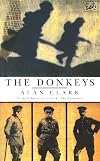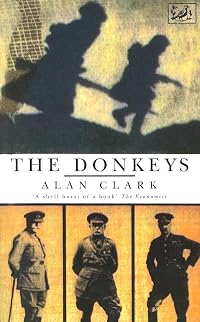
The Donkeys
by Alan Clark
On This Page
Description
"On 26 September 1915 twelve British battalions - a strength of almost 10,000 men - were ordered to attack German positions at Loos in north-east France. In the three-and-a-half hours of the actual battle, they sustained 8,246 casualties. The Germans suffered no casualties at all. iThe Donkeys is a study of the Western Front on 1915, a brilliant expose of a key stage of the Great War, when the opposing armies were locked in trench warfare. Alan Clark scrutinizes the major battles of the show more year. He casts a steady and revealing light on those in High Command - French, Rawlinson, Watson and Haig among them- whose orders resulted in the virtual destruction of the odd professional British Army." show lessTags
Recommendations




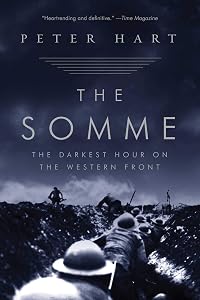

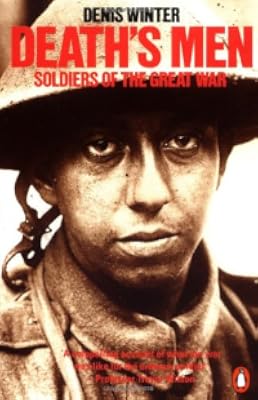

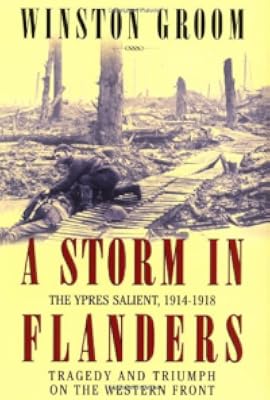














Member Recommendations


Member Reviews
A look at the Western front in 1915, the major battles; Neuve Chapelle, Aubers Ridge and Loos to the dismissal of Sir John French. Tedious at times but poignant at others, focusing on battles that are hardly known anymore and the sloppiness of decisions that lead to the high rate of casualties.
1009 The Donkeys, by Alan Clark (read 25 May 1969) I did not find this book as good as the great books on World War One I had read in the past: The Price of Glory, by Alistair Horne; In Flanders Fields, by Leon Wolff; The Guns of August, by Barbara Tuchman; 1918: The Last Act, by Barrie Pitt; and others.
Ratings
Members
- Recently Added By
Lists

THE WAR ROOM
813 works; 24 members
Author Information

23+ Works 2,361 Members
Alan Clark, the noted historian, entered politics in 1972. He is currently Secretary of State in Margaret Thatcher's cabinet
Work Relationships
Has the adaptation
Common Knowledge
- Original publication date
- 1961
- People/Characters
- John French; Douglas Haig; Herbert Kitchener
- Important events
- World War I
- Dedication
- For
Jane - First words
- This is the story of the destruction of an army- the old professional army of the United Kingdom that always won the last battle, whose regiments had fought at Quebec, Corunna, in the Indies, were trained in musketry at Hythe... (show all), drilled on the parched earth of Chuddapore, and were machine-gunned, gassed and finally buried in 1915.
- Last words
- (Click to show. Warning: May contain spoilers.)I don't want to die,
I want to go home.
I don't want to to go to the trenches no more,
Where the whizz-bangs and shells do whistle and roar.
I don't want to go over the sea,
To where the alleyman will shoot at me,
I want to go home
I don't want to die.
Classifications
Statistics
- Members
- 176
- Popularity
- 185,892
- Reviews
- 2
- Rating
- (3.65)
- Languages
- English
- Media
- Paper, Ebook
- ISBNs
- 5
- ASINs
- 10