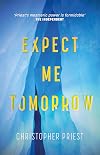
Expect Me Tomorrow
by Christopher Priest
On This Page
Description
A petty thief who called himself John Smith was arrested in 1877, for theft through fraudulent behaviour. He was convicted and sent to prison. In 1852, Adler and Adolf Beck's father died on a glacier, and their lives separated. One became a respected climate scientist; the other a globally renowned opera singer, or so he claimed. They remained in touch, to share details of the mysterious voices only they could hear. In 2050, Charles Ramsey also has a twin. Greg is a climate journalist. show more Charles used to be a police profiler, but his redundancy leads to him being sent home with an experimental chip in his head. His brother urges him to explore a little-known aspect of their family history. All these people are connected, impossibly, inexorably. All their lives will intersect. And the climate of their world will keep on changing. show lessTags
Recommendations





















Member Reviews
In this novel, Christopher Priest explores climate change though two pairs of twins, separated by nearly two hundred years. In the 1850s, a Norwegian glaciologist named Joseph Beck dies in an accident whilst exploring a glacier. His twin sons, Adler and Adolf, react differently; Adler takes up his father's work and devotes his life to the study of glaciers and the factors acting on them, whilst Adolf - taking the name Dolf - emigrates to the Americas, there to seek his fortune. Meanwhile, in the Britain of 2050, Charles Ramsey and his twin brother Greg, contest with the slow collapse of the country under the twin influences of political and societal decline and ever-increasing climate instability. Charles is a police profiler, whilst show more Greg is a journalist working in the linked fields of politics and climate.
These four people are linked by their search for truth - a nebulous concept at the best of times. The Adler twins' search has two strands; one is the developing science of climatology, whilst the other is that of science in the service of justice, exposed when Dolf Beck is accused of a series of frauds perpetrated in London. Meanwhile, Charles Ramsey is fitted with a new device grafted onto his skull that gives the wearer direct and intimate access to the Internet - and, it seems, person-to-person communication of a most intrusive kind. His brother then engages him to apply his profiling skills to a series of highly sensitive reports on the progress of climate change. But Ramsey is also, in his spare moments, interested in researching some family history, about a disreputable "Uncle Adolf" that he recollects hearing about when a child.
All these strands come together in a thought-provoking conclusion.
Like most Priest novels, this book does require some considerable engagement. But the reader should not take this too far; whilst Priest is returning to one of his favourite themes, that of twins, he is also not past throwing some red herrings in the reader's path. Adler Beck at one point goes to Key West, Florida, to further his research, though I suspect that was put in merely to allow Priest to use the word "archipelago" and throw readers off.
However, of more importance is the climatological theme. Adler Beck is convinced that the inter-glacial period that we are experiencing is coming to an end and a new Ice Age threatens. This was current scientific thinking as late as the 1970s, and is regularly cited by climate change sceptics as "evidence" that discussion of global warming is a fallacy and that scientists are either wrong or actively conspiring to conceal a truth for unstated aims. Some people have read this book as supporting such claims. But that is based on a misreading, just as similar claims about Priest's earlier novel, An American Story, suggest that he is supporting 9/11 conspiracy theories. I believe that the earlier novel is looking at the mutability of facts based on the power of consensus thinking; in Expect me Tomorrow, Priest is looking at scientific consensus, how that may change over time and with new evidence. There is a lot of discussion in this book about climate science, arriving at the conclusion that something as complex as the Earth's climate cannot be reduced to simplistic 'either/or' binaries.
Meanwhile, the nature of truth is further examined by the struggle Dolf Beck has to obtain justice. The account in this novel is based on the real-life case of Adolf Beck; for this character in the novel was a real person (although his twin brother seems to be an invention of Priest's). In 1895, Adolf Beck was arrested in London for a series of frauds, and sentenced to prison. He was released on parole in 1901, but in 1904 was re-arrested on similar charges. He was again found guilty; but whilst awaiting sentencing, a police officer who had had some involvement with the case encountered another instance of a similar fraud being carried out by someone answering Beck's description - but the crime was committed at a time when Beck was in custody. Both cases against Beck were quickly found to be a case of mistaken identity, based on another conviction obtained against a man of similar appearance to Beck in 1877. Beck's later convictions - gained through errors of identification, circumstantial evidence and the influence of a judge drawing inferences unsustained by evidence - were overturned. The case led to the establishment of the Court of Appeal.
There is much food for thought in this novel; the nature of truth and the exacting search for evidence are major underpinnings to both stories. The portrait of the Britain of 2050, a society disintegrating under the stress of climactic and political collapse, seems all too possible. Charles Ramsey loses his job in 2050 through political infighting within the police in a way that should not be possible if the organs of the state were abiding by their own laws; but political integrity down to the most basic levels is something else that is disintegrating in the future Britain of the novel. Priest draws on his own literary antecedents, describing the plight of climate refugees being turned back from the south coast of Britain in passages reminiscent of his early, and controversial, 1972 novel Fugue for a Darkening Island. This book stands towards the end of Priest's literary career, bookending his work with something that should make the reader think instead of just accepting a story told by others. show less
These four people are linked by their search for truth - a nebulous concept at the best of times. The Adler twins' search has two strands; one is the developing science of climatology, whilst the other is that of science in the service of justice, exposed when Dolf Beck is accused of a series of frauds perpetrated in London. Meanwhile, Charles Ramsey is fitted with a new device grafted onto his skull that gives the wearer direct and intimate access to the Internet - and, it seems, person-to-person communication of a most intrusive kind. His brother then engages him to apply his profiling skills to a series of highly sensitive reports on the progress of climate change. But Ramsey is also, in his spare moments, interested in researching some family history, about a disreputable "Uncle Adolf" that he recollects hearing about when a child.
All these strands come together in a thought-provoking conclusion.
Like most Priest novels, this book does require some considerable engagement. But the reader should not take this too far; whilst Priest is returning to one of his favourite themes, that of twins, he is also not past throwing some red herrings in the reader's path. Adler Beck at one point goes to Key West, Florida, to further his research, though I suspect that was put in merely to allow Priest to use the word "archipelago" and throw readers off.
However, of more importance is the climatological theme. Adler Beck is convinced that the inter-glacial period that we are experiencing is coming to an end and a new Ice Age threatens. This was current scientific thinking as late as the 1970s, and is regularly cited by climate change sceptics as "evidence" that discussion of global warming is a fallacy and that scientists are either wrong or actively conspiring to conceal a truth for unstated aims. Some people have read this book as supporting such claims. But that is based on a misreading, just as similar claims about Priest's earlier novel, An American Story, suggest that he is supporting 9/11 conspiracy theories. I believe that the earlier novel is looking at the mutability of facts based on the power of consensus thinking; in Expect me Tomorrow, Priest is looking at scientific consensus, how that may change over time and with new evidence. There is a lot of discussion in this book about climate science, arriving at the conclusion that something as complex as the Earth's climate cannot be reduced to simplistic 'either/or' binaries.
Meanwhile, the nature of truth is further examined by the struggle Dolf Beck has to obtain justice. The account in this novel is based on the real-life case of Adolf Beck; for this character in the novel was a real person (although his twin brother seems to be an invention of Priest's). In 1895, Adolf Beck was arrested in London for a series of frauds, and sentenced to prison. He was released on parole in 1901, but in 1904 was re-arrested on similar charges. He was again found guilty; but whilst awaiting sentencing, a police officer who had had some involvement with the case encountered another instance of a similar fraud being carried out by someone answering Beck's description - but the crime was committed at a time when Beck was in custody. Both cases against Beck were quickly found to be a case of mistaken identity, based on another conviction obtained against a man of similar appearance to Beck in 1877. Beck's later convictions - gained through errors of identification, circumstantial evidence and the influence of a judge drawing inferences unsustained by evidence - were overturned. The case led to the establishment of the Court of Appeal.
There is much food for thought in this novel; the nature of truth and the exacting search for evidence are major underpinnings to both stories. The portrait of the Britain of 2050, a society disintegrating under the stress of climactic and political collapse, seems all too possible. Charles Ramsey loses his job in 2050 through political infighting within the police in a way that should not be possible if the organs of the state were abiding by their own laws; but political integrity down to the most basic levels is something else that is disintegrating in the future Britain of the novel. Priest draws on his own literary antecedents, describing the plight of climate refugees being turned back from the south coast of Britain in passages reminiscent of his early, and controversial, 1972 novel Fugue for a Darkening Island. This book stands towards the end of Priest's literary career, bookending his work with something that should make the reader think instead of just accepting a story told by others. show less
I am coming late to Christopher Priest’s party. He is a well-established, well-reviewed English novelist I have somehow missed. Expect Me Tomorrow is a carefully crafted piece of work. The tone is just right for the subject matter. It has a sly take on the vagaries of the historical record, climate change, social media, the surveillance state, and what Dr. Who would call timey wimey. A police profiler in 2050 with a misbehaving social-media implant makes intermittent contact with twin brothers in the late 19th century. One is an opera singer falsely accused of fraud. The other is an unappreciated climate scientist. We find out from a bibliography at the end that at least part of this story is sort of true. I will have to read some show more more of Priest’s novels. 4 stars. show less
Chris Priest is one of my favourite authors, but this wasn't a good book. Better than his recent An American story, but that's all. Several strands of the story never really come together. A lot of undigested research is dumped on the reader with little finesse. And again, just like An American story, partly based on the premise that scientists are wrong (the climate) or the establishment has been lying to us (9/11). I see no good reason for that, because those premises were not used well. And other weirdnesses, like that in the future, radio communication will be possible with the past, but that doesn't cause any sensations, it is just accepted with a shrug by the protagonists. One strand of the story seems to be just the author's show more fascination with a forgotten 19th century court case.
No, this book simply didn't come together. show less
No, this book simply didn't come together. show less
I decided to read [b:Expect Me Tomorrow|60382966|Expect Me Tomorrow|Christopher Priest|https://i.gr-assets.com/images/S/compressed.photo.goodreads.com/books/1661210022l/60382966._SY75_.jpg|95155874] as it looked like climate change sci-fi. The two protagonists are a mid-21st century former police profiler named Charles and his ancestor, a 19th century climate researcher named Adler. Their lives become connected when the former has weird technology implanted in his skull. I must say, although the technology itself was utterly implausible, the corporate bureaucracy around Charles acquiring it was very convincing.
Looking at climate change from two time periods, including the 19th century, was an intriguing choice. Adler’s researches show more appeared broadly consistent with what I read of historical climate research in [b:The Discovery of Global Warming|78687|The Discovery of Global Warming|Spencer R. Weart|https://i.gr-assets.com/images/S/compressed.photo.goodreads.com/books/1388356090l/78687._SY75_.jpg|75979]. Nonetheless, as a climate novel [b:Expect Me Tomorrow|60382966|Expect Me Tomorrow|Christopher Priest|https://i.gr-assets.com/images/S/compressed.photo.goodreads.com/books/1661210022l/60382966._SY75_.jpg|95155874] didn’t have much of an impact. The narrow dual point of view and dispassionate narrative tone, including lots of infodumping, failed to viscerally convey the uncanny scale and uncontrollability of the climate. To be fair, very few authors manage this; I think [a:Martin MacInnes|8337709|Martin MacInnes|https://s.gr-assets.com/assets/nophoto/user/u_50x66-632230dc9882b4352d753eedf9396530.png] is the best at it of any I know. The structure of reminded me of [a:Adam Roberts|23023|Adam Roberts|https://images.gr-assets.com/authors/1222988832p2/23023.jpg] scifi novels, although I find Roberts is better at creating tension. There just wasn’t a lot of that here. I also found the ending underwhelming to the point of seeming complacent.
I’ve now read four Christopher Priest novels and only really enjoyed [b:The Prestige|239239|The Prestige|Christopher Priest|https://i.gr-assets.com/images/S/compressed.photo.goodreads.com/books/1414195709l/239239._SY75_.jpg|1688160], perhaps because I liked the film. I appreciate his ideas much more than their execution, so probably won’t give any more of his books a try. The plot of [b:Expect Me Tomorrow|60382966|Expect Me Tomorrow|Christopher Priest|https://i.gr-assets.com/images/S/compressed.photo.goodreads.com/books/1661210022l/60382966._SY75_.jpg|95155874] has a lot of potential but ultimately I was disappointed with it. show less
Looking at climate change from two time periods, including the 19th century, was an intriguing choice. Adler’s researches show more appeared broadly consistent with what I read of historical climate research in [b:The Discovery of Global Warming|78687|The Discovery of Global Warming|Spencer R. Weart|https://i.gr-assets.com/images/S/compressed.photo.goodreads.com/books/1388356090l/78687._SY75_.jpg|75979]. Nonetheless, as a climate novel [b:Expect Me Tomorrow|60382966|Expect Me Tomorrow|Christopher Priest|https://i.gr-assets.com/images/S/compressed.photo.goodreads.com/books/1661210022l/60382966._SY75_.jpg|95155874] didn’t have much of an impact. The narrow dual point of view and dispassionate narrative tone, including lots of infodumping, failed to viscerally convey the uncanny scale and uncontrollability of the climate. To be fair, very few authors manage this; I think [a:Martin MacInnes|8337709|Martin MacInnes|https://s.gr-assets.com/assets/nophoto/user/u_50x66-632230dc9882b4352d753eedf9396530.png] is the best at it of any I know. The structure of reminded me of [a:Adam Roberts|23023|Adam Roberts|https://images.gr-assets.com/authors/1222988832p2/23023.jpg] scifi novels, although I find Roberts is better at creating tension. There just wasn’t a lot of that here. I also found the ending underwhelming to the point of seeming complacent.
I’ve now read four Christopher Priest novels and only really enjoyed [b:The Prestige|239239|The Prestige|Christopher Priest|https://i.gr-assets.com/images/S/compressed.photo.goodreads.com/books/1414195709l/239239._SY75_.jpg|1688160], perhaps because I liked the film. I appreciate his ideas much more than their execution, so probably won’t give any more of his books a try. The plot of [b:Expect Me Tomorrow|60382966|Expect Me Tomorrow|Christopher Priest|https://i.gr-assets.com/images/S/compressed.photo.goodreads.com/books/1661210022l/60382966._SY75_.jpg|95155874] has a lot of potential but ultimately I was disappointed with it. show less
https://fromtheheartofeurope.eu/expect-me-tomorrow-by-christopher-priest-brief-n...
An intricate story, involving (as usual from Priest) twins and (unusually for him) climate change, with three timelines (late 19th century, early 20th, mid-21st) whose interlinkages gradually come into view, meshing to form a complete story. Not my all-time favourite book by this writer but I still liked it a lot.
An intricate story, involving (as usual from Priest) twins and (unusually for him) climate change, with three timelines (late 19th century, early 20th, mid-21st) whose interlinkages gradually come into view, meshing to form a complete story. Not my all-time favourite book by this writer but I still liked it a lot.
DNF. Didn’t engage my interest.
Members
- Recently Added By
Lists

2023 Hugo Awards -- Eligible Works -- Novels
70 works; 21 members

Books Read in 2024
4,623 works; 126 members
Author Information

63+ Works 11,856 Members
Awards and Honors
Series
Belongs to Publisher Series
Gallimard, Folio SF (734)
Common Knowledge
- Canonical title*
- Rendez-vous demain
- Original title
- Expect me Tomorrow
- Original language*
- Anglais britannique
*Some information comes from Common Knowledge in other languages. Click "Edit" for more information.
Classifications
Statistics
- Members
- 87
- Popularity
- 367,926
- Reviews
- 8
- Rating
- (3.62)
- Languages
- English, French
- Media
- Paper, Ebook
- ISBNs
- 5
- ASINs
- 2