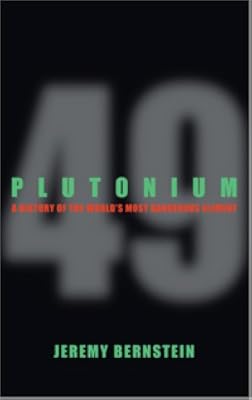
Plutonium: A History of the World's Most Dangerous Element
by Jeremy Bernstein
On This Page
Description
Historically fascinating and scientifically rigorous, Plutonium tells the story of a rare and exotic element put to deadly use in atomic bombs, from its discovery to the present day. From the discovery of uranium in 1789 to the Manhattan Project, from Nazi efforts to build a nuclear bomb to the cold war between the USA and USSR, Bernstein tells the important story of one of nature's rarest elements, put to deadly use in nuclear weapons. Along the way, he paints revealing pen portraits of show more scientists who helped discover the element and produce it in vast quantities during World War II-from Marie show lessTags
Recommendations























Member Reviews
This must be one of the most important subjects of the century. Bernstein does a nice job of introducing it. The approach is almost entirely historical. He discusses the discovery of Uranium in the early days of chemistry, and then the discovery of radioactivity at the beginning of the twentieth century. He goes into greater detail with the 1930s when fission was discovered and people were trying to synthesize transuranics, e.g. Plutonium. There is a lot of discussion of chemistry, valence electrons, and the periodic table of elements.
An explanation of the chemical behavior of lanthanides and actinides occurs in a couple places. I rather suspect the second discussion, at the bottom of p. 149, got garbled by an editor who knows no show more science. Which electrons matter for chemistry, the outside ones or the inside ones? On p. 73, it seems it's the inside electrons that don't play chemistry. This seems correct. It gets turned backwards on p. 149.
Another blooper on p. 160 has U-238 absorbing a neutron, which creates U-239 "along with the emission of two neutrons". The next sentence starts with U-237. How about "followed by the emission of two neutrons" and then "The resulting U-237"...
I was impressed that Bernstein did pretty well getting across electron orbitals. This is a great book for folks to be introduced to these ideas, the foundations of modern science. I hope these little errors don't discourage any budding scientists!
I was disappointed that there was so little about the toxicity of Plutonium. There was some talk here on the subject. but just a few pages. How dangerous is Plutonium? There are essentially two risks: bombs, and pollution. Bernstein does a good job covering the bombs & the possible use of different mixes of isotopes of Plutonium. It's an easier subject, for sure, than the statistics of cancer etc.
Bernstein is a physicist, and this book really concentrates on the physics of Plutonium. It's surely a great starting point and foundation for further research. I suspect, though, that there aren't too many accessible next steps! We need more books like this, that move the discussion further. How does Plutonium move through biological tissue? How does Plutonium move with ground water, or in the atmosphere?
Bernstein tells us that there is currently about 1900 tons of the stuff that has been created since the birth of nuclear technology, increasing at about 70 tons per year. This is a serious global risk that we need to manage carefully. Folks can start learning what this means from Bernstein's book. show less
An explanation of the chemical behavior of lanthanides and actinides occurs in a couple places. I rather suspect the second discussion, at the bottom of p. 149, got garbled by an editor who knows no show more science. Which electrons matter for chemistry, the outside ones or the inside ones? On p. 73, it seems it's the inside electrons that don't play chemistry. This seems correct. It gets turned backwards on p. 149.
Another blooper on p. 160 has U-238 absorbing a neutron, which creates U-239 "along with the emission of two neutrons". The next sentence starts with U-237. How about "followed by the emission of two neutrons" and then "The resulting U-237"...
I was impressed that Bernstein did pretty well getting across electron orbitals. This is a great book for folks to be introduced to these ideas, the foundations of modern science. I hope these little errors don't discourage any budding scientists!
I was disappointed that there was so little about the toxicity of Plutonium. There was some talk here on the subject. but just a few pages. How dangerous is Plutonium? There are essentially two risks: bombs, and pollution. Bernstein does a good job covering the bombs & the possible use of different mixes of isotopes of Plutonium. It's an easier subject, for sure, than the statistics of cancer etc.
Bernstein is a physicist, and this book really concentrates on the physics of Plutonium. It's surely a great starting point and foundation for further research. I suspect, though, that there aren't too many accessible next steps! We need more books like this, that move the discussion further. How does Plutonium move through biological tissue? How does Plutonium move with ground water, or in the atmosphere?
Bernstein tells us that there is currently about 1900 tons of the stuff that has been created since the birth of nuclear technology, increasing at about 70 tons per year. This is a serious global risk that we need to manage carefully. Folks can start learning what this means from Bernstein's book. show less
The history of plutonium requires the explaining of a lot of physics and chemistry. This was one of the most difficult books I've ever read on science history, but Bernstein does a brilliant job of communicating the science involved to the lay reader. It's rewarding to make it through this book, and it's a fascinating subject, but unless you know a lot about the science involved already, be prepared for an uphill climb as you get deeper into the book. It's well worth it, though. Great book.
A fantastic explanation on the discovery of plutonium, what it takes to produce it, and why it is so complicated as it does not behave like any other compound. The writer does tend to wander off onto different tangents, but always comes back around. He does his best to simplify the science parts, but honestly many of the equations are way over my head, what the reader can understand are the basic concepts, and the author does a great job at this, he also lets you know when parts are going to be heavy science.
Good read on the subject. Highly recommended for a solid over view of the discovery and uses of plutonium.
Ratings
Members
- Recently Added By
Lists

Chemistry
53 works; 3 members
Author Information
52+ Works 1,680 Members
Jeremy Bernstein was a long time staff writer for The New Yorker Magazine as well as a theoretical physicist. He has received several awards for his writing.
Classifications
Statistics
- Members
- 145
- Popularity
- 226,729
- Reviews
- 4
- Rating
- (3.66)
- Languages
- English
- Media
- Paper, Ebook
- ISBNs
- 9
- ASINs
- 3