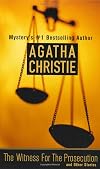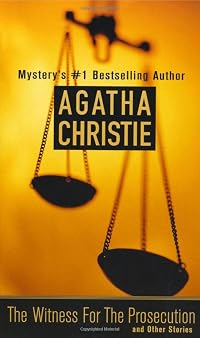
The Witness for the Prosecution and Other Stories
by Agatha Christie
On This Page
Description
Presents eleven Agatha Christie mysteries including "S.O.S.," "The Mystery of the Blue Jar," and "The Second Gong."Tags
Recommendations









Member Reviews
Collection of eleven short stories written between 1924 and 1932. Even though it is labeled as Poirot #28, you do not need to read the twenty-seven previous books first. There is very little of Poirot, only a couple stories even mention him (e.g., The Second Gong, a locked room mystery). My favorite is the title story, The Witness for the Prosecution. It is told by the defense attorney for a man who has been accused of murder. It is a clever story with a twist or two, and I am impressed by the author’s ability to condense a larger complex story into a succinct narrative. The other stories are entertaining. I particularly enjoyed The Accident. As is the case in most short story collections, I liked some more than others. I am not a big show more fan of the supernatural, and there are a few of those (The Red Signal, The Fourth Man). All in all, I’d say it is a better-than-average set of enticing mysteries. show less
Review: The Witness For The Prosecution by Agatha Christie. It’s always enjoyable reading one of Agatha Christie’s books. This is one of her books that have short mystery stories. Christie relates her stories in a taut, fast paced and satisfying manner and more than once brings her stories to quite an unexpected climax. Most short story books have one or two that don’t meet the reader’s high expectations. I appreciated the great unique writing style and the development of the characters. Some of the stories in this collection include straightforward deception, murder, spiritualism, and a classic wise mystery featuring Hercule Poirot. Some of the stories are certainly old, but the sheer enjoyment of uncovering the truths behind show more Christie’s mysteries is worth the read. show less
This is collection of short stories, so some of them are better than others. The only one I really disliked is "The Fourth Man". My favorites were the title story, "Philomel Cottage", and "Where There's a Will" (should have a been an episode of Suspense!).
I love the short story anthologies. This was the third one I read this summer. Included are the following:
The Witness for the Prosecution is the story from which the title comes from. This is a story where the crime is what it seems but the people are not.
The Fourth Man was a very unusual story, one I had to give a great deal of thought to. It was not one of the regular mysteries with a cut and dried solution at the end. You are asked to suspend your disbelief and consider if souls can switch bodies.
S.O.S. is another one of the people switching mysteries Christie is so good at.
Where There's a Will is a very clever story of a nephew who attempts to speed up the receiving of his inheritance through some wicked means and of course gets show more exactly what he deserves.
The Mystery of the Blue jar was a favorite. In this story super natural elements are used to set up a con job.
Sing a Song of sixpence was one of the "closed door" type of mysteries where one of the people present has to be the murderer. The man who was brought in to solve the mystery was an acquaintance of one of the suspects. They had a May December type romance. I don't know if it was acceptable in Christie's time but not too many people today would be down with a seventeen year old having sexual relations with an old man. It came off very strange when he was waxing on how attractive he found teenagers.
The Mystery of the Spanish Shawl was another con type mystery evocative of The Blue Jar.
Philomel Cottage was another favorite. In it a woman may end up a victim of her new husband or is it the other way around.
Accident was another story that didn't play out the way you thought it would. You think the victim is going to be one person and it ends up being someone else.
The final story is a Hercule Poirot one, The Second Gong. Poirot is called to an estate to do an investigation and if you know Poirot he always gets his man.
This was enjoyable collection of short stories from the master of mystery. This is a highly recommended read. show less
The Witness for the Prosecution is the story from which the title comes from. This is a story where the crime is what it seems but the people are not.
The Fourth Man was a very unusual story, one I had to give a great deal of thought to. It was not one of the regular mysteries with a cut and dried solution at the end. You are asked to suspend your disbelief and consider if souls can switch bodies.
S.O.S. is another one of the people switching mysteries Christie is so good at.
Where There's a Will is a very clever story of a nephew who attempts to speed up the receiving of his inheritance through some wicked means and of course gets show more exactly what he deserves.
The Mystery of the Blue jar was a favorite. In this story super natural elements are used to set up a con job.
Sing a Song of sixpence was one of the "closed door" type of mysteries where one of the people present has to be the murderer. The man who was brought in to solve the mystery was an acquaintance of one of the suspects. They had a May December type romance. I don't know if it was acceptable in Christie's time but not too many people today would be down with a seventeen year old having sexual relations with an old man. It came off very strange when he was waxing on how attractive he found teenagers.
The Mystery of the Spanish Shawl was another con type mystery evocative of The Blue Jar.
Philomel Cottage was another favorite. In it a woman may end up a victim of her new husband or is it the other way around.
Accident was another story that didn't play out the way you thought it would. You think the victim is going to be one person and it ends up being someone else.
The final story is a Hercule Poirot one, The Second Gong. Poirot is called to an estate to do an investigation and if you know Poirot he always gets his man.
This was enjoyable collection of short stories from the master of mystery. This is a highly recommended read. show less
Great book, wonderful movie.
Ratings
Members
- Recently Added By
Lists

Top 100 Mystery Novels of All Time
98 works; 9 members

British Mystery
469 works; 14 members

Crime and Mysteries to Read
746 works; 31 members

Agatha Christie story collections
19 works; 1 member

Detective Stories
343 works; 5 members

Books Read in 2020
4,379 works; 124 members
Author Information

2,165+ Works 441,586 Members
One of the most successful and beloved writer of mystery stories, Agatha Mary Clarissa Christie was born in 1890 in Torquay, County Devon, England. She wrote her first novel, The Mysterious Affair at Styles, in 1920, launching a literary career that spanned decades. In her lifetime, she authored 79 crime novels and a short story collection, 19 show more plays, and six novels written under the name of Mary Westmacott. Her books have sold over a billion copies in the English language with another billion in 44 foreign languages. Some of her most famous titles include Murder on the Orient Express, Mystery of the Blue Train, And Then There Were None, 13 at Dinner and The Sittaford Mystery. Noted for clever and surprising twists of plot, many of Christie's mysteries feature two unconventional fictional detectives named Hercule Poirot and Miss Jane Marple. Poirot, in particular, plays the hero of many of her works, including the classic, The Murder of Roger Ackroyd (1926), and Curtain (1975), one of her last works in which the famed detective dies. Over the years, her travels took her to the Middle East where she met noted English archaeologist Sir Max Mallowan. They married in 1930. Christie accompanied Mallowan on annual expeditions to Iraq and Syria, which served as material for Murder in Mesopotamia (1930), Death on the Nile (1937), and Appointment with Death (1938). Christie's credits also include the plays, The Mousetrap and Witness for the Prosecution (1953; film 1957). Christie received the New York Drama Critics' Circle Award for 1954-1955 for Witness. She was also named Dame Commander of the Order of the British Empire in 1971. Christie died in 1976. (Bowker Author Biography) show less
Common Knowledge
- Canonical title
- The Witness for the Prosecution and Other Stories
Classifications
Statistics
- Members
- 263
- Popularity
- 123,386
- Reviews
- 5
- Rating
- (3.66)
- Languages
- English
- Media
- Paper, Ebook
- ISBNs
- 1