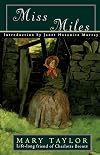
Miss Miles: or, A Tale of Yorkshire Life 60 Years Ago
by Mary Taylor
On This Page
Description
The only novel written by Charlotte Bronte's life-long friend, Mary Taylor, this is the story of the education and up-bringing of a group of young women, which emphasizes their friendship and their ability to maintain mental and economic well-being in straightened circumstances.Tags
Recommendations


















Member Recommendations

Member Reviews
Imagine how the story might have read if Lizzie and Jane Bennet had lost their parents in their youth and never married well... or if the Dashwoods had not found a sort of safety net in Sir John Middleton... or if any of the well-bred but teetering on the edge of poverty young ladies in most Regency and Victorian fiction had no rescuer in the form of a likable suitor with a respectable bank account.
What would they do?
This book explores that question by telling the stories of several women in the vicinity of one Yorkshire village. One of them, the eponymous Miss Miles (Sarah), is working-class and spends her entire youth wondering what it is that enables "ladies" to have so much money and a better life. She's just sure that there must show more be something they've learned or something they know how to do, that lets them earn their way into that life. She can't understand the doctrine of helpless subordination being enough to get you the good life, because it doesn't really make sense. At least not to her "upright and downright" mind.
Others, like Dora Wells and Maria Bell, struggle with the weight of how to live in a socially acceptable way when they have no male protector. They are told time and again, in a crushing repetition, to wait, not to take any action, but wait, wait, wait, because something will surely turn up. This theme is repeated in variations with other characters too.
Well, I'm pretty sure these women would accept "something" if it turned up, but it doesn't. So what else can they do but act?
This book is a spirited defense of a woman's right to provide for herself honestly, to know her own business affairs, and to be taken seriously by men as a fellow creature... not, for all practical purposes, an infant.
The theme of the novel can be seen in one climactic exchange of letters. When Maria is desperate to find some way to help a friend in need, her suitor worries that she will harm her own reputation. He calls her his dove, his flower, and tells her, like everyone else is saying to these women all the time, to Just. Wait.
Maria, who has no one else to turn to, weeps over his reaction and tells him, "Your white dove and white flower are merely decorations to hide fetters too heavy for me to bear. Offer me them no more, for I refuse to be helped on such terms."
This is a thought-provoking read. It feels innovative for its time, but it also feels sad that it was innovative, when you realize that Maria, and Dora, and Sarah, and others, are not propounding anything radical. They just want to be able to live. That's all. But they are trying to do it in a world that acknowledges that, yes, they have no other options, but still, they should... Wait.
______________________________
The book has some shortcomings... It has a few too many characters and you never quite get a grip on some of them. And the transcribed Yorkshire dialect of Sarah's storyline can be hard to follow, especially when important moments are happening.
It's interesting to read this with the Brontes in mind, as Mary Taylor was so close to them. She apparently had a lot of concern about what would become of Charlotte if she didn't get away from life at Haworth.
Knowing some of those biographical details drives home the point that women of this time were in a very real struggle for economic survival. It's why the classics (like Austen) are much more than romances. A lot was depending on their yes or no to a marriage proposal. So I would say this book helped to add a new layer of understanding to my reading of other 19th century works. show less
What would they do?
This book explores that question by telling the stories of several women in the vicinity of one Yorkshire village. One of them, the eponymous Miss Miles (Sarah), is working-class and spends her entire youth wondering what it is that enables "ladies" to have so much money and a better life. She's just sure that there must show more be something they've learned or something they know how to do, that lets them earn their way into that life. She can't understand the doctrine of helpless subordination being enough to get you the good life, because it doesn't really make sense. At least not to her "upright and downright" mind.
Others, like Dora Wells and Maria Bell, struggle with the weight of how to live in a socially acceptable way when they have no male protector. They are told time and again, in a crushing repetition, to wait, not to take any action, but wait, wait, wait, because something will surely turn up. This theme is repeated in variations with other characters too.
Well, I'm pretty sure these women would accept "something" if it turned up, but it doesn't. So what else can they do but act?
This book is a spirited defense of a woman's right to provide for herself honestly, to know her own business affairs, and to be taken seriously by men as a fellow creature... not, for all practical purposes, an infant.
The theme of the novel can be seen in one climactic exchange of letters. When Maria is desperate to find some way to help a friend in need, her suitor worries that she will harm her own reputation. He calls her his dove, his flower, and tells her, like everyone else is saying to these women all the time, to Just. Wait.
Maria, who has no one else to turn to, weeps over his reaction and tells him, "Your white dove and white flower are merely decorations to hide fetters too heavy for me to bear. Offer me them no more, for I refuse to be helped on such terms."
This is a thought-provoking read. It feels innovative for its time, but it also feels sad that it was innovative, when you realize that Maria, and Dora, and Sarah, and others, are not propounding anything radical. They just want to be able to live. That's all. But they are trying to do it in a world that acknowledges that, yes, they have no other options, but still, they should... Wait.
______________________________
The book has some shortcomings... It has a few too many characters and you never quite get a grip on some of them. And the transcribed Yorkshire dialect of Sarah's storyline can be hard to follow, especially when important moments are happening.
It's interesting to read this with the Brontes in mind, as Mary Taylor was so close to them. She apparently had a lot of concern about what would become of Charlotte if she didn't get away from life at Haworth.
Knowing some of those biographical details drives home the point that women of this time were in a very real struggle for economic survival. It's why the classics (like Austen) are much more than romances. A lot was depending on their yes or no to a marriage proposal. So I would say this book helped to add a new layer of understanding to my reading of other 19th century works. show less
Mary Taylor was (with Ellen Nussey) one of Charlotte Bronte's two BFFs from boarding-school days at Margaret Wooler's school at Roe Head. Taylor was the particularly adventuresome of the three and emigrated to New Zealand, where she eventually made enough money from a general store to be able to return to England and take up "the woman's question" without financial dependency on anyone. For Taylor, a woman's "first duty" was to be financially self-supporting and not dependent on men. Taylor was portrayed in CB's Shirley in the person of Rose Yorke; and, while she appreciated CB's favorable portrait of the character, she disagreed with CB on "social issues" – Taylor being a Radical and a Dissenter, in contrast with CB the Tory show more Anglican. Miss Miles, set in "Shirley country," can be seen as Shirley written from a working-class and feminist POV. Published in 1890, it is set in Yorkshire in the 1830s.
Taylor's portrayal of some of the male characters is a bit weak, but her portrayal of the women is excellent. Altogether, I found this a much better novel than George Gissing's similarly themed and better-known The Odd Women show less
Taylor's portrayal of some of the male characters is a bit weak, but her portrayal of the women is excellent. Altogether, I found this a much better novel than George Gissing's similarly themed and better-known The Odd Women show less
Feminist look at struggle for unmarried women to navigate political, economic, and social expectations in victorian England.
Ratings
Members
- Recently Added By
Author Information

5 Works 62 Members
Some Editions
Common Knowledge
- Original publication date
- 1890
Classifications
Statistics
- Members
- 55
- Popularity
- 556,035
- Reviews
- 4
- Rating
- (3.25)
- Languages
- English
- Media
- Paper, Ebook
- ISBNs
- 6