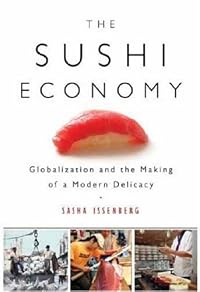
The Sushi Economy: Globalization and the Making of a Modern Delicacy
by Sasha Issenberg
On This Page
Description
"A combination of culinary biography, behind-the-scenes restaurant detail, and a unique exploration of globalization's dynamics, this book traces sushi's journey from Japanese street snack to global delicacy. The Sushi Economy takes you through the stalls of Tokyo's massive Tsukiji market, where the auctioneers sell millions of dollars of fish each day, and to the birthplace of modern sushi - in Canada. Issenberg then follows sushi's evolution in America, exploring how it became LA's show more favorite food. You're taken behind the sushi bar with Chef Nobu Matsuhisa, whose distinctive travels helped define the flavors of global sushi cuisine, and with a unique sushi chef blazing a path in Texas. Issenberg also delves into the complex economics of the fish trade, following the ups and downs of the hunt for bluefin off New England, the tuna cowboys on the southern coast of Australia who invented the art of tuna ranching, and uncovering the mysterious underworld of pirates, smugglers, and the tuna black market."--Jacket. show lessTags
Recommendations








































Member Reviews
By far the best economics book that I have ever read. Granted, I'm no economist and haven't read many economics books that weren't required for college. Unlike other books, this is not chock full of dull theories, equations and graphs. It does a great job at explaining the history and economics of sushi, especially the global tuna industry. While it focuses on tuna, it would serve as a good macro-economics text as it shows how various things such as technology, weather, globalization, environmental restrictions, government, currency fluctuations, etc. impact an industry over time.
One suspects that this book is now a little dated in the wake of the economic crash of 2008 and the increasing concern about sustainable seafood. On the other hand, as a portrait of an economic system designed to spread risk and involving a group of players who even almost ten years ago knew that they were involved in a risky game, perhaps this book has held up better then one might have thought. It's a topic that could probably stand to be revisited which is why I don't rate it a little higher.
I like books about the restaurant business and I'm interested in the sea and the history of commerce and commodities, and I like sushi, so that's why I grabbed the book off the library's new book shelves. I finished it in two days because it's pretty well written.
It takes you on a meandering tour of the sushi world, focusing on bluefin tuna, from the point of view of restauranteurs, auction houses, fishmongers, tuna ranchers (I certainly didn't know there was any such thing) and more. Each chapter introduces a specific person and describes what that person does in the global market.
I will keep the little Seafood Watch card in my wallet (which says I should avoid bluefin tuna anyway - which is fine because apparently it never comes show more near my local sushi joints, nor could I afford it if it did). But I will never imagine again that I can know where any fish came from. show less
It takes you on a meandering tour of the sushi world, focusing on bluefin tuna, from the point of view of restauranteurs, auction houses, fishmongers, tuna ranchers (I certainly didn't know there was any such thing) and more. Each chapter introduces a specific person and describes what that person does in the global market.
I will keep the little Seafood Watch card in my wallet (which says I should avoid bluefin tuna anyway - which is fine because apparently it never comes show more near my local sushi joints, nor could I afford it if it did). But I will never imagine again that I can know where any fish came from. show less
Great in parts but very inconsistent in that so many chapters are bland and dull. But the first part about this history of sushi and Nobu are excellent.
Ratings
Members
- Recently Added By
Published Reviews
Sasha Issenberg writes in The Sushi Economy: Globalization and the Making of a Modern Delicacy that "a book about what goes into the making of sushi has to really be a narrative about the development of twentieth-century global capitalism," arguing that prerequisites for the production of good sushi include "historical exposure to business travelers, tourists, and skilled migrants; integration show more into international labor markets; intercontinental cargo connections; supply-chain expertise; and exposure to the worldly flavor currents of both haute cuisine and fast food" (p. xxiv). In his attempt to trace that narrative, Issenberg, a print journalist whose body of work has focused on political reporting, escorts the reader around the world and back again to introduce a myriad cast of characters and issues that have contributed to and sprung from the rise of sushi's popularity in Japan and abroad. As the crown jewel of sushi sh, tuna more often than not is the star of this story. show less
added by sgump
Author Information

6 Works 633 Members
Sasha Issenberg is a columnist for Slate and the Washington correspondent for Monocle. He covered the 2008 election as a national political correspondent for the Boston Globe, and his work has also appeared in New York, the Atlantic, and the New York Times Magazine.
Common Knowledge
- Blurbers
- Johnson, Steven
Classifications
- Genres
- Economics, Nonfiction, General Nonfiction, Food & Cooking, History, Business
- DDC/MDS
- 641.692 — Applied Science & Technology Home economics & family management Food, Cooking & Recipes / Meals, Picnics Cooking specific materials Cooking game, seafood, miscellaneous foods Fish
- LCC
- TX747 .I74 — Technology Home economics Home economics Cooking
- BISAC
Statistics
- Members
- 233
- Popularity
- 139,256
- Reviews
- 4
- Rating
- (3.39)
- Languages
- English, Italian
- Media
- Paper, Ebook
- ISBNs
- 4
- ASINs
- 4