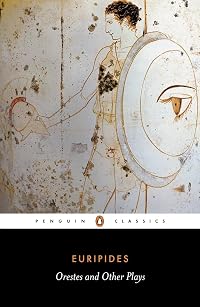
Orestes and Other Plays (Penguin Classics)
by Euripides
On This Page
Description
Written during the long battles with Sparta that were to ultimately destroy ancient Athens, these six plays by Euripides brilliantly utilize traditional legends to illustrate the futility of war. The Children of Heracles holds a mirror up to contemporary Athens, while Andromache considers the position of women in Greek wartime society. In The Suppliant Women, the difference between just and unjust battle is explored, while Phoenician Women describes the brutal rivalry of the sons of King show more Oedipus, and the compelling Orestes depicts guilt caused by vengeful murder. Finally, Iphigenia in Aulis, Euripides' last play, contemplates religious sacrifice and the insanity of war. Together, the plays offer a moral and political statement that is at once unique to the ancient world, and prophetically relevant to our own. show lessTags
Recommendations












Member Reviews
These six plays chart Euripides' evolving despair at the war and those who continue to prosecute it year after year, decade after decade. I liked each one more than the one before it, with Orestes and Iphigenia in Aulis being just wild, savage, cruel masterpieces of indignant irony, black comedy and nihilistic beauty. I love the long, intricate antiphonal passages, the interspersed choral odes, the moments of total weirdness that 2,400+ years of cultural and textual dislocation tend to produce. I like Vellacott's roughly iambic translation, too, and his opinionated introductions to each of the plays.
Picked this up for 50 cents at the library booksale — that's less than 10 cents per play! Can't believe it's taken me this long to tap show more into Greek drama! show less
Picked this up for 50 cents at the library booksale — that's less than 10 cents per play! Can't believe it's taken me this long to tap show more into Greek drama! show less
I have reached the last of Euripides' (surviving) plays. This book contained six!
The Children of Heracles: This play has only partially survived and unfortunately too much is missing to get a coherent idea of what Euripides is aiming for. The play focuses on the aftermath of Heracles' death (by poison shirt as we saw in Heracles), with his children, mother, and now-elderly companion Aeolus being pursued and persecuted across all of Greece. We once again have the moral question of the sacrifice of a maiden for political/military gain, which I didn't realise was such a popular trope. Macaria resolves to die to save her brothers, and walks off-stage never to be mentioned again. With Alcmene (Heracles' mother) taking the stage I expected show more every moment for the reveal that her daughter was dead (or had been saved??) but alas Macaria's ultimate fate is unknown.
Andromache: This was one I'd been waiting for, being another play in which Euripides focuses on a female character who might otherwise be overlooked. We saw Andromache taken into slavery in The Women of Troy, her infant son torn from her arms and murdered. Now the concubine of Achilles' son Neoptolemus, she finds herself the target of his lawful wife Hermione and Hermione's scheming father Menelaus. They are upset that Andromache has borne a son to her captor, while Hermione remains childless. Menelaus really embraces the villain role here, gloating and threatening almost like a modern movie villain. Then Orestes (Menelaus's nephew) arrives fresh with Neoptolemus's blood on his hands, to claim Hermione for himself. A tangled web indeed. For my own part, I am simply satisfied that poor Andromache survives to later become a queen.
The Suppliant Women: This was a bit of a miss for me. Basically the losers of the Seven Against Thebes battle (in which Oedipus's sons off each other and effectively end his family line) come crawling to Athens to beg Theseus's help to recover the bodies of their dead. Theseus, being a super good and noble guy, intervenes to retrieve the bodies but otherwise refuses to interfere, although from a modern perspective he is a huge asshole to Adrastus (the foreign king) in the process. From the ancient Greek perspective I expect he would be considered justified in talking down to the defeated king - after all, the defeat shows that he did not have the favour of the gods on his side. In the end the breaved wives and mothers are able to mourn the men they pointlessly lost in that failure of a war, but their young sons vow to seek vengeance once they come of age - sowing the seeds for yet another pointless loss of life.
The Phoenician Women: We return to the siege of Thebes as Oedipus's sons face off against each other. Somehow, Jocasta is still alive and provides the central figure for this drama. Creon, one of my favourite characters, is back again, still dealing with his family's nonsense. We have another "maiden" sacrifice, but this time the "maiden" is a young boy - one of Creon's sons. The debate between Polynieces and Eteocles is probably the best part. Polynieces is concerned with fairness while Eteocles believes that might is right. As always, they are drawn toward mutual annihilation by either stubbornness or fate. Unlike the house of Atreus, which gets a second chance through Orestes' purification, there is no hope for Oedipus's family.
Orestes: Takes place directly after Orestes murders his mother, before his cleansing by trial. The furies in this case take the form of a deadly illness and hallucinations that plague the matricidal hero. The tension steadily increases as it becomes clear that Orestes and Electra will be judged guilty by the citizens, who wish to stone them to death. Tyndareos raises a very pertinent question - why jump to murder when the rule of law exists? Couldn't Orestes have avoided all of this blood guilt simply by bringing a case against his mother? It's sort of funny, this intrusion of realism into this epic cycle of revenge. Orestes, still convicted of his righteousness despite the condemnation of the court, plunges increasingly into madness, and the climax sees Orestes shut up in his burning ancestral home, having murdered Helen, knife now at Hermione's throat, threatening to murder her unless Menelaus does something to absolve him. At this point, kind of hilariously, Apollo turns up and tells everyone to chill out. The speed at which Menelaus switches from desperate fear for his only child to reassured that everything will work out is completely out of place against the high drama of a moment ago. And poor Hermione - we never get to hear what she thinks of Apollo's pronouncement that her "happy ending" is that she will marry the man who is currently holding her hostage.
Iphigenia in Aulis: Another I was really eager for. The sacrifice of Iphigenia has such massive impact on the fates of so many, and now we get to see it for ourselves. The young girl is brought to Aulis by the promise of a marriage to Achilles, escorted by her mother Clytamnestra who brings the infant Orestes along too. There's a lot of irony in Clytamnestra's interactions with her husband - he knows she has come to die, while she thinks a wedding is soon to take place. Achilles comes off as a blustering buffoon, and that's probably intentional - he talks a good talk about saving Iphigenia but I imagine he's relieved when she goes willingly to her death. The most heartbreaking moment for me was when Iphigenia expresses her humiliation over the marriage-ruse. Among all the grandstanding, that's a really human moment. Clytamnestra's anger is understandable, but even now she expresses her fatal flaw - her habit of clinging to bitter grudges interferes with her ability to truly reason with her husband.
I liked Euripides. I liked his focus on women and how the structure of the patriarchal society they live in impacts their lives. They are tools, slaves, sacrifices and child-bearers. They lack true agency of their own, and if they try to seize it by some act of rage or rebellion, they are villainised. show less
The Children of Heracles: This play has only partially survived and unfortunately too much is missing to get a coherent idea of what Euripides is aiming for. The play focuses on the aftermath of Heracles' death (by poison shirt as we saw in Heracles), with his children, mother, and now-elderly companion Aeolus being pursued and persecuted across all of Greece. We once again have the moral question of the sacrifice of a maiden for political/military gain, which I didn't realise was such a popular trope. Macaria resolves to die to save her brothers, and walks off-stage never to be mentioned again. With Alcmene (Heracles' mother) taking the stage I expected show more every moment for the reveal that her daughter was dead (or had been saved??) but alas Macaria's ultimate fate is unknown.
Andromache: This was one I'd been waiting for, being another play in which Euripides focuses on a female character who might otherwise be overlooked. We saw Andromache taken into slavery in The Women of Troy, her infant son torn from her arms and murdered. Now the concubine of Achilles' son Neoptolemus, she finds herself the target of his lawful wife Hermione and Hermione's scheming father Menelaus. They are upset that Andromache has borne a son to her captor, while Hermione remains childless. Menelaus really embraces the villain role here, gloating and threatening almost like a modern movie villain. Then Orestes (Menelaus's nephew) arrives fresh with Neoptolemus's blood on his hands, to claim Hermione for himself. A tangled web indeed. For my own part, I am simply satisfied that poor Andromache survives to later become a queen.
The Suppliant Women: This was a bit of a miss for me. Basically the losers of the Seven Against Thebes battle (in which Oedipus's sons off each other and effectively end his family line) come crawling to Athens to beg Theseus's help to recover the bodies of their dead. Theseus, being a super good and noble guy, intervenes to retrieve the bodies but otherwise refuses to interfere, although from a modern perspective he is a huge asshole to Adrastus (the foreign king) in the process. From the ancient Greek perspective I expect he would be considered justified in talking down to the defeated king - after all, the defeat shows that he did not have the favour of the gods on his side. In the end the breaved wives and mothers are able to mourn the men they pointlessly lost in that failure of a war, but their young sons vow to seek vengeance once they come of age - sowing the seeds for yet another pointless loss of life.
The Phoenician Women: We return to the siege of Thebes as Oedipus's sons face off against each other. Somehow, Jocasta is still alive and provides the central figure for this drama. Creon, one of my favourite characters, is back again, still dealing with his family's nonsense. We have another "maiden" sacrifice, but this time the "maiden" is a young boy - one of Creon's sons. The debate between Polynieces and Eteocles is probably the best part. Polynieces is concerned with fairness while Eteocles believes that might is right. As always, they are drawn toward mutual annihilation by either stubbornness or fate. Unlike the house of Atreus, which gets a second chance through Orestes' purification, there is no hope for Oedipus's family.
Orestes: Takes place directly after Orestes murders his mother, before his cleansing by trial. The furies in this case take the form of a deadly illness and hallucinations that plague the matricidal hero. The tension steadily increases as it becomes clear that Orestes and Electra will be judged guilty by the citizens, who wish to stone them to death. Tyndareos raises a very pertinent question - why jump to murder when the rule of law exists? Couldn't Orestes have avoided all of this blood guilt simply by bringing a case against his mother? It's sort of funny, this intrusion of realism into this epic cycle of revenge. Orestes, still convicted of his righteousness despite the condemnation of the court, plunges increasingly into madness, and the climax sees Orestes shut up in his burning ancestral home, having murdered Helen, knife now at Hermione's throat, threatening to murder her unless Menelaus does something to absolve him. At this point, kind of hilariously, Apollo turns up and tells everyone to chill out. The speed at which Menelaus switches from desperate fear for his only child to reassured that everything will work out is completely out of place against the high drama of a moment ago. And poor Hermione - we never get to hear what she thinks of Apollo's pronouncement that her "happy ending" is that she will marry the man who is currently holding her hostage.
Iphigenia in Aulis: Another I was really eager for. The sacrifice of Iphigenia has such massive impact on the fates of so many, and now we get to see it for ourselves. The young girl is brought to Aulis by the promise of a marriage to Achilles, escorted by her mother Clytamnestra who brings the infant Orestes along too. There's a lot of irony in Clytamnestra's interactions with her husband - he knows she has come to die, while she thinks a wedding is soon to take place. Achilles comes off as a blustering buffoon, and that's probably intentional - he talks a good talk about saving Iphigenia but I imagine he's relieved when she goes willingly to her death. The most heartbreaking moment for me was when Iphigenia expresses her humiliation over the marriage-ruse. Among all the grandstanding, that's a really human moment. Clytamnestra's anger is understandable, but even now she expresses her fatal flaw - her habit of clinging to bitter grudges interferes with her ability to truly reason with her husband.
I liked Euripides. I liked his focus on women and how the structure of the patriarchal society they live in impacts their lives. They are tools, slaves, sacrifices and child-bearers. They lack true agency of their own, and if they try to seize it by some act of rage or rebellion, they are villainised. show less
Dramas from the era of the Peloponnesian wars between Sparta and Athens. Athenian playwright Euripides calls upon existing myths and legends to create plays that critically display the futility of war.
If you're looking to read Euripides in English I recommend this edition, or any edition with Philip Vellacott's translations.
Ratings
Members
- Recently Added By
Author Information

1,345+ Works 34,170 Members
Euripides was born in Attica, Greece probably in 480 B.C. He was the youngest of the three principal fifth-century tragic poets. In his youth he cultivated gymnastic pursuits and studied philosophy and rhetoric. Soon after he received recognition for a play that he had written, Euripides left Athens for the court of Archelaus, king of Macedonia. show more Fragments of about fifty-five plays survive. Among his best-known plays are Alcestis, Medea and Philoctetes, Electra, Iphigenia in Tauris, The Trojan Women, and Iphigenia in Aulis Iphigenia. He died in Athens in 406 B.C. (Bowker Author Biography) show less
All Editions
Series
Belongs to Publisher Series
Penguin Classics (L259)
Work Relationships
Common Knowledge
- Alternate titles
- 6 Plays: Andromache / Children of Heracles / Iphigenia in Aulis / Orestes / Phoenician Women / Suppliant Women
- Original publication date
- 1972
- Disambiguation notice
- Do not combine with the Oxford World's Classics edition of Orestes and Other Plays; it contains a different selection of plays.
Classifications
- Genre
- Fiction and Literature
- DDC/MDS
- 882.01 — Literature & rhetoric Classical & modern Greek literatures Classical Greek dramatic poetry and drama standard subdivisions; collections; history, description, critical appraisal; Specific periods Ancient period to ca. 499
- LCC
- PA3975 .A2 — Language and Literature Greek language and literature. Latin language and literature Greek literature Individual authors Euripedes
- BISAC
Statistics
- Members
- 278
- Popularity
- 116,102
- Reviews
- 4
- Rating
- (4.50)
- Languages
- English
- Media
- Paper, Ebook
- ISBNs
- 3
- ASINs
- 1