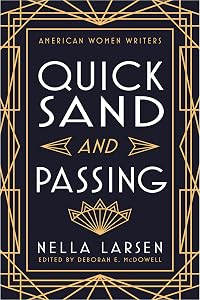
Quicksand and Passing
by Nella Larsen
On This Page
Description
A beautifully designed series that pays homage to the essential books of the most important and revolutionary Black arts movements in modern history.Celebrating the finest works of the Harlem Renaissance, one of the most important Black arts movements in modern history.Tags
Recommendations




























Member Reviews
Review of Quicksand:
Quicksand is a semi-autobiographical novel by Harlem Renaissance author Nella Larsen. It follows the main character, Helga Crane, for several years during early womanhood. Helga lost both parents at an early age (her father left the family when she was very young and her mother died when she was a teenager), and she spent much of her teenage years in the household of her mother’s second husband, a cruel white man, who always resented her. Helga’s mixed-race heritage (Danish mother and African American father) informs most aspects of her life in early twentieth century America. Helga feels as though she does not fit in anywhere and she is desperately trying to find peace and contentment, but it seems to be always show more out of her grasp. In addition, the novel expresses Helga’s severe preoccupation with shades of skin color. Nearly every chapter makes some reference to the different skin shades of the African American characters – black, brown, amber, yellow, etc. and what they signify.
The novel begins with Helga teaching at Naxos, a southern school for black children (presumably modeled after the Tuskegee Institute.) She decides to leave because she can no longer stand the conservative philosophy of the school’s administration and how it affects the children (presumably a - much deserved, in my opinion - dig on Booker T. Washington’s philosophy.) Throughout the novel, Helga constantly escapes to new places (first Chicago, then Harlem, then Copenhagen, then the South). She desperately tries to convince herself that this time she is happy and that this is what she is meant to do, but soon, loneliness, depression, and that feeling of not belonging creeps in and she flees.
One of the most fascinating aspects of this novel (and also Passing) is that it works on two levels. Most importantly, it deals with the oppression and injustice experienced by African Americans in the United States. However, it is also an interesting study of depression and (while I’m no psychologist) possibly something like borderline personality disorder. Helga is clearly dealing with quite severe mental illness and the novel gives us access to her tragically flawed thought processes.
I highly recommend this and Larsen’s other novel, Passing, which deals with somewhat similar themes and with a similar main character. It is unfortunate that this incredibly talented author wrote only two short novels and a few short stories. show less
Quicksand is a semi-autobiographical novel by Harlem Renaissance author Nella Larsen. It follows the main character, Helga Crane, for several years during early womanhood. Helga lost both parents at an early age (her father left the family when she was very young and her mother died when she was a teenager), and she spent much of her teenage years in the household of her mother’s second husband, a cruel white man, who always resented her. Helga’s mixed-race heritage (Danish mother and African American father) informs most aspects of her life in early twentieth century America. Helga feels as though she does not fit in anywhere and she is desperately trying to find peace and contentment, but it seems to be always show more out of her grasp. In addition, the novel expresses Helga’s severe preoccupation with shades of skin color. Nearly every chapter makes some reference to the different skin shades of the African American characters – black, brown, amber, yellow, etc. and what they signify.
The novel begins with Helga teaching at Naxos, a southern school for black children (presumably modeled after the Tuskegee Institute.) She decides to leave because she can no longer stand the conservative philosophy of the school’s administration and how it affects the children (presumably a - much deserved, in my opinion - dig on Booker T. Washington’s philosophy.) Throughout the novel, Helga constantly escapes to new places (first Chicago, then Harlem, then Copenhagen, then the South). She desperately tries to convince herself that this time she is happy and that this is what she is meant to do, but soon, loneliness, depression, and that feeling of not belonging creeps in and she flees.
One of the most fascinating aspects of this novel (and also Passing) is that it works on two levels. Most importantly, it deals with the oppression and injustice experienced by African Americans in the United States. However, it is also an interesting study of depression and (while I’m no psychologist) possibly something like borderline personality disorder. Helga is clearly dealing with quite severe mental illness and the novel gives us access to her tragically flawed thought processes.
I highly recommend this and Larsen’s other novel, Passing, which deals with somewhat similar themes and with a similar main character. It is unfortunate that this incredibly talented author wrote only two short novels and a few short stories. show less
The edition I had is actually 2 novellas, both dealing with issues of being a mixed race woman in the 1920s. They are short, hard-hitting books with no happy endings, no simple answers, and with complex characters. The structural racism (and sexism) that traps the characters is reinforced by their own actions within that system.
It has taken me a while to read this book. To be honest, if soffitta1 hadn't requested it, it would probably still linger on my TBR shelf.
What great books they are. Passing, the sevond novel in this book I read in one day. I was completely taken by the book, finding out this meaning of passing. Had no idea, really. It was a very interesting read, both because of the information, sphere of America in the 1920. A place and time completely foreign to me. And yet I felt strangely at home both with Passing, as well as with Quicksand. The emotions described seem to be universal, transgressing physical borders, time differences as well as racial lines.
Despite I liked Quicksand a lot, I didn't really sympathize with Helga a lot. I guess show more that's because of the narrative, 3rd person. I followed her search, her longing with interest, but didn't feel outrage or real sympathy for her at all when she, finally settling down, finds out how hard a woman's life may be. show less
What great books they are. Passing, the sevond novel in this book I read in one day. I was completely taken by the book, finding out this meaning of passing. Had no idea, really. It was a very interesting read, both because of the information, sphere of America in the 1920. A place and time completely foreign to me. And yet I felt strangely at home both with Passing, as well as with Quicksand. The emotions described seem to be universal, transgressing physical borders, time differences as well as racial lines.
Despite I liked Quicksand a lot, I didn't really sympathize with Helga a lot. I guess show more that's because of the narrative, 3rd person. I followed her search, her longing with interest, but didn't feel outrage or real sympathy for her at all when she, finally settling down, finds out how hard a woman's life may be. show less
Two short novels from an African-American woman writer of the 1920s and 30s. Well written stories that i enjoyed more than expected. 'Passing' is mainly the story of a mixed race woman who spent a lot of her life 'passing' as a white person in a time when it mattered.
Quicksand and Passing (American Women Writers Series) by Nella Larsen (1986)
Members
- Recently Added By
Lists

Best African American Literature
53 works; 9 members

American Lit for Eng 11 Research Project
368 works; 6 members

Writing
81 works; 1 member
Author Information

11+ Works 6,096 Members
Nella Larsen was associated with the Harlem Renaissance. She also worked as a librarian and a nurse in New York City, pursuing nursing after her brief, successful writing career until her death in 1964. Larsen's mother was Danish, and her father was West Indian; she used her experience as the child of middle-class parents in a mixed marriage to show more create characters in two novels who are stranded, caught between two cultures and unable to feel wholly at home in either. In each of Larsen's novels, the heroine suffers suffocating constrictions of her identity in both African American and white European culture. These crises in both Quicksand (1928) and Passing (1929) are further complicated by the heroine's quest for sexual as well as social identity, and both novels end without hopeful resolution. Both contain autobiographical elements, but Quicksand, the more successful, reproduced in fictional form many of the circumstances of Larsen's own early life. Although her work had been out of print for many years, she has recently been rediscovered. (Bowker Author Biography) show less
Some Editions
Series
Belongs to Publisher Series
Work Relationships
Contains
Common Knowledge
Classifications
Statistics
- Members
- 1,038
- Popularity
- 24,873
- Reviews
- 6
- Rating
- (3.77)
- Languages
- English
- Media
- Paper, Audiobook, Ebook
- ISBNs
- 19
- ASINs
- 8