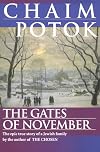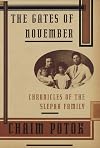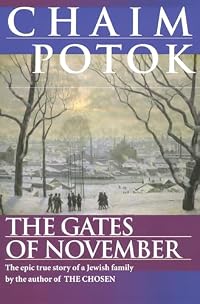
The Gates of November
by Chaim Potok
On This Page
Description
Biography & Autobiography. History. Politics. Nonfiction. HTML:"REMARKABLE . . . A WONDERFUL STORY."—The Boston Globe
The father is a high-ranking Communist officer, a Jew who survived Stalin's purges. The son is a "refusenik," who risked his life and happiness to protest everything his father held dear. Now, Chaim Potok, beloved author of the award-winning novels The Chosen and My Name is Asher Lev, unfolds the gripping true story of a father, a son, and a conflict that spans Soviet show more history. Drawing on taped interviews and his harrowing visits to Russia, Potok traces the public and privates lives of the Slepak family: Their passions and ideologies, their struggles to reconcile their identities as Russians and as Jews, their willingness to fight—and die—for diametrically opposed political beliefs.
"[A] vivid account . . . [Potok] brings a novelist's passion and eye for detail to a gripping story that possesses many of the elements of fiction—except that it's all too true."
—San Francisco... show less
Tags
Recommendations




















Member Reviews
In January, 1985, Chaim Potok and his wife traveled to Moscow specifically to visit Vladimir (Volodya) and Maria (Masha) Slepak, dissident (“refuseniks” Russian Jews who had achieved international fame for their nearly 20 year effort to emigrate to Israel. There were other well-known refuseniks, as well Russian dissidents protesting the brutality of life under various Soviet regimes, but Volodya and Masha represented a special case: Volodya’s father, Solomon Slepak, was on Old Bolshevik, one of the original revolutionaries who fount against the tsar and then on the side of the Communists in the Russian Civil War. Solomon, a fanatic Bolshevik who refused to see anything wrong with the Soviet system and who was an enthusiastic show more supporter of Stalin, had achieved fairly high rank under the Communist system. But when Stalin began consolidating power, he turned on everyone, including his most loyal supporters; almost all were either executed or disappeared. The central mystery, as Potok says, is why Solomon was never included in Stalin’s purges of the 1930s. Thus Volodya and Masha occupied a special place within the dissident community. The Potoks spent a great deal of time with the Slepak family, recording and transcribing a massive amount of information about the Slepak family in general and Volodya and Masha’s lives in particular.
Potok starts the book’s history with what is known, from family chronicles, about Solomon’s life. Born at the turn of the 20th century to a poor teacher of Jewish children in Dubrovno, on the Dnieper, Solomon experienced from early on the violent Russian anti-Semitism. At age 13, he ran away from home; in the next two decades, he managed to work his way across Europe to live in America; when the Russian Revolution unfolded, Solomon made his way back to Russian where he commanded troops in the Civil War.
Potok follows Solomon’s career as an unofficial Soviet diplomat who spent a great deal of time abroad, mainly in China. Volodya spent a good part of his childhood in China, recalling that as a happy time. Up through his young adulthood, Volodya’s life was a fairly contented one as the child of a member of the Russian elite, attending the best schools and living a life of privilege.
So why did this son of a dedicated Bolshevik turn against his own country losing nearly everything--losing comfortable and important jobs, freedom (he and Masha spent 5 years in exile in Siberia), and risking their lives in a terrible effort to emigrate to Israel?
The answer to that in Potok’s books is a brief history of the Russian Revolution as well as the Russian attitude towards the Jews. There is a great deal about Stalin and his policies, of the attitudes of the dictators who came afterwards, and of the craziness of Soviet policies and procedures. The book contains a wealth of information about Russian dissidents, the Jewish dissident movement, and the reaction of foreign powers to the condition of Russian Jewry at that time.
The book is extremely well written, flowing easily as a narrative, thanks to Potok’s skill in writing fiction. It is quietly factual, never shrill, always focusing on the lives of the people who worked so hard for their own independence. It is never ideological; it keeps true to Volodya and Masha themselves, and that is its greatest strength.
Potok ends the book with the questions: from where does one get the courage to risk annihilation, as he puts it, in order to resist a despotic regime? Would I have the ability to do the same? These, of course, are unanswerable, but perfectly valid anyway, given the story Potok has just narrated.
Highly recommended. show less
Potok starts the book’s history with what is known, from family chronicles, about Solomon’s life. Born at the turn of the 20th century to a poor teacher of Jewish children in Dubrovno, on the Dnieper, Solomon experienced from early on the violent Russian anti-Semitism. At age 13, he ran away from home; in the next two decades, he managed to work his way across Europe to live in America; when the Russian Revolution unfolded, Solomon made his way back to Russian where he commanded troops in the Civil War.
Potok follows Solomon’s career as an unofficial Soviet diplomat who spent a great deal of time abroad, mainly in China. Volodya spent a good part of his childhood in China, recalling that as a happy time. Up through his young adulthood, Volodya’s life was a fairly contented one as the child of a member of the Russian elite, attending the best schools and living a life of privilege.
So why did this son of a dedicated Bolshevik turn against his own country losing nearly everything--losing comfortable and important jobs, freedom (he and Masha spent 5 years in exile in Siberia), and risking their lives in a terrible effort to emigrate to Israel?
The answer to that in Potok’s books is a brief history of the Russian Revolution as well as the Russian attitude towards the Jews. There is a great deal about Stalin and his policies, of the attitudes of the dictators who came afterwards, and of the craziness of Soviet policies and procedures. The book contains a wealth of information about Russian dissidents, the Jewish dissident movement, and the reaction of foreign powers to the condition of Russian Jewry at that time.
The book is extremely well written, flowing easily as a narrative, thanks to Potok’s skill in writing fiction. It is quietly factual, never shrill, always focusing on the lives of the people who worked so hard for their own independence. It is never ideological; it keeps true to Volodya and Masha themselves, and that is its greatest strength.
Potok ends the book with the questions: from where does one get the courage to risk annihilation, as he puts it, in order to resist a despotic regime? Would I have the ability to do the same? These, of course, are unanswerable, but perfectly valid anyway, given the story Potok has just narrated.
Highly recommended. show less
This was a non-fiction read, but read like a novel. It was the story of the Slepak family from the days of Bolshevism to the son's eventual emigration to Israel. Potok collected information from the family through taped interviews and photographs. This Jewish family suffered terribly under Brezhnev, Kosygin, and Tikhonov regimes. From Potok's epilogue, ""Can we learn something from these chronicles about iron righteousness and rigid doctrine, about the stony heart, the sealed mind, the capricious use of law, and the tragedies that often result when theories are not adjusted to realities?" 272 pages
A concise, highly readable history of Russia in the 20th century, told from the generational perspective of Solomon Slepak, an "Old Bolshevik" who somehow managed to avoid being purged in the Stalin years, while never giving up his dream of a perfect Communist society; and his son, Vladimir, a refusenik who suffered all the usual hardships inflicted on Jewish dissenters through the Soviet years while repeatedly being turned down for permission to emigrate to Israel. Fascinating, enlightening and highly recommended.
From Potok's epilogue: "Can we learn something from these chronicles about iron righteousness and rigid doctrine, about the stony heart, the sealed mind, the capricious use of law, and the tragedies that often result when show more theories are not adjusted to realities?" show less
From Potok's epilogue: "Can we learn something from these chronicles about iron righteousness and rigid doctrine, about the stony heart, the sealed mind, the capricious use of law, and the tragedies that often result when show more theories are not adjusted to realities?" show less
This was a great book, no surprise coming from Chaim Potok. It's incredibly informative, covering nearly a century of Russian/Soviet (political) history, centered around three generations of one particular family - the Slepaks.
In some places the years jumped around a bit- presumably due to putting the book together from audio accounts made by the family, and trying to fit pieces together nicely. It wasn't a big problem or anything, but it was a smidge confusing when most of it is chronological, and then something would be mentioned that was a little into the future/past. An editor should have slipped those where they went, or worked with Potok to rearrange things somewhat so they fit in better. As is, there's a few little things where show more it could be just a wee bit hard to keep the time-line straight there. But since it was pretty much minor things, it's not a big issue, and doesn't change the fact that this was a fabulous account of a truly inspirational family.
The book painted a clear picture of Russia in times past, and of the struggle of the Slepak family, who are clearly intelligent, strong-willed people. I would highly recommended this to anyone. show less
In some places the years jumped around a bit- presumably due to putting the book together from audio accounts made by the family, and trying to fit pieces together nicely. It wasn't a big problem or anything, but it was a smidge confusing when most of it is chronological, and then something would be mentioned that was a little into the future/past. An editor should have slipped those where they went, or worked with Potok to rearrange things somewhat so they fit in better. As is, there's a few little things where show more it could be just a wee bit hard to keep the time-line straight there. But since it was pretty much minor things, it's not a big issue, and doesn't change the fact that this was a fabulous account of a truly inspirational family.
The book painted a clear picture of Russia in times past, and of the struggle of the Slepak family, who are clearly intelligent, strong-willed people. I would highly recommended this to anyone. show less
Een gemakkelijk leesbare en verhelderende beschrijving van de problemen die de joden in de USSR de laatste decennia ondervonden. Ondanks het streven naar een nauwkeurige beschrijving van de lotgevallen van drie generaties is de hoeveelheid feiten nooit storend en het achterliggende verhaal steeds beklijvend. Het helpt wel als je al wat enige geschiedkundige achtergrond hebt, voor zeer jonge lezers is het misschien een wat hardere leesdobber.
Sep 26, 2012Dutch
Tot nu toe kende ik Potok alleen als schrijver van fictie. Vriendin T., fervent lezer van Potok, raadde mij – vanwege mijn interesse in Rusland – dit non-fictie werk aan. Om er zeker van te zijn dat ik het zou lezen, gaf ze mij haar oude exemplaar, toen ze zelf een mooiere uitgave op de kop had getikt. Bedankt T.!
Lees verder op deze pagina van mijn boekenblog.
Lees verder op deze pagina van mijn boekenblog.
Nov 26, 2010Dutch
Ratings
Members
- Recently Added By
Lists

Jewish Books
367 works; 24 members

Top Five Books of 2023
767 works; 317 members
Author Information

35+ Works 23,152 Members
Chaim Potok was born in New York City in 1929. He graduated summa cum laude (with highest honors) from Yeshiva University in 1950, and received an advanced degree from Jewish Theological Seminary in 1954, when he also became an ordained Conservative rabbi. After two years of military service as a chaplain in Korea, Potok married Adena Sarah show more Mosevitsky in 1958. The couple had three children. Eventually Potok returned to school and received his Ph.D. from the University of Pennsylvania in 1965. Potok has held a variety of positions within the Jewish community, including directing a camp in Los Angeles, teaching at the University of Judaism in Los Angeles at a Jewish Theological Seminary in New York, and working as an editor on various religious publications, Potok's first novel, The Chosen, was published in 1967, and he quickly won acclaim for this best-selling book about tensions within the Orthodox and Hasidic Jewish communities. This and later books have been both critically and popularly successful. Many of them explore the meaning of Judaism in the modern era, focusing on the conflict between traditional teachings and the pressures of modern life. The Chosen was nominated for a National Book Award in 1967 and made into a successful film in 1982. Its sequel, The Promise (1969) was the winner of an Athenaeum Award. Potok is also the author of a nonfiction volume, Wanderings: Chaim Potok's History of the Jews (1978), as well as several short stories and articles that have been published in both religious and secular magazines. (Bowker Author Biography) show less
Some Editions
Common Knowledge
- Original publication date
- 1996
- Epigraph*
- Stilaan meldden
zich saaie weken zonder kleur:
november stond al voor de deur
- Aleksandr Poesjkin - - Dedication*
- Het verhaal van de dissidenten in de voormalige Sovjet-Unie is een van de weinige, waarlijk indrukwekkende gebeurtenissen van de twintigste eeuw. Sommigen, zoals Adrej Sacharov, waren al heroïsche figuren voordat ze de weg v... (show all)an de oppositie kozen. Anderen, zoals Volodya en Masja Slepak, verwierven hun grandeur pas nadat ze uit de anonimiteit traden. Uiteraard konden binnen dit bestek niet alle dissidenten ter sprake komen. Het is dan ook aan ieder van hen dat ik dit boek opdraag.
- First words*
- De geschiedenis heeft twee energieke volkeren op dezelfde bodem tezamen gebracht.
- Last words*
- (Click to show. Warning: May contain spoilers.)Het was hem niet ontgaan dat er in de flat in de Gorkistraat nu geen joden meer woonden.
- Original language*
- Engels
*Some information comes from Common Knowledge in other languages. Click "Edit" for more information.
Classifications
- Genres
- Biography & Memoir, Nonfiction
- DDC/MDS
- 947.085 — History & geography History of Europe Eastern European Counties and Russia Russian & Slavic History by Period 1855- 1953-1991
- LCC
- DS135 .R95 .S55976 — History of Europe, Asia, Africa and Oceania Asia History of Asia Israel (Palestine). The Jews Jews outside of Palestine
- BISAC
Statistics
- Members
- 476
- Popularity
- 63,582
- Reviews
- 6
- Rating
- (3.97)
- Languages
- 6 — Dutch, English, French, German, Hungarian, Italian
- Media
- Paper, Ebook
- ISBNs
- 19
- ASINs
- 2