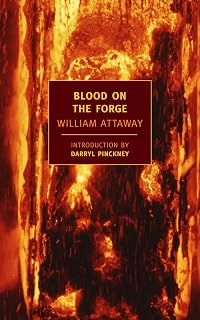
Blood on the Forge
by William Attaway
On This Page
Description
This brutally gripping novel about the African-American Great Migration follows the three Moss brothers, who flee the rural South to work in industries up North. Delivered by day into the searing inferno of the steel mills, by night they encounter a world of surreal devastation, crowded with dogfighters, whores, cripples, strikers, and scabs. Keenly sensitive to character, prophetic in its depiction of environmental degradation and globalized labor, Attaway's novel is an unprecedneted show more confrontation with the realities of American life, offering an apocalyptic vision of the melting pot not as an icon of hope but as an instrument of destruction. Blood on the Forge was first published in 1941, when it attracted the admiring attention of Richard Wright and Ralph Ellison. It is an indispensable account of a major turning point in black history, as well as a triumph of individual style, charged with the concentrated power and poignance of the blues. show lessTags
Recommendations

















Member Recommendations

Member Reviews
5/5
I'm beginning to find that one of the qualities that I enjoy the most in a novel is a feeling that I'm in a little over my head, that there's a depth to the writing that is escaping me. This is obviously a very fine line to tread. I don't want a work to be so obtuse that I can't decipher any of it even with a focused reading, and I don't want complexity for complexity's sake. Rather, what I enjoy is a complexity that is layered, where the more you focus and the more you attempt to understand, the more you can find. The migration of the Moss brothers from their sharecropping land in Kentucky to the mills of the north in Blood on the Forge has this quality. Like having a swim in a calm ocean, Blood on the Forge never requires your show more absolute attention to appreciate and enjoy, but rewards you peering below to the surface to see how deep it goes.
Blood on the Forge has one of the best openings to novel that I've ever read. So much of real consequence happens in the first thirty pages; dense and yet expeditious. The plot is immediately clear and compelling, the characters clear, the setting vivid. Their mother recently dead while tilling the fields, the Moss brothers are lucky to eat the offal of the hog processing like barnyard animals, tempted by the strike breakers from the mill, and fleeing the retribution of the landowner after Big Mat potentially kills a riding boss. It's novel that grips you from page one and doesn't let you go.
It's a brutal world that the Moss brothers inhabit, one that is claustrophobic, always on the verge of calamity, and unsympathetic towards the misfortune souls that find themselves caught between the hammer and anvil. Nothing gets easier for the Moss brothers after their migration either. We watch in real time as each of them independently gets filed down to the bare nub of existence. What good is a wage when your working days are at least twelve hours long in the stiffling and unsafe mill? How can you find the strength to save the little you make to send home, when you're struggling to survive as it is? Their sense of family get worn away and they turn to vice to fill the hole that was left from leaving the loamy muddy bottoms of their farm.
Attaway writes in a stripped down and simple style that feels colloquial and intimate, which makes the moments of brutality and violence that much closer at hand. Stark, sharp prose sometimes gives way to transcendent passages of insight and humanity. Especially memorable are Attaway's descriptions of heat and personifications of the steel itself in the mill, the Moss brother's yearning for the red clay hill of Kentucky, and the struggle to find peace between the striking mill workers and minuscule amount of power the mill gives them in exchange for crossing the picket line.
As much about the circumstances of those that participated in the Great Migration as is it about the degradation of the natural world, the loss of blues culture, the myth of the American dream, and the mechanization of industry. As much as the Moss brothers idealize the South after they've been working at the mill for awhile, we know the horrendous conditions they lived in there as well. There is simply no place for them to go that does not exploit their labor and give them only scraps in return.This is a novel that has lodged its way into my long term memory, one that I can't help but find myself thinking about. show less
I'm beginning to find that one of the qualities that I enjoy the most in a novel is a feeling that I'm in a little over my head, that there's a depth to the writing that is escaping me. This is obviously a very fine line to tread. I don't want a work to be so obtuse that I can't decipher any of it even with a focused reading, and I don't want complexity for complexity's sake. Rather, what I enjoy is a complexity that is layered, where the more you focus and the more you attempt to understand, the more you can find. The migration of the Moss brothers from their sharecropping land in Kentucky to the mills of the north in Blood on the Forge has this quality. Like having a swim in a calm ocean, Blood on the Forge never requires your show more absolute attention to appreciate and enjoy, but rewards you peering below to the surface to see how deep it goes.
Blood on the Forge has one of the best openings to novel that I've ever read. So much of real consequence happens in the first thirty pages; dense and yet expeditious. The plot is immediately clear and compelling, the characters clear, the setting vivid. Their mother recently dead while tilling the fields, the Moss brothers are lucky to eat the offal of the hog processing like barnyard animals, tempted by the strike breakers from the mill, and fleeing the retribution of the landowner after Big Mat potentially kills a riding boss. It's novel that grips you from page one and doesn't let you go.
It's a brutal world that the Moss brothers inhabit, one that is claustrophobic, always on the verge of calamity, and unsympathetic towards the misfortune souls that find themselves caught between the hammer and anvil. Nothing gets easier for the Moss brothers after their migration either. We watch in real time as each of them independently gets filed down to the bare nub of existence. What good is a wage when your working days are at least twelve hours long in the stiffling and unsafe mill? How can you find the strength to save the little you make to send home, when you're struggling to survive as it is? Their sense of family get worn away and they turn to vice to fill the hole that was left from leaving the loamy muddy bottoms of their farm.
Attaway writes in a stripped down and simple style that feels colloquial and intimate, which makes the moments of brutality and violence that much closer at hand. Stark, sharp prose sometimes gives way to transcendent passages of insight and humanity. Especially memorable are Attaway's descriptions of heat and personifications of the steel itself in the mill, the Moss brother's yearning for the red clay hill of Kentucky, and the struggle to find peace between the striking mill workers and minuscule amount of power the mill gives them in exchange for crossing the picket line.
As much about the circumstances of those that participated in the Great Migration as is it about the degradation of the natural world, the loss of blues culture, the myth of the American dream, and the mechanization of industry. As much as the Moss brothers idealize the South after they've been working at the mill for awhile, we know the horrendous conditions they lived in there as well. There is simply no place for them to go that does not exploit their labor and give them only scraps in return.This is a novel that has lodged its way into my long term memory, one that I can't help but find myself thinking about. show less
A searing and brutal story of three brothers who travel from rural Kentucky to the steel mills of Pennsylvania in 1919, during the Great Migration. What at first seems like an escape from the racism, near-slavery, and oppression of the share-cropping South turns out to be nearly the same thing just in another form.
This story was unrelenting in its harshness and grim reality, from white farmers, union organizers, union breakers, whores, drunks, black migrants, white immigrants, violence, and danger. The unraveling of the relationship among the three brothers was sad but unsurprising, as nothing good and true could possibly survive in the conditions in which they found themselves.
An important - and strongly told - novel, that should be show more better known. show less
This story was unrelenting in its harshness and grim reality, from white farmers, union organizers, union breakers, whores, drunks, black migrants, white immigrants, violence, and danger. The unraveling of the relationship among the three brothers was sad but unsurprising, as nothing good and true could possibly survive in the conditions in which they found themselves.
An important - and strongly told - novel, that should be show more better known. show less
The early part of the twentieth century saw huge upheavals in the US. The south faced economic decline. Black sharecroppers facd a hopeless situation of debt and early death working for white landowners who controlled so many aspects of their lives. The solution for many was to head north for paid hourly work in what became known as the Great Migration. At the same time, immigrants from Eastern Europe were pouring into the northeast, the first place the boats docked. Poor whites from the south were also heading north looking for work in the ever increasing number of factories and mills.
Blood on the Forge takes these groups and throws them together in the steel mill town of Vaughan Pennsylvania. Attaway's main characters are the three show more Moss brothers from Kentucky. The oldest, Big Mat, had murdered the overseer. That same day, his brothers Melody and Chinatown had made arrangements with a jackleg recruiter from the north to board a train north for work. Big Mat, fleeing for his life, joined them, leaving behind his wife Hattie. The five day journey in a sealed train is the first intimation of what is to come.
The Moss brothers' new lives throw them together with the Slavs and a new kind of racial tension. The immigrants looked down on the blacks not on traditional American grounds of race, but on economic ones. They feared they would lose work to these lower paid men. This was a real concern in 1919, the year in which the novel is set. The push for unionization was strong, and blacks were used as scab labour. Management would bring in trainloads of them from the south as a silent threat, whenever a strike looked likely. Walking down the street their first day in town, the brothers realized "In the eyes of all the Slavs was a hatred and contempt different from anything they had ever experienced in Kentucky."
While none of the three brothers was afraid of the punishing physical work, there were real differences. Work in Kentucky had been outdoors, with the rhythms of the seasons and contact with the natural world. "What men in their right minds would leave off tending green growing things to tend iron monsters?" In the south, the brothers and Hattie had lived together in their shack. Here they lived in a dorm, with no sense of a home life. Danger in the south had been from lynch mobs. Here it was ever present in their work "... furnace gas, electric shock, falls into the pit, slides of piled iron on the narrow gauge railways". Without a home life, the empty hours outside work were filled with card games, dog fights, corn liquor and trips to visit the women of Mex town.
Through it all is the leitmotif of the blues and Melody's guitar, the music that sings of everything that has been lost, even when there are no words to express it, until one day even the music is gone.
No happy ending could be expected here, and none is given. The brothers are destroyed physically and spiritually. There is no nostalgia here for the south. As the child of black parents who left Mississippi for Chicago, Attaway knew better. There is however, a powerful sense of loss for a time before unfettered capitalism governed life. More than that, there is a real concern both for the migrant workers' ability to earn an honest living and a decent life, and for those left behind with even less opportunity to improve their lot. show less
Blood on the Forge takes these groups and throws them together in the steel mill town of Vaughan Pennsylvania. Attaway's main characters are the three show more Moss brothers from Kentucky. The oldest, Big Mat, had murdered the overseer. That same day, his brothers Melody and Chinatown had made arrangements with a jackleg recruiter from the north to board a train north for work. Big Mat, fleeing for his life, joined them, leaving behind his wife Hattie. The five day journey in a sealed train is the first intimation of what is to come.
The Moss brothers' new lives throw them together with the Slavs and a new kind of racial tension. The immigrants looked down on the blacks not on traditional American grounds of race, but on economic ones. They feared they would lose work to these lower paid men. This was a real concern in 1919, the year in which the novel is set. The push for unionization was strong, and blacks were used as scab labour. Management would bring in trainloads of them from the south as a silent threat, whenever a strike looked likely. Walking down the street their first day in town, the brothers realized "In the eyes of all the Slavs was a hatred and contempt different from anything they had ever experienced in Kentucky."
While none of the three brothers was afraid of the punishing physical work, there were real differences. Work in Kentucky had been outdoors, with the rhythms of the seasons and contact with the natural world. "What men in their right minds would leave off tending green growing things to tend iron monsters?" In the south, the brothers and Hattie had lived together in their shack. Here they lived in a dorm, with no sense of a home life. Danger in the south had been from lynch mobs. Here it was ever present in their work "... furnace gas, electric shock, falls into the pit, slides of piled iron on the narrow gauge railways". Without a home life, the empty hours outside work were filled with card games, dog fights, corn liquor and trips to visit the women of Mex town.
Through it all is the leitmotif of the blues and Melody's guitar, the music that sings of everything that has been lost, even when there are no words to express it, until one day even the music is gone.
No happy ending could be expected here, and none is given. The brothers are destroyed physically and spiritually. There is no nostalgia here for the south. As the child of black parents who left Mississippi for Chicago, Attaway knew better. There is however, a powerful sense of loss for a time before unfettered capitalism governed life. More than that, there is a real concern both for the migrant workers' ability to earn an honest living and a decent life, and for those left behind with even less opportunity to improve their lot. show less
What a perfect novel. I was blown away by the story and once again found myself thanking whatever God that birthed NYRB books. My library is filled with great finds that NYRB has chosen to resurrect. "Blood on the Forge" is one of the best depictions of the horrors of factory life in the early part of the 20th century. The narrative and prose is visceral, it is like reading an open wound. James Baldwin blasted it for not showing any redemption for the characters. The narrative (and history) answers for itself, there never was any redemption for black steel workers.
The Great Migration as experienced by three Kentucky sharecropper brothers turned Pennsylvania steel mill workers in the wake of WWI. It's just great.
Ratings
Members
- Recently Added By
Lists

Top Five Books of 2018
802 works; 265 members
Author Information

4+ Works 256 Members
Series
Belongs to Publisher Series
Work Relationships
Is abridged in
Common Knowledge
- Canonical title
- Blood on the Forge
- Original publication date
- 1941
- People/Characters
- Big Mat Moss; Melody Moss; Chinatown Moss; Anna; Hattie
- Important events
- The Great Migration
- First words
- He never had a craving that he couldn't slick away on his guitar. You have to be a native to the red-clay hills of Kentucky to understand that.
- Last words
- (Click to show. Warning: May contain spoilers.)Melody watched the nod. He looked at the two blind men closely. Their heads cocked to one side, listening for sounds that didn't exist. They were twins.
Classifications
- Genres
- Fiction and Literature, General Fiction, Historical Fiction
- DDC/MDS
- 813.52 — Literature & rhetoric American literature in English American fiction in English 1900-1999 1900-1945
- LCC
- PS3501 .T59 .B55 — Language and Literature American literature American literature Individual authors 1900-1960
- BISAC
Statistics
- Members
- 236
- Popularity
- 138,728
- Reviews
- 5
- Rating
- (4.21)
- Languages
- English
- Media
- Paper, Ebook
- ISBNs
- 4
- ASINs
- 1