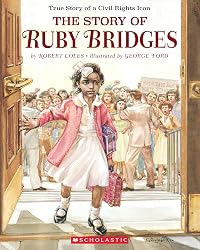
The Story of Ruby Bridges: True Story of a Civil Rights Icon
by Robert Coles
On This Page
Description
For months six-year-old Ruby Bridges must confront the hostility of white parents when she becomes the first African American girl to integrate Frantz Elementary School in New Orleans in 1960.Tags
Recommendations


Member Reviews
Child psychiatrist Robert Coles, is (according to journalist Scott London) perhaps “best known for his explorations of children's lives and books that explore their moral, political, and spiritual sensibilities.” He was eminently qualified to write a picture book about Ruby Bridges, the first African-American child to attend, in 1960, a whites-only elementary school. Coles apparently witnessed the six-year-old enter the school accompanied by armed US marshalls, and he subsequently supported the girl and her family through what can only be described as an ordeal.
This is a simple but beautiful and powerful picture book. It opens with a few details about Ruby’s early life. She was born in Mississippi where her daddy worked hard to show more support his family by picking crops. He lost that job when the owners of the land brought in farm equipment. The family subsequently moved to New Orleans, where her father got janitorial work and her mother stayed home with Ruby and her siblings by day and scrubbed the floors of banks by night. The family was extremely poor.
In 1960 when a judge ordered that four black girls were to be allowed to attend two white elementary schools (in the fully segregated New Orleans school system), the Bridges were proud that Ruby had been selected. They prayed for strength and courage and that the little girl would be “a credit to her people.” She was the only one of the four children to attend William Frantz Elementary.
Ruby was from a deeply spiritual family. Her mother wanted the children to feel “close to God” and ensured that everyone attended church every Sunday.
Familiar as I am with Ruby’s story and others similar to it, I have to say that reading a picture book about the hate spewed at this tidy little girl with a bow in her hair was enough to make me weep. She said not a word to those who called her names and threatened her. The abuse went on for months.
Also for months, Ruby was the only child in her grade-one class. Her teacher, Mrs. Henry, was struck by how polite and relaxed the girl was. There was no anxiety, irritability, or fear on display. Ruby was calmly committed to learning to read and write.
One morning from a school window, Mrs. Henry saw Ruby speaking to the people screaming at her. The teacher was later to find out that the little girl hadn’t been talking to them at all; she had been praying for these people who hated her, asking God to forgive them as Jesus had long ago forgiven those who’d been terrible to him. Uncharacteristically, that morning, Ruby had forgotten the prayers she usually said a few blocks before she reached the school, so she pronounced them at the school’s doorstep.
In an afterword, Coles explains that Ruby did not remain the sole student in the classroom. Later that year, a couple of white boys were sent back to school because they were getting into too much trouble at home. The mob was pretty angry with them, too. In time, however, more children returned, and by Ruby’s grade-two year, the hateful crowd had given up. The author also explains that Ruby finished elementary and high school, married a contractor, had four sons, and created The Ruby Bridges Foundation.
To conclude, I want to quote from Scott London’s excellent article on Coles, which I was very glad to have found online:
“Coles feels that we learn our most lasting moral lessons through stories. Storytelling, in the form of both personal narratives and the established literary tradition, gives us a fuller understanding of ourselves and the experiences of others. ‘The whole point of stories,’ he observes, ‘is not “solutions” or “resolutions” but a broadening and even heightening of our struggles.’ They remind us of what is important in life, admonish us, point us in new directions, engage us in self-reflection, and sometimes inspire us to lead lives of moral integrity. The beauty of a story, he says, is in its openness — ‘the way you or I can take it in, and use it for ourselves.’”
This simple picture book surely inspires young readers to understand something about the courage of a very young person in the face of hate. I can see it being used with children as young as Ruby was at the time of her experience and even with young teenagers. show less
This is a simple but beautiful and powerful picture book. It opens with a few details about Ruby’s early life. She was born in Mississippi where her daddy worked hard to show more support his family by picking crops. He lost that job when the owners of the land brought in farm equipment. The family subsequently moved to New Orleans, where her father got janitorial work and her mother stayed home with Ruby and her siblings by day and scrubbed the floors of banks by night. The family was extremely poor.
In 1960 when a judge ordered that four black girls were to be allowed to attend two white elementary schools (in the fully segregated New Orleans school system), the Bridges were proud that Ruby had been selected. They prayed for strength and courage and that the little girl would be “a credit to her people.” She was the only one of the four children to attend William Frantz Elementary.
Ruby was from a deeply spiritual family. Her mother wanted the children to feel “close to God” and ensured that everyone attended church every Sunday.
Familiar as I am with Ruby’s story and others similar to it, I have to say that reading a picture book about the hate spewed at this tidy little girl with a bow in her hair was enough to make me weep. She said not a word to those who called her names and threatened her. The abuse went on for months.
Also for months, Ruby was the only child in her grade-one class. Her teacher, Mrs. Henry, was struck by how polite and relaxed the girl was. There was no anxiety, irritability, or fear on display. Ruby was calmly committed to learning to read and write.
One morning from a school window, Mrs. Henry saw Ruby speaking to the people screaming at her. The teacher was later to find out that the little girl hadn’t been talking to them at all; she had been praying for these people who hated her, asking God to forgive them as Jesus had long ago forgiven those who’d been terrible to him. Uncharacteristically, that morning, Ruby had forgotten the prayers she usually said a few blocks before she reached the school, so she pronounced them at the school’s doorstep.
In an afterword, Coles explains that Ruby did not remain the sole student in the classroom. Later that year, a couple of white boys were sent back to school because they were getting into too much trouble at home. The mob was pretty angry with them, too. In time, however, more children returned, and by Ruby’s grade-two year, the hateful crowd had given up. The author also explains that Ruby finished elementary and high school, married a contractor, had four sons, and created The Ruby Bridges Foundation.
To conclude, I want to quote from Scott London’s excellent article on Coles, which I was very glad to have found online:
“Coles feels that we learn our most lasting moral lessons through stories. Storytelling, in the form of both personal narratives and the established literary tradition, gives us a fuller understanding of ourselves and the experiences of others. ‘The whole point of stories,’ he observes, ‘is not “solutions” or “resolutions” but a broadening and even heightening of our struggles.’ They remind us of what is important in life, admonish us, point us in new directions, engage us in self-reflection, and sometimes inspire us to lead lives of moral integrity. The beauty of a story, he says, is in its openness — ‘the way you or I can take it in, and use it for ourselves.’”
This simple picture book surely inspires young readers to understand something about the courage of a very young person in the face of hate. I can see it being used with children as young as Ruby was at the time of her experience and even with young teenagers. show less
This is the story of Ruby Bridges, a 6-year-old black girl who was chosen to be one of the first kids to attend a non-segregated school. The story focuses on her first year in school, the mob that would come harass her every morning, and her reaction to it. It's a story of perseverance and forgiveness with a strong religious undertone. The illustrations are beautiful and the story is well written. I wish that there had been a little bit about who Ruby Bridges grew up to be, or more about what happened when the other students started coming back to school.
What a beautiful book!
I knew about a black girl who was the first child ordered by a federal judge to be allowed to go to a school that had previously been only for all white children. I didn't know any more of that story so I decided to read this book when I came across it. It's a story that brought me to tears.
This young child, Ruby Bridges, had to endure not only heckling by an angry crowd and be accompanied to school by federal marshals, but the first year of class she was in an empty classroom with her teacher and in an empty school because white families would not send their children to the same school until a year later when they realized their own children were being cheated out of an education.
This book stresses the show more importance of religion in the life of Ruby Bridges and how it helped her to cope with a situation you would never want a first-grader to endure. I think this is a wonderful book to stress good values whether or not one's own family is religious. It's about what is fair. show less
I knew about a black girl who was the first child ordered by a federal judge to be allowed to go to a school that had previously been only for all white children. I didn't know any more of that story so I decided to read this book when I came across it. It's a story that brought me to tears.
This young child, Ruby Bridges, had to endure not only heckling by an angry crowd and be accompanied to school by federal marshals, but the first year of class she was in an empty classroom with her teacher and in an empty school because white families would not send their children to the same school until a year later when they realized their own children were being cheated out of an education.
This book stresses the show more importance of religion in the life of Ruby Bridges and how it helped her to cope with a situation you would never want a first-grader to endure. I think this is a wonderful book to stress good values whether or not one's own family is religious. It's about what is fair. show less
I learned a lot from Ruby Bridges. I had no idea about her story. I knew about the high schools, but I can’t imagine being in elementary school and going through her story. It made me think about being in Ruby’s situation and what I would have done. She seemed very mature for her age and definitely deserved to go to school. When she was being yelled at before she came into school every day, her teacher saw her stop and speak to the crowd, although she was just praying. The strength it takes to still pray for others as they are yelling hateful things at you, shows that Ruby was a fantastic young lady and had a bright future. Even though this book took place when so many important historical events were happening, it is still aimed at show more elementary school children. This book can easily be read to teach about America’s history and provide a great lesson for children. I think the big message in this book is everyone deserves an education. Now we still face this problem with bilingual and multicultural students. Even though all students do not speak English, they should still be provided with the same educational opportunities. show less
The Story of Ruby Bridges tells the experience of six year old Ruby Bridges when she integrated William Franz Elementary School. The book does a lovely job of portraying Ruby's strength, bravery, and kindness during her difficult experience. I like this book because it discusses integration in a way that is accessible to children and I enjoy the illustrations. I would use it in my teaching to discuss acceptance vs. discrimination with Grades 1-3, and The Story of Ruby Bridges would also fit themes of biography, civil rights, and integration vs. segregation.
This is the story of courageous six-year-old girl that helped shape history in the world, starting in New Orleans. She was the first African American, first grader sent to an all-white school. The story shows how brave Ruby was starring in the face of the dangerous, angry mobs as she was escorted to school. The illustrations are beautiful. Racism can be a difficult topic to discuss with young students but this books tells the story of how children can make a difference with kindness and courage.
Ruby Bridges was a young girl during segregation when 4 African American girls were chosen to go to white schools. Although Ruby's family was honored that their daughter got chosen, they were scared of the discrimination that Ruby may have to witness first hand. Ruby was met with protests against Ruby going to school. She saw them everyday, and was escorted by marshals so that she would not be harmed. White families eventually took their children out of school in protest. Ruby excelled in school, despite the hate that was thrown at her. Her teacher soon discovers that every day Ruby prays to God to forgive the mob. She asks him to forgive their angry words, and to love them.
This was a very heartfelt story. I couldn't imagine being a show more child, and having so many individuals hate me for just being me. I don't know how Ruby had the strength for that, but I don't know if I could ever.
Children these days don't realize how lucky hey are to be protected in schools. Back then, this wasn't the case. Schools were segregated by law. I think that although young children may no be able to comprehend the entirety of the civil rights movement, this would be a great way to introduce it. show less
This was a very heartfelt story. I couldn't imagine being a show more child, and having so many individuals hate me for just being me. I don't know how Ruby had the strength for that, but I don't know if I could ever.
Children these days don't realize how lucky hey are to be protected in schools. Back then, this wasn't the case. Schools were segregated by law. I think that although young children may no be able to comprehend the entirety of the civil rights movement, this would be a great way to introduce it. show less
Members
- Recently Added By
Published Reviews
added by cteets93
Lists

Picture Books About Civil Rights
51 works; 4 members

Youth: BLM
265 works; 1 member

BLM
210 works; 1 member
Author Information

112+ Works 10,544 Members
Boston-born psychiatrist and author Robert Martin Coles devoted his professional life to the psychology of children. Coles has been associated with the Harvard University Medical School since 1960. Winner of the Pulitzer Prize for his five-volume series entitled Children in Crisis, Coles has contributed hundreds of articles to popular magazines, show more as well as writing over thirty books for adults and children. Other books include The Mind's Fate, Flannery O'Connor's South, and Walker Percy: An American Search. (Bowker Author Biography) Robert Coles is a professor of psychiatry and medical humanities at the Harvard Medical school and a research psychiatrist for the Harvard University Health Services. His many books include the Pulitzer Prize-winning five-volume Children of Crisis and the bestselling The Moral Intelligence of Children. He is also the James Agee Professor of Social Ethics at Harvard. He lives in Massachusetts. (Publisher Provided) Robert Coles is a professor of psychiatry & medical humanities at the Harvard Medical School, a research psychiatrist for the Harvard University Health Services, & the James Agee Professor of Social Ethics at Harvard College. His many books include the Pulitzer Prize-winning "Children of Crisis" series as well as the best-selling "The Spiritual Life of Children" & "The Moral Intelligence of Children". Dr. Coles is a founding editor of the award-winning magazine "DoubleTake". (Publisher Provided) show less
Some Editions
Awards and Honors
Awards
Common Knowledge
- Canonical title
- The Story of Ruby Bridges: True Story of a Civil Rights Icon
- Original publication date
- 1995
- People/Characters
- Ruby Bridges
- Important places
- New Orleans, Louisiana, USA; Louisiana, USA
- Important events
- Brown v. Board of Education (1954)
Classifications
Statistics
- Members
- 5,404
- Popularity
- 2,510
- Reviews
- 182
- Rating
- (4.43)
- Languages
- English, Spanish
- Media
- Paper, Ebook
- ISBNs
- 21
- UPCs
- 1
- ASINs
- 6