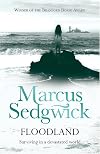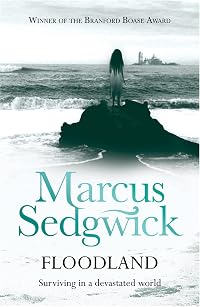
Floodland
by Marcus Sedgwick
On This Page
Description
After global warming causes the sea to rise until cities in England become islands, ten-year-old Zoe goes on a harrowing solitary boat journey to search for her parents.Tags
Recommendations







Member Reviews
Set in a future dystopia where rising sea levels have turned Britain into a chain of islands and isolated groups of children have formed themselves into barbaric tribes, the novel follows the travails of little Zoe as she braves the elements (and other people) in order to be reunited with her parents. Unfortunately, despite glaring allusions to "Lord of the Flies" and a couple of mystical references à la William Blake, the whole fails to equal the sum of its parts. An easy read nonetheless, some might say "rushed", and entertaining if viewed as an allegory aimed at young adults.
Post-holocaust novels are now perhaps old hat, and the genre of the future will be post-climate-change novels. This is a worthy addition to the field, aimed at teenage readers. (Although I've tagged it "SF", the "science" label is scarcely apt for what is essentially a realistic novel set in an entirely mundane future England.)
As the eastern counties of England are slowly drowned by the encroaching sea, Zoe is separated from her parents as they attempt to board the last boat west out of Norwich. Making her own escape from the isolated and increasingly chaotic town in a rowing boat, she is washed up on a small island dominated by a cathedral. (This, though named etymologically as "Eel Island", is clearly Ely, perched on its tiny mound show more above the fens.) It is inhabited only by a band of feral children, the adults having perished of disease or conflict with other tribal groups, except for the semi-lucid William Blake, a mild-mannered and educated lunatic, who wanders around quoting gnomic fragments from the works of his great namesake. Ely's chaos is held back from complete anarchy by the brutal Dooby, an unpleasantly amoral teenager who has made himself into a gangster leader, but he is intelligent enough to realise that the shrinking island is doomed, and Zoe survives only because he hopes to force her to take him to safety in her boat.
Like much solid and readable speculative fiction, the book relies more on situation and atmosphere than character or personal relationships. Although comparisons of Sedgwick's Ely with Lord of the Flies are inevitable, little attempt is made to impede the flow of the story with detailed social or psychological analysis, and the characterization (like J. K. Rowling's) is sufficient to inform the reader, provide plausible motivations, and move the plot forward, without becoming a serious focus. There are moments of genuine pathos, and some realistic moral dilemmas. In a tale about flooding, I was relieved to find that the only biblical references were veiled allusions to large boats and the need for breeding pairs to sustain livestock, though Noah's ancient Near Eastern analogue Utnapishtim is unexpectedly named. The placing of the action in a claustrophobically tiny enclave of eastern England, out of touch with the rest of the world, is reminiscent of other post-catastrophic settings such as the Kent of Russell Hoban's Riddley Walker, the Oxfordshire of Brian Aldiss's Greybeard, or the "wherever it is" of Iain Banks's Song of Stone. The eventual ending is a slightly rushed resolution, but I don't think this is a major weakness, though most adult novels would probably have avoided it in favour of bleak pessimism. show less
As the eastern counties of England are slowly drowned by the encroaching sea, Zoe is separated from her parents as they attempt to board the last boat west out of Norwich. Making her own escape from the isolated and increasingly chaotic town in a rowing boat, she is washed up on a small island dominated by a cathedral. (This, though named etymologically as "Eel Island", is clearly Ely, perched on its tiny mound show more above the fens.) It is inhabited only by a band of feral children, the adults having perished of disease or conflict with other tribal groups, except for the semi-lucid William Blake, a mild-mannered and educated lunatic, who wanders around quoting gnomic fragments from the works of his great namesake. Ely's chaos is held back from complete anarchy by the brutal Dooby, an unpleasantly amoral teenager who has made himself into a gangster leader, but he is intelligent enough to realise that the shrinking island is doomed, and Zoe survives only because he hopes to force her to take him to safety in her boat.
Like much solid and readable speculative fiction, the book relies more on situation and atmosphere than character or personal relationships. Although comparisons of Sedgwick's Ely with Lord of the Flies are inevitable, little attempt is made to impede the flow of the story with detailed social or psychological analysis, and the characterization (like J. K. Rowling's) is sufficient to inform the reader, provide plausible motivations, and move the plot forward, without becoming a serious focus. There are moments of genuine pathos, and some realistic moral dilemmas. In a tale about flooding, I was relieved to find that the only biblical references were veiled allusions to large boats and the need for breeding pairs to sustain livestock, though Noah's ancient Near Eastern analogue Utnapishtim is unexpectedly named. The placing of the action in a claustrophobically tiny enclave of eastern England, out of touch with the rest of the world, is reminiscent of other post-catastrophic settings such as the Kent of Russell Hoban's Riddley Walker, the Oxfordshire of Brian Aldiss's Greybeard, or the "wherever it is" of Iain Banks's Song of Stone. The eventual ending is a slightly rushed resolution, but I don't think this is a major weakness, though most adult novels would probably have avoided it in favour of bleak pessimism. show less
This is a satisfying read. Slim but carefully formed it feels a little like a fable, telling the story of Zoe who has been abandonned on the new island of Norwich in a world where rising sea levels have submerged civilisation along with land. Zoe is focussed on survival and on the hope that her parents are still alive somewhere. This could have been stretched into a full length novel but is satisfying in this form. I agree with other readers that the ending seems a little neat and rushed, however this adds to the fable like quality.
A middle-grade short novel about a post-global-warming world in which much of what was England is now under water. Ten-year-old Zoe and her parents struggle to survive in Norwich, now an island, until the last supply ship is set to take them away. But Zoe gets separated from her parents and misses the boat. Months later she finds a small boat and sets out to try to find them.
Meh. S’okay. It felt like it could have been fleshed out much more than it was; honestly it reads more like an outline of a story rather than the finished product.
Meh. S’okay. It felt like it could have been fleshed out much more than it was; honestly it reads more like an outline of a story rather than the finished product.
Annotation:
In a future world where the ocean is now covering half of what used to be land, Ely uses a rowboat to search for her missing parents.
Review:
Floodland explores the possibility of what life would be like in a future where global warming has increased the volume of water on the planet so that much of the land around the world is now underwater. By a series of unfortunate events, Ely’s parents were separated from her when the family tried to leave the island on a fishing boat.
Ely, forced to fend for her self, has been surviving by sleeping in abandoned buildings and scavenging for food. After finding an abandoned rowboat Ely leaves the island to go in search of her parents. Instead she discovers a “Lord of the Flies” like show more civilization of children, who are ruled by their merciless leader, Dobby. Now Ely must find a new opportunity to escape and leave the wild clan of children behind.
The story in Floodland is compelling with a plot that moves very quickly. Ely is a strong, intelligent and determined character who children will enjoy rooting for. Unlike Ely, the character development of the other children in the novel is very sparse resulting in black and white style characterizations of good or bad, smart or stupid, and industrious or lazy. Although there is a female protagonist both genders should appreciate this exciting story of survival. It is recommended for children ages 9-13.
Other Reviews: Both reviews of the book are positive. The Horn Book felt that the characters lacked a level of complexity that would have made for a richer story. I think better character development would have improved the book, but the plot is dramatic enough so that the book is still an enjoyable read.
The Horn Book Magazine 77.2 (March 2001): 213
School Library Journal 47.3 (March 2001): 256 show less
In a future world where the ocean is now covering half of what used to be land, Ely uses a rowboat to search for her missing parents.
Review:
Floodland explores the possibility of what life would be like in a future where global warming has increased the volume of water on the planet so that much of the land around the world is now underwater. By a series of unfortunate events, Ely’s parents were separated from her when the family tried to leave the island on a fishing boat.
Ely, forced to fend for her self, has been surviving by sleeping in abandoned buildings and scavenging for food. After finding an abandoned rowboat Ely leaves the island to go in search of her parents. Instead she discovers a “Lord of the Flies” like show more civilization of children, who are ruled by their merciless leader, Dobby. Now Ely must find a new opportunity to escape and leave the wild clan of children behind.
The story in Floodland is compelling with a plot that moves very quickly. Ely is a strong, intelligent and determined character who children will enjoy rooting for. Unlike Ely, the character development of the other children in the novel is very sparse resulting in black and white style characterizations of good or bad, smart or stupid, and industrious or lazy. Although there is a female protagonist both genders should appreciate this exciting story of survival. It is recommended for children ages 9-13.
Other Reviews: Both reviews of the book are positive. The Horn Book felt that the characters lacked a level of complexity that would have made for a richer story. I think better character development would have improved the book, but the plot is dramatic enough so that the book is still an enjoyable read.
The Horn Book Magazine 77.2 (March 2001): 213
School Library Journal 47.3 (March 2001): 256 show less
A kind of modern Global Warming meets Lord of the Flies. Land is shrinking; government, food, and organization have all disappeared; and one girl, left behind in the chaos, struggles to survive to find her family.
Members
- Recently Added By
Lists

Climate Change
39 works; 2 members

Books Read in 2024
4,727 works; 128 members

Survival, islands -- children's/young adult fiction
123 works; 7 members

Floods -- children's/young adult fiction
29 works; 2 members
Author Information

58+ Works 7,581 Members
Marcus Sedgwick was born in East Kent, England. He is primarily a young adult author. His books include She Is Not Invisible, White Crow, Revolver, and The Ghosts of Heaven. He won the 2014 Michael L. Printz Award for Midwinterblood. His first adult novel, A Love Like Blood, was published in 2014. (Bowker Author Biography)
Awards and Honors
Awards
Classifications
Statistics
- Members
- 206
- Popularity
- 159,116
- Reviews
- 7
- Rating
- (3.28)
- Languages
- English, French
- Media
- Paper, Audiobook, Ebook
- ISBNs
- 15
- ASINs
- 3