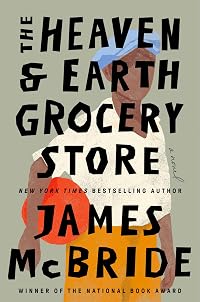
The Heaven & Earth Grocery Store
by James McBride
On This Page
Description
"In 1972, when workers in Pottstown, Pennsylvania, were digging the foundations for a new development, the last thing they expected to find was a skeleton at the bottom of a well. Who the skeleton was and how it got there were two of the long-held secrets kept by the residents of Chicken Hill, the dilapidated neighborhood where immigrant Jews and African Americans lived side by side and shared ambitions and sorrows. Chicken Hill was where Moshe and Chona Ludlow lived when Moshe integrated show more his theater and where Chona ran the Heaven & Earth Grocery Store. When the state came looking for a deaf boy to institutionalize him, it was Chona and Nate Timblin, the Black janitor at Moshe's theater and the unofficial leader of the Black community on Chicken Hill, who worked together to keep the boy safe. As these characters' stories overlap and deepen, it becomes clear how much the people who live on the margins of white, Christian America struggle and what they must do to survive. When the truth is finally revealed about what happened on Chicken Hill and the part the town's white establishment played in it, McBride shows us that even in dark times, it is love and community--heaven and earth--that sustain us."-- show lessTags
Recommendations








Member Reviews
No wonder this one is a bestseller! Talented writer (and musician) James McBride serves up a slice of 1930s America — with rich, quirky characters, moments of stomach-sinking horror, and profoundly subtle humor. Plus I cried at the end. What more could you want? 4.5 stars is a more accurate rating.
THE HEAVEN AND EARTH GROCERY STORE is a uniquely constructed story and quite hard to describe. So bear with me.
Think of the novel as having roughly two parts:
• The first part introduces the real town of Pottstown, Pennsylvania, a small industrial town 40 miles from Philadelphia. This is Depression-era America, so Pottstown really represents any place during this period. Residents are struggling to get by and each life is influenced, for show more better or worse, by the relationships formed with those around them.
• In the second part of the book, McBride skillfully lines up his characters in multiple but interdependent situations. It reminded me of a badly-aligned string of standing dominos. You can’t tell by looking whether each will fall the way you want -- but you know they simply HAVE TO, to get to a satisfying ending. The mounting suspense that results is intense.
Pottstown, like many places in the 1930s, reflects the 20th century influx of immigrants. Some have been there long enough to wield political power. Others more recently arrived do not. There was a significant Jewish population, but most have now moved away. Most of those remaining are Black Americans, providing most of the key service and labor jobs needed to maintain the town.
These are people who understand their community. Corruption is widespread. White residents understand you can’t necessarily expect help through legal and government channels. And Black residents have always understood their lives are ruled by a different set of laws altogether. So the question becomes: what solution is possible when an important need arises -- like helping a 12-year-old deaf boy get the protection he needs?
Under these circumstances, people wind up having to rely on one another. Like on Moshe (who brings entertainers to town) and his wife Chona (who runs the grocery store referenced in the book title) who are two of the Jews who have NOT moved away. They remain in Pottstown, alongside those who are most important to them -- like their Black neighbors.
Each of James McBride’s characters felt both distinctive and familiar. Types we all know because they live everywhere. Bullies and crooked cops. Gamblers and loan sharks. Sultry women manipulating the men around them. Even a town doctor who heals by day, but marches with the Ku Klux Klan at night. And for all of them, under the surface, there are also deep allegiances and long kept secrets at work.
Ultimately, the book's message is universal and exposes the best and worst of we humans. Expect instances of injustice, torment and abuse alongside moments full of good intentions and deep human connection. Along with reassuring proof of all that one person is willing to do to help another. Don't miss this one! It's a great American novel. show less
THE HEAVEN AND EARTH GROCERY STORE is a uniquely constructed story and quite hard to describe. So bear with me.
Think of the novel as having roughly two parts:
• The first part introduces the real town of Pottstown, Pennsylvania, a small industrial town 40 miles from Philadelphia. This is Depression-era America, so Pottstown really represents any place during this period. Residents are struggling to get by and each life is influenced, for show more better or worse, by the relationships formed with those around them.
• In the second part of the book, McBride skillfully lines up his characters in multiple but interdependent situations. It reminded me of a badly-aligned string of standing dominos. You can’t tell by looking whether each will fall the way you want -- but you know they simply HAVE TO, to get to a satisfying ending. The mounting suspense that results is intense.
Pottstown, like many places in the 1930s, reflects the 20th century influx of immigrants. Some have been there long enough to wield political power. Others more recently arrived do not. There was a significant Jewish population, but most have now moved away. Most of those remaining are Black Americans, providing most of the key service and labor jobs needed to maintain the town.
These are people who understand their community. Corruption is widespread. White residents understand you can’t necessarily expect help through legal and government channels. And Black residents have always understood their lives are ruled by a different set of laws altogether. So the question becomes: what solution is possible when an important need arises -- like helping a 12-year-old deaf boy get the protection he needs?
Under these circumstances, people wind up having to rely on one another. Like on Moshe (who brings entertainers to town) and his wife Chona (who runs the grocery store referenced in the book title) who are two of the Jews who have NOT moved away. They remain in Pottstown, alongside those who are most important to them -- like their Black neighbors.
Each of James McBride’s characters felt both distinctive and familiar. Types we all know because they live everywhere. Bullies and crooked cops. Gamblers and loan sharks. Sultry women manipulating the men around them. Even a town doctor who heals by day, but marches with the Ku Klux Klan at night. And for all of them, under the surface, there are also deep allegiances and long kept secrets at work.
Ultimately, the book's message is universal and exposes the best and worst of we humans. Expect instances of injustice, torment and abuse alongside moments full of good intentions and deep human connection. Along with reassuring proof of all that one person is willing to do to help another. Don't miss this one! It's a great American novel. show less
Summary: A story centered around a grocery store in the midst of Pottstown’s Chicken Hill district, inhabited by immigrant Jews and the local Black community.
In 1972, a body is found at the bottom of a well, but swept away by Hurricane Agnes. In one sense the rest of this novel answers the question of how that body got there (and so I won’t). But this is a rich story about so much more, that all centers around a Jewish grocery, The Heaven & Earth Grocery Store. Jewish immigrants with a daughter Chona owned the store. She married a struggling theatre owner, Moshe Ludlow. Eventually Moshe figured out that the money was in Black acts, that the Black residents of Chicken Hill as well as surrounding areas would attend.
Chicken Hill was show more where those living on the margins, trying to get a toehold, lived–Blacks, immigrant Jews, and later, Latinos. Moshe and Chona lived above the store. While his theatres profited, the store lost money, mostly because Chona was generous with extending credit and slow to ask repayment. As more Jews moved away, Moshe wanted to join them but Chona refused. Today, we would call her a community activist. She was greatly loved, whether by the Jewish immigrants or Black residents, many of whom McBride introduces us.
Nate Timblin worked for Moshe, doing repairs. He had a dark past, according to rumors, but Moshe knows nothing of this. So when he asks Moshe and Chona to help a bright child deafened by a stove explosion to hide from white authorities who want to institutionalize him at Pennhurst, they agree. Dodo quickly becomes beloved by Chona, and a great help as she was weakened by periods of illness. This was not a child who needed institutionalization. They succeed until the town’s white doctor visits the store. Dodo defends her against an assault by the doctor, who flees only to return with the police, who take Dodo to Pennhurst, which is as horrible as all the rumors.
Nate and Addie, the woman he has been seeing, figure out what happened to Chona. And an amazing thing happens. Two communities touched by this evil act come together to rescue Dodo, honor Chona, and to get back at the city councilman, Gus Plitzka, who controls their water supply. And this underscores the larger context of this story. Pottstown is controlled by its white establishment. In these incidents, two ethnic communities, each in many ways self-contained, except by the generosity of Chona, come together to shrewdly resist the white establishment in plots with many moving parts. As kind of a dark counterpart to Chona, Nate chooses to risk all to deliver Dodo from the horrors of Pennhurst.
It’s not hard to see why this book has won numerous recognitions. McBride paints a rich portrait of these two communities that stand against white power and venality. We see two communities galvanized by attacks on an innocent boy and a generous and righteous woman. But all this was sown through years of care and generosity where heaven and earth met at a grocery store. show less
In 1972, a body is found at the bottom of a well, but swept away by Hurricane Agnes. In one sense the rest of this novel answers the question of how that body got there (and so I won’t). But this is a rich story about so much more, that all centers around a Jewish grocery, The Heaven & Earth Grocery Store. Jewish immigrants with a daughter Chona owned the store. She married a struggling theatre owner, Moshe Ludlow. Eventually Moshe figured out that the money was in Black acts, that the Black residents of Chicken Hill as well as surrounding areas would attend.
Chicken Hill was show more where those living on the margins, trying to get a toehold, lived–Blacks, immigrant Jews, and later, Latinos. Moshe and Chona lived above the store. While his theatres profited, the store lost money, mostly because Chona was generous with extending credit and slow to ask repayment. As more Jews moved away, Moshe wanted to join them but Chona refused. Today, we would call her a community activist. She was greatly loved, whether by the Jewish immigrants or Black residents, many of whom McBride introduces us.
Nate Timblin worked for Moshe, doing repairs. He had a dark past, according to rumors, but Moshe knows nothing of this. So when he asks Moshe and Chona to help a bright child deafened by a stove explosion to hide from white authorities who want to institutionalize him at Pennhurst, they agree. Dodo quickly becomes beloved by Chona, and a great help as she was weakened by periods of illness. This was not a child who needed institutionalization. They succeed until the town’s white doctor visits the store. Dodo defends her against an assault by the doctor, who flees only to return with the police, who take Dodo to Pennhurst, which is as horrible as all the rumors.
Nate and Addie, the woman he has been seeing, figure out what happened to Chona. And an amazing thing happens. Two communities touched by this evil act come together to rescue Dodo, honor Chona, and to get back at the city councilman, Gus Plitzka, who controls their water supply. And this underscores the larger context of this story. Pottstown is controlled by its white establishment. In these incidents, two ethnic communities, each in many ways self-contained, except by the generosity of Chona, come together to shrewdly resist the white establishment in plots with many moving parts. As kind of a dark counterpart to Chona, Nate chooses to risk all to deliver Dodo from the horrors of Pennhurst.
It’s not hard to see why this book has won numerous recognitions. McBride paints a rich portrait of these two communities that stand against white power and venality. We see two communities galvanized by attacks on an innocent boy and a generous and righteous woman. But all this was sown through years of care and generosity where heaven and earth met at a grocery store. show less
It didn’t really begin in 1972 with the discovery of a skeleton at the bottom of a well, but what led up to that discovery is what this tale is all about. It was a secret kept by the residents of Chicken Hill, a rundown place where Jews and Blacks lived peaceably side by side. In this town, neighbors help each other, whether it be by giving food when food is scarce or by hiding a disabled boy from the authorities who say they want to help but in reality will only cause harm. James McBride has spun a folksy tale filled with quirky but very down-home and likable people. Except not all the people are nice or likable, hence, a skeleton. This tale is rich in imagery and delightful in characters, and is an all around entertaining, show more first-rate story. show less
The Heaven and Earth Grocery Store is the kind of book to lose yourself in. Written by a storyteller at the top of his game, James McBride's account of the neglected community of Chicken Hill during the 1930s, when it was where immigrants and Jewish people landed before moving into one of Pottstown's more acceptable neighborhoods, and where Black Americans always lived. The story begins and ends with a body in a well, yet this isn't a mystery novel, but an expansive book about the many people who called Chicken Hill home. If you're looking for a tightly-constructed plot, this isn't the book for you; this one ranges here and there, while remaining centered on the small grocery store at the center of the community, run by a small Jewish show more woman who refuses to be quiet and whose compassion is legendary. For all this, McBride's story never forgets the harshness of the world in which these characters live. It's wonderfully told and while it seems to wander off into side stories, they all work together to make this book something remarkable. show less
This sprawling novel begins with a skeleton found in a well and then flashes back several decades, to the town of Pottstown PA, where the reader slowly discovers the origin of this mysterious body. The story is mostly set in Chicken Hill, a neighborhood that is mostly populated with black and Jewish residents and much of it revolves around the Heaven & Earth Grocery Store. It is owned and operated by a very kind Jewish woman and her equally kind, theater-operating husband. There are many dark secrets on Chicken Hill, along with rampant racism. McBride manages to coax a wonderful, complex tale out of this place and time, proving his absolute mastery at story-telling and plotting.
The Heaven & Earth Grocery Store - McBride
4.5 stars
“Light is only possible through dialogue between cultures, not through rejection of one or the other.”
This book had so much flavor. It’s kosher and soul food. The neighborhood of Chicken Hill pulses with activity. The overlapping, intersecting lives of the characters in this book reminded me of the tribal characters in Erdrich’s The Night Watchman. In McBride’s book there’s a mingling of tribes. It’s a mingling of marginalized people, immigrant people; the excluded people. Much of the mingling happens at the Grocery Store.
The book begins with the discovery of a skeleton in the bottom of a well. That’s a dark beginning and the book has no lack of injustice and human show more suffering. However, the harsh reality can’t compete with the humor and the human kindness. I enjoyed the quirky characters, their ramshackle environment, and their underhanded victory. Despite McBride’s prophetic foreshadowing of a bleak 21st century, (Chona’s whiff of a hotdog scented future), I was feeling optimistic as I read the last page.
I had a limited time library ebook of this title. I was propping up my eyelids to finish it the night before it vanished from my kindle. I will need to buy a copy so I can reread. I need to go back to see how all the little puzzle pieces fit together. I also miss these characters now that they have disappeared. It would be good to visit them again. show less
4.5 stars
“Light is only possible through dialogue between cultures, not through rejection of one or the other.”
This book had so much flavor. It’s kosher and soul food. The neighborhood of Chicken Hill pulses with activity. The overlapping, intersecting lives of the characters in this book reminded me of the tribal characters in Erdrich’s The Night Watchman. In McBride’s book there’s a mingling of tribes. It’s a mingling of marginalized people, immigrant people; the excluded people. Much of the mingling happens at the Grocery Store.
The book begins with the discovery of a skeleton in the bottom of a well. That’s a dark beginning and the book has no lack of injustice and human show more suffering. However, the harsh reality can’t compete with the humor and the human kindness. I enjoyed the quirky characters, their ramshackle environment, and their underhanded victory. Despite McBride’s prophetic foreshadowing of a bleak 21st century, (Chona’s whiff of a hotdog scented future), I was feeling optimistic as I read the last page.
I had a limited time library ebook of this title. I was propping up my eyelids to finish it the night before it vanished from my kindle. I will need to buy a copy so I can reread. I need to go back to see how all the little puzzle pieces fit together. I also miss these characters now that they have disappeared. It would be good to visit them again. show less
This book had a lot of moving pieces but was such a rich and compelling read. All of the characters had flaws of some sort, but the majority of them were good decent people. The heart of this historical novel is about secrets, why people keep them, and the unintended long term consequences of them. It's at times rip roaringly funny and other times heartbreakingly sad. There are a wide variety of poor people living on Chicken Hill, but by and large they are either Black or Jewish (with a few enterprising Italians thrown in for good measure). They are both rejected by the community of Pottstown but they form an uneasy alliance - mostly because of the work of Chona, a Jewess who extends credit to any on the hill who need it. Her generosity show more and happy spirit help bond the Jew and the Black folx together - which is good because soon they will face a challenge neither party ever expected. show less
Members
- Recently Added By
Lists

Books recommended by Barack Obama
295 works; 28 members

Black Authors
384 works; 32 members

Books Read in 2023
5,638 works; 147 members

Overdue Podcast
808 works; 9 members

Obama Reads
181 works; 3 members

NYT Readers best of 21st C
100 works; 8 members

Books Read in 2025
4,128 works; 98 members

Fiction: BLM
60 works; 1 member

Top Five Books of 2024
795 works; 264 members

Best Mysteries With a Historical Setting
292 works; 160 members

To Be Read
15 works; 1 member

Top Five Books of 2023
767 works; 317 members

Borrowed Books 2024 (Books We Have Read BUT do NOT Own)
20 works; 1 member

Books Read in 2024
4,727 works; 128 members

2024 Notable Books for Adults
26 works; 1 member
Recently Added January 2024
8 works; 1 member

2023 Christmas Gifts
39 works; 11 members

2024 Tournament of Books
18 works; 9 members

Library List - Pulitzer Adjacent
40 works; 1 member
Author Information

12+ Works 18,371 Members
James McBride studied composition at The Oberlin Conservatory of Music in Ohio and received a master's degree in journalism from Columbia University. He was a staff writer for The Boston Globe, People Magazine, and The Washington Post. His works include the memoir The Color of Water, the biography Kill 'Em and Leave, and two novels entitled show more Miracle at St. Anna and Song Yet Sung. He wrote the screenplay for Miracle at St. Anna when it was made into a movie in 2008. He won the National Book Award for The Good Lord Bird. He is a saxophonist and former sideman for jazz legend Jimmy Scott. He has written songs for Anita Baker, Grover Washington Jr., Gary Burton, and Barney, the PBS television character. He received the Stephen Sondheim Award and the Richard Rodgers Foundation Horizon Award for his musical Bo-Bos co-written with playwright Ed Shockley. In 2005, he published the first volume of a CD-based documentary about life as lived by low-profile jazz musicians entitled The Process. He is currently a Distinguished Writer in Residence at New York University. (Bowker Author Biography) show less
Some Editions
Awards and Honors
Awards
Distinctions
Notable Lists
Common Knowledge
- Canonical title
- The Heaven & Earth Grocery Store
- Original publication date
- 2023
- People/Characters
- Chona Ludlow; Moshe Ludlow; Dodo
- Important places
- Pottstown, Pennsylvania, USA
- Important events
- Hurricane Agnes (1972)
- Dedication
- To Sy Friend, who taught all of us
the meaning of Tikkun Olam - First words
- There was an old Jew who lived at the site of the old synagogue up on Chicken Hill in the town of Pottstown, Pa., and when Pennsylvania State Troopers found the skeleton at the bottom of an old well off Hayes Street, the old ... (show all)Jew's house was the first place they went to.
- Quotations
- The old man shrugged. Jewish life is portable, he said. (p. 3)
The Negroes of Chicken Hill loved Chona. They saw her not as a neighbor but as an artery to freedom, for the recollection of Chona's telltale limp as she and her childhood friend, a tall, gorgeous, silent soul named Bernice D... (show all)avis, walked down the pitted mud roads of the Hill to school each morning was stamped in their collective memory. It was proof of the American possibility of equality: we all can get along no matter what, look at those two. (p. 31)
She felt the prayer more than heard it; it started from somewhere deep down and fluttered toward her head like tiny flecks of light, tiny beacons moving like a school of fish, continually swimming away from a darkness that th... (show all)reatened to swallow them (p. 218)
They moved slowly like fusgeyers, wanderers seeking a home in Europe, or eru West African tribesmen herded off a ship on a Virginia shore to peer back across the Atlantic in the direction of their homeland one last time, movi... (show all)ng toward a common destiny, all of them - Isaac, Nate, and the rest - into a future of American nothing. (p. 225)
Chona wasn't one of them. She was the one among them who ruined his hate for them, and for that he resented her. (p. 237)
He had spent his entire adult life running, ever since he was thirteen -just past Dodo's age - for he was thirteen when he, too, had experienced his own accident, his own explosion. Not from a stove, but from a father who had... (show all) dragged his family from the perilous Low Country of South Carolina to the promised land of Pennsylvania only to discover that despite living on Hemlock Row among the peaceful Lowgods, justice and freedom had as little currenca in the new land as it had in the old. (p. 353) - Last words
- (Click to show. Warning: May contain spoilers.)"Thank you, Monkey Pants."
- Blurbers
- Coban, Harlan; Patchett, Ann; Smith, Danez; Charles, Ron; Garmus, Bonnie
- Original language
- English
- Canonical DDC/MDS
- F MCB
- Canonical LCC
- PS3613.C28
Classifications
Statistics
- Members
- 4,417
- Popularity
- 3,382
- Reviews
- 184
- Rating
- (4.03)
- Languages
- 5 — English, French, German, Norwegian, Spanish
- Media
- Paper, Audiobook, Ebook
- ISBNs
- 21
- ASINs
- 8