On This Page
Description
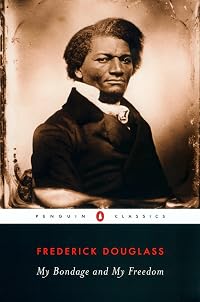
The second in the series of three autobiographies penned by Frederick Douglass, My Bondage and My Freedom picks up where Narrative of the Life of Frederick Douglass left off. This volume recounts more gripping details of Douglass' transformation from illiterate slave to leading light of the abolitionist movement and offers an extended philosophical meditation on the meaning of slavery..
Tags
Recommendations










Member Reviews
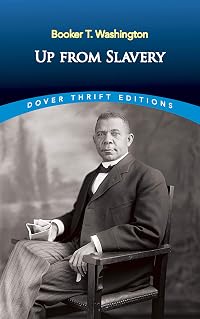
This is a great book, by a great American. Skeptics looking at that statement might think, well sure you think that reading his own account. Except I've found autobiographies unintentionally revealing in fascinating ways. Within the last year I read autobiographies and memoirs by Ghandi, Dian Fossey and Booker T. Washington. The first book lessened my admiration and liking, the second made me absolutely hate the woman because of her own words, and the last left me ambivalent. And in the case of others, I've become disillusioned afterwards reading other accounts of their lives. Neither is the case with Frederick Douglass--after reading this--and even, hell especially, after reading further about him, I have a new hero. I couldn't help show more but admire him given so much related here--particularly how, after his experience of being treated with dignity and respect in Britain, he decided to come back to America to fight to end slavery. And reading beyond this book, I learned he was a staunch supporter not just of civil rights for African Americans, but equal rights for women as well. Hardly a popular cause or common attitude back then.
And simply in terms of content, this book was riveting. The 1855 introduction by James M'Cune Smith did give me momentary pause. It read, like so much 19th century literature I've encountered, as tedious, overly religious and stuffy. Once you reach Douglass' own account however, that's no longer the case. Yes, there is a formal tone that is characteristic of the age, but there wasn't one line of this entire book that wasn't fascinating; he's a master storyteller. After purchasing this book, I learned this is actually the second of three autobiographies written by Douglass. The first, Narrative of the Life of Frederick Douglass, published in 1845, is the most famous and arguably of the three the most influential and historically important. Yet an introduction by Brent Hayes Edwards in the edition I read makes the case for the second biography as the better, more strongly written book. Which makes sense--after all, in the decade since that first biography Douglass had spent years as editor of The North Star, which would have honed his thinking and writing.
I also have read that this middle book includes the most expansive account of his time in slavery. And that account is full of insights, not simply into slavery, but how power over others corrupts victim and perpetrator alike. And I've never read a more moving account of the liberating power of literacy. I wish young people could read this early in their schooling, and read of how young Frederick heard his master talk of how reading makes a man unfit for slavery--and understand the importance of reading for setting a mind alight. The appendix contains other items of interest--the gem I think is Douglass' "Letter to his Old Master." Truly, this is a wonderful read. show less
And simply in terms of content, this book was riveting. The 1855 introduction by James M'Cune Smith did give me momentary pause. It read, like so much 19th century literature I've encountered, as tedious, overly religious and stuffy. Once you reach Douglass' own account however, that's no longer the case. Yes, there is a formal tone that is characteristic of the age, but there wasn't one line of this entire book that wasn't fascinating; he's a master storyteller. After purchasing this book, I learned this is actually the second of three autobiographies written by Douglass. The first, Narrative of the Life of Frederick Douglass, published in 1845, is the most famous and arguably of the three the most influential and historically important. Yet an introduction by Brent Hayes Edwards in the edition I read makes the case for the second biography as the better, more strongly written book. Which makes sense--after all, in the decade since that first biography Douglass had spent years as editor of The North Star, which would have honed his thinking and writing.
I also have read that this middle book includes the most expansive account of his time in slavery. And that account is full of insights, not simply into slavery, but how power over others corrupts victim and perpetrator alike. And I've never read a more moving account of the liberating power of literacy. I wish young people could read this early in their schooling, and read of how young Frederick heard his master talk of how reading makes a man unfit for slavery--and understand the importance of reading for setting a mind alight. The appendix contains other items of interest--the gem I think is Douglass' "Letter to his Old Master." Truly, this is a wonderful read. show less
This is one of the greatest autobiographies I've ever read. It blends a story of triumph over adversity, a retelling of a man's education, and an almost-Tocquevillean analysis of a society and how its economic foundation, slavery, seeps into every aspect of that society from religion to family even to the calendar. This should be required reading
This an excellent book that explains slavery from a personal perspective. Frederick Douglass is articulate and logical. I have learned what it would be like to be a slave and what cruel circumstances this entails. His comparative treatment in Great Britain to America is definitely disheartening for a modern American. I strongly recommend this book.
Born a slave, Douglass became an outspoken force in the antislavery movement. The best of Douglass's autobiographies. Graphic description of slave life.
Ratings
Members
- Recently Added By
Lists

Chronological 2016
33 works; 1 member

Best African American Literature
53 works; 9 members

United States Slave Narratives
28 works; 1 member

Books Read in 2021
5,361 works; 113 members

Ryan Holiday's Books To Base Your Life On
97 works; 2 members
Author Information

201+ Works 18,477 Members
Born a slave in Maryland in about 1817, Frederick Douglass never became accommodated to being held in bondage. He secretly learned to read, although slaves were prohibited from doing so. He fought back against a cruel slave-breaker and finally escaped to New Bedford, Massachusetts, in 1838 at about the age of 21. Despite the danger of being sent show more back to his owner if discovered, Douglass became an agent and eloquent orator for the Massachusetts Antislavery Society. He lectured extensively in both England and the United States. As an ex-slave, his words had tremendous impact on his listeners. In 1845 Douglass wrote his autobiography, Narrative of the Life of Frederick Douglass, which increased his fame. Concerned that he might be sent back to slavery, he went to Europe. He spent two years in England and Ireland speaking to antislavery groups. Douglass returned to the United States a free man and settled in Rochester, New York, where he founded a weekly newspaper, The North Star, in 1847. In the newspaper he wrote articles supporting the antislavery cause and the cause of human rights. He once wrote, "The lesson which [the American people] must learn, or neglect to do so at their own peril, is that Equal Manhood means Equal Rights, and further, that the American people must stand for each and all for each without respect to color or race." During the Civil War, Douglass worked for the Underground Railroad, the secret route of escape for slaves. He also helped recruit African-Americans soldiers for the Union army. After the war, he continued to write and to speak out against injustice. In addition to advocating education for freed slaves, he served in several government posts, including United States representative to Haiti. In 1855, a longer version of his autobiography appeared, and in 1895, the year of Douglass's death, a completed version was published. A best-seller in its own time, it has since become available in numerous editions and languages. (Bowker Author Biography) show less

Frederick Douglass has a Legacy Library. Legacy libraries are the personal libraries of famous readers, entered by LibraryThing members from the Legacy Libraries group.
Some Editions
Series

Belongs to Publisher Series
Work Relationships
Is contained in
Common Knowledge
- Canonical title
- My Bondage and My Freedom
- Original publication date
- 1855
- People/Characters
- Frederick Douglass
- Important places
- Maryland, USA
- First words
- In Talbot County, Eastern Shore, Maryland, near Easton, the county town of that county, there is a small district of county, thinly populated, and remarkalbe for nothing that I know of more than for the worn-out, sandy,desert... (show all)-like appearance of its soil, the general diapidation of its farm and fences, the indigent and spiritless character of its inhabitants, and the prevalence of ague and fever.
- Last words
- (Click to show. Warning: May contain spoilers.)Believing that one of the best means of emancipating the slaves of the south is to improve and elevate the character of the free colored people of the north I shall labor in the future, as I have labored in the past, to promote the moral, social, religious, and intellectual elevation of the free colored people; never forgetting my own humble orgin, nor refusing, while Heaven lends me ability, to use my voice, my pen, or my vote, to advocate the great and primary work of the universal and unconditional emancipation of my entire race.
- Blurbers
- Garrison, William Lloyd
- Original language
- English
Classifications
- Genres
- Biography & Memoir, Nonfiction, History, General Nonfiction
- DDC/MDS
- 973.8092 — History & geography History of North America United States The Gilded Age, Reconstruction, Spanish American War (1865-1901)
- LCC
- E449 .D738 — History of the United States United States Revolution to the Civil War, 1775/1783-1861 Slavery in the United States. Antislavery
- BISAC
Statistics
- Members
- 1,233
- Popularity
- 20,125
- Reviews
- 5
- Rating
- (4.36)
- Languages
- English, French
- Media
- Paper, Audiobook, Ebook
- ISBNs
- 132
- UPCs
- 1
- ASINs
- 32