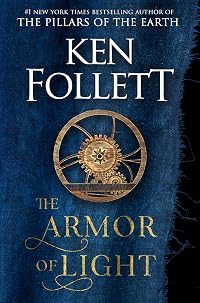
The Armor of Light
by Ken Follett
Kingsbridge {Chronological Order} (5), Kingsbridge {Publication Order} (5)
On This Page
Description
"The Spinning Jenny was invented in 1770, and with that, a new era of manufacturing and industry changed lives everywhere within a generation. A world filled with unrest wrestles for control over this new world order: A mother's husband is killed in a work accident due to negligence; a young woman fights to fund her school for impoverished children; a well-intentioned young man unexpectedly inherits a failing business; one man ruthlessly protects his wealth no matter the cost, all the while show more war cries are heard from France, as Napoleon sets forth a violent master plan to become emperor of the world. As institutions are challenged and toppled in unprecedented fashion, ripples of change ricochet through our characters' lives as they are left to reckon with the future and a world they must rebuild from the ashes of war."-- show lessTags
Recommendations









Member Reviews
* Copy courtesy of Pan Macmillan *
The Armour of Light by Ken Follett is a 700+ page novel, but if you're concerned it'll be a slow burn or you'll have to suffer through a slow start, fear not. As always, bestselling author Ken Follett drags the reader into the lives of his characters by the scruff of the neck, whether they've made the commitment to invest the requisite time with him or not.
But this is historical fiction I hear you cry, not a thriller. How does he do that? Well, how's this for an opening line?
"Until that day, Sal Clitheroe had never heard her husband scream." Page 3
Okay, I'm in! The opening line introduces us to Sal Clitheroe and we become immediately invested in her plight and that of her husband and family. It's 1792, show more the focus soon widens and we begin to meet more characters from a range of backgrounds from the town who will go on to tell this story. Some are friends, some are foes and they all have their faults, but together a relatable history of the period begins to form in the reader's mind.
Set in Kingsbridge, England during the Napoleonic Wars, I'll admit to being surprised at the date we pick up the thread again. I wanted to return to the moment soon after the events of The Evening and the Morning and the naming of Kingsbridge which gave me a very pleasant gasp of recognition that left me wanting more.
That said, The Evening and the Morning was actually the prequel to The Pillars of the Earth, however The Armour of Light is the 5th novel in the series and chronologically follows on more than a century after A Column of Fire*.
In The Armour of Light, we return to Kingsbridge 150 (or so) years after those events and during the industrial revolution.* The characters in Kingsbridge are struggling with the introduction of machinery to the local mills, which causes unrest amongst the workers.
Meanwhile, I learned about press gangs for the first time and didn't know that men could be kidnapped or tricked and captured, later waking up on a ship.
"Britain was in constant need of men for the navy. The militia, the home defence force, had no shortage, for it had the power to conscript men whether they liked it or not. There was no conscription into the regular army, but poverty-stricken Ireland supplied about a third of army recruits and the criminal courts accounted for most of the rest... So the biggest problem was the navy, which kept the seas free for British trade." Page 427
"In England, teams called press gangs kidnapped, or 'impressed', able-bodied men in coastal towns, took them aboard ships, and kept them tied up until they were miles from land. The system was hated, and often led to rioting." Page 427
I don't recall this ever coming up in the historical fiction I've read until now, but I could be mistaken. It seems preposterous, doesn't it? That you could drop into your local tavern for a beer and be kidnapped and forced into service, unable to alert your family or provide for them and this plays out in the book.
As in previous work, Follett's depth of research is supported by excellent writing, with the occasional line that made me smile for the sheer joy of it:
"The two men set off again. Willard House was on the market square. The irritatingly officious Sergeant Beach was on duty in the hall, and after a token display of reluctance he showed them in to Donaldson." Page 552
I love the 'token display of reluctance' and seeing this kind of detailed observation on the page is always an unexpected delight. Other than commencing close to two centuries later than I expected, The Armour of Light by Ken Follett delivered on every other hope and expectation. I came to care about the plight and wellbeing of the millworkers and villagers as well as the success of the town, all while understanding that the challenges faced in the industrial revolution were only going to increase.
Follett is able to distil the events of history and make them relatable through the impact to his characters, and I'm now feeling a little more informed about the Napoleonic wars and can't wait to see the release of Napoleon here in Australia later this month.
The Armour of Light by Ken Follett was my most highly anticipated title for 2023 and I can highly recommend it for readers of historical fiction.
* Here's a look at the Kingsbridge series of books in the order you should read them, and the time periods they cover:
Book #0 The Evening and the Morning 997AD - 1007AD
Book #1 The Pillars of the Earth 1135 - 1174
Book #2 World Without End 1327 - 1361
Book #3 A Column of Fire 1558 - 1606
Book #4 The Armour of Light 1792 - 1824 show less
The Armour of Light by Ken Follett is a 700+ page novel, but if you're concerned it'll be a slow burn or you'll have to suffer through a slow start, fear not. As always, bestselling author Ken Follett drags the reader into the lives of his characters by the scruff of the neck, whether they've made the commitment to invest the requisite time with him or not.
But this is historical fiction I hear you cry, not a thriller. How does he do that? Well, how's this for an opening line?
"Until that day, Sal Clitheroe had never heard her husband scream." Page 3
Okay, I'm in! The opening line introduces us to Sal Clitheroe and we become immediately invested in her plight and that of her husband and family. It's 1792, show more the focus soon widens and we begin to meet more characters from a range of backgrounds from the town who will go on to tell this story. Some are friends, some are foes and they all have their faults, but together a relatable history of the period begins to form in the reader's mind.
Set in Kingsbridge, England during the Napoleonic Wars, I'll admit to being surprised at the date we pick up the thread again. I wanted to return to the moment soon after the events of The Evening and the Morning and the naming of Kingsbridge which gave me a very pleasant gasp of recognition that left me wanting more.
That said, The Evening and the Morning was actually the prequel to The Pillars of the Earth, however The Armour of Light is the 5th novel in the series and chronologically follows on more than a century after A Column of Fire*.
In The Armour of Light, we return to Kingsbridge 150 (or so) years after those events and during the industrial revolution.* The characters in Kingsbridge are struggling with the introduction of machinery to the local mills, which causes unrest amongst the workers.
Meanwhile, I learned about press gangs for the first time and didn't know that men could be kidnapped or tricked and captured, later waking up on a ship.
"Britain was in constant need of men for the navy. The militia, the home defence force, had no shortage, for it had the power to conscript men whether they liked it or not. There was no conscription into the regular army, but poverty-stricken Ireland supplied about a third of army recruits and the criminal courts accounted for most of the rest... So the biggest problem was the navy, which kept the seas free for British trade." Page 427
"In England, teams called press gangs kidnapped, or 'impressed', able-bodied men in coastal towns, took them aboard ships, and kept them tied up until they were miles from land. The system was hated, and often led to rioting." Page 427
I don't recall this ever coming up in the historical fiction I've read until now, but I could be mistaken. It seems preposterous, doesn't it? That you could drop into your local tavern for a beer and be kidnapped and forced into service, unable to alert your family or provide for them and this plays out in the book.
As in previous work, Follett's depth of research is supported by excellent writing, with the occasional line that made me smile for the sheer joy of it:
"The two men set off again. Willard House was on the market square. The irritatingly officious Sergeant Beach was on duty in the hall, and after a token display of reluctance he showed them in to Donaldson." Page 552
I love the 'token display of reluctance' and seeing this kind of detailed observation on the page is always an unexpected delight. Other than commencing close to two centuries later than I expected, The Armour of Light by Ken Follett delivered on every other hope and expectation. I came to care about the plight and wellbeing of the millworkers and villagers as well as the success of the town, all while understanding that the challenges faced in the industrial revolution were only going to increase.
Follett is able to distil the events of history and make them relatable through the impact to his characters, and I'm now feeling a little more informed about the Napoleonic wars and can't wait to see the release of Napoleon here in Australia later this month.
The Armour of Light by Ken Follett was my most highly anticipated title for 2023 and I can highly recommend it for readers of historical fiction.
* Here's a look at the Kingsbridge series of books in the order you should read them, and the time periods they cover:
Book #0 The Evening and the Morning 997AD - 1007AD
Book #1 The Pillars of the Earth 1135 - 1174
Book #2 World Without End 1327 - 1361
Book #3 A Column of Fire 1558 - 1606
Book #4 The Armour of Light 1792 - 1824 show less
Suffers from the same problem A Column of Fire had, in a diffusion of purpose. Though more of it takes place in Kingsbridge, it builds toward and has its final part set in France again, this time going up against Ol Boney, in scenes that wishes they were half as engaging as Cornwell's Sharpe series. Follett can't take that up close and personal view, and keeps reverting to a God's eye that stops any feeling of engaged tension and reads like a Youtuber's battlefield summary. It's a bit similar with the rest of the plot points he bakes into the narrative, where he's so keen to show off the research he made into sweeping social and technological changes, the characters at times just become cutouts to stand next to his real purpose in show more summarizing a historical period in fictional form. What Pillars of the Earth managed so well was firstly building interesting characters and drama, and letting the historical context be a compelling backdrop to that central story, and now it's like they're just stock characters that need to be there to tell a story about the historical context. show less
If someone gave him a prize for every million copies his books sold, Ken Follett would have 17 of them.
His métier is the long historical saga. The Armor of Light, the fourth novel set in the fictional cathedral town of Kingsbridge, runs more than 700 pages. Each of the Kingsbridge novels is set in a different historical period. The Armor of Light covers the Kingsbridge families of clerics, mill owners, and mill hands from the mid-1790s to the mid-1820s. It gives a much more working-class picture of English society than Jane Austen ever imagined. We follow the clothing industry from hand-spun and hand-woven cloth to batteries of steam-driven looms and the beginnings of card-programmed machines. We hear of the Luddite movement, military show more impressment, and anti-union laws.
The plot follows four or five central characters with interlocked relationships. The shifting point of view keeps the plot moving, and we are not surprised when several of them find themselves with Wellington at Waterloo. There are middle-class children born out of wedlock, women doing men’s work, and successful same-sex relationships that are more credible than expected.
It is a good long beach read. I found it fun to compare it to other chroniclers of the period, Elizabeth Gaskell, Jane Austen, and William Makepeace Thackeray. And I suppose Dickens’s Hard Times deserves a shoutout. Only Dickens could have rivaled Follett for sales. show less
His métier is the long historical saga. The Armor of Light, the fourth novel set in the fictional cathedral town of Kingsbridge, runs more than 700 pages. Each of the Kingsbridge novels is set in a different historical period. The Armor of Light covers the Kingsbridge families of clerics, mill owners, and mill hands from the mid-1790s to the mid-1820s. It gives a much more working-class picture of English society than Jane Austen ever imagined. We follow the clothing industry from hand-spun and hand-woven cloth to batteries of steam-driven looms and the beginnings of card-programmed machines. We hear of the Luddite movement, military show more impressment, and anti-union laws.
The plot follows four or five central characters with interlocked relationships. The shifting point of view keeps the plot moving, and we are not surprised when several of them find themselves with Wellington at Waterloo. There are middle-class children born out of wedlock, women doing men’s work, and successful same-sex relationships that are more credible than expected.
It is a good long beach read. I found it fun to compare it to other chroniclers of the period, Elizabeth Gaskell, Jane Austen, and William Makepeace Thackeray. And I suppose Dickens’s Hard Times deserves a shoutout. Only Dickens could have rivaled Follett for sales. show less
As the people of France execute their king and become a republic, the people of Britain are facing a different set of changes. The advancement of technology has reached the textiles industry of Kingsbridge and nothing will be the same. As workers' rights become a focus and are then made illegal, the poor get poorer and the rich get richer. Religious change is also on the way as the Methodists grow in power but across the Channel there is a greater threat, Napoleon Bonaparte.
I love the Kingsbridge novels, they are my guilty pleasure in my history reading cannon! Here the focus is on the late eighteenth and early nineteenth centuries with the Industrial Revolution and the beginnings of unionisation before the action moves to the show more Napoleonic Wars. As ever, Follett uses brilliant characterisation and an exciting narrative to drive the historical fact. It's a great and ongoing story. show less
I love the Kingsbridge novels, they are my guilty pleasure in my history reading cannon! Here the focus is on the late eighteenth and early nineteenth centuries with the Industrial Revolution and the beginnings of unionisation before the action moves to the show more Napoleonic Wars. As ever, Follett uses brilliant characterisation and an exciting narrative to drive the historical fact. It's a great and ongoing story. show less
Reading a Kingsbridge novel is like putting on a warm sweater - instantly comfortable and cozy. Follett's writing style is simple, yet meticulously researched. I enjoy historical fiction largely because it gets me excited about history and presents me with a on-the-ground-view of what paradigm-shifts of civilization really meant for people. Seeing the evolution of various machines, war and the folk of Kingsbridge's reactions to that was fascinating and it's such a breezy read that I couldn't put it down.
Alderman Hornbeam was a terrific villain to root against, even if he seemed cartoonishly evil at times. Much like in Column of Fire, by the end I really did feel like I'd spent hours watching these people's lives and how they survived. show more I'll read a Follett book anytime. show less
Alderman Hornbeam was a terrific villain to root against, even if he seemed cartoonishly evil at times. Much like in Column of Fire, by the end I really did feel like I'd spent hours watching these people's lives and how they survived. show more I'll read a Follett book anytime. show less
Another outstanding addition to Ken Follett’s Kingsbridge series. The Armor of Light takes place at the beginning of the industrial revolution as steam powered textile manufacturing comes to Kingsbridge. The social upheaval it causes along with Great Britain's involvement in the Napoleonic Wars set the stage for this fast-paced and dramatic story to play out on. One major difference I found in comparison to the previous books was a larger gray area in how the characters are depicted. It isn't strictly heroes vs. villains; there are good people with flaws, bad people with redeeming qualities, and plenty who fall in between. I’m sure I’m not the only one hoping the next book (or two) will tie this series to the author’s Century show more Trilogy. show less
Ken Follett does it again with this book! It’s great to return to Kingsbridge in this book set in the late 18th and early 19th Century. As always with Ken Follett he creates great characters, both good and bad, and he does an excellent job of making you have to read on to find out what is going to happen next.
As you can imagine from the time this was set, amongst the Industrial Revolution and the Napoleonic wars, this isn’t all hearts and roses. The authorities are clamping down on the ‘workers’ as they are running scared following the French Revolution and fear the same will happen in England. There are some tragic stories and cases within this book which leave you crestfallen and both upset and angry. Ken Follett really does show more an excellent job bringing this period to life, and showing the impact on everyday lives.
Towards the end of the book it also covers the Battle of Waterloo, and Napoleon’s last stand. This is well-written, but feels a bit out of place compared to the rest of the book. It is however important for the book in what happens to our characters following the battle.
I cannot recommend this book highly enough, and despite being over 1000 pages, it passes all too quickly. If anything it makes me want to go back and restart the whole if this series. I do hope he will continue this series.
Put quite simply, five stars and a favourite! show less
As you can imagine from the time this was set, amongst the Industrial Revolution and the Napoleonic wars, this isn’t all hearts and roses. The authorities are clamping down on the ‘workers’ as they are running scared following the French Revolution and fear the same will happen in England. There are some tragic stories and cases within this book which leave you crestfallen and both upset and angry. Ken Follett really does show more an excellent job bringing this period to life, and showing the impact on everyday lives.
Towards the end of the book it also covers the Battle of Waterloo, and Napoleon’s last stand. This is well-written, but feels a bit out of place compared to the rest of the book. It is however important for the book in what happens to our characters following the battle.
I cannot recommend this book highly enough, and despite being over 1000 pages, it passes all too quickly. If anything it makes me want to go back and restart the whole if this series. I do hope he will continue this series.
Put quite simply, five stars and a favourite! show less
Members
- Recently Added By
Published Reviews
ThingScore 100
"This epic canvas holds a mélange of relationships which all work out exactly as they should while Follett brings Kingsbridge up to the Regency era."
added by bookfitz
"The result is an impressive and immersive epic."
added by bookfitz — edited by conceptDawg
"A treat for fans of historical fiction."
added by bookfitz
Lists

LoanStars | Adult List: September 2023
10 works; 1 member
Violette's Best Historical Fiction of 2023
10 works; 1 member
Violette's Top Five Books 2023
5 works; 1 member
Author Information

180+ Works 129,358 Members
Ken Follett was born in Wales, United Kingdom on June 5, 1949. He received an Honours degree in philosophy from University College, London. He began his career as a newspaper reporter for the South Wales Echo and later with the London Evening News. He decided to switch to publishing and worked for a small London publishing house, Everest Books, show more eventually becoming Deputy Managing Director. His first bestselling novel, Eye of the Needle, was published in 1978 and won the Edgar Award. His other works include Triple, The Key to Rebecca, The Man from St. Petersburg, Lay Down with Lions, The Pillars of the Earth, The Third Twin, The Hammer of Eden, Code to Zero, Whiteout, World Without End, The Century Trilogy, and A Column of Fire. Many of his novels have been adapted into films and television miniseries. He has won numerous awards including the Corine Prize in 2003 for Jackdaws. His nonfiction works include On Wings of Eagles. (Bowker Author Biography) show less
Awards and Honors
Awards
Series


Common Knowledge
- Canonical title
- The Armor of Light
- Original title
- The Armor of Light
- Original publication date
- 2023-09-26
- People/Characters
- Sal Clitheroe; Kit Clitheroe; Jarge Box; Amos Barrowfield; Joseph Hornbeam; Roger Riddick (show all 13); Arabella Latimer; Elsie Latimer; Spade; Jane Northwood; Henry Northwood; Duke of Welington; Kenelm Mackintosh
- Important places
- England, UK; Kingsbridge, England, UK; Brussels, Belgium; Waterloo, Walloon Brabant, Belgium; Badford
- Important events
- Napoleonic Wars; Battle of Waterloo
- Epigraph
- Cast off the works of darkness, and let us
put on the armor of light.
-Romans 13:12 - Dedication
- This book is dedicated to the historians.
There are many thousands of them all over the world. Some sit in libraries, hunched over ancient manuscripts, trying to understand dead languages in mysterious hieroglyphs.
... (show all)Others kneel on the ground sifting earth on the sites of ruined buildings, seeking fragments from lost civilizations. Yet more read through interminably dull government papers dealing with long-forgotten political crises. They are relentless in their search for the truth.
Without them we would not understand where we come from. And that would make it even more difficult to figure out where we're going. - First words
- Until that day, Sal Clitheroe had never heard her husband scream.
- Last words
- (Click to show. Warning: May contain spoilers.)Roger put his arms around Kit. "Let me show you," he said.
- Original language
- English
Classifications
Statistics
- Members
- 1,304
- Popularity
- 18,609
- Reviews
- 31
- Rating
- (3.99)
- Languages
- 13 — Catalan, Danish, Dutch, English, Finnish, French, German, Hungarian, Italian, Polish, Portuguese, Spanish, Swedish
- Media
- Paper, Audiobook, Ebook
- ISBNs
- 51
- ASINs
- 19