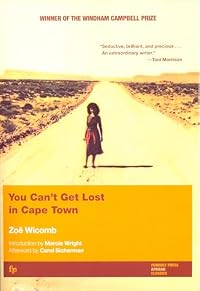
You Can't Get Lost in Cape Town
by Zoë Wicomb
On This Page
Description
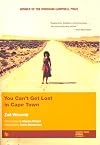
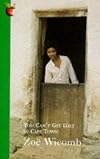
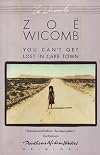
You Can't Get Lost in Cape Town is among the only works of fiction to explore the experience of "Coloured" citizens in apartheid-era South Africa, whose mixed heritage traps them, as Bharati Mukherjee wrote in the New York Times, "in the racial crucible of their country." Frieda Shenton, the daughter of Coloured parents in rural South Africa, is taught as a child to emulate whites: she is encouraged to learn correct English, to straighten her hair, and to do more than, as her father says, show more "peg out the madam's washing." While still a self-conscious and overweight adolescent, Frieda is sent away from home to be among the first to integrate a prestigious Anglican high school in Cape Town, and finds herself in a city where racial lines are so strictly drawn that it is not possible to step out of one's place. At last, Frieda flees to England, only to return more than a decade later to a South Africa now in violent rebellion against apartheid--but still, seemingly, without a place for her. It is only as Frieda finds the courage to tell her "terrible stories" that she at last begins to create her own place in a world where she has always felt herself an exile. show lessTags
Recommendations

















Member Recommendations
Member Reviews
Poetic - and yet not my cup of tea at all,, 29 January 2015
This review is from: YOU CAN'T GET LOST IN CAPETOWN (Paperback)
Published in 1987, this is a series of ten vignettes of life in S Africa. All ten are narrated by the same character, Frieda Shenton, a 'respectable Coloured', and are little chronological glimpses into her life in the apartheid state.
I found it difficult to review this book: Ms Wicomb's writing is poetic with threads of deeper meaning, and yet I didn't find it at all interesting. I use the word 'vignettes' rather than 'stories' as many of them didn't seem to be the latter.
Ten out of ten for creative writing, but I was glad to get to the end!
This review is from: YOU CAN'T GET LOST IN CAPETOWN (Paperback)
Published in 1987, this is a series of ten vignettes of life in S Africa. All ten are narrated by the same character, Frieda Shenton, a 'respectable Coloured', and are little chronological glimpses into her life in the apartheid state.
I found it difficult to review this book: Ms Wicomb's writing is poetic with threads of deeper meaning, and yet I didn't find it at all interesting. I use the word 'vignettes' rather than 'stories' as many of them didn't seem to be the latter.
Ten out of ten for creative writing, but I was glad to get to the end!
Under the cruel restrictions of apartheid, the personal and the political became inextricably linked. This book is written as a series of linking short stories telling how a young coloured girl from the provinces comes to CapeTown and gets a university degree. As a result she is able to leave South Africa and live abroad but eventually returns to her land and her folk.
I liked this book. And easy read, nothing more,nothing less. Considering the fact that I'm usually not too fond of novels situated in Africa, that's really not a bad thing.
I liked especially the stories themselves, the mixture of 'today', and child memories was good.
I liked especially the stories themselves, the mixture of 'today', and child memories was good.
I read this in college--great book, unique writing voice.
Ratings
Members
- Recently Added By
Author Information

10+ Works 431 Members
Some Editions
Awards and Honors
Notable Lists
Series
Belongs to Publisher Series
Virago Modern Classics (420)
Work Relationships
Common Knowledge
- Canonical title
- You Can't Get Lost in Cape Town
- Original publication date
- 1987
- People/Characters
- Frieda Shenton
- Important places
- South Africa; Cape Town, Western Cape, South Africa
- Epigraph
- Origins trouble the voyager much, those roots
that have slipped the waters of another continent...
it is solitude that mutilates, the night bulb that reveals ash on my sleeve.
ARTHUR NORTJE
Don't travel beyond
Acton at noon in the intimate summer light
of England
ARTHUR NORTJE
In writing the history of unfashionable families one is apt to fall into a tone of emphasis which is very far from being the tone of good society, where principles and beliefs are not only of an extremely moderate kind, but a... (show all)re always presupposed, no subjects being eligible but such as can be touched with a light and graceful irony.
GEORGE ELIOT, The Mill on the Floss - Dedication
- For Hannah and Roger
- First words
- At first Mr Weedon came like any white man in a motor car, enquiring about sheep or goats or servants.
- Last words
- (Click to show. Warning: May contain spoilers.)But with something to do here at home perhaps you won't need to make up those terrible stories hey?
Classifications
Statistics
- Members
- 164
- Popularity
- 199,026
- Reviews
- 4
- Rating
- (3.82)
- Languages
- 5 — Dutch, English, French, German, Italian
- Media
- Paper, Ebook
- ISBNs
- 13
- ASINs
- 2