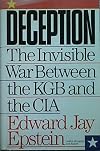
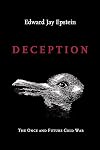
Deception: The Invisible War Between the KGB and the CIA
by Edward Jay Epstein
On This Page
Description
Investigative reporter Edward Jay Epstein defines the seldom seen universe of intelligence and counterintelligence.Set in the era of the Cold War, it explores the ultimate art of nations: Winning without fighting, or, in a single word, deception. It concerns, as James Jesus Angleton described it to the author, " a state of mind -and the mind of the state." With a new Preface (2014)Praise For Edward Jay Epstein"Epstein delves deep into the wheels-within-wheels of superpower intelligence and show more counterintelligence, showing ways in which the CIA and the KGB have been "provoked, seduced, lured into false trails, blinded, and turned into unwitting agents." Readers will find new information here on a multitude of subjects: programs involving CIA-written books published under defectors' names; the story of Yuri Nosenko, a KGB officer who defected in 1963 and was "at the heart of everything that happened at the CIA for a decade"; and the theories of James Angleton, the former CIA chief of counterintelligence, on the hidden motives of KGB super-mole Kim Philby. The book concludes with an ominously plausible argument that Gorbachev's glasnost is merely the sixth phase in a grand strategy of Soviet deception conceived soon after the Bolshevik Revolution. Highly recommended."---Publishers Weekly"Epstein's account of the world of intelligence is fascinating, instructive, and, in parts, sensational."-Irving Kristol American Enterprise Institute"This is an important book that reflects an epoch in United States counterintelligence operations and philosophy."-William R. Harris The RAND Corporation"A brilliant investigator examines the fascinating history of glasnost and the unseen motives and machinery of the Soviet state."-Lou Dobbs, CNN show lessTags
Recommendations










































Member Reviews
An interesting book of the use of deception by the world's intelligence agencies. This book shows that the KGB is the master of using deception to further Soviet Union's national interest. According to the author the function of intelligence agencies are not only gathering information, but also to present information AND passing disinformation to adversaries in such ways that the adversaries will react accordingly.
Ratings
Members
- Recently Added By
Author Information

43+ Works 1,214 Members
Classifications
- Genres
- Nonfiction, History, General Nonfiction, Politics and Government
- DDC/MDS
- 327.1 — Society, government, & culture Political science International Relations: Spies Foreign policy and specific topics in international relations
- LCC
- JK468 .I6 .E67 — Political Science Political institutions and public administration (United States) Political institutions and public administration United States Government. Public administration
- BISAC
Statistics
- Members
- 72
- Popularity
- 437,628
- Reviews
- 1
- Rating
- (3.83)
- Languages
- English, Swedish
- Media
- Paper, Ebook
- ISBNs
- 5
- ASINs
- 2