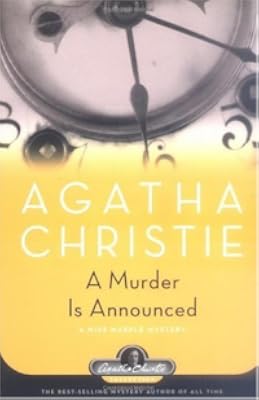
On This Page
Description
A Murder is Announced in a small-town newspaper advertisementâ??and Miss Marple must unravel the fiendish puzzle when a crime does indeed occur.The villagers of Chipping Cleghorn are agog with curiosity when the Gazette advertises "A murder is announced and will take place on Friday, October 29th, at Little Paddocks at 6.30 p.m."
A childish practical joke? Or a spiteful hoax? Unable to resist the mysterious invitation, the locals arrive at Little Paddocks at the appointed time when, show more without warning, the lights go out and a gun is fired. When they come back on, a gruesome scene is revealed. An impossible crime? Only Miss Marple can unravel it./ show less
Tags
Recommendations











Member Reviews
This was a very enjoyable read. I liked that it was a novel dominated by collecting and grinding through data to solve who did it and why. Instead, it was a novel lit up by the diverse set of women who lived in the village and were associated with the crime.
At first, I was a little put off by how many of the women declared themselves or were declared by their friends to be stupid. Then I realised that with one charming exception, the 'Oh, I'm so stupid about such things' stance was camouflage that hid both secrets and intellects.
I liked that almost all of the characters were likeable to a degree. There was no obvious evil witch in their midst wreaking havoc just ordinary and sometimes admirable women making the best of things, show more Except for whoever it was who was killing people and even they seemed to be taking no joy in their actions.
This a Miss Marple novel (although she would protest, modestly, that she merely shared a few thoughts and that it was that bright young policeman who solved the crime) and her way of looking at who people really are, her lack of trust in who people present themselves as being and her resigned acceptance that even nice people may find a good reason to do bad things, set the tone for the story. One consequence of this is that the novel, published in 1950, gives some fascinating details of village life after World War II. How migration had changed the character of the village by adding people who had not grown up there or been introduced by people whom one knew and trusted but who had rather presented themselves and their story on arrival and built their lives anew. How the continuation of rationing had drawn all of the women in the village into an illegal but taken-for-granted barter system that combined intimacy with complicity. How much loss the war had imposed on families, how much dislocation it had caused, and how much change it had driven, particularly in the lives of women. Taken together, these things painted a picture of village life in transition with everyone having to adjust to new and unasked-for realities and, for the most part, supporting one another in muddling through.
For me, this credible, fallible, very human context made the murders into violations that seemed much more unforgivable than the deaths in the Poirot books where it often seems that bad people kill other bad people in clever ways for trivial reasons. In this book, the people do not deserve to die and the killings destroy the murderer's peace of mind as well as spreading grief throughout the village.
I've always preferred Miss Marple to Poirot, She's scarier than he is but more human. She sees the world clearly and expects very little of it but never descends into bitterness. She hopes that people will do the right thing but has is never surprised when they do the wrong thing or the easy thing instead.
For me, the biggest difference between Marple and Poirot is that, to Marple, murder is not a game. It's not a puzzle to be solved with the little grey cells. It's a tragedy in progress, an eruption of evil that must be contained and stopped. The whole novel is coloured by this way of seeing the world and is the richer for it.
The plot was clever, if a little improbable. The explanations all worked although I paid them little attention in the end. I'll remember the deaths and the grief long after I've forgotten the mechanics of the plot. show less
At first, I was a little put off by how many of the women declared themselves or were declared by their friends to be stupid. Then I realised that with one charming exception, the 'Oh, I'm so stupid about such things' stance was camouflage that hid both secrets and intellects.
I liked that almost all of the characters were likeable to a degree. There was no obvious evil witch in their midst wreaking havoc just ordinary and sometimes admirable women making the best of things, show more Except for whoever it was who was killing people and even they seemed to be taking no joy in their actions.
This a Miss Marple novel (although she would protest, modestly, that she merely shared a few thoughts and that it was that bright young policeman who solved the crime) and her way of looking at who people really are, her lack of trust in who people present themselves as being and her resigned acceptance that even nice people may find a good reason to do bad things, set the tone for the story. One consequence of this is that the novel, published in 1950, gives some fascinating details of village life after World War II. How migration had changed the character of the village by adding people who had not grown up there or been introduced by people whom one knew and trusted but who had rather presented themselves and their story on arrival and built their lives anew. How the continuation of rationing had drawn all of the women in the village into an illegal but taken-for-granted barter system that combined intimacy with complicity. How much loss the war had imposed on families, how much dislocation it had caused, and how much change it had driven, particularly in the lives of women. Taken together, these things painted a picture of village life in transition with everyone having to adjust to new and unasked-for realities and, for the most part, supporting one another in muddling through.
For me, this credible, fallible, very human context made the murders into violations that seemed much more unforgivable than the deaths in the Poirot books where it often seems that bad people kill other bad people in clever ways for trivial reasons. In this book, the people do not deserve to die and the killings destroy the murderer's peace of mind as well as spreading grief throughout the village.
I've always preferred Miss Marple to Poirot, She's scarier than he is but more human. She sees the world clearly and expects very little of it but never descends into bitterness. She hopes that people will do the right thing but has is never surprised when they do the wrong thing or the easy thing instead.
For me, the biggest difference between Marple and Poirot is that, to Marple, murder is not a game. It's not a puzzle to be solved with the little grey cells. It's a tragedy in progress, an eruption of evil that must be contained and stopped. The whole novel is coloured by this way of seeing the world and is the richer for it.
The plot was clever, if a little improbable. The explanations all worked although I paid them little attention in the end. I'll remember the deaths and the grief long after I've forgotten the mechanics of the plot. show less
Guessed the culprit very early on in the novel but I really enjoyed this story nonetheless, which goes to show Christie could have been a delightful general fiction author too. Very interesting characters, some funny lines and some metatextual references to Christie's life as an author plus some an intertextual reference at the end to Elephants Can Remember which I thought was lovely. Really great atmosphere throughout - I could picture everything very easily. Just like the Poirot books at some point, Christie lingers on how society has changed and how little people follow expected patterns of behaviour now. It made me think about how the profession of policeman and detective has changed since 1950 and how little it relies on actual show more detection and psychology today. This is a nice book, with an interesting premise and a jolly good read. show less
This is the second Miss Marple book I have read, but it won't be the last. I loved it! Everyone in Chipping Cleghorn is stunned when "a murder is announced" in the local gazette. Naturally, they all assume it will be a dinner party with a dramatized crime, but it's still odd that no one knew anything about it beforehand - least of all Ms. Blacklock, at whose house it is supposed to occur! Knowing her neighbors as she does, she expects them all to drop by at the appointed time. Once everyone is gathered, the lights go out and a gun goes off. The body of a young man is very real, as is the bullet graze on Ms. Blacklock's ear. Who could have orchestrated this and why would anyone want to harm Ms. Blacklock?
This is a Miss Marple mystery, show more but like her first case Murder at the Vicarage, it is not told from her point of view. This time, the Constable tells the story as he tries to sort through all the witnesses, make sense of small town life, and track the killer. Miss Marple appears about a third of the way through, visiting friends. Her keen observations, and familiarity with small town life, help point the way for the constable. She isn't the only one who connects some of the dots, and there will be more victims before she solves the mystery.
It's rare for a book to surprise me, even a mystery, but the conclusion here was nearly as brilliant as the one in "And Then There Were None." Further, it was completely earned. Sometimes, I feel like the deduction of super sleuths are too contrived - they arrive at the last to put the puzzle together with information only they have. Here, Christie laid out all the clues Miss Marple pieces together so the solution works. A great read. show less
This is a Miss Marple mystery, show more but like her first case Murder at the Vicarage, it is not told from her point of view. This time, the Constable tells the story as he tries to sort through all the witnesses, make sense of small town life, and track the killer. Miss Marple appears about a third of the way through, visiting friends. Her keen observations, and familiarity with small town life, help point the way for the constable. She isn't the only one who connects some of the dots, and there will be more victims before she solves the mystery.
It's rare for a book to surprise me, even a mystery, but the conclusion here was nearly as brilliant as the one in "And Then There Were None." Further, it was completely earned. Sometimes, I feel like the deduction of super sleuths are too contrived - they arrive at the last to put the puzzle together with information only they have. Here, Christie laid out all the clues Miss Marple pieces together so the solution works. A great read. show less
One of my favourite Miss Marples. Set in a small village in post war Britain, where the social order has been disrupted by the war populated by types who may or not be who they say they are, a murder IS announced in the local paper and the locals turn up expecting a game only to find a real murder taking place in their midst. Miss Marple is invited by her goddaughter, the vicar's wife, to help solve the crime. I particularly love the discrete but obvious depiction of the loving female couple Hinch and Murgatroyd. A very entertaining read.
‘’People with a grudge against the world are always dangerous.’’
An idyllic village in the English countryside is waking up, its quirky residents about to start their day with their favourite newspaper, where an invitation to murder is waiting for them. Can you think of anything more interesting? Leticia, the ‘’queen’’ of the village, is completely unaware of the play supposedly staged in her house, but what the heck, let’s go with the flow. And a murder does take place but not in the way everyone has imagined. Thus, everything is ready for one of the finest mysteries by Queen Agatha.
In my opinion, this novel has one of the most interesting, vivid, quirky, memorable characters in all Dramatis Personae ever composed by show more Christie. From the lady of the manor, the disturbed veteran, the farm ladies in a relationship (Agatha never shied away from sexual dynamics), the alluring siblings, the kind-hearted friend who is there for everyone. My favourite characters have always been Philippa, the gardener, and Mitzi, the housemaid who escaped a war ravaged country to find herself face-to-face with strange murders. As always, identities are mixed, unrevealed secrets kill by the dozen, relationships are broken and mended, lights go out to hide the faces of evil. This is one of the cleverest crimes conceived by the brilliant mind of the Queen of Crime. My grandma had a shepherdess memento from Italy. I remember that after reading A Murder Is Announced, quite a few years ago, I never looked at that porcelain thing in the same way as before. Not that I ever liked it but anyway...Revisiting this mystery always feels like reading it for the very first time.
Would you accept an invitation to murder?
‘’People in the dark are quite different, aren’t they?’’
My reviews can also be found on https://theopinionatedreaderblog.wordpress.com show less
An idyllic village in the English countryside is waking up, its quirky residents about to start their day with their favourite newspaper, where an invitation to murder is waiting for them. Can you think of anything more interesting? Leticia, the ‘’queen’’ of the village, is completely unaware of the play supposedly staged in her house, but what the heck, let’s go with the flow. And a murder does take place but not in the way everyone has imagined. Thus, everything is ready for one of the finest mysteries by Queen Agatha.
In my opinion, this novel has one of the most interesting, vivid, quirky, memorable characters in all Dramatis Personae ever composed by show more Christie. From the lady of the manor, the disturbed veteran, the farm ladies in a relationship (Agatha never shied away from sexual dynamics), the alluring siblings, the kind-hearted friend who is there for everyone. My favourite characters have always been Philippa, the gardener, and Mitzi, the housemaid who escaped a war ravaged country to find herself face-to-face with strange murders. As always, identities are mixed, unrevealed secrets kill by the dozen, relationships are broken and mended, lights go out to hide the faces of evil. This is one of the cleverest crimes conceived by the brilliant mind of the Queen of Crime. My grandma had a shepherdess memento from Italy. I remember that after reading A Murder Is Announced, quite a few years ago, I never looked at that porcelain thing in the same way as before. Not that I ever liked it but anyway...Revisiting this mystery always feels like reading it for the very first time.
Would you accept an invitation to murder?
‘’People in the dark are quite different, aren’t they?’’
My reviews can also be found on https://theopinionatedreaderblog.wordpress.com show less
http://nwhyte.livejournal.com/2170468.html
In my current run of Agatha Christies, this is the first I've read from after the second world war, and I must say I found it very interesting. It combines a particularly ingenious plot with some fascinating, if somewhat wrong-headed, social commentary. Christie puts words in her characters' mouths which suggest that she feels the world is going to pot as a result of the upheavals during and after the war (in a way that she doesn't do so much for the aftermath of the First World War; she was born in 1890 so experienced both in adulthood), and the story - the first murder being that of a Swiss immigrant - seems to be an indictment of how the general decay of morals in society works itself out in show more a specific case of corruption of the outwardly very respectable murderer. There is also another character who is a refugee from Nazi atrocity, and appears at first to be a complete stereotype but actually turns out to be one of the most helpful in solving the mystery.
Another point which is very deserving of note: the book features what I understand to be the most overtly gay couple in any of Christie's works. The omniscient narrator speculates as little about the sex lives of Miss Hinchliffe and Miss Murgatroyd as about any of the other characters, but it's pretty obvious what is going on, and it really takes some colossal blinkers to claim otherwise. And it's an absolutely clear statement from Christie, in 1950; true, the characters are somewhat stereotyped (though nothing like as badly as Mitzi the maid) but their treatment by the author is entirely sympathetic, and their relationship is accepted without comment by everyone else in the village. show less
In my current run of Agatha Christies, this is the first I've read from after the second world war, and I must say I found it very interesting. It combines a particularly ingenious plot with some fascinating, if somewhat wrong-headed, social commentary. Christie puts words in her characters' mouths which suggest that she feels the world is going to pot as a result of the upheavals during and after the war (in a way that she doesn't do so much for the aftermath of the First World War; she was born in 1890 so experienced both in adulthood), and the story - the first murder being that of a Swiss immigrant - seems to be an indictment of how the general decay of morals in society works itself out in show more a specific case of corruption of the outwardly very respectable murderer. There is also another character who is a refugee from Nazi atrocity, and appears at first to be a complete stereotype but actually turns out to be one of the most helpful in solving the mystery.
Another point which is very deserving of note: the book features what I understand to be the most overtly gay couple in any of Christie's works. The omniscient narrator speculates as little about the sex lives of Miss Hinchliffe and Miss Murgatroyd as about any of the other characters, but it's pretty obvious what is going on, and it really takes some colossal blinkers to claim otherwise. And it's an absolutely clear statement from Christie, in 1950; true, the characters are somewhat stereotyped (though nothing like as badly as Mitzi the maid) but their treatment by the author is entirely sympathetic, and their relationship is accepted without comment by everyone else in the village. show less
Taken from my blog post: https://clsiewert.wordpress.com/2014/12/13/a-murder-is-announced-by-agatha-chris...
I grew up on Christie. At the time, I was limited to whatever my local library branch physically had on the shelves, so it took awhile to work my way through her bibliography, and even now, I’m not sure I’ve read all of her books. There was that pesky problem of British and American editions with separate titles, leaving me hopelessly confused about what I’ve read. Thankfully, A Murder is Announced had the same title in both editions, which might be why I remember it so well. It might also be because it is an amazingly well written with a nicely tricky mystery.
Oh, Letty! A murder has been announced in the personals section show more of the local gazette. You kids may not know this, but that’s like Craigslist in print form. And game murder mysteries were old-fashioned acted-out parties where guests solved the mystery. That’s why the residents of the village of Chipping Cleghorn assume they are being invited. Nonetheless, a newspaper invite bit informal, so they contrive excuses to drop by Letitia Blacklock’s home. As they’re settled in, having a smoke and a sherry, a masked man holds them up. The lights go out. Shots echo in the dark room. When someone flips a light, the unknown masked intruder is dead. The police are prone to write it off as a burglary gone bad, except Inspector Craddock can’t quite let it go. His godfather points him in the direction of the little old ladies of the case, citing his own Miss Marple as an example. Before long, we meet her in person.
Christie is in peak form here, displaying skill in every aspect of writing, balanced with atmosphere, character, mystery and philosophy, with not an excess word present. Oh sure, had Christie Sandersonized it, it could have been far beyond its 300 pages, filled with details about the village foliage or the design of their dresses. Except those details are there, and rarely does she tell us; we discover it in clever word choice or implicit in dialogue. This may be why A Murder is Announced is one of her better mysteries; though she provides a number of clues and red herrings, her details are so sparse that careful reading is needed. Come to think of it, Sanderson presents a symphony in a book, while Christie is the soloist, the violin virtuoso, each note given star attention.
Clues are dropped. I wish I could give an opinion on the mystery, but the truth is, I’ve read this enough times that I remembered the solution, just not the reasoning. Still, astute minds in the Goodreads Agatha Christie Lovers group pointed out Dame Agatha was dropping subtle clues from the beginning, along with plenty of red herrings.
Characterization is amazing. Scant descriptors, and yet every utterance hints at character. Check this brief oratory by an elderly gardener when being questioned:
“‘I’ve no idea,’ said Craddock. ‘I suppose this hold-up caused a lot of talk?’
“That it did. What’s us coming to? That’s what Ned Barker said. Comes of going to the pictures so much, he said. But Tom Riley, he says it comes of letting these furriners run about loose. And depend on it, he says, that girl that cooks up there for Miss Blacklock and ‘as such a nasty temper–she’s in it, he said. She’s a Communist or worse, he says, and we don’t like that sort ‘ere.’“
All he does is talk, and with every sentence, Christie gives us the picture of the small town, the gossip, the dynamic between the young and the old, the long-time residents and the foreigners–or furriners, as he says. And so much about the man himself–what he chooses to share with police, his education, his speech pattern, his peer group. Clever, clever.
The sly humor is a nice touch for an adult read–I’m not sure I picked up on it when I was younger.
“‘And it isn’t,’ pursued Mrs. Swettenham, ‘as though you were a worker. You don’t do any work at all.’
‘That’s not in the least true,’ said Edmund indignantly. ‘I’m writing a book.’
‘I meant real work,’ said Mrs. Swettenham.“
But I have no doubt that it was a great deal of work indeed, to craft a book that provides excellent entertainment, and yet such insight into the residents of a small English town. An enjoyable trip down memory lane that gives me all new appreciation for her skill. show less
I grew up on Christie. At the time, I was limited to whatever my local library branch physically had on the shelves, so it took awhile to work my way through her bibliography, and even now, I’m not sure I’ve read all of her books. There was that pesky problem of British and American editions with separate titles, leaving me hopelessly confused about what I’ve read. Thankfully, A Murder is Announced had the same title in both editions, which might be why I remember it so well. It might also be because it is an amazingly well written with a nicely tricky mystery.
Oh, Letty! A murder has been announced in the personals section show more of the local gazette. You kids may not know this, but that’s like Craigslist in print form. And game murder mysteries were old-fashioned acted-out parties where guests solved the mystery. That’s why the residents of the village of Chipping Cleghorn assume they are being invited. Nonetheless, a newspaper invite bit informal, so they contrive excuses to drop by Letitia Blacklock’s home. As they’re settled in, having a smoke and a sherry, a masked man holds them up. The lights go out. Shots echo in the dark room. When someone flips a light, the unknown masked intruder is dead. The police are prone to write it off as a burglary gone bad, except Inspector Craddock can’t quite let it go. His godfather points him in the direction of the little old ladies of the case, citing his own Miss Marple as an example. Before long, we meet her in person.
Christie is in peak form here, displaying skill in every aspect of writing, balanced with atmosphere, character, mystery and philosophy, with not an excess word present. Oh sure, had Christie Sandersonized it, it could have been far beyond its 300 pages, filled with details about the village foliage or the design of their dresses. Except those details are there, and rarely does she tell us; we discover it in clever word choice or implicit in dialogue. This may be why A Murder is Announced is one of her better mysteries; though she provides a number of clues and red herrings, her details are so sparse that careful reading is needed. Come to think of it, Sanderson presents a symphony in a book, while Christie is the soloist, the violin virtuoso, each note given star attention.
Clues are dropped. I wish I could give an opinion on the mystery, but the truth is, I’ve read this enough times that I remembered the solution, just not the reasoning. Still, astute minds in the Goodreads Agatha Christie Lovers group pointed out Dame Agatha was dropping subtle clues from the beginning, along with plenty of red herrings.
Characterization is amazing. Scant descriptors, and yet every utterance hints at character. Check this brief oratory by an elderly gardener when being questioned:
“‘I’ve no idea,’ said Craddock. ‘I suppose this hold-up caused a lot of talk?’
“That it did. What’s us coming to? That’s what Ned Barker said. Comes of going to the pictures so much, he said. But Tom Riley, he says it comes of letting these furriners run about loose. And depend on it, he says, that girl that cooks up there for Miss Blacklock and ‘as such a nasty temper–she’s in it, he said. She’s a Communist or worse, he says, and we don’t like that sort ‘ere.’“
All he does is talk, and with every sentence, Christie gives us the picture of the small town, the gossip, the dynamic between the young and the old, the long-time residents and the foreigners–or furriners, as he says. And so much about the man himself–what he chooses to share with police, his education, his speech pattern, his peer group. Clever, clever.
The sly humor is a nice touch for an adult read–I’m not sure I picked up on it when I was younger.
“‘And it isn’t,’ pursued Mrs. Swettenham, ‘as though you were a worker. You don’t do any work at all.’
‘That’s not in the least true,’ said Edmund indignantly. ‘I’m writing a book.’
‘I meant real work,’ said Mrs. Swettenham.“
But I have no doubt that it was a great deal of work indeed, to craft a book that provides excellent entertainment, and yet such insight into the residents of a small English town. An enjoyable trip down memory lane that gives me all new appreciation for her skill. show less
Members
- Recently Added By
Lists

Crime and Mysteries to Read
746 works; 31 members

Anthony Boucher's Best Crime Fiction of the Year
115 works; 5 members

Agatha Christie Miss Marple
12 works; 1 member

British Mystery
469 works; 14 members

Books About Murder
313 works; 7 members

Teresa's favorite mystery series and authors
55 works; 2 members

Detective Stories
343 works; 5 members

Favorite Books from the 1950s
33 works; 2 members

Agatha Christie Chronology
93 works; 1 member

Books We Couldn't Put Down
443 works; 197 members
Must Read Detective Stories (Nick Fuller)
278 works; 2 members

TBR
77 works; 1 member

Books Read in 2023
5,547 works; 145 members

Books With the Most Memorable Titles
478 works; 158 members

TML 200 Best Books 1950-1999
202 works; 10 members

Books Read in 2022
5,166 works; 112 members

1950s
340 works; 22 members

Literary Witches
86 works; 4 members

Nifty Fifties
129 works; 13 members

Books Read in 2010
631 works; 10 members

Books Read in 2018
4,360 works; 110 members

Books With Complete Sentence Titles
374 works; 15 members

Books Read in 2017
4,249 works; 129 members

The Modern Library (The Two Hundred Best Novels....
202 works; 1 member
Author Information

2,150+ Works 439,856 Members
One of the most successful and beloved writer of mystery stories, Agatha Mary Clarissa Christie was born in 1890 in Torquay, County Devon, England. She wrote her first novel, The Mysterious Affair at Styles, in 1920, launching a literary career that spanned decades. In her lifetime, she authored 79 crime novels and a short story collection, 19 show more plays, and six novels written under the name of Mary Westmacott. Her books have sold over a billion copies in the English language with another billion in 44 foreign languages. Some of her most famous titles include Murder on the Orient Express, Mystery of the Blue Train, And Then There Were None, 13 at Dinner and The Sittaford Mystery. Noted for clever and surprising twists of plot, many of Christie's mysteries feature two unconventional fictional detectives named Hercule Poirot and Miss Jane Marple. Poirot, in particular, plays the hero of many of her works, including the classic, The Murder of Roger Ackroyd (1926), and Curtain (1975), one of her last works in which the famed detective dies. Over the years, her travels took her to the Middle East where she met noted English archaeologist Sir Max Mallowan. They married in 1930. Christie accompanied Mallowan on annual expeditions to Iraq and Syria, which served as material for Murder in Mesopotamia (1930), Death on the Nile (1937), and Appointment with Death (1938). Christie's credits also include the plays, The Mousetrap and Witness for the Prosecution (1953; film 1957). Christie received the New York Drama Critics' Circle Award for 1954-1955 for Witness. She was also named Dame Commander of the Order of the British Empire in 1971. Christie died in 1976. (Bowker Author Biography) show less
Some Editions
Awards and Honors
Series

Belongs to Publisher Series
Gran Pan (144)
Scherz-classic-Krimi (79)
Work Relationships
Is contained in
A Miss Marple Quartet: The Body in the Library, A Pocket Full of Rye, A Murder Is Announced, The Moving Finger by Agatha Christie
Starring Miss Marple = The Invincible Miss Marple: A Murder is Announced, The Body in the Library, Murder with Mirrors by Agatha Christie
The Murder of Roger Ackroyd / The Mysterious Affair at Styles / A Murder Is Announced by Agatha Christie
Agatha Christie Crime Collection: Cards on the Table / N or M? / A Murder Is Announced by Agatha Christie
Seven Deadly Sins: The ABC Murders / A Murder Is Announced / Sparkling Cyanide / Evil Under the Sun / At Bertram's Hotel / Endess Night / Five Little Pigs by Agatha Christie
Murder by the Box: "The Murder of Roger Ackroyd", "Murder in the Mews", "Sleeping Murder", "A Murder is Announced" No. 2: Four Classic Murder Mysteries by Agatha Christie
Common Knowledge
- Canonical title
- A Murder Is Announced
- Original title
- A murder is announced
- Alternate titles*
- Se anuncia un asesinato
- Original publication date
- 1950
- People/Characters
- Jane Marple; Letitia Blacklock; Dora 'Bunny' Bunner; Phillipa Haymes; Julia Simmons; Patrick Simmons (show all 20); Mitzi; Mrs Swettenham; Edmund Swettenham; Mrs Easterbrook; Colonel Easterbrook; Diana 'Bunch' Harmon; Rev. Julian Harmon; Miss Hinchliffe; Amy Murgatroyd; Dermot Craddock (Detective Inspector); Sir Henry Clithering; Rudi Scherz; George Rydesdale (Chief Constable); Myrna Harris
- Important places
- Chipping Cleghorn, England, UK; Scotland, UK
- Related movies
- "Goodyear Television Playhouse" A Murder Is Announced (1956 | IMDb); A Murder Is Announced (1985 | IMDb); Marple: A Murder Is Announced (2005 | IMDb)
- Epigraph*
- Moord is geen spelletje, vond Miss Marple.....
- Dedication
- To Ralph and Anne Newman at whose house I first tasted 'Delicious Death!'
- First words
- Between 7.30 and 8.30 every morning except Sundays, Johnnie Butt made the round of the village of Chipping Cleghorn on his bicycle, whistling vociferously between his teeth, and alighting at each house or cottage to shove thr... (show all)ough the letterbox such morning papers had been ordered by the occupants of the house in question from Mr Totman, stationer, of the High Street.
- Quotations
- Remember that an elderly unmarried woman who knits and gardens is streets ahead of any detective sergeant. She can tell you what might have happened and what ought to have happened and even what actually did happen! And she c... (show all)an tell you why it happened. (Sir Henry Clithering)
- Last words
- (Click to show. Warning: May contain spoilers.)How else would they know what's going on round here?
- Blurbers
- James, P.D.; Attenborough, Richard; Lathen, Emma
- Original language
- English
*Some information comes from Common Knowledge in other languages. Click "Edit" for more information.
Classifications
Statistics
- Members
- 5,484
- Popularity
- 2,432
- Reviews
- 113
- Rating
- (3.82)
- Languages
- 29 — Arabic, Bulgarian, Catalan, Chinese, Czech, Danish, Dutch, English, Estonian, Finnish, French, German, Hungarian, Indonesian, Italian, Japanese, Korean, Norwegian (Bokmål), Norwegian, Polish, Romanian, Russian, Croatian, Slovenian, Spanish, Swedish, Thai, Turkish, Portuguese (Portugal)
- Media
- Paper, Audiobook, Ebook
- ISBNs
- 196
- UPCs
- 2
- ASINs
- 77