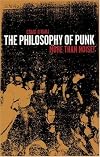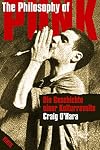
The Philosophy of Punk: More Than Noise
by Craig O'Hara
On This Page
Description
Contents Introduction by Marc Bayard Preface by the author Why Punk: Background comparisons with previous art movements; some defining characteristics of punk. Media Misrepresentations: How television, glossy magazines, and mindless mass media have done their best to defang the beast. Skinheads: Who they are, where they're from and do they have to do with punk anyway. Intra-Movement Communication: Fanzines-communcation from the Xerox machine to the underground. Anarchism: An alternative to show more existing systems. What it is and why it is embraced by punks all over the world. The failure of "bought and paid for" politicians has ensured a counterculture receptive to the idea that we would be better off without these vampires. Gender Issues: Sexism, feminism and open homosexuality. Environmentalism and Ecological Concerns: The ideas and techniques of Earth First, ALF, and others have found a comfortable home in the punk scene. Straight Edge: A movement that went from being a minor threat to a convervative, conformist no threat. DIY Bibliography show lessTags
Recommendations











































Member Reviews
In The Philosophy of Punk, Craig O'Hara draws from numerous punk bands and writings by punks to outline a general philosophy of punk aesthetic, ethics, and activism. He is clear to articulate that he is discussing a certain "brand" (my word) of punk rock: not generic, more consumption-oriented punk, but rather the more "authentic" punk of the late 70s and early 80s. This punk, he argues, was importantly about "tak[ing:] on responsibility" (39). While punk music involves rage, anti-authority views, and anti-conformity (27-28), O'Hara argues that punk ethics was (and is) one of responsibility.
He blames mass media for misrepresenting (and misrecognizing) punk as violent, negative, and a trend, as well as too simply equating punks with show more skinheads. Instead, O'Hara urges that in order to understand punk, one must go to the "primary sources" (61). I fully agree with his reading of media representation, and in the scope of his book, it makes sense, but this could have more analytical force if he didn't rely on the idea that there is somehow a way to accurately represent oneself.
O'Hara's discussion takes force as he describes punk's anarchist ethics—and how this is related to responsibility. Anarchy isn't a matter of checking out because "personal anarchy is elitist, unanarchistic, and counter revolutionary" (87). Those who ascribe to personal anarchy, but have "resign[ed:] himself to the fact that other people are not capable of ruling themselves" might still be participating and spreading ideas, but have given up on the ideals of anarchy (87). To O'Hara, anarchy is admitting responsibility: not simply "no laws," but "no need for laws" (97).
O'Hara's last few chapters deal with sexism, homophobia, environmentalism, vegetarianism, and Straight-Edge, and are pretty good discussions, though quickly sped through. For the purpose of the book, though, I thought they were developed enough—though I think the book was a bit too celebratory of anti-sexism and the inclusion of women in the punk movement, if only because a lot of punk can be masculinist and not very inviting to women. O'Hara is claiming to discuss a specific group of punks ("authentic" punks), but at times, seems to idealize them. Perhaps this is because he is trying to outline a philosophy (instead of, say, an anthropology/sociology/rhetoric) and is trying to discuss the ideals and beliefs of punks. show less
He blames mass media for misrepresenting (and misrecognizing) punk as violent, negative, and a trend, as well as too simply equating punks with show more skinheads. Instead, O'Hara urges that in order to understand punk, one must go to the "primary sources" (61). I fully agree with his reading of media representation, and in the scope of his book, it makes sense, but this could have more analytical force if he didn't rely on the idea that there is somehow a way to accurately represent oneself.
O'Hara's discussion takes force as he describes punk's anarchist ethics—and how this is related to responsibility. Anarchy isn't a matter of checking out because "personal anarchy is elitist, unanarchistic, and counter revolutionary" (87). Those who ascribe to personal anarchy, but have "resign[ed:] himself to the fact that other people are not capable of ruling themselves" might still be participating and spreading ideas, but have given up on the ideals of anarchy (87). To O'Hara, anarchy is admitting responsibility: not simply "no laws," but "no need for laws" (97).
O'Hara's last few chapters deal with sexism, homophobia, environmentalism, vegetarianism, and Straight-Edge, and are pretty good discussions, though quickly sped through. For the purpose of the book, though, I thought they were developed enough—though I think the book was a bit too celebratory of anti-sexism and the inclusion of women in the punk movement, if only because a lot of punk can be masculinist and not very inviting to women. O'Hara is claiming to discuss a specific group of punks ("authentic" punks), but at times, seems to idealize them. Perhaps this is because he is trying to outline a philosophy (instead of, say, an anthropology/sociology/rhetoric) and is trying to discuss the ideals and beliefs of punks. show less
I bought this from a table at an Ill Scarlett show benefiting World Vision. Overall, it was a very interesting look at the history of punk, as well as its place both in the larger culture, as well as in history. While there are some parts of what O'Hara discusses that I disagree with (anarchism, for example), it's an undoubtedly important part of punk history and culture.
This book could have been much better. The author, who was in the punk rock scene in D.C. since the eighties, certainly brought a good deal of first-hand knowledge to the subject, but his writing skills are poorly developed. The book was originally published as photocopied pages that were staple bound, and it was eventually published by AK Press, a major radical publisher. The writing is not really publishable, in my opinion, however.
Of course, in keeping with the punk rock tradition, the book does not rely on academic or mainstream sources, and that is a potential strength if it demonstrates that a book can coherently present a social phenomenon this complex without recourse to anything but alternative, collective, autonomous show more institutions. Bayard uses letters published in zines as his primary sources, which is a great idea. Unfortunately instead of drawing convincing conclusions from the research, he contributes little more than the preachy letters he quotes.
He wanted to write a book for people unfamiliar with the punk-rock subculture, but I think he could have written a better memoir without the explicit intention of educating the public. show less
Of course, in keeping with the punk rock tradition, the book does not rely on academic or mainstream sources, and that is a potential strength if it demonstrates that a book can coherently present a social phenomenon this complex without recourse to anything but alternative, collective, autonomous show more institutions. Bayard uses letters published in zines as his primary sources, which is a great idea. Unfortunately instead of drawing convincing conclusions from the research, he contributes little more than the preachy letters he quotes.
He wanted to write a book for people unfamiliar with the punk-rock subculture, but I think he could have written a better memoir without the explicit intention of educating the public. show less
Them All
Dec 6, 2011Indonesian
Ratings
Members
- Recently Added By
Published Reviews
Why Everything you think you know about Punk ROck is completely wrong
added by EdVonBlue
Lists


Author Information
5 Works 189 Members
Classifications
Statistics
- Members
- 182
- Popularity
- 179,313
- Reviews
- 5
- Rating
- (3.39)
- Languages
- English, German
- Media
- Paper
- ISBNs
- 3