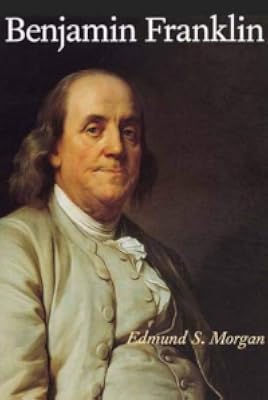
Benjamin Franklin
by Edmund S. Morgan
On This Page
Description
Benjamin Franklin is perhaps the most remarkable figure in American history: the greatest statesman of his age, he played a pivotal role in the formation of the American republic. He was also a pioneering scientist, a best-selling author, the country's first postmaster general, a printer, a bon vivant, a diplomat, a ladies' man, and a moralist - and the most prominent celebrity of the 18th century. Franklin was, however, a man of vast contradictions, as Edmund Morgan demonstrates in this show more brilliant biography. A reluctant revolutionary, Franklin had desperately wished to preserve the British Empire, and he mourned the break, even as he led the fight for American independence. Despite his passion for sciences, Franklin viewed his groundbreaking experiments as secondary to his civic duties. And although he helped to draft both the Declaration of Independence and the American Constitution, he had personally hoped that the new American government would take a different shape. Unraveling the enigma of Franklin's character, Morgan shows that he was the rare individual who constantly placed the public interest before his own desires. Written by one of our greatest historians, Benjamin Franklin offers a provocative portrait of America's most extraordinary patriot. show lessTags
Recommendations






Member Reviews
In this biographical sketch, the author -- a noted historian of the American Revolution -- expresses his admiration for this remarkable figure. A generation older than other leading Founding Fathers, Franklin had already earned enough to retire from business and devote himself to public service while Washington was a teenager and Jefferson a child. The international renown he achieved through his scientific experiments was of inestimable value when he went to France during the Revolution to plead America’s case in its quest for independence, but even more valuable in Morgan’s estimation was his integrity and winning personality.
Morgan does not gloss over Franklin’s blunders, the chief of which his feud with Thomas Penn, proprietor show more of the Pennsylvania colony. This son of William, colony founder, displayed all the faults of an absentee landlord, which seems to have violated Franklin’s sense of right and wrong to such an extent that he departed from the pragmatism and far-sightedness that normally governed his conduct. Yet the moribund government that resulted from Penn’s neglect was the environment in which Franklin practiced his growing skill at organizing private schemes for the public good such as a fire department and a library. It was characteristic of the man, and a key to his success, that he never appeared to lead, but let others take the initiative and even the credit in projects he organized. Those in the know saw through this, of course, and esteemed him the more for it. Ironically, this led the British to suspect that Franklin, in the long years he spent in London as agent of the colonies, was the ringleader of the growing rebellion. They were wrong, but not by much.
Franklin’s own vision of America as a partner in a transatlantic empire, in time, the dominant partner, was frustrated in his lifetime, primarily because a succession of British governments were led by men who lacked the imagination to share it (others, such as William Pitt, did grasp it, but were no longer in power). Franklin’s hope was eventually realized nevertheless in the special relationship between the two English-speaking powers through most of the 20th century.
Few people born three centuries ago are as accessible as he. Morgan based his research primarily on Franklin's own writings, which fill 46 volumes in the critical edition. At the same time, he stresses that there is always something Franklin seems to be withholding.
Morgan tells the tale well and has succeeded in his goal of presenting Franklin as an appealing personality. Some other figures, such as John Adams, who is seen through the prism of his own overweening vanity and faulted for claiming to one and all he could have done a better job negotiating with both the French and English, come off more poorly. I would have liked more of an exploration of the origins of Franklin's insatiably curious mind and astounding physical energy, but Morgan avoids the pitfalls of psycho-biography.
This is not a detailed biography, but a good first introduction to this giant of a man whose vitality, optimism and gregarious nature were emblematic of the new nation taking shape on the Western shore of the Atlantic. Highly recommended. show less
Morgan does not gloss over Franklin’s blunders, the chief of which his feud with Thomas Penn, proprietor show more of the Pennsylvania colony. This son of William, colony founder, displayed all the faults of an absentee landlord, which seems to have violated Franklin’s sense of right and wrong to such an extent that he departed from the pragmatism and far-sightedness that normally governed his conduct. Yet the moribund government that resulted from Penn’s neglect was the environment in which Franklin practiced his growing skill at organizing private schemes for the public good such as a fire department and a library. It was characteristic of the man, and a key to his success, that he never appeared to lead, but let others take the initiative and even the credit in projects he organized. Those in the know saw through this, of course, and esteemed him the more for it. Ironically, this led the British to suspect that Franklin, in the long years he spent in London as agent of the colonies, was the ringleader of the growing rebellion. They were wrong, but not by much.
Franklin’s own vision of America as a partner in a transatlantic empire, in time, the dominant partner, was frustrated in his lifetime, primarily because a succession of British governments were led by men who lacked the imagination to share it (others, such as William Pitt, did grasp it, but were no longer in power). Franklin’s hope was eventually realized nevertheless in the special relationship between the two English-speaking powers through most of the 20th century.
Few people born three centuries ago are as accessible as he. Morgan based his research primarily on Franklin's own writings, which fill 46 volumes in the critical edition. At the same time, he stresses that there is always something Franklin seems to be withholding.
Morgan tells the tale well and has succeeded in his goal of presenting Franklin as an appealing personality. Some other figures, such as John Adams, who is seen through the prism of his own overweening vanity and faulted for claiming to one and all he could have done a better job negotiating with both the French and English, come off more poorly. I would have liked more of an exploration of the origins of Franklin's insatiably curious mind and astounding physical energy, but Morgan avoids the pitfalls of psycho-biography.
This is not a detailed biography, but a good first introduction to this giant of a man whose vitality, optimism and gregarious nature were emblematic of the new nation taking shape on the Western shore of the Atlantic. Highly recommended. show less
My first take after beginning this book was the title is misleading. Not because it isn't about Benjamin Franklin, but that it is not simply a biography. But upon further reflection, the title is exactly what the book is about: who was Benjamin Franklin.
From a well respected biographer-historian, Edmund S. Morgan boils down the essence of the prolific Founding Father. More like a philosophical work, Mr. Morgan skips an introductory chapter and begins exploring Franklin's scientific work.
"What was he thinking?" is the currency this book trades on and unfortunately, Benjamin Franklin was efficient at compartmentalizing his personal and public lives. Morgan is honest in prefacing aspects of the statesman's that shall remain show more mysteries.
Written in a manner allowing any reader to understand, only those familiar with Franklin's life will appreciate the scrutiny given one of America's finest scientist, humorist, printer, and politician. show less
From a well respected biographer-historian, Edmund S. Morgan boils down the essence of the prolific Founding Father. More like a philosophical work, Mr. Morgan skips an introductory chapter and begins exploring Franklin's scientific work.
"What was he thinking?" is the currency this book trades on and unfortunately, Benjamin Franklin was efficient at compartmentalizing his personal and public lives. Morgan is honest in prefacing aspects of the statesman's that shall remain show more mysteries.
Written in a manner allowing any reader to understand, only those familiar with Franklin's life will appreciate the scrutiny given one of America's finest scientist, humorist, printer, and politician. show less
This is a short but incisive biography of one of the leaders of both Revolutionary America and the Enlightenment. Edmund Morgan highlights his contradictions that were evident in his difficult loyalty to revolutionary America, his scientific ventures, and his civic duties. This is a good place to start learning about the mind and life of one of America's first geniuses.
Morgan describes this as an introduction to a CD full of writings Franklin left us. It balances content between his personal and political life, focusing most of the last half on the latter. What doesn't fit the typical portrayal is that Franklin was a fit, athletic young man (he swam in a time when others of his class usually wouldn't). Franklin had an intense curiosity, an easygoing manner, and a very subtle approach to power through the influencing of others to get them to see an action as being in their best interest. He didn't want to split with England, but ultimately saw the basis for doing so and struggled to get them to accept that Americans would accept nothing less. He was endeared by locals at all levels during his stays in show more England and France. show less
I picked this book up in the store at the National Archies, which has a great selection of history books and DVD's. I've been wanting to read more Revolution Era history, so this seemed appropriate. Unfortunately, I found this to be very hard to read and difficult to put into perspective. It jumps right into the middle of Franklin's life, completely ignoring his childhood and family. It also focuses a bit too much on the people Franklin interacts with, rather than his actions. I did learn quite a bit about Franklin, the times and the other actors of the pre-Revolutionary War period, it did a good job at that. Unfortunately, because of the way it was written, I just found it very difficult to read more than a few pages at a sitting, show more which made it even more disjointed. I did get a good perspective of his attitudes and his approach to science and politics and his accomplishments. show less
Morgan has spent a long time reading all of Franklin's writings and letters, which, when completely published, will comprise 45 or so volumes. His picture of Franklin that emerges is that of a man with immense talents, but who knew that he would have more influence if he listened more than he talked. He was also immensely curious about everything, including his fellow humans, no matter what gender, religion, or class. For example, he was a friend of the preacher George Whitefield, though he had by then developed his philosophy of moral virtues and had left any formal church.
I've always found the Founding Fathers pretty remarkable, but this book brings into focus how amazing it was that they had the variety of talents needed to make this show more unprecedented event happen. Franklin, because of his scientific and other accomplishments, had the respect in other countries that made it possible for him to negotiate in France for the money, arms, and men that made the American victory possible.
The years Franklin spent in England were also important. Franklin had an image of a British empire in which the focus was equally on the Amercan continent. He could see that in population, territory, and every measure the colonies were going to surpass England, and he thought the English would recognize it and deal more fairly with the colonies. But he was in the forefront to realize this wasn't going to happen, and it moved him to ideas of an independent America.
This book overall is a remarkable picture of a remarkable man. show less
I've always found the Founding Fathers pretty remarkable, but this book brings into focus how amazing it was that they had the variety of talents needed to make this show more unprecedented event happen. Franklin, because of his scientific and other accomplishments, had the respect in other countries that made it possible for him to negotiate in France for the money, arms, and men that made the American victory possible.
The years Franklin spent in England were also important. Franklin had an image of a British empire in which the focus was equally on the Amercan continent. He could see that in population, territory, and every measure the colonies were going to surpass England, and he thought the English would recognize it and deal more fairly with the colonies. But he was in the forefront to realize this wasn't going to happen, and it moved him to ideas of an independent America.
This book overall is a remarkable picture of a remarkable man. show less
Enjoyed this as I continue to read more about this country's founding fathers. I find Mr. Franklin almost as interesting as Thomas Jefferson. Now, while I appreciated an easy to read biography, I found the way the author clustered certain forward and backward looking comments from a point of time in Franklin's life took a bit of getting used to. Stylistically not my preference, but I got used to it. Worth a look as a first read in to Franklin's life.
Members
- Recently Added By
Author Information

36+ Works 6,618 Members
Born in Minneapolis, Minnesota, Edmund Morgan spent most of his youth in Cambridge, Massachusetts, and was educated at the Belmont Hill School, Harvard, and the London School of Economics. He received his Ph.D. from Harvard in 1942 and three years later began his teaching career at the University of Chicago.From there he moved first to Brown show more University and then to Yale, where he became Sterling Professor in 1965 and emeritus in 1986. Morgan's historical writings greatly enhance our understanding of such complex aspects of the American experience as Puritanism, the Revolution, and the relationship between slavery and racism. At the same time, they captivate readers in the classroom and beyond. His work is a felicitous blend of rigorous scholarship, imaginative analysis, and graceful presentation. Although sometimes characterized as the quintessential Whig historian, in reality Morgan transcends simplistic categorization and has done more, perhaps, than any other historian to open new and creative paths of inquiry into the meaning of the early American experience. (Bowker Author Biography) show less
Awards and Honors
Distinctions
Notable Lists
Series
Belongs to Publisher Series
Common Knowledge
- People/Characters
- Abigail Adams; John Adams; Samuel Adams; William Allen; Benjamin Franklin Bache; Sarah Franklin Bache (show all 43); David Barclay; Francis Bernard (1st Baronet, 1712-1779); Chevalier de Bonvoulour; Edward Braddock; Anne-Louise Boivin D'Hardancourt Brillon de Jouy; John Stuart, 3rd Earl of Bute; Charles Pratt, 1st Earl Camden; Jacques-Donatien Leray de Chaumont; Cadwallader Colden; Peter Collinson; Samuel Cooper; Thomas Cushing; William Legge, 2nd Earl of Dartmouth; Silas Dean; John Dickinson; Charles-Guillaume-Frédéric Dumas; Jared Eliot; John Fothergill; Benjamin Franklin; Deborah Read Franklin; Elizabeth Downes Franklin; James Franklin; John Franklin; Josiah Franklin; William Franklin; William Temple Franklin; Robert Fulton; Thomas Gage; Joseph Galloway; George III, King of the United Kingdom; Alexander Gillon; John Carteret, 2nd Earl Granville; Catherine Ray Greene; George Grenville; David Hall; David Hartley; Anne-Catherine de Ligniville, Madame Helvétius
- Important places
- Albany, New York, USA; Boston, Massachusetts, USA; Canada; France; Massachusetts, USA; New York, USA (show all 8); Pennsylvania, USA; Philadelphia, Pennsylvania, USA
- Important events
- American Revolution (1775 | 1783); Boston Tea Party (1773)
- Dedication
- For Marie
Classifications
- Genres
- Biography & Memoir, History, Nonfiction, General Nonfiction
- DDC/MDS
- 973.3092 — History & geography History of North America United States Revolutionary War (1775-89) Personal narratives--American Revolution
- LCC
- E302.6 .F8 .M86 — History of the United States United States Revolution to the Civil War, 1775/1783-1861 Biography (Late eighteenth century)
- BISAC
Statistics
- Members
- 1,050
- Popularity
- 24,435
- Reviews
- 12
- Rating
- (3.69)
- Languages
- English, Estonian, French, German
- Media
- Paper, Audiobook, Ebook
- ISBNs
- 11
- ASINs
- 4