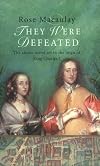
They Were Defeated
by Rose Macaulay
On This Page
Description
THEY WERE DEFEATED begins in 1640 at a harvest festival - but religious persecution is in the air, and the idyllic rural scene is soon darkened by the threat of a witch hunt... Rose Macaulay interweaves the lives of Robert Herrick and other contemporary poets with those of a small group of fictional characters. Their lives, and in particular the life of her heroine Julian, are set vividly before us against a period which was one of the most dramatic and unsetttled in English history. show more Skilfully intertwining tragedy, comedy and beauty, THEY WERE DEFEATED was Rose Macaulay¿s only historical novel, and is 'her greatest success' [Observer] First published in 1932. show lessTags
Recommendations



















Member Reviews
Set in Devon and Cambridge in 1640-1641, on the eve of the English Civil War, packed with poets, politics, and theological disputes, intensely language-based, with a subversive feminist agenda and scarcely a description of a costume or a piece of furniture anywhere in the book, this ought to be my sort of historical novel. And it very nearly was. I loved Macaulay's very precise ear for the patterns of 17th century English — both standard and in various shades of Devon dialect — and her ruthless elimination of 20th century language. Few historical novelists can keep that up so consistently for the length of a whole book. The central characters were promising too: two teenage girls, one a tomboy and the other a scholar; an eccentric show more sceptical physician; and the poet and clergyman Robert Herrick.
The trouble is, these people look as though they are being set up for an adventure story, but in fact they are only there to allow the author to comment on the ideas of 17th century England. They don't develop in the course of the story, despite listening — ad nauseam — to all sorts of clever people telling each other things they already know about current events. Not much happens, except on the news, and the characters continue much as they were, until the author gets tired of them and eliminates them arbitrarily.
With hindsight, some of what Macaulay is saying about 17th century England, with moderate Anglicans caught between the hardcore puritans on one side and papists on the other on the verge of a destructive conflict, must read onto the fascism and communism of thirties Europe. But a lot of it probably reflects her own somewhat complicated religious feelings as well.
A very interesting book, as history, and a very clever one technically, but I found it a disappointment as a novel. Obviously written as a by-product of Macaulay's Milton biography. show less
The trouble is, these people look as though they are being set up for an adventure story, but in fact they are only there to allow the author to comment on the ideas of 17th century England. They don't develop in the course of the story, despite listening — ad nauseam — to all sorts of clever people telling each other things they already know about current events. Not much happens, except on the news, and the characters continue much as they were, until the author gets tired of them and eliminates them arbitrarily.
With hindsight, some of what Macaulay is saying about 17th century England, with moderate Anglicans caught between the hardcore puritans on one side and papists on the other on the verge of a destructive conflict, must read onto the fascism and communism of thirties Europe. But a lot of it probably reflects her own somewhat complicated religious feelings as well.
A very interesting book, as history, and a very clever one technically, but I found it a disappointment as a novel. Obviously written as a by-product of Macaulay's Milton biography. show less
Before coming across this at an estate sale, I was familiar with Rose Macaulay only as the author of The Towers of Trebizond, her best known novel by far. From this book, I deduce, first, that she had the disposition and talents of a scholar as well; and second, that academia slighted her because of her sex. This is a sensitive portrayal of a the world of English letters in 1640 -- a world on the brink of the cataract that was the Civil War.
Of the 527 poems in the Oxford anthology of seventeenth-century pottery, 127 are by people who appear as characters in this novel: Milton, Crashaw, Herrick, Marvell, Suckling, Cowley, Henry More, and John Cleveland (the villain of the piece, and a nasty piece of work Dame Rose made of him).
This was show more published in the US under the title The Shadow Flies. My copy is of that edition. show less
Of the 527 poems in the Oxford anthology of seventeenth-century pottery, 127 are by people who appear as characters in this novel: Milton, Crashaw, Herrick, Marvell, Suckling, Cowley, Henry More, and John Cleveland (the villain of the piece, and a nasty piece of work Dame Rose made of him).
This was show more published in the US under the title The Shadow Flies. My copy is of that edition. show less
A beautifully written book, Macaulay's only historical novel of the English Civil War.
Ratings
Members
- Recently Added By
Lists

Lives of the Poets (and Philosophers)
110 works; 5 members
Author Information

49+ Works 3,889 Members
Series
Belongs to Publisher Series
Common Knowledge
- Original title
- They Were Defeated
- Alternate titles
- The Shadow Flies
- Original publication date
- 1932
- People/Characters
- Julian Conybeare; Robert Herrick; John Suckling; John Cleveland
- Important events
- English Civil War
- Dedication
- To my Uncle
WILLIAM HERRICK MACAULAY
this story of Cambridge
and one of our distant relatives - First words
- Things were going none too well this morning, the vicar felt.
- Last words
- (Click to show. Warning: May contain spoilers.)Slowly he walked from Dean bridge across the meadows to the Court; and he seemed to have already put on immortality, for he might have been some sturdy sylvan god in that serene pastoral landskip, passing on his way to eat and drink with his friends.
Classifications
Statistics
- Members
- 94
- Popularity
- 342,913
- Reviews
- 3
- Rating
- (3.50)
- Languages
- English
- Media
- Paper
- ISBNs
- 4
- ASINs
- 2