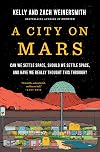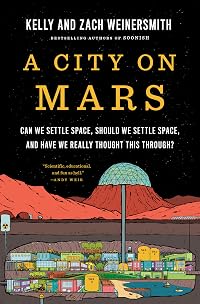
A City on Mars: Can we settle space, should we settle space, and have we really thought this through?
by Kelly Weinersmith, Zach Weinersmith
On This Page
Description
"Earth is not well. The promise of starting life anew somewhere far, far away--no climate change, no war, no Twitter--beckons, and settling the stars finally seems within our grasp. Or is it? Critically acclaimed, bestselling authors Kelly and Zach Weinersmith set out to write the essential guide to a glorious future of space settlements, but after years of research, they aren't so sure it's a good idea. Space technologies and space business are progressing fast, but we lack the knowledge show more needed to have space kids, build space farms, and create space nations in a way that doesn't spark conflict back home. In a world hurtling toward human expansion into space, A City on Mars investigates whether the dream of new worlds won't create nightmares, both for settlers and the people they leave behind. In the process, the Weinersmiths answer every question about space you've ever wondered about, and many you've never considered: Can you make babies in space? Should corporations govern space settlements? What about space war? Are we headed for a housing crisis on the Moon's Peaks of Eternal Light--and what happens if you're left in the Craters of Eternal Darkness? Why do astronauts love taco sauce? Speaking of meals, what's the legal status of space cannibalism? With deep expertise, a winning sense of humor, and art from the beloved creator of Saturday Morning Breakfast Cereal, the Weinersmiths investigate perhaps the biggest questions humanity will ever ask itself--whether and how to become multiplanetary. Get in, we're going to Mars"-- show lessTags
Recommendations





















Member Reviews
This is a nonfiction book that goes into meticulous detail about the challenges of space colonization, in Earth orbit, on the moon, and on Mars, from both a scientific and legal perspective. Lots of good details, lively writing. My main takeaway was that however hard you think space colonization might be, it's much much harder, way harder than it's commonly portrayed by science fiction stories, or by the tech billionaires currently trying to set up Ayn Randian utopias on Mars. Not about science fiction per se, but clearly "related" to it; I enjoyed it a lot and keep thinking about tidbits from it months after reading it.
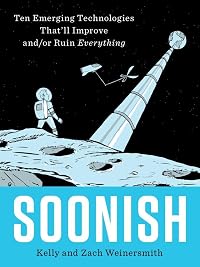
The Weinersmiths (authors of the interesting and entertaining Soonish: Ten Emerging Technologies That'll Improve and/or Ruin Everything) initially set out to write a book about what we should expect from the exciting new era of space settlement to come in the not-too-distant future. What they ended up writing, after lots and lots of research, is a book about how very, very not ready we are to start living on Mars, or anywhere else that isn't Earth.
In particular, they focus on a lot of issues that advocates of space settlement tend to gloss over or ignore while they're busy thinking about rocket schedules and mineral abundances. Like, for instance, the fact that the longest anyone has ever been in space is about a year and a half and no show more one's ever lived in Moon gravity for more than a few days or Mars gravity at all. So we have zero data on what it would mean, physiologically, to spend a lifetime somewhere other than Earth, or whether we can reproduce there without problems. Indeed, there hasn't even been much in the way of good animal experiments on any of that yet. Then there are issues of psychology and government, because no matter what the most idealistic of space dreamers might want to believe, humans do inevitably take our own flawed humanity with us wherever we go. And what about legal barriers? Does current space law even permit this sort of thing? Do we need to have clearer and more useful international law on the subject first to prevent problems down the road? And is expanding into space going to usher in a new era of cosmic harmony, or is it likely to actually be a new source of conflict?
On top of which, the simple fact is that space is a terrible place. As is the moon, as is Mars. It is profoundly difficult to overestimate just how hard it will be to keep human beings alive there, never mind thriving, or how much of what we take absolutely for granted on Earth will have to be struggled for there. Antarctica is a garden spot by comparison.
None of which is probably anything space enthusiasts (of which I do count myself one, although never one who thought Elon Musk-style near-term Mars settlement was anything but a pipe dream) are likely to want to hear. But whether or not you're convinced by their arguments, they are very much worth listening to, and the authors are certainly right that not enough attention is paid to these topics.
I should say that, while this sounds like a massive downer, it is written in a pleasant, humorous style (even if it is sometimes a stretch to keep that up during long chapters about international law), and also that the authors don't think that cities on Mars don't sound awesome, or even that they're not a good long-term goal for humanity. Ultimately, their argument is for doing it when we're actually truly capable of doing it right... and that that is really not today. show less
In particular, they focus on a lot of issues that advocates of space settlement tend to gloss over or ignore while they're busy thinking about rocket schedules and mineral abundances. Like, for instance, the fact that the longest anyone has ever been in space is about a year and a half and no show more one's ever lived in Moon gravity for more than a few days or Mars gravity at all. So we have zero data on what it would mean, physiologically, to spend a lifetime somewhere other than Earth, or whether we can reproduce there without problems. Indeed, there hasn't even been much in the way of good animal experiments on any of that yet. Then there are issues of psychology and government, because no matter what the most idealistic of space dreamers might want to believe, humans do inevitably take our own flawed humanity with us wherever we go. And what about legal barriers? Does current space law even permit this sort of thing? Do we need to have clearer and more useful international law on the subject first to prevent problems down the road? And is expanding into space going to usher in a new era of cosmic harmony, or is it likely to actually be a new source of conflict?
On top of which, the simple fact is that space is a terrible place. As is the moon, as is Mars. It is profoundly difficult to overestimate just how hard it will be to keep human beings alive there, never mind thriving, or how much of what we take absolutely for granted on Earth will have to be struggled for there. Antarctica is a garden spot by comparison.
None of which is probably anything space enthusiasts (of which I do count myself one, although never one who thought Elon Musk-style near-term Mars settlement was anything but a pipe dream) are likely to want to hear. But whether or not you're convinced by their arguments, they are very much worth listening to, and the authors are certainly right that not enough attention is paid to these topics.
I should say that, while this sounds like a massive downer, it is written in a pleasant, humorous style (even if it is sometimes a stretch to keep that up during long chapters about international law), and also that the authors don't think that cities on Mars don't sound awesome, or even that they're not a good long-term goal for humanity. Ultimately, their argument is for doing it when we're actually truly capable of doing it right... and that that is really not today. show less
The authors have done a lot of research into the the question of settling space. They have looked beyond "rocket science" and the mechanics of getting human beings into space to examine biological issues, physical and mental health issues, legal questions, social concerns, moral issues and governance. Fascinating stuff. Well written with humour injected at times in a way that enhances their narrative without detracting from important points.
There bottom line is that we are nowhere near ready to settle space given the harsh environment and lack of data on long term effects of living in those conditions. And, even if we were, technically, ready, it doesn't mean we should settle space just because we can. They especially argue that space show more settlements should be large enough to be mostly self-sustaining -- what they call the "wait and go big" approach to avoid exorbitant costs and to ensure all necessary services (including mental health) can be provided. show less
There bottom line is that we are nowhere near ready to settle space given the harsh environment and lack of data on long term effects of living in those conditions. And, even if we were, technically, ready, it doesn't mean we should settle space just because we can. They especially argue that space show more settlements should be large enough to be mostly self-sustaining -- what they call the "wait and go big" approach to avoid exorbitant costs and to ensure all necessary services (including mental health) can be provided. show less
Summary: A study of the complexities of human settlements in space, and whether this is as good an idea as some think.
With the recent Artemis mission, human space missions once again captured the public imagination. It put us on notice that there are well-funded entities with ambitions to settle on the Moon, and eventually Mars or elsewhere. Some have spoken of this as an alternative if climate conditions become unbearable on earth or as an “ark” to preserve human and other life if the unthinkable were to happen on earth.
Kelly and Zach Weinersmith, a scientist and a cartoonist respectively, are self-admitted space geeks. But as they have taken a hard look at the complexities of space settlement, they argue very good case for at show more least going slow if we do this at all. At best, they argue for this being a project of centuries–a wait-and-go-big approach. To begin, they puncture a variety of myths about how space settlement could save humanity, make us all rich, end war, and will unify us and make us wise.
Then they take a deep dive into the complexities of creating sustainable space settlements. Firstly, consider survival. Space has all kinds of ways to kill humans, both fast and slow. Fundamentally, there is the question of air, and the reality that the lack of it, even for seconds can kill. There are also a variety of longer term killers from bone and muscle loss to radiation exposure from which our atmosphere protects us. And while sex in space is possible, we do not know the effects of low or no gravity environments on human development. Likewise, what would long-term residence in a low gravity environment would mean for returning to Earth?
Secondly, comes the question of where. The Weinersmiths consider the possibilities. The Moon is close but comes with challenges. Only a few mountaintops at the poles are always in sunlight. The soil is abrasive, just to mention the most obvious problems. Mars is little better, with toxic, perchlorate soils and challenging atmospheric conditions. Then there are giant space stations, wheels in the sky. However, the size to create gravity approximating earth presents construction challenges. All the other options are far worse.
Thirdly, creating self-contained settlements has its own challenges. Biosphere Two barely pulled this off on earth. But the most likely settlements on the Moon or Mars would be underground, in lava tubes. These protect from unlivable temperatures, toxins, and radiation. But the challenge is that they have to be self-sustaining for long periods, from oxygen generation to food and energy production. We don’t know how to do this yet.
Fourthly, is the state of and challenges of space law. The Weinersmiths discuss the existing Outer Space Treaty, that has both worked but leaves many questions unanswered. When you are talking brief, exploratory missions and a few samples, there are few problems. However, can a “commons” approach work when there are multiple entities with settlements?
Finally, the Weinersmiths consider what is involved in “going big.” They envision that settlements would be the equivalent of the company town. And how many people are needed for a self-sustaining civilization? The estimates vary widely from under ten thousand to a million or more people. Of course, that begs the question of how we will get them there. And, because human nature doesn’t change, the Weinersmiths explore everything from crime to space war.
The Weinersmiths break up all this serious science and technology talk with comics, down to earth descriptions, like the Moon as a “fixer-upper” and humorous sidenotes like the tale of the tampon bandolier for early female astronauts and why astronauts love taco sauce. Don’t skip over the Nota Bene at the end of each section.
The upshot of all this is that we better not rely on space settlement as a Plan B for the human race. At one point, they note that the best space alternatives are still objectively worst than even extreme climate change conditions. And none are near-term. We are far wiser to focus on the only place we know we can live. However, they do not close the door to space settlement. Rather, to do it well and ethically, there is a lot of groundwork to lay that will take far more than 20-25 years as some would propose. The Weinersmiths suggest centuries, although our ADHD society probably can’t tolerate that. And they weigh the words of naysayers and those who worry what Pandora’s box space settlement could open.
What is valuable is that the Weinersmiths inject a healthy dose of realism into discussions given to hyperbole. Their style is such that readers have fun while considering serious matters. And since a space settlement effort will effect all of us, it’s well worth learning about what is involved and the challenges we may face. This book is a good place to start. show less
With the recent Artemis mission, human space missions once again captured the public imagination. It put us on notice that there are well-funded entities with ambitions to settle on the Moon, and eventually Mars or elsewhere. Some have spoken of this as an alternative if climate conditions become unbearable on earth or as an “ark” to preserve human and other life if the unthinkable were to happen on earth.
Kelly and Zach Weinersmith, a scientist and a cartoonist respectively, are self-admitted space geeks. But as they have taken a hard look at the complexities of space settlement, they argue very good case for at show more least going slow if we do this at all. At best, they argue for this being a project of centuries–a wait-and-go-big approach. To begin, they puncture a variety of myths about how space settlement could save humanity, make us all rich, end war, and will unify us and make us wise.
Then they take a deep dive into the complexities of creating sustainable space settlements. Firstly, consider survival. Space has all kinds of ways to kill humans, both fast and slow. Fundamentally, there is the question of air, and the reality that the lack of it, even for seconds can kill. There are also a variety of longer term killers from bone and muscle loss to radiation exposure from which our atmosphere protects us. And while sex in space is possible, we do not know the effects of low or no gravity environments on human development. Likewise, what would long-term residence in a low gravity environment would mean for returning to Earth?
Secondly, comes the question of where. The Weinersmiths consider the possibilities. The Moon is close but comes with challenges. Only a few mountaintops at the poles are always in sunlight. The soil is abrasive, just to mention the most obvious problems. Mars is little better, with toxic, perchlorate soils and challenging atmospheric conditions. Then there are giant space stations, wheels in the sky. However, the size to create gravity approximating earth presents construction challenges. All the other options are far worse.
Thirdly, creating self-contained settlements has its own challenges. Biosphere Two barely pulled this off on earth. But the most likely settlements on the Moon or Mars would be underground, in lava tubes. These protect from unlivable temperatures, toxins, and radiation. But the challenge is that they have to be self-sustaining for long periods, from oxygen generation to food and energy production. We don’t know how to do this yet.
Fourthly, is the state of and challenges of space law. The Weinersmiths discuss the existing Outer Space Treaty, that has both worked but leaves many questions unanswered. When you are talking brief, exploratory missions and a few samples, there are few problems. However, can a “commons” approach work when there are multiple entities with settlements?
Finally, the Weinersmiths consider what is involved in “going big.” They envision that settlements would be the equivalent of the company town. And how many people are needed for a self-sustaining civilization? The estimates vary widely from under ten thousand to a million or more people. Of course, that begs the question of how we will get them there. And, because human nature doesn’t change, the Weinersmiths explore everything from crime to space war.
The Weinersmiths break up all this serious science and technology talk with comics, down to earth descriptions, like the Moon as a “fixer-upper” and humorous sidenotes like the tale of the tampon bandolier for early female astronauts and why astronauts love taco sauce. Don’t skip over the Nota Bene at the end of each section.
The upshot of all this is that we better not rely on space settlement as a Plan B for the human race. At one point, they note that the best space alternatives are still objectively worst than even extreme climate change conditions. And none are near-term. We are far wiser to focus on the only place we know we can live. However, they do not close the door to space settlement. Rather, to do it well and ethically, there is a lot of groundwork to lay that will take far more than 20-25 years as some would propose. The Weinersmiths suggest centuries, although our ADHD society probably can’t tolerate that. And they weigh the words of naysayers and those who worry what Pandora’s box space settlement could open.
What is valuable is that the Weinersmiths inject a healthy dose of realism into discussions given to hyperbole. Their style is such that readers have fun while considering serious matters. And since a space settlement effort will effect all of us, it’s well worth learning about what is involved and the challenges we may face. This book is a good place to start. show less
Though we’ve known since the early 20th century that Mars is essentially a lifeless wasteland, humans have been reluctant to relinquish the dream of one day living there. In A City On Mars, self-described space geeks, Kelly and Zach Weinersmith explore the feasibility of life among the stars.
As technology advances providing continued innovation in space travel the dream may seem closer than ever but it’s only a single practical challenge among many. Drawing from several years of original research including interviews with a myriad of experts, the Weinersmith’s explore topics with regards to the the ability of both the human body and mind to withstand life in space for long periods, and the obstacles to creating safe, self show more sustaining biomes at scale among hostile environments. It’s surprising to realise just how much we don’t know about living in space, and I found these sections to be the most engaging.
A large section of the book is also devoted to examining legal and ethical concerns regarding space settlement, and though I found myself skimming a fair bit of the detail that covered the former, the issues raised were interesting to consider. The analogy with company towns is a clever comparison, I look at the mess Musk’s ego has made of Twitter, and know I could never trust him to act in my (or society’s) best interests.
The Weinersmith’s interject some humour into their work, which enhances its readability and their enthusiasm for the topic comes across well. Zach’s illustrations are a lighthearted, if superfluous, addition. I do think readers will require at least a casual interest in the subject to stay engaged with the narrative. The length of the book works against it slightly, though I appreciate the authors’ thoroughness.
A City on Mars is a pretty pessimistic view of the viability of space colonisation, there are still many questions to be answered and I agree with the Weinersmith’s conclusion that just because we can, doesn’t mean we should. Life in space is no guarantee of utopia, in fact we’d just be taking all the same problems with us, and likely creating many more. show less
As technology advances providing continued innovation in space travel the dream may seem closer than ever but it’s only a single practical challenge among many. Drawing from several years of original research including interviews with a myriad of experts, the Weinersmith’s explore topics with regards to the the ability of both the human body and mind to withstand life in space for long periods, and the obstacles to creating safe, self show more sustaining biomes at scale among hostile environments. It’s surprising to realise just how much we don’t know about living in space, and I found these sections to be the most engaging.
A large section of the book is also devoted to examining legal and ethical concerns regarding space settlement, and though I found myself skimming a fair bit of the detail that covered the former, the issues raised were interesting to consider. The analogy with company towns is a clever comparison, I look at the mess Musk’s ego has made of Twitter, and know I could never trust him to act in my (or society’s) best interests.
The Weinersmith’s interject some humour into their work, which enhances its readability and their enthusiasm for the topic comes across well. Zach’s illustrations are a lighthearted, if superfluous, addition. I do think readers will require at least a casual interest in the subject to stay engaged with the narrative. The length of the book works against it slightly, though I appreciate the authors’ thoroughness.
A City on Mars is a pretty pessimistic view of the viability of space colonisation, there are still many questions to be answered and I agree with the Weinersmith’s conclusion that just because we can, doesn’t mean we should. Life in space is no guarantee of utopia, in fact we’d just be taking all the same problems with us, and likely creating many more. show less
Entertaining enough though it gets a bit repetitive, since the answers are “not at all presently,” “probably not,” and “definitely not.” It’s a deliberate answer to boosters: “reading about space settlement today is kind of like reading about what quantity of beer is safe to drink in a world where all the relevant books are written by breweries.” Not only are they worried about military conflicts over space resources, but space is a really dangerous place; we can barely make the necessary high-tech supplies on Earth, and being self-sustaining would require incredible amounts of energy and technical innovation. And that’s before you get into the human factors: a company town in a “poisonous hellscape” six months show more away from any alternatives is not a recipe for successful human interactions. For five generations of a self-sustaining population, you’d want about thirty thousand people, and even that is low. “[T]he most autarkic countries on Earth have much more than 1 million people, are not the most economically desirable places on Earth, and incidentally would both like to be less autarkic.” But even that understates the challenge, given the resource constraints. “Even if you have 99 percent reuse of something like water, that loss of 1 percent mass adds up to 40 percent of your mass over fifty years.”
Ultimately, though, they’re really worried about governance. Going off Earth might just give us more ways to destroy ourselves, up to and including throwing rocks down the gravity well. show less
Ultimately, though, they’re really worried about governance. Going off Earth might just give us more ways to destroy ourselves, up to and including throwing rocks down the gravity well. show less
This is a fun, accessible read on a very heavy topic, and, spoiler warning: the answer to the last question in subtitle is "No." And, honestly, I knew that going in (though of course I hoped I was wrong), but I still appreciated the detail and care the Weinersmiths put into making it absolutely clear how extremely we've not thought this through and how very much we're not ready for this. This book does a great job of elucidating the many ways this could all go wrong, and the many steps between here and even attempting it. (To be clear, this is a book about *settling* space. Obviously, science in space is a whole different and much more plausible concept.)
This is also a surprisingly relevant book. It's hard not to look at the smoking show more ruins of Twitter (and the quieter disaster that is Tesla) and shudder when you imagine the dude who accomplished that being in charge of a space city. It's hard not to look at Jeff Bezos's incredible commitment to hoarding every resource on this planet to the point of destruction and shudder when you imagine him in charge of a space program.
The books' tone is light enough and amusing enough to be enjoyable, and the content is definitely easy to understand. (Yes, the Weinersmiths do belabor their points a bit, but given the general attitude of most space enthusiasts, I understand why. They're fighting an uphill battle against zealots here.) Overall, recommended for people interested in space and for people who write or read a lot of fiction about space. show less
This is also a surprisingly relevant book. It's hard not to look at the smoking show more ruins of Twitter (and the quieter disaster that is Tesla) and shudder when you imagine the dude who accomplished that being in charge of a space city. It's hard not to look at Jeff Bezos's incredible commitment to hoarding every resource on this planet to the point of destruction and shudder when you imagine him in charge of a space program.
The books' tone is light enough and amusing enough to be enjoyable, and the content is definitely easy to understand. (Yes, the Weinersmiths do belabor their points a bit, but given the general attitude of most space enthusiasts, I understand why. They're fighting an uphill battle against zealots here.) Overall, recommended for people interested in space and for people who write or read a lot of fiction about space. show less
Members
- Recently Added By
Published Reviews
ThingScore 75
As Carl Sagan wrote: “Even after 400 generations in villages and cities, we haven’t forgotten. The open road still softly calls, like a nearly forgotten song of childhood.” We need to chisel our jaws and put on space boots.
Woah! say Kelly and Zach Weinersmith in this romp through the many rooms of a space folly.
Woah! say Kelly and Zach Weinersmith in this romp through the many rooms of a space folly.
added by Nevov
Lists

Best Science Books for Non-Scientists
113 works; 57 members

Best Laugh Out Loud Books
143 works; 49 members

Non-Fiction Worth Reading
1,016 works; 263 members

Audio Books
29 works; 3 members

Books With Place Names in the Title
267 works; 11 members

Best 21st Century Books (So Far)
679 works; 86 members
Author Information

3+ Works 1,660 Members
Dr. Kelly Weinersmith is Adjunct Faculty in the BioSciences Department at Rice University, where she studies parasites that manipulate the behavior of their hosts. In addition to being a respected researcher, she cohosts Science...Sort Of, which is one of the top 20 natural science podcasts. Kelly spoke at Smithsonian Magazine's "The Future is show more Here 2015," and her work has been featured in The Atlantic, Science, and Nature. show less
23+ Works 3,328 Members
Some Editions
Awards and Honors
Awards
Distinctions
Notable Lists
Common Knowledge
- Original publication date
- 2023-11-07
- Important places
- The Moon; Mars
- Dedication
- To the space-settlement community. You welcomed us and you shared your wisdom. Also, your data. We worry that many of you will be disappointed by some of our conclusions, but where we have diverged from your views, we haven't... (show all) diverged from your vision of a glorious human future.
- First words
- Wherever you are on this planet, you've recently given some thought to leaving it.
- Last words
- (Click to show. Warning: May contain spoilers.)We have to become wise if we want to go to the stars.
- Publisher's editor
- Smith-Younce, Virginia; Sydney, Caroline
- Blurbers
- Weir, Andy; Corey, James S. A.; Roach, Mary; Aaronson, Scott; Plait, Phil; Green, Hank (show all 9); Cham, Jorge; O'Sullivan, Sinead; Kowal, Mary Robinette
- Original language
- English
Classifications
Statistics
- Members
- 776
- Popularity
- 36,189
- Reviews
- 30
- Rating
- (4.07)
- Languages
- English, Finnish
- Media
- Paper, Audiobook, Ebook
- ISBNs
- 10
- ASINs
- 3