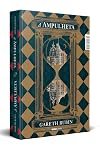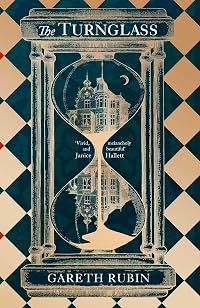
The Turnglass
by Gareth Rubin
On This Page
Description
1880s, Essex, England: Dr. Simeon Lee arrives at remote Turnglass House to treat his ailing relative Parson Oliver Hawes. Hawes believes he's being poisoned by his sister-in-law, Florence, who was declared mad after killing the parson's brother in a jealous rage. Hawes has locked her in a glass-walled apartment; the secret to how she came to be there is found in his tete-beche journal--each side tells a completely different story. 1930s, Hollywood: Celebrated author Oliver Tooke, the show more governor's son, is found dead by apparent suicide. His friend Ken Kourian isn't convinced Oliver took his own life. To get to the truth, Ken must decipher clues hidden in Oliver's final book, a tete-beche novel called The Turnglass--about a young doctor named Simeon Lee. show lessTags
Recommendations














Member Reviews
Since I received an ARC copy, I can't fault the author for not being able to turn over the book. The idea is very entertaining though and more writers should take advantage of such a clever trick. I didn't mind the tonal difference between the two, in fact it takes admirable skill to "flip" the script like that. Yet both stories carry their themes successfully: a "malignant" house on the water, a murder, a hidden journal, forced imprisonment.. However, the first half was almost too good. It was a mystery that was so engrossing and atmospheric that it could've stood on its own. After so much build up I had become invested in the numerous characters and was left wanting more. The tell-all exposition/reveal at the end probably wouldn't show more have felt rushed if there wasn't a second half to get through.
In the second half, the mention of polio, FDR, the Great War, and eugenics were all a little on the nose. Like the reader needed to be certain it was the 1930s. The governor of California even reminded me of old Joe Kennedy. But one can't deny the racism and homophobia of the era, and I appreciate Rubin for not glossing over it. But I wish Ken and Oliver had been childhood friends, or had a prior, perhaps implied, history. It took quite some time to solidify their newfound friendship before the mystery even got started. However I am definitely keeping an eye on Rubin and checking out any of their future works. Both Florences will be sticking with me! show less
In the second half, the mention of polio, FDR, the Great War, and eugenics were all a little on the nose. Like the reader needed to be certain it was the 1930s. The governor of California even reminded me of old Joe Kennedy. But one can't deny the racism and homophobia of the era, and I appreciate Rubin for not glossing over it. But I wish Ken and Oliver had been childhood friends, or had a prior, perhaps implied, history. It took quite some time to solidify their newfound friendship before the mystery even got started. However I am definitely keeping an eye on Rubin and checking out any of their future works. Both Florences will be sticking with me! show less
Interesting pair of linked novellas where the physical book is turned over to read the other one: a work apparently referred to as a tete-beche. The blue side (cover) is set in the late 19th century, about a doctor Simeon Lee, who is called to examine a distant relation, a parson called Oliver Hawes, who believes he is being poisoned. On arrival at the remote house, on a small island off the coast of Essex, linked by a causeway to the mainland at one end and a larger island on the other, he discovers that Oliver is in charge of Florence, his sister-in-law who was implicated in the death of the parson's brother. She apparently threw a heavy object at him which cut him on the cheek, and the wound subsequently became infected. It is show more implied that she also did other things, resulting in her incarceration behind a wall of glass in the large upstairs library. This was the alternative than sending her to an unpleasant lunatic asylum.
Gradually, Simeon discovers that there is more behind this story than Oliver admits. It's a very murky story of opium dens and other ills of the period including the subservient position of women. The motif of a book that can be read in two ways features in the story itself, when Simeon reads a book which is, at one end, a story set in the then-future of 1938 and in California, and at the other an incriminating journal. I did find the ending odd in that Simeon had destroyed one piece of evidence, and they were talking about destroying the journal, when surely those could have been used to exonerate Florence.
The other (red cover) end of the book is the story set in California in 1938 when Oliver Tooke, celebrated author and son of the state governor, befriends a young man called Ken Kourian. When Oliver is murdered, Ken sets out to discover the killer and finds his own life in jeopardy. The solution involves the story in the 'blue' half of the book, in which Oliver has placed various clues. I must admit to guessing the big twist quite a bit before the end. I also found the scene where the police nearly murder Ken in a jail cell not terribly convincing as there didn't seem to be a reason for going so far.
One distraction for me was the name Simeon Lee immediately conjured up the association with the character of the same name in 'Hercule Poirot's Christmas' by Agatha Christie. The writing was creaky in places - I especially found parson Oliver's journal unconvincing. On the positive side, the non-stop action of the California segment resembled a 1930s pot-boiler crime novel in contrast to the slow burn of the tale in Victorian England. Despite that it seemed the 'real' story and the Victorian one the pastiche by Oliver Tooke.
On balance, I would award this four stars. I'd like to thank the publishers and author for a free copy of the hardcover obtained in a giveaway. show less
Gradually, Simeon discovers that there is more behind this story than Oliver admits. It's a very murky story of opium dens and other ills of the period including the subservient position of women. The motif of a book that can be read in two ways features in the story itself, when Simeon reads a book which is, at one end, a story set in the then-future of 1938 and in California, and at the other an incriminating journal. I did find the ending odd in that Simeon had destroyed one piece of evidence, and they were talking about destroying the journal, when surely those could have been used to exonerate Florence.
The other (red cover) end of the book is the story set in California in 1938 when Oliver Tooke, celebrated author and son of the state governor, befriends a young man called Ken Kourian. When Oliver is murdered, Ken sets out to discover the killer and finds his own life in jeopardy. The solution involves the story in the 'blue' half of the book, in which Oliver has placed various clues. I must admit to guessing the big twist quite a bit before the end. I also found the scene where the police nearly murder Ken in a jail cell not terribly convincing as there didn't seem to be a reason for going so far.
One distraction for me was the name Simeon Lee immediately conjured up the association with the character of the same name in 'Hercule Poirot's Christmas' by Agatha Christie. The writing was creaky in places - I especially found parson Oliver's journal unconvincing. On the positive side, the non-stop action of the California segment resembled a 1930s pot-boiler crime novel in contrast to the slow burn of the tale in Victorian England. Despite that it seemed the 'real' story and the Victorian one the pastiche by Oliver Tooke.
On balance, I would award this four stars. I'd like to thank the publishers and author for a free copy of the hardcover obtained in a giveaway. show less
Basically an Ace Doubles of interlinked stories, and it's fine, quite clever, though I felt the mystery in the 1880s was more involved than that of the 1930s. If the 1880s story had been interwoven with the 1930s, I wonder if the effect would have been the same? Anyway, I suggest reading the 1880s story first as it gets referenced a lot in the 1930s story.
Tête-bêche (n)
A book split into two parts printed back-to-back and head-to-foot.
“The Turnglass” is the first Tête-bêche book I remember reading and I quite enjoyed it. It was an adventure on its own and added excitement to the story.
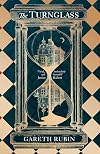
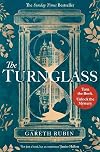
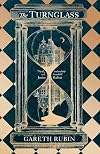
Even picking what story to read was an adventure in itself. You pick the book up, and one side of the book is covered in green. This side takes you to 1880s England. Then you flip the book and you get the red side, a story set in California in the 1930s. It is up to you to choose which side to read first, the stories can be read in any order.
I chose to go with 1880s England first.
Only because it is set earlier in the past. The two stories are connected to each other, and, of course, they have The show more Turnglass house in common. Whilst I was reading, I had a feeling that every detail mentioned could be important at a later date. I couldn’t fully enjoy and immerse myself in the story, because I couldn’t help pretend to be Sherlock Holmes and always look out for clues.
That being said, the chapters are fast-paced and intriguing. They often featured letters or book quotes that brought diversity to the format. Both stories were interesting and kept me guessing until the very end. I liked how it all tied up in the end. There is no special ending – both stories have their own endings. There is nothing to wrap them both up or a big reveal to unite them. Although, with this format, that’s very much expected.
In all honesty, I don’t know if the reading order would have changed anything. But I will never know. “The Turnglass” is one of those books I wish I was able to read again for the first time. Only to try the other order of the stories and see if my reading experience would change. I would definitely recommend this book. It’s a gorgeous, adventurous and mysterious read for sure.
“I guess you learn a lot more about someone from the books they read than where they spend their vacations or which box they tick on a voting paper.”
Wishlist | Blog | Facebook | Twitter | Instagram | Ko-fi show less
A book split into two parts printed back-to-back and head-to-foot.
“The Turnglass” is the first Tête-bêche book I remember reading and I quite enjoyed it. It was an adventure on its own and added excitement to the story.
Even picking what story to read was an adventure in itself. You pick the book up, and one side of the book is covered in green. This side takes you to 1880s England. Then you flip the book and you get the red side, a story set in California in the 1930s. It is up to you to choose which side to read first, the stories can be read in any order.
I chose to go with 1880s England first.
Only because it is set earlier in the past. The two stories are connected to each other, and, of course, they have The show more Turnglass house in common. Whilst I was reading, I had a feeling that every detail mentioned could be important at a later date. I couldn’t fully enjoy and immerse myself in the story, because I couldn’t help pretend to be Sherlock Holmes and always look out for clues.
That being said, the chapters are fast-paced and intriguing. They often featured letters or book quotes that brought diversity to the format. Both stories were interesting and kept me guessing until the very end. I liked how it all tied up in the end. There is no special ending – both stories have their own endings. There is nothing to wrap them both up or a big reveal to unite them. Although, with this format, that’s very much expected.
In all honesty, I don’t know if the reading order would have changed anything. But I will never know. “The Turnglass” is one of those books I wish I was able to read again for the first time. Only to try the other order of the stories and see if my reading experience would change. I would definitely recommend this book. It’s a gorgeous, adventurous and mysterious read for sure.
“I guess you learn a lot more about someone from the books they read than where they spend their vacations or which box they tick on a voting paper.”
Wishlist | Blog | Facebook | Twitter | Instagram | Ko-fi show less
Le danger avec ce genre de format c'est que la forme ait été privilégiée par rapport au fond et c'est ce qui s'est passé avec cette lecture.
J'ai malheureusement plus adhéré à une histoire (celle qui se passe dans l'Essex) par rapport à l'autre.
L'ambiance a été bien plus travaillée et m'a bien plus entraînée dans l'intrigue (même si beaucoup d'éléments étaient assez attendus). Néanmoins j'ai trouvé les personnages peu approfondis (après chacune des deux histoires fait en moyenne 200 pages) et manquaient parfois de logique dans leur évolution.
Pour la seconde histoire, on commence à voir les fils qui s'entremêlent entre les deux récits mais je m'attendais à ce que ce soit plus mis en valeur. L'histoire met show more beaucoup de temps à se mettre en place et malheureusement j'ai vu venir la fin bien longtemps en avance.
En bref de bonnes idées mais vu la longueur de chaque récit on ne pouvait pas s'attendre à plus de profondeur dans l'histoire. J'ai été un peu déçue quant au format qui finalement n'a pas été assez exploité et qui m'a laissé sur ma fin. show less
J'ai malheureusement plus adhéré à une histoire (celle qui se passe dans l'Essex) par rapport à l'autre.
L'ambiance a été bien plus travaillée et m'a bien plus entraînée dans l'intrigue (même si beaucoup d'éléments étaient assez attendus). Néanmoins j'ai trouvé les personnages peu approfondis (après chacune des deux histoires fait en moyenne 200 pages) et manquaient parfois de logique dans leur évolution.
Pour la seconde histoire, on commence à voir les fils qui s'entremêlent entre les deux récits mais je m'attendais à ce que ce soit plus mis en valeur. L'histoire met show more beaucoup de temps à se mettre en place et malheureusement j'ai vu venir la fin bien longtemps en avance.
En bref de bonnes idées mais vu la longueur de chaque récit on ne pouvait pas s'attendre à plus de profondeur dans l'histoire. J'ai été un peu déçue quant au format qui finalement n'a pas été assez exploité et qui m'a laissé sur ma fin. show less
Angleterre 1881, Californie 1939. Une demeure isolée, une maison de verre. Deux histoires tête-bêche en miroir dont les personnages et les situations se répondent. Un roman (ou deux ?) étonnant, qui peut être lu dans les deux sens, et qui, sans renouveler le roman policier, sait surprendre tout en laissant au spectateur le soin de deviner et reconstituer. Une jolie découverte.
Apr 6, 2026French
Ratings
Members
- Recently Added By
Lists

Books as Objects & Metatextual Works
32 works; 3 members

Library Historical Fiction
159 works; 1 member
Author Information

10 Works 387 Members
Awards and Honors
Awards
Distinctions
Common Knowledge
- Canonical title
- The Turnglass
Classifications
Statistics
- Members
- 218
- Popularity
- 149,803
- Reviews
- 6
- Rating
- (3.61)
- Languages
- 5 — English, French, Italian, Polish, Portuguese
- Media
- Paper, Audiobook, Ebook
- ISBNs
- 16
- ASINs
- 6