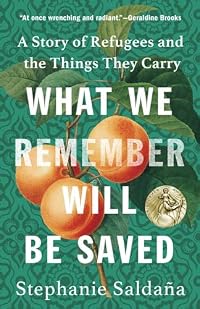
What We Remember Will Be Saved: A Story of Refugees and the Things They Carry
by Stephanie Saldaña
On This Page
Description
HTML:In an era of mass migration in which more than 100 million people are displaced comes this lyrical portrait of Syrian and Iraqi refugees and the belongings they carry. What We Remember Will Be Saved is a book of hope, home, and the stories we hold within us when everything else has been lost.Journalist and scholar Stephanie Saldaña, who lived in Syria before the war, sets out on a journey across nine countries to meet refugees and learn what they salvaged from the ruins when they show more escaped. Now, in the narratives of six extraordinary women and men, from Mt. Sinjar to Aleppo to Lesvos to Amsterdam, we discover that the little things matter a great deal. Saldaña introduces us to a woman who saved her city in a dress, a musician who saved his stories in songs, and a couple who rebuilt their destroyed pharmacy even as the city around them fell apart. Together they provide a window into a religiously diverse corner of the Middle East on the edge of unraveling, and the people keeping it alive with their stories.
Born of years of friendship and reporting, What We Remember Will Be Saved is a breathtaking, elegiac odyssey into the heart of the largest refugee crisis in modern history. Biography & Autobiography. Nonfiction. Sociology. show less
Tags
Recommendations



Member Reviews
Saldana spent several years in the Middle East and Europe, befriending and talking with refugees from Iraq and Syria. This book focuses on 5 of those individuals and their stories. Rather than just a re-telling of the horrors they witnessed and the struggle to find safety, this is a richly textured book about fear, courage, and heartbreak, as well as a fascinating and eye-opening book about the various cultures and religions that flourished in what we now tend to just think of as an amorphous war zone.
It took me longer than usual to get through this book, because I could only read it in pieces, as the stories were intense and the language very florid at times. They were also a bit repetitive at times, though that is perhaps show more understandable given the similarities among some of the stories. That said, it's an important work, and one that I am glad I read and hope more people will seek out.*
4.25 stars
"It can be easy enough to see the so-called 'refugee crisis' as a story that is primarily about other people's lives. On Lesvos, I finally understood how much it is about all of us. It is about our own unwillingness to see refugees and migrants as our neighbors, our friends -- or even as ourselves, for it was increasingly obvious to me that any of us could be refugees in other circumstances. It is about our refusal to admit that the ways in which we welcome refugees and migrants can contribute to their mental health outcomes, and the ways in which we reject them can contribute to their isolation and despair. It is about our willingness to exile to islands those people we would rather not confront with our own eyes, even if it meant leaving children out in the cold." show less
It took me longer than usual to get through this book, because I could only read it in pieces, as the stories were intense and the language very florid at times. They were also a bit repetitive at times, though that is perhaps show more understandable given the similarities among some of the stories. That said, it's an important work, and one that I am glad I read and hope more people will seek out.*
4.25 stars
"It can be easy enough to see the so-called 'refugee crisis' as a story that is primarily about other people's lives. On Lesvos, I finally understood how much it is about all of us. It is about our own unwillingness to see refugees and migrants as our neighbors, our friends -- or even as ourselves, for it was increasingly obvious to me that any of us could be refugees in other circumstances. It is about our refusal to admit that the ways in which we welcome refugees and migrants can contribute to their mental health outcomes, and the ways in which we reject them can contribute to their isolation and despair. It is about our willingness to exile to islands those people we would rather not confront with our own eyes, even if it meant leaving children out in the cold." show less
 This review was written for LibraryThing Early Reviewers.
I received this book through the Library Thing Early Reviewer program. The author writes a collection of true stories about refugees from Syria and Iraq and the places they live now. Each story centers around an object they chose to keep that ties them to their home: a dress, seeds, a musical instrument, a pharmacy.
Many of the stories go into detail about the violence and terror they had to endure: Whole towns of tens of thousands of people leaving in one night, the conditions of refugee camps, the unwelcome treatment by Europeans.
As each year we see millions more people leaving their homes either forced by conflict or natural disasters, these stories are crucial. The stories Sadaña tells makes the reader understand that in all of our show more communities we have neighbors who have been forced from their homes to survive. We all need to be welcoming, recognize their stories of loss and the talents and gifts they bring to us.
“I hope this book makes clear that the people we call “refugees” are artists, historians, musicians, chefs, mother and fathers, children and siblings, and those on the front line of heritage preservation.” show less
Many of the stories go into detail about the violence and terror they had to endure: Whole towns of tens of thousands of people leaving in one night, the conditions of refugee camps, the unwelcome treatment by Europeans.
As each year we see millions more people leaving their homes either forced by conflict or natural disasters, these stories are crucial. The stories Sadaña tells makes the reader understand that in all of our show more communities we have neighbors who have been forced from their homes to survive. We all need to be welcoming, recognize their stories of loss and the talents and gifts they bring to us.
“I hope this book makes clear that the people we call “refugees” are artists, historians, musicians, chefs, mother and fathers, children and siblings, and those on the front line of heritage preservation.” show less
This review was written for LibraryThing Early Reviewers.I hope this book makes clear that the people we call “refugees” are artists, historians, musicians, chefs, mother and fathers, children and siblings, and those on the front line of heritage preservation. It could one day be any of us.
from What We Remember Will Be Saved by Stephanie Saldana
First, I will state: You must read this book.
You must read this book for the sheer beauty of the writing and story telling. You must read this book to understand that no one leaves their home willingly, but for survival. You must read to learn the true scope of loss when conflict drives one to leave everything behind, except memories and the ways we preserve them. You must read this book to see how entire cultures and peoples are displaced and show more destroyed, how they long to return to what was lost.
Maybe you will think that you will go back. But don’t go back. The distance going back is the same as for going forward.
refugee quoted in What We Remember Will Be Saved by Stephanie Saldana
Second, I will state: Like a refining fire, this book will break your heart and strengthen your resolve. You will be angry. You will marvel at human indifference and fear. You will cast your eyes around and wonder how you can make a difference.
That was what I was learning: that when all else is taken away, then we have no choice but to create what we carry.
from What We Remember Will Be Saved by Stephanie Saldana
This book evolved from years of interviewing refugees from Syria and Iraq, learning of their home villages, the catastrophe of war that drove them away, their sorrows and losses, how they keep their past life alive. An embroidered dress showing the daily life and places of the hometown lost. Music. Food. Story. Knowledge.
Story is what keeps us whole.
from What We Remember Will Be Saved by Stephanie Saldana
You learn about their past, their struggles to survive, their new lives, so hard won.
You must not think that I saved my family. I didn’t save them. It was the women and children who kept me alive. If it wasn’t for them, I would have let myself die on that mountain. But I stayed alive because they needed us to save them.
quoted in What We Remember Will Be Saved by Stephanie Saldana
And you will think of your own story, how lucky you are in your easy life, or how your ancestors faced such things, or consider if this will someday be your future.
The words of these people will echo in your heart.
Thanks to the publisher for a free book through LibraryThing.
2 likes show less
from What We Remember Will Be Saved by Stephanie Saldana
First, I will state: You must read this book.
You must read this book for the sheer beauty of the writing and story telling. You must read this book to understand that no one leaves their home willingly, but for survival. You must read to learn the true scope of loss when conflict drives one to leave everything behind, except memories and the ways we preserve them. You must read this book to see how entire cultures and peoples are displaced and show more destroyed, how they long to return to what was lost.
Maybe you will think that you will go back. But don’t go back. The distance going back is the same as for going forward.
refugee quoted in What We Remember Will Be Saved by Stephanie Saldana
Second, I will state: Like a refining fire, this book will break your heart and strengthen your resolve. You will be angry. You will marvel at human indifference and fear. You will cast your eyes around and wonder how you can make a difference.
That was what I was learning: that when all else is taken away, then we have no choice but to create what we carry.
from What We Remember Will Be Saved by Stephanie Saldana
This book evolved from years of interviewing refugees from Syria and Iraq, learning of their home villages, the catastrophe of war that drove them away, their sorrows and losses, how they keep their past life alive. An embroidered dress showing the daily life and places of the hometown lost. Music. Food. Story. Knowledge.
Story is what keeps us whole.
from What We Remember Will Be Saved by Stephanie Saldana
You learn about their past, their struggles to survive, their new lives, so hard won.
You must not think that I saved my family. I didn’t save them. It was the women and children who kept me alive. If it wasn’t for them, I would have let myself die on that mountain. But I stayed alive because they needed us to save them.
quoted in What We Remember Will Be Saved by Stephanie Saldana
And you will think of your own story, how lucky you are in your easy life, or how your ancestors faced such things, or consider if this will someday be your future.
The words of these people will echo in your heart.
Thanks to the publisher for a free book through LibraryThing.
2 likes show less
This review was written for LibraryThing Early Reviewers.In a Nutshell: A book focussing not on refugees or their distressing situations, but on what they carry with them of their earlier lives, whether material or intangible. Hard-hitting content that will not leave you easily even after the last page.
~~~~~~~~~~~~~~~~~~~~~~~~~~~~~
Before I dive into my review, I want to share an anecdote.
At about 3 a.m. on 27th June 2014 (I remember the date because it was exactly a day before my sister’s wedding), the doorbell of my house rang furiously. We were startled awake, having gone to bed just an hour prior, after a pre-wedding function. It was the security guard, going floor to floor warning everyone to vacate their houses. An air conditioner on the 5th floor had short-circuited, and that show more apartment was in blazes. (My house is on the 13th floor.) In that strange mix of being half-asleep as well as hyper-conscious, my husband and I scrambled to get going. He helped his aged parents out while I took charge of our two little ones. Just as we were about to leave the house, I rushed back to our room to grab a bag, and in it, I stuffed our passports, bank docs, and our Aadhar cards (a unique identity card held by every citizen of India.) The fire was extinguished at about 5 a.m., and until then, we waited in the garden below, the kids asleep on my lap as I sat on the grass along with many other neighbours. After we were given the green signal to return home, my husband appreciated my presence of mind in carrying the important documents along despite the urgency. I too felt quite happy that I remembered something important.
A few days later though, I wondered what would have happened had the fire been even worse. My wedding album, my kids’ toys and clothes, all their priceless photographs from babyhood to toddlerhood, so many precious mementoes from my years of marriage and our travels together, my beloved books – everything would have been lost because I carried ONLY the practical essentials but not the emotional ones.
As I read this book, I thought back to that night of 2014 and realised how lucky I was that I had had the luxury of returning to my house with all our possessions intact. Not everyone shares the same fortune.
~~~~~~~~~~~~~~~~~~~~~~~~~~~~~
Imagine being forced to move out of your home, even your country, for things beyond your control. What would you carry, especially keeping in mind that you probably won’t be able to return? Or that with no means to travel with a heavy load, you will need to leave behind many fond items? Or that your smuggler, with that flimsy dinghy to carry you across the sea to “safety”, won’t allow you to board with more than one hand luggage?
What do you carry?
What do you leave behind?
This book tells us the six stories of men and women from Syria and Iraq, and the things they carried with them when they were compelled to vacate not just their houses but leave behind an entire life. Today, they have either received citizenship in some Western country, or they are still in a refugee camp waiting and hoping for their papers to be processed, or they are in limbo, caught in a country that refuses to legalise them but not willing to go elsewhere.
We call these people ‘refugees’. We picture them living in camps or struggling to survive in a new land speaking a new language. But do we ever remember that they had an identity before they were “refugees”? They were musicians, pharmacists, professors, farmers, engineers,… It is not just their material wealth that has vanished, but also their identity.
The author carried out her interviews with these displaced citizens over a period of six years in multiple countries. Through her question about what they carried from their homes, we get to know much more than an account of their physical possessions. We hear not just of their tangible losses but also of their memories, their language, their heritage. This book doesn’t contain a story of pain and helplessness, but one of hope and resilience, about determination and courage. It is the story of a shal, a buzuq, a pharmacy or two,… Of a musician and of a camel herder… Of an Aramaic speaker and a Yazidi raconteur… Of ordinary humans caught in extraordinary circumstances… Of the people who survived and yet died.
The anecdotes of these interviewees aren’t easy to read. The chapter based in Lesvos shattered me so much that I kept the book aside for a whole week. While each narrative was hardhitting, the one dearest to my heart was the story of the Syrian pharmacist couple, Adnan and Ghadir, possibly because theirs held the strongest promise of hope. In a book that broke me through and through, even the tiniest glimpse of hope made a difference.
There are so many takeaways from this work. We see the power of storytelling. We understand the importance of familial support. We despair over the destruction of monuments and cultures by political and religious extremists. We recognise the need to have faith (not necessarily in the one above) even in the darkest of times. But my most important takeaway from this work is: Be grateful for what you have, but don’t take anything for granted. You never know when your own world could be upended either by climate change or by political or religious jerks. (Using the word “jerks” in both its meanings here.) As the author herself says, "It could one day be any of us."
A must read, without a doubt. A portion of the proceeds from this book will go to organisations that support refugees.
4.5 stars. (Docking off 0.5 stars as there were no photos.)
The author's insightful prologue, and her extensive notes on each chapter at the end of the book provide plenty of shocking facts about the displaced people of Syria and Iraq. I shall present just one of them here:
“One in every seventy-eight people globally has been forced to flee from their homes.”
One in every seventy-eight! Let that sink in.
My thanks to Broadleaf Books and Edelweiss+ for the DRC of “What We Remember Will Be Saved: A Story of Refugees and the Things They Carry”. This review is voluntary and contains my honest opinion about the book.
~~~~~~~~~~~~~~~~~~~~~~~~~~~~~
Connect with me through:
My Blog | The StoryGraph | Instagram | Facebook | Twitter show less
~~~~~~~~~~~~~~~~~~~~~~~~~~~~~
Before I dive into my review, I want to share an anecdote.
At about 3 a.m. on 27th June 2014 (I remember the date because it was exactly a day before my sister’s wedding), the doorbell of my house rang furiously. We were startled awake, having gone to bed just an hour prior, after a pre-wedding function. It was the security guard, going floor to floor warning everyone to vacate their houses. An air conditioner on the 5th floor had short-circuited, and that show more apartment was in blazes. (My house is on the 13th floor.) In that strange mix of being half-asleep as well as hyper-conscious, my husband and I scrambled to get going. He helped his aged parents out while I took charge of our two little ones. Just as we were about to leave the house, I rushed back to our room to grab a bag, and in it, I stuffed our passports, bank docs, and our Aadhar cards (a unique identity card held by every citizen of India.) The fire was extinguished at about 5 a.m., and until then, we waited in the garden below, the kids asleep on my lap as I sat on the grass along with many other neighbours. After we were given the green signal to return home, my husband appreciated my presence of mind in carrying the important documents along despite the urgency. I too felt quite happy that I remembered something important.
A few days later though, I wondered what would have happened had the fire been even worse. My wedding album, my kids’ toys and clothes, all their priceless photographs from babyhood to toddlerhood, so many precious mementoes from my years of marriage and our travels together, my beloved books – everything would have been lost because I carried ONLY the practical essentials but not the emotional ones.
As I read this book, I thought back to that night of 2014 and realised how lucky I was that I had had the luxury of returning to my house with all our possessions intact. Not everyone shares the same fortune.
~~~~~~~~~~~~~~~~~~~~~~~~~~~~~
Imagine being forced to move out of your home, even your country, for things beyond your control. What would you carry, especially keeping in mind that you probably won’t be able to return? Or that with no means to travel with a heavy load, you will need to leave behind many fond items? Or that your smuggler, with that flimsy dinghy to carry you across the sea to “safety”, won’t allow you to board with more than one hand luggage?
What do you carry?
What do you leave behind?
This book tells us the six stories of men and women from Syria and Iraq, and the things they carried with them when they were compelled to vacate not just their houses but leave behind an entire life. Today, they have either received citizenship in some Western country, or they are still in a refugee camp waiting and hoping for their papers to be processed, or they are in limbo, caught in a country that refuses to legalise them but not willing to go elsewhere.
We call these people ‘refugees’. We picture them living in camps or struggling to survive in a new land speaking a new language. But do we ever remember that they had an identity before they were “refugees”? They were musicians, pharmacists, professors, farmers, engineers,… It is not just their material wealth that has vanished, but also their identity.
The author carried out her interviews with these displaced citizens over a period of six years in multiple countries. Through her question about what they carried from their homes, we get to know much more than an account of their physical possessions. We hear not just of their tangible losses but also of their memories, their language, their heritage. This book doesn’t contain a story of pain and helplessness, but one of hope and resilience, about determination and courage. It is the story of a shal, a buzuq, a pharmacy or two,… Of a musician and of a camel herder… Of an Aramaic speaker and a Yazidi raconteur… Of ordinary humans caught in extraordinary circumstances… Of the people who survived and yet died.
The anecdotes of these interviewees aren’t easy to read. The chapter based in Lesvos shattered me so much that I kept the book aside for a whole week. While each narrative was hardhitting, the one dearest to my heart was the story of the Syrian pharmacist couple, Adnan and Ghadir, possibly because theirs held the strongest promise of hope. In a book that broke me through and through, even the tiniest glimpse of hope made a difference.
There are so many takeaways from this work. We see the power of storytelling. We understand the importance of familial support. We despair over the destruction of monuments and cultures by political and religious extremists. We recognise the need to have faith (not necessarily in the one above) even in the darkest of times. But my most important takeaway from this work is: Be grateful for what you have, but don’t take anything for granted. You never know when your own world could be upended either by climate change or by political or religious jerks. (Using the word “jerks” in both its meanings here.) As the author herself says, "It could one day be any of us."
A must read, without a doubt. A portion of the proceeds from this book will go to organisations that support refugees.
4.5 stars. (Docking off 0.5 stars as there were no photos.)
The author's insightful prologue, and her extensive notes on each chapter at the end of the book provide plenty of shocking facts about the displaced people of Syria and Iraq. I shall present just one of them here:
“One in every seventy-eight people globally has been forced to flee from their homes.”
One in every seventy-eight! Let that sink in.
My thanks to Broadleaf Books and Edelweiss+ for the DRC of “What We Remember Will Be Saved: A Story of Refugees and the Things They Carry”. This review is voluntary and contains my honest opinion about the book.
~~~~~~~~~~~~~~~~~~~~~~~~~~~~~
Connect with me through:
My Blog | The StoryGraph | Instagram | Facebook | Twitter show less
I received a free copy of this book from the publisher.
In this collection of stories, Stephanie Saldana relates to the reader the stories of five refugees and their families: the stories of their struggles to flee their homes in Iraq, Syria during times of war. These refugees could not carry many items with them as they fled, many on foot. What they did carry, however, were their stories, their traditions, their faith, their history. Saldana's beautiful prose captures each refugee's heartbreaking yet inspiring story. I cannot imagine hearing each story firsthand, with all its weight and emotion. This book will stay with me for a long time.
In this collection of stories, Stephanie Saldana relates to the reader the stories of five refugees and their families: the stories of their struggles to flee their homes in Iraq, Syria during times of war. These refugees could not carry many items with them as they fled, many on foot. What they did carry, however, were their stories, their traditions, their faith, their history. Saldana's beautiful prose captures each refugee's heartbreaking yet inspiring story. I cannot imagine hearing each story firsthand, with all its weight and emotion. This book will stay with me for a long time.
This review was written for LibraryThing Early Reviewers.The author traveled to nine countries as she followed the journeys of half a dozen people who had to flee Iraq and Syria due to war. The resulting book is organized around the six individuals and what they saved: unexpected, practical, sentimental, needed. As a priest says “I didn’t even bring my liturgical clothes with me…only my passport and my computer. You don’t think about what you can bring when you escape your city at four in the morning.” One family from Baghdad saved a dress, a “shal” of many colors with their history embroidered onto it. Another person brought only his phone—but it contained hundreds of photos, documenting a place now destroyed. The author has dual passports, speaks Arabic, and has lived in the show more Middle East for many years. She clearly loves and mourns what has been lost; the book is a testament to courage and heartbreak and memory. show less
This review was written for LibraryThing Early Reviewers.What a tremendously important topic this author has chosen.
In a lesson no one should ever forget, Stephanie Saldana reminds us that “refugees” are not merely groups of people but are, instead, individuals who, like all of us, have jobs and rich histories in the cities where they reside, families and friends, dreams and hopes, favorite tea shops, schools and parks where they play. They have full lives. And then, in a heartbeat, all of this is taken away – and in this case, because of terror. Because of ISIS.
I was eager to hear their stories, eager to try to understand the incomprehensible.
And then, about halfway through the book I realized I was losing my concentration because the author made the unfortunate decision to insert show more herself into the text. I have no idea why Ms. Saldana thought her own ramblings here were important:
"I had arrived in Amsterdam in search of Aleppo, a city I had known well before the war. There’s something jarring about seeing the people of one city in an entirely different one. I had not been prepared for the heaviness, or the order, or the feeling I would have meeting Syrians speaking their dialect among the canals and bike lanes."
"There are cities in the world that contain ghosts, that will always contain ghosts. For a long time, I had believed that a city is no longer that city once its inhabitants are gone – that the people of the city are its very soul. But perhaps I had been wrong."
"I was terrible at making kleicha: I cut all the pastries much too large, and they teased me good-naturedly. They laughed together, speaking in their language and remembering to translate for me into Arabic every now and then so that I wouldn’t feel left out."
I also did not care for the way the author seemed to infuse every sentence with a kind of moral heaviness, as though telling readers: “You need to understand how important this is.”
"I stopped in front of two gravestones. Jalal Molla, four years old. Alaa Jajo, six years old. Both dead beneath the waters on November 14, 2015.
"I wanted to vomit. I sobbed and touched the cold ground. I felt my body torn between being frozen and wanting to escape, and I held on to the earth to keep me rooted to those names, that place. Those children."
I do not need to be told that the death of two tiny children is a tragedy. I have no interest in hearing how the discovery of their gravestones made the author want to vomit.
A talented writer knows that the key to good writing is to show us, don’t tell us how to feel. If you paint a vivid enough picture of anguish, and if you let the carefully chosen words speak for themselves instead of ramming morality down our throats, our hearts will be broken.
I gave this book two stars because there were memorable moments – when the author let the subjects speak for themselves – and I learned a bit (but not nearly enough) about their lives. But for the most part I found reading this book a chore because the writing, and thus the refugees’ stories, became boring although I know they are anything but – and that’s a double tragedy considering what they have already endured. show less
In a lesson no one should ever forget, Stephanie Saldana reminds us that “refugees” are not merely groups of people but are, instead, individuals who, like all of us, have jobs and rich histories in the cities where they reside, families and friends, dreams and hopes, favorite tea shops, schools and parks where they play. They have full lives. And then, in a heartbeat, all of this is taken away – and in this case, because of terror. Because of ISIS.
I was eager to hear their stories, eager to try to understand the incomprehensible.
And then, about halfway through the book I realized I was losing my concentration because the author made the unfortunate decision to insert show more herself into the text. I have no idea why Ms. Saldana thought her own ramblings here were important:
"I had arrived in Amsterdam in search of Aleppo, a city I had known well before the war. There’s something jarring about seeing the people of one city in an entirely different one. I had not been prepared for the heaviness, or the order, or the feeling I would have meeting Syrians speaking their dialect among the canals and bike lanes."
"There are cities in the world that contain ghosts, that will always contain ghosts. For a long time, I had believed that a city is no longer that city once its inhabitants are gone – that the people of the city are its very soul. But perhaps I had been wrong."
"I was terrible at making kleicha: I cut all the pastries much too large, and they teased me good-naturedly. They laughed together, speaking in their language and remembering to translate for me into Arabic every now and then so that I wouldn’t feel left out."
I also did not care for the way the author seemed to infuse every sentence with a kind of moral heaviness, as though telling readers: “You need to understand how important this is.”
"I stopped in front of two gravestones. Jalal Molla, four years old. Alaa Jajo, six years old. Both dead beneath the waters on November 14, 2015.
"I wanted to vomit. I sobbed and touched the cold ground. I felt my body torn between being frozen and wanting to escape, and I held on to the earth to keep me rooted to those names, that place. Those children."
I do not need to be told that the death of two tiny children is a tragedy. I have no interest in hearing how the discovery of their gravestones made the author want to vomit.
A talented writer knows that the key to good writing is to show us, don’t tell us how to feel. If you paint a vivid enough picture of anguish, and if you let the carefully chosen words speak for themselves instead of ramming morality down our throats, our hearts will be broken.
I gave this book two stars because there were memorable moments – when the author let the subjects speak for themselves – and I learned a bit (but not nearly enough) about their lives. But for the most part I found reading this book a chore because the writing, and thus the refugees’ stories, became boring although I know they are anything but – and that’s a double tragedy considering what they have already endured. show less
This review was written for LibraryThing Early Reviewers.Members
- Recently Added By
Lists

History: Africa & Latin America
38 works; 1 member
Author Information

4 Works 210 Members
Awards and Honors
Awards
Distinctions
Common Knowledge
- Canonical title
- What We Remember Will Be Saved: A Story of Refugees and the Things They Carry
- Original title
- What We Remember Will Be Saved: A Story of Refugees and the Things They Carry
- Original publication date
- 2023-09-12
- Important places
- Syria; Mt. Sinjar; Aleppo; Lesvos; Amsterdam, North Holland, Netherlands; The Middle East (show all 8); Greece; Iraq, Middle East, Afghanistan
- Important events
- Syrian Refugee Crisis; Syrian Civil War; Migration Crisis; The Middle East unrest
- Dedication
- In memory of all those who lost their lives searching for sanctuary
- First words
- The first time I saw Hana, she was standing at the back of a room, holding a dress in her hands.
- Quotations
- The people we call “refugees” are artists, historians, musicians, chefs, mothers and fathers, children and siblings, and those on the front lines of heritage preservation. It could one day be any of us.
There are always hidden historians among the survivors of war. These are the people who carry the stories of what happened with them when they escape, so that the past can be remembered. They carry these stories not in books ... (show all)but through little things. A sapling, a spoon, a scarf, a recipe for eggplants stuffed with walnuts, a prayer in a dying language.
I have come to believe that a lost neighborhood can be salvaged in a song and that an entire city can be carried in a dress. I have met those who save the past simply by speaking it aloud, who write the dead into living by pl... (show all)anting a tree.
These individuals were articulating a version of history in which they were not victims but agents, the small things they salvaged not mere fragments but windows into the histories they were now entrusted with remembering and... (show all) transmitting to future generations. - Blurbers
- Brooks, Geraldine; Degollado, Ruben; Nye, Naomi Shihab; Hadhad, Tareq; Martin, James, SJ; Tolan, Sandy
Classifications
- Genres
- Nonfiction, Biography & Memoir, General Nonfiction
- DDC/MDS
- 362.7 — Society, Government, and Culture Social problems and social services Social Welfare Child welfare
- LCC
- HV640.5 .I76 .S245 — Social sciences Social pathology. Social and public welfare. Criminology Social pathology. Social and public welfare. Refugee problems
- BISAC
Statistics
- Members
- 40
- Popularity
- 728,981
- Reviews
- 15
- Rating
- (4.18)
- Languages
- English
- Media
- Paper, Audiobook, Ebook
- ISBNs
- 5
- ASINs
- 3