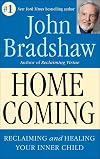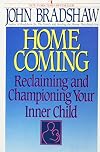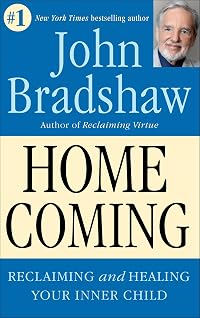
Homecoming: Reclaiming and Championing Your Inner Child
by John Bradshaw
On This Page
Description
Are you outwardly successful but inwardly do you feel like a big kid? Do you aspire to be a loving parent but all too often “lose it” in hurtful ways? Do you crave intimacy but sometimes wonder if it’s worth the struggle? Or are you plagued by constant vague feelings of anxiety or depression?If any of this sounds familiar, you may be experiencing the hidden but damaging effects of a painful childhood—carrying within you a “wounded inner child” that is crying out for attention show more and healing.
In this powerful book, John Bradshaw shows how we can learn to nurture that inner child, in essence offering ourselves the good parenting we needed and longed for. Through a step-by-step process of exploring the unfinished business of each developmental stage, we can break away from destructive family rules and roles and free ourselves to live responsibly in the present. Then, says Bradshaw, the healed inner child becomes a source of vitality, enabling us to find new joy and energy in living.
Homecoming includes a wealth of unique case histories and interactive techniques, including questionnaires, letter-writing to the inner child, guided meditations, and affirmations. Pioneering when introduced, these classic therapies are now being validated by new discoveries in attachment research and neuroscience. No one has ever brought them to a popular audience more effectively and inspiringly than John Bradshaw. show less
Tags
Recommendations











Member Reviews
A narcissistic, alcoholic, and abusive mother who was there to raise the kids from multiple fathers. A mostly absent, drug addicted, abusive father who wanted nothing to do with his first two children (my brother and I). A child that wanted to do everything in their power to do right by the both of them, despite having to destroy their own personhood and self esteem along the way.
I feel like this book was made for me, and I'm more than glad I happened to come across it on accident while doing freelance work. It has helped me work through a lot of my memories and feelings. I have come across memories that didn't seem too bad until I brought them up with other people and they were disgusted and shocked by what I was saying. Yet I have show more also come across memories that I'm not sure actually happened to begin with.
This book is doing wonders for my wounded inner child. I've seen several therapists, been on different medications, and had finally given up on trying to move forward with my life. I had decided to stuff it all down further and further until I almost couldn't reach it besides the random painfully intrusive thought here and there. After having my first baby, I knew I needed to do something, I just didn't know what would work. Oddly enough, this book is working better than anything else has thus far. My only qualm is the occasional vague religious undertones that leads me to feel like perhaps I can't fully recover and move forward without some sort of diety/higher power(s). I do like, however, that it is accepting of all theistic/spiritual leanings.
I do recommend this book, and have personally recommended it to two different people in my life. It's likely not for everyone, but it doesn't hurt to give it a try! show less
I feel like this book was made for me, and I'm more than glad I happened to come across it on accident while doing freelance work. It has helped me work through a lot of my memories and feelings. I have come across memories that didn't seem too bad until I brought them up with other people and they were disgusted and shocked by what I was saying. Yet I have show more also come across memories that I'm not sure actually happened to begin with.
This book is doing wonders for my wounded inner child. I've seen several therapists, been on different medications, and had finally given up on trying to move forward with my life. I had decided to stuff it all down further and further until I almost couldn't reach it besides the random painfully intrusive thought here and there. After having my first baby, I knew I needed to do something, I just didn't know what would work. Oddly enough, this book is working better than anything else has thus far. My only qualm is the occasional vague religious undertones that leads me to feel like perhaps I can't fully recover and move forward without some sort of diety/higher power(s). I do like, however, that it is accepting of all theistic/spiritual leanings.
I do recommend this book, and have personally recommended it to two different people in my life. It's likely not for everyone, but it doesn't hurt to give it a try! show less
I bought this book at the suggestion of a therapist I have been seeing. I did my best to work through the activities and ignore his constant attacks on my Catholic faith and religion in general.
What eventually led me to put down this book was Chapter 7: Reclaiming Your School Age Self. In this chapter, he shames the whole system and gripes about how schools are set up to harm children. He compares them to prisons and calls the grading system "very shaming and distressing" which "creates toxic shame." "In our schools," he says, "if you did not learn geometry as fast as other kids your age, you failed geometry." Essentially, this is a child's voice couched in pseudo-academic language. It sounds as if, years later, he hasn't gotten over show more the fact that math wasn't his strongest subject. I disagree with him on what he says here (and in many other places), and while reading it I feel he is trying to shame me with the "toxic shame" he so often decries simply because I disagree with him.
Throughout what I read, Bradshaw complains about how the world is out to hurt everyone. You'll begin to wonder how anyone makes it through life at all. His tone is whiny, self-righteous and sanctimonious. His book advocates embracing victim-hood instead of becoming a warrior who has overcome your problems.
If you want to remain a child with even greater problems, buy this book and start sucking your thumb. Otherwise, keep looking, and keep living. show less
What eventually led me to put down this book was Chapter 7: Reclaiming Your School Age Self. In this chapter, he shames the whole system and gripes about how schools are set up to harm children. He compares them to prisons and calls the grading system "very shaming and distressing" which "creates toxic shame." "In our schools," he says, "if you did not learn geometry as fast as other kids your age, you failed geometry." Essentially, this is a child's voice couched in pseudo-academic language. It sounds as if, years later, he hasn't gotten over show more the fact that math wasn't his strongest subject. I disagree with him on what he says here (and in many other places), and while reading it I feel he is trying to shame me with the "toxic shame" he so often decries simply because I disagree with him.
Throughout what I read, Bradshaw complains about how the world is out to hurt everyone. You'll begin to wonder how anyone makes it through life at all. His tone is whiny, self-righteous and sanctimonious. His book advocates embracing victim-hood instead of becoming a warrior who has overcome your problems.
If you want to remain a child with even greater problems, buy this book and start sucking your thumb. Otherwise, keep looking, and keep living. show less
Rediscover your inner child; resolve conflicts; unleash your creativity.
One of the great self help books of the 70-80's
Using a wealth of practical techniques, informative case histories and unique questionnaires, John Bradshaw demonstrates how your wounded inner child may be causing you pain. You'll learn to gradually, safely, go back to reclaim and nurture that inner child - and literally help yourself grow up again. Homecoming shows you how to:
Validate your inner child through meditations and affirmations
Give your child permission to break destructive family roles and rules
Adopt new rules allowing pleasure and honest self-expression
Deal with anger and difficult relationships
Pay attention to your innermost purpose and desires...and find new joy and energy in living.
Validate your inner child through meditations and affirmations
Give your child permission to break destructive family roles and rules
Adopt new rules allowing pleasure and honest self-expression
Deal with anger and difficult relationships
Pay attention to your innermost purpose and desires...and find new joy and energy in living.
Ratings
Members
- Recently Added By
Lists

Psicología - Clásicos
165 works; 2 members

Tom's Bookstore
346 works; 2 members

Men's healing resources
747 works; 1 member

Healing resources
124 works; 1 member

Healing resources for women
588 works; 1 member

trauma
38 works; 1 member
Author Information

34 Works 3,136 Members
John Elliot Bradshaw was born in Houston, Texas on June 29, 1933. He received a bachelor's degree in sacred theology and a master's degree in philosophy from the University of Toronto. He taught at the University of St. Thomas for a year. In 1964, just days before he was to be ordained, he left the Basilian Order. He eventually checked himself show more into an alcohol-treatment program at a state hospital in Austin. On being released, he returned to Houston and attended Alcoholics Anonymous meetings daily for the next three years. He soon began teaching adult Sunday school classes at Palmer Memorial Episcopal Church and working with addicts in the church's drug-abuse program. He also appeared on local television as the host of a talk show entitled Spotlight and found himself in demand as a lecturer on family psychology. In the early 1980s, he did a television series on the psychologist Erik Erikson's eight stages of man, which was broadcast on PBS. He also created a 10-part series entitled Bradshaw On: The Family, which also aired on PBS. He wrote numerous books during his lifetime including Bradshaw On: The Family, Bradshaw On: Healing the Shame That Binds You, Homecoming: Reclaiming and Championing Your Inner Child, Creating Love, Family Secrets: What You Don't Know Can Hurt You, and Post-Romantic Stress Disorder: What to Do When the Honeymoon Is Over. Many of his books were turned into PBS specials. He died of heart failure on May 8, 2016 at the age of 82. (Bowker Author Biography) show less
Awards and Honors
Distinctions
Work Relationships
Is replied to in
Common Knowledge
- Original publication date
- 1990
- Quotations
- Co-dependence is fostered in unhealthy family systems. For example, everyone in an alcoholic family becomes co-dependent on the alcoholic’s drinking. Because the drinking is so life-threatening to each family member, they a... (show all)dapt by becoming chronically alert (hypervigilant). Adaptation to stress was intended by nature to be a temporary state. It was never intended to be chronic. Over time, a person living with the chronic distress of alcoholic behavior loses touch with his own internal cues—his own feelings, needs, and desires.
Children need security and healthy modeling of emotions in order to understand their own inner signals. They also need help in separating their thoughts from their feelings. When the family environment is filled with violence (chemical, emotional, physical, or sexual), the child must focus solely on the outside. Over time he loses the ability to generate self-esteem from within. Without a healthy inner life, one is exiled to trying to find fulfillment on the outside. This is codependence, and it is a symptom of a wounded inner child. Codependent behavior indicates that the person's childhood needs were unmet, and therefore he cannot know who he is.
DEPENDENCE
Children are dependent and needy by nature, not by choice. Unlike an adult, a child cannot meet his needs through his own resources, so he must depend on others to fill these needs. Unfortunately, thi... (show all)s dependence on others is the child’s greatest vulnerability. The child doesn’t even know what he needs or what he feels. For better or for worse, his life is shaped from the beginning by the ability of his primary caretakers to know and to meet his needs at each stage of development.
If our caretakers have a wounded inner child, their neediness will prevent them from meeting their own children’s needs. Instead, they will either be angry at their child’s neediness or will try to get their own needs met by making their child an extension of themselves.
The wonder child is dependent because he is in a process of maturing, or “ripening.” Each stage of development is a step toward the full ripening of adulthood. If the child’s needs are not met at the proper time and in the proper sequence, he moves on without the resources necessary to meet the tasks of the next stage. A small mistake in the beginning has far-reaching consequences later on.
Healthy human life is characterized by continual growth. The very characteristics of childhood I am describing—wonder, dependency, curiosity, optimism—are crucial to the growth and flowering of human life.
In one sense, we remain dependent all our lives. We always are in need of love and interaction. No one is so self-sufficient that he does not need anyone else. Our wonder child's dependency allows us to form attachments and to make commitments. As we grow older, we need to be needed. At some point in healthy growth we become generative and care for life itself. This is our evolutionary vocation, if you will. It’s really a matter of balance between dependency and undependency. When the inner child has been wounded through neglect of his developmental dependency needs, he either isolates and withdraws or clings and becomes enmeshed.
Emotional Abuse
Emotional abuse also inflicts the spiritual wound. Screaming and yelling at children violates their sense of value. Parents who call their children “stupid,” “silly,” “crazy,” “assh... (show all)ole,” and so on wound them with every word. Emotional abuse also comes in the form of rigidity, perfectionism, and control. Perfectionism produces a deep sense of toxic shame. No matter what you do, you never measure up. All shame-based families use perfectionism, control, and blame as manipulating rules. Nothing you say, do, feel, or think is okay. You shouldn’t feel what you feel, your ideas are crazy, your desires are stupid. You are continuously found to be flawed and defective.
One final note. One way adult children avoid their legitimate suffering is by staying in their heads. This involves obsessing about things, analyzing, discussing, reading, and spending lots of energy in trying to figur... (show all)e things out. There is a story about a room with two doors. Each door has a sign on it. One says HEAVEN; the other says LECTURE ON HEAVEN. All the co-dependent adult children are lined up in front of the door that says LECTURE ON HEAVEN!
Adult children have a great need to figure things out because their parents were unpredictable adult children themselves. Sometimes they parented you as adults; sometimes they parented you as wounded and selfish children. Sometimes they were in their addictions, sometimes not. What resulted was confusion and unpredictability. Someone once said that growing up in a dysfunctional family is like “getting to a movie in the middle and never understanding the plot.” Someone else described it as “growing up in a concentration camp.” This unpredictability caused your continual need to figure things out.
And until you heal the past, you will continue to try to figure it out. Staying in one’s head is also an ego defense. By obsessing on things, one does not have to feel. To feel anything is to tap in to the immense reservoir of frozen feelings that are bound by your wounded child’s toxic shame.
Numbing our pain is achieved through various ego defenses we use when reality becomes intolerable. Some of the most common defenses are: denial (“it’s not really happening”); repression (“it never happened”); dissoc... (show all)iation (“I don’t remember what happened”); projection (“it’s happening to you, not to me”); conversion (“I eat or have sex when I feel it happening”); and minimizing (“it happened, but it’s no big deal”).
Basically, our ego defenses are ways to distract us from the pain we are feeling.
GROWTH DISORDER
Fritz Perls described neurosis as “growth disorder.” I like that. It’s a good way of expressing the problem of your wounded inner child’s toxic shame and resulting co-dependence. We would... (show all) not be codependent adult children if our developmental needs had been met. When these needs are not adequately met in infancy, severe problems result. The Index of Suspicion at the beginning of this chapter describes some of these problems. They can be summed up under the term narcissistic deprivation. We did not get the mirroring and echoing we needed. We were not loved unconditionally; as a result, we didn’t develop a basic sense of trust. This sets up the insatiable cravings that some people act out with ingestive addictions. It also sets up the need to be continually validated—almost as if we would cease to exist without such validation. Other consequences include insatiable cravings to be touched and hugged; too great a focus of your sexuality on orality; being out of touch with your physical needs (the signals from your body); a tendency to "swallow things whole"—to be the sucker who is born every minute. Most of all, when your infancy needs are not met, it sets you up to feel ashamed of yourself, to feel deep down that something is wrong with you.
The grief work has to be done. Fritz Perls said: “Nothing changes till it becomes what it is.” Only by demythologizing our parents can we gasp the real harm that was done to us. To grasp that real harm was done to us allo... (show all)ws us to own our feelings about being violated. To feel the feelings is the original pain work. Once we’ve connected with and expressed those feelings, we are free to move on. Since we no longer carry unfinished business from the past, we no longer contaminate the present. Our energy is now available for empowering our lives. We can live in the now and create the future.
Forgiveness allows us to leave our parents. Our frozen grief formed the deep resentments that kept us attached to them. Resentments cause us to recycle the same feelings over and over again. Our wounded child’s payoff for this is that we never have to separate from our parents. As long as we spend our energy secretly hating them, we remain attached to them, and this provides us with a way to avoid growing up. Forgiveness heals our resentments and enables us to divorce our wonder child from the shaming voices of our internalized parental figures. Forgiveness is the way we leave home internally.
Once we’ve reclaimed our wounded inner child, we must make a decision about our real parents, if they are still alive. What kind of relationship will we have with them? For those whose parents are still offenders, the decision should be to stay away from them. I recommend that you leave them to their fate! I know of many cases where parents continue to violate their adult children.
If your parents refuse to take any responsibility for their own wounded inner child, you need to remember that your primary obligation to your own life. You didn’t come into this world to take care of your parents. I’m not speaking here of infirm or disabled parents. I’m speaking of parents who refuse to take responsibility for their own inner woundedness. Each of you must let your adult decide on your boundaries with your real parents. Remember, your inner child is in your trust now. He expects you to protect him.
For most people, the reclaiming of their wounded child creates a context for a new and richer relationship with their real parents. By becoming a new parent to your inner child, you help him finish the past and fill the void in his psyche. As the child feels new hope, autonomy, purpose, initiative, and competence, he can establish his own identity. Then he can have a healthy relationship with his parents.
FINDING A NEW FAMILY
Championing your inner child involves getting him a new family of choice. A new family is necessary in order to give your child protection while he is forming new boundaries and doing his co... (show all)rrective learning. If your family of origin is not in recovery, it is almost impossible to get support from them while you’re in your own recovery process. Often they think that what you’re doing is stupid and they shame you for it. Often they are threatened by your doing this work, because as you give up your old family roles, you disrupt the frozen equilibrium of the family system. You were never allowed to be yourself before. Why would they suddenly start allowing that now? If your family of origin was dysfunctional, it is the least likely place to get your nurturing needs met. So, I advise you to keep a safe distance and work on finding a new, nonshaming, supportive family. This could be a support group of friends, it could be the group you joined to work on your inner child, or it could be any one of the myriad 12 Step groups now available all over the country. It could also be a church synagogue, or therapy group. Whatever your choice, I urge your adult to find a group for both of you. You are the champion for your inner child and he needs the support and protection of a new family of affiliation.
Corrective work is the most hopeful aspect of inner child work. Our woundedness is partly the result of learning deficits, and we can correct those deficits with new learning. We do some of this new learning incidentally as w... (show all)e respond to the social demands of growing up. But for most of us with a wounded inner kid, there are still large areas where the lack of these developmental skills causes great pain and discomfort. Many adult children do not know that their abortive behavior is due to learning deficits. They relentlessly shame and blame themselves for their failures and character defects. Doing corrective exercises helps your wounded inner child to understand that your defects are actually deficits. The behavioral contaminations from your wounded inner child are actually ways he learned to survive. Psychiatrist Timmen Cermak compares these survival behaviors to the characteristics of postraumatic stress disorder. Soldiers in battle, and other people going through traumatic events, must use all their resources to survive. They do not have time to express their feelings, which is necessary to integrate the trauma. Later on, the unresolved grief manifests itself in traits such as anxiety attacks, overcontrol, memory lapses, depression, age regressions, and hypervigilance. These are the traits associated with posttraumatic stress disorder (PTSD). If I gave you the entire list of PTSD traits, you’d see how closely they resemble the wounded inner child’s contaminations I described…
Archetypes embody both positive and negative aspects of the patterns they represent. In the mother archetype the positive aspect is the nurturing and life-giving mother; the negative aspect is the mother who smothers, devours... (show all), and destroys her children.
In the father archetype, the positive aspect protects and sets limits for his children and passes on the laws and traditions of the culture. The negative father is the tyrant who, fearing the loss of his power, keeps his children in bondage and refuses to pass on the traditions.
In the child archetype, the positive child is vulnerable, childlike, spontaneous, and creative. The negative child is selfish, childish, and resists emotional and intellectual growth. The negative aspect of the child is the wounded child. It is only in our century that the wounded inner child has received our attention.
In times past, the abuse and subjugation of children were commonplace and often taken for granted. As late as 1890, there was no Society for the Prevention of Cruelty to Children, although there was a Society for the Prevention of Cruelty to Animals.
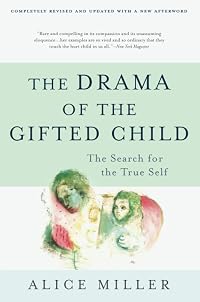
One of the great advances of our generation has been the exposure of child abuse. We have come to see that our prevailing rules for raising children shame and violate their uniqueness and their dignity. Such rules have been a part of our emotional endarkenment. Alice Miller has shown with painful clarity how our current parenting rules have aimed at making the child fit the projected image of the parent. They have also enforced the idealization of parents by the wounded child. Such idealization creates a fantasy bond that assures the wounded child of his parents’ love for him. But it has also perpetuated the abuse of children for generations.
Classifications
Statistics
- Members
- 882
- Popularity
- 30,600
- Reviews
- 5
- Rating
- (3.64)
- Languages
- 9 — Chinese, Danish, Dutch, English, French, German, Norwegian (Bokmål), Portuguese, Spanish
- Media
- Paper, Audiobook, Ebook
- ISBNs
- 27
- UPCs
- 1
- ASINs
- 15