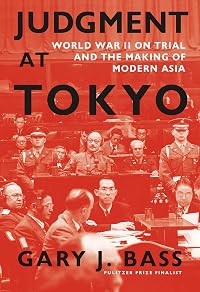
Judgment at Tokyo: World War II on Trial and the Making of Modern Asia
by Gary J. Bass
On This Page
Description
"In the weeks after Japan finally surrendered to the Allies, the world turned to the question of how to move on from years of carnage and destruction. For Harry Truman, Douglas MacArthur, and their fellow victors, the questions of justice seemed clear: Japan's leaders needed to be tried and punished for the surprise attack at Pearl Harbor; shocking atrocities against citizens in China, the Philippines, Korea, and elsewhere; rampant abuses of POWs. For the Allied Forces, the trial was an show more opportunity to achieve justice against the defendants, but also to create a legal framework for the prosecution of war crimes and to prohibit the use of aggressive war, and to create the kind of liberal international order that would prevail in Europe. For the Japanese leaders facing trial, it was their chance to argue that their war had been waged to liberate Asia from Western imperialism. For more than two years, lawyers for both sides presented their cases before a panel of judges from China, India, the Philippines, and Australia, as well as the US and Europe. The testimony ran from horrific accounts of brutality and the secret plans to attack Pearl Harbor to the Japanese military's threats to destabilize the government if it sued for peace. Yet rather than clarity and unanimity, the trial brought division and complexity; these tensions and contradictions could also be seen playing out across Asia as the trial unfolded, from China's descent into civil war to India's independence and partition to Japan's first successful democratic elections and the rewriting of a new, liberal constitution"-- show lessTags
Recommendations







Member Reviews
This brick of a book is a comprehensive discussion of the Tokyo Trials, the less well-known counterpart (at least in the West) to the Nuremberg trials, in which Japanese criminals were tried post-WWIII. Gary Bass recounts not just the events that were being judged at the Trials, and the deliberations and verdicts, but also how lingering resentments over the Trials have helped to shape international relations in East and South-East Asia in the near century since they took place.
The Tokyo Trials are far from straightforward, then or now. As Bass makes clear, they raise many thorny issues about racism, colonialism, imperialism, diplomacy, the rule of law and the nature of justice and of "just(ified) war." Was the tribunal a legitimate show more body? There might have been a moral case to answer, but was there actually a legal one? Should Emperor Hirohito have been tried or not? Why was the head of the notorious Unit 731, the Japanese group that carried out biological weapons testing and medical torture on Chinese people, not standing in the dock?
Radhabinod Pal, the Indian judge on the court, wrote a blistering dissent against the convictions, several hundred pages long, which pointed out that Japan's actions weren't unique, that there was a long history of Western colonialism, racism, and hypocrisy, and that, apparently, "Only a lost war is a crime." Examining Pal's dissent and the forces that shaped it made for one of the most fascinating parts of the book for me. (Pal was certainly right about American hypocrisy—no high-ranking American ever faced consequences for the fire-bombing of Japanese cities or later for Vietnam, Cambodia, Iraq or Afghanistan—but his rather binary way of thinking let him down some awful paths, such as engaging in denialism about mass rape as a war crime and about the Holocaust.)
This is a long, dense book, but Bass writes with verve. Even if you might not always agree with Bass's framing of some things (he recognises the U.S.'s faults here, but I did wish he had pushed his critique further) or some of his conclusions, this is a thoughtful book that you should find rewarding if you have an interest in this moment in history or these historical themes. show less
The Tokyo Trials are far from straightforward, then or now. As Bass makes clear, they raise many thorny issues about racism, colonialism, imperialism, diplomacy, the rule of law and the nature of justice and of "just(ified) war." Was the tribunal a legitimate show more body? There might have been a moral case to answer, but was there actually a legal one? Should Emperor Hirohito have been tried or not? Why was the head of the notorious Unit 731, the Japanese group that carried out biological weapons testing and medical torture on Chinese people, not standing in the dock?
Radhabinod Pal, the Indian judge on the court, wrote a blistering dissent against the convictions, several hundred pages long, which pointed out that Japan's actions weren't unique, that there was a long history of Western colonialism, racism, and hypocrisy, and that, apparently, "Only a lost war is a crime." Examining Pal's dissent and the forces that shaped it made for one of the most fascinating parts of the book for me. (Pal was certainly right about American hypocrisy—no high-ranking American ever faced consequences for the fire-bombing of Japanese cities or later for Vietnam, Cambodia, Iraq or Afghanistan—but his rather binary way of thinking let him down some awful paths, such as engaging in denialism about mass rape as a war crime and about the Holocaust.)
This is a long, dense book, but Bass writes with verve. Even if you might not always agree with Bass's framing of some things (he recognises the U.S.'s faults here, but I did wish he had pushed his critique further) or some of his conclusions, this is a thoughtful book that you should find rewarding if you have an interest in this moment in history or these historical themes. show less
In September 1945, shortly before his arrest by Allied soldiers, Japan’s wartime prime minister Tōjō Hideki was asked by an American reporter who he considered responsible for the war. ‘You are the victors’, replied Tōjō, ‘and you are able to name him now … But historians 500 or 1,000 years from now may judge differently.’
Here, in essence, was one of the biggest challenges that faced the International Military Tribunal for the Far East when it convened in Tokyo in April 1946: how to avoid the impression of victors’ justice? Modelled on the Nuremberg trials, then ongoing in Germany, the aim of the ‘Tokyo trials’, as they became known, was to try senior Japanese leaders for a range of crimes committed both during the show more Second World War and in the period leading up to it. When the trials concluded in December 1948, each of the 25 defendants was found guilty on at least one count. Seven, including Tōjō Hideki, were sentenced to death.
In obvious ways the trials did indeed represent victors’ justice. The victors set the mandate and populated the judges’ bench. Their own conduct in the war – firebombing Japanese cities and using atomic weapons on Hiroshima and Nagasaki – was exempt from consideration. And their point of view on the causes of war decided the chronology of the trials: beginning with Japanese militarism in the late 1920s, rather than – as a Japanese witness at the trial suggested – in 1853, with America’s forced opening of Japan to trade and diplomacy on Western terms. Tōjō himself thought that the Opium Wars of the 19th century might be a reasonable point of departure.
And yet as Gary J. Bass points out in this magisterial account – long but never sprawling; thick with detail yet always engrossing – true victors’ justice, as far as some of the Allied leaders were concerned, would have involved putting Emperor Hirohito on trial and most likely hanging him. Large proportions of the Allies’ domestic populations wanted to see Japan destroyed. Bass reports that 85 per cent of Americans had been in favour of dropping the atomic bomb on Japan.
Read the rest of the review at HistoryToday.com.
Christopher Harding is a cultural historian and broadcaster based at the University of Edinburgh. His latest book is The Light of Asia: A History of Western Fascination with the East (Allen Lane, 2024) and he writes about Asia’s impact on Western life at IlluminAsia.org. show less
Here, in essence, was one of the biggest challenges that faced the International Military Tribunal for the Far East when it convened in Tokyo in April 1946: how to avoid the impression of victors’ justice? Modelled on the Nuremberg trials, then ongoing in Germany, the aim of the ‘Tokyo trials’, as they became known, was to try senior Japanese leaders for a range of crimes committed both during the show more Second World War and in the period leading up to it. When the trials concluded in December 1948, each of the 25 defendants was found guilty on at least one count. Seven, including Tōjō Hideki, were sentenced to death.
In obvious ways the trials did indeed represent victors’ justice. The victors set the mandate and populated the judges’ bench. Their own conduct in the war – firebombing Japanese cities and using atomic weapons on Hiroshima and Nagasaki – was exempt from consideration. And their point of view on the causes of war decided the chronology of the trials: beginning with Japanese militarism in the late 1920s, rather than – as a Japanese witness at the trial suggested – in 1853, with America’s forced opening of Japan to trade and diplomacy on Western terms. Tōjō himself thought that the Opium Wars of the 19th century might be a reasonable point of departure.
And yet as Gary J. Bass points out in this magisterial account – long but never sprawling; thick with detail yet always engrossing – true victors’ justice, as far as some of the Allied leaders were concerned, would have involved putting Emperor Hirohito on trial and most likely hanging him. Large proportions of the Allies’ domestic populations wanted to see Japan destroyed. Bass reports that 85 per cent of Americans had been in favour of dropping the atomic bomb on Japan.
Read the rest of the review at HistoryToday.com.
Christopher Harding is a cultural historian and broadcaster based at the University of Edinburgh. His latest book is The Light of Asia: A History of Western Fascination with the East (Allen Lane, 2024) and he writes about Asia’s impact on Western life at IlluminAsia.org. show less
Bass writes well, but I can't shake the feeling this book could've been at least 200 pages shorter. A tighter narrative would've enhanced its readability; as it stands I can't imagine this book anywhere outside of an academic setting, required reading in a course on legal history.
The trial itself was doomed from the start for two reasons. First, the Americans made it clear that Emperor Hirohito was to be excused from prosecution or blame, instead selecting a handful of his cabinet and advisors to take the
Sure, it's easy to armchair general a conflict with the benefit of hindsight. There's no denying that a D-Day style assault on the mainland of Japan would've been incredibly devastating for both US soldiers and Japanese civilians conscripted into defense of their home island. My grandfather was a radio operator in the Pacific theater, he lived through it in part because the war was ended before an invasion of mainland Japan. I'm sure he'd be absolutely furious to read my thoughts, safe and warm in my house reflecting back on a war I wasn't in. Nevertheless, I am appalled with the justification used now: that because Japan started the war, any action America took to end it was valid.
Will the day come when the US acknowledges Hiroshima and Nagasaki for what they were: atrocities and crimes against humanity? Until then, the judgment rendered at Tokyo remains a hypocrisy.
Wow! Stunning, horrifying, earnest, rich with detail and anecdotes that brought everyone wonderfully, infuriatingly, to life. The incompetence of the Americans is staggering. MacArthur is a terrible person. The whole trial was a disaster, and we deal with those mistakes to this day. Wonderful read, wish I had waited for the paperback copy because it was a haul carrying this 1,000 page book around.
This is a detailed account of the trial that was held in Tokyo after the end of World War II to assess the guilt of "Class A" suspects. That is, those who were not only accused of war crimes and crimes against humanity, but also of starting wars of aggression (read: of conquest), and of conspiring in a plan to wage such wars. Bass gives us a long warts-and-all account, which highlights the many weakness of the process. He clearly sides with those who were of the opinion that neither the Australian chief justice not the American chief prosecutor were sufficiently competent to cope with the enormous responsibilities assigned to them. He highlights the selective assembly of the court, which was dominated by white colonial voices. China, show more the Philippines and India were represented on the panel of judges, but Indochina and Indonesia, which had suffered much during the war, were only represented by their colonial overlords. The Indian judge Pal famously wrote a very lengthy dissent in which he excoriated the trial as riddled with colonial hypocrisy, much to the embarrassment of the government of the newly independent India, which did not agree.
Last but not least, the jurisdiction and legitimacy of the tribunal was founded very much on a charter issued by the occupying forces, and the US Supreme Court found it necessary to state that as far as it was concerned, the international tribunal was purely a tool of executive power. Several judges cast around for something better, be it "natural law" or treaty precedents, without much success.
The Tokyo trial followed the Neurenberg precedent of declaring it criminal to wage a war of aggression. As Bass documents, this too entered new legal territory, and several of the judges were of the opinion that the defendants could not be held criminally responsible for this, as there had been no internationally accepted law in 1937 or 1941 explicitly forbidding it. Even trickier was the accusation of conspiracy. Bass doesn't discuss this in any detail, but Japanese government in the 1940s by and large operated by the careful and laborious negotiation of consensus between the different factions, before the agreement was formalised as a government decision. It was essential to the way this government functioned, so was it fair to call this a conspiracy? (Bizarrely, as Eri Hotta has shown in her work on 1941, this flawed decision process generated a consensus for war in spite of the private opposition of many, perhaps most, of the key decision makers.)
Despite these fundamental weaknesses, the trial as described by Bass could be described as largely fair. The author clearly is of the opinion that the civilian ministers Togo and Kaya were found only guilty by association, bearing the collective responsibility of the cabinets they had been part of, despite being personally opposed to the war. Most of the military men plainly enough were responsible for war crimes and crimes against humanity perpetrated under their command, and their protests of ignorance were unconvincing. Several of them also blatantly wanted to use the narrow window of opportunity in 1941-1943 to create an empire in the Pacific and South-East Asia. They deserved their condemnation, and the judges acted with commendable independence.
One of the biggest controversies surrounding the trial was caused by the decision, a largely US decision, to keep the emperor Hirohito out of it. This was politically expedient but how people perceived it depended a lot on their acceptance of Hirohito as a constitutional monarch. I am skeptic of the way in which Bass treats every ritual statement of obeisance to the emperor that the civilian and military leaders made, as a gotcha. There is a world of difference between words of pious reverence spoken about a living deity, and practical politics. Reality, as far as my reading suggests, is that Hirohito was conservative and nationalist by instinct as the product of his upbringing and his role, but not an effective leader. He tended to give his blessing to the consensus or to the already established facts on the ground, and in this he followed precedent. It was tragic that at a crucial time Japan had a weak head of state, but such are the risks of hereditary monarchy. (Hirohito's father had been entirely incapable of handling government responsibility.)
There are some other flaws in the narrative of Bass. For example, he takes the Japanese leaders to the task for treating the Vichy government as the legitimate government of France in 1941, but forgets that the USA did exactly the same. More worryingly, Bass repeatedly condemns Kido Koichi for recommending the appointment of the "belligerent" Tojo Hideki as prime minister in late 1941, but at the time Tojo was actually urging Kido to try to find a way to reverse an earlier decision to go to war. Kido was probably naive, but not entirely reckless is recommending this appointment, as there was a real possibility that Tojo could steer the Army away from war. The general was at best ambivalent and at worst two-faced about war, perhaps mainly because as a staff officer he was acutely aware that Japan would face impossible odds.
So it seems harsh, with hindsight, to condemn Tojo outright as an aggressive warmonger. That said, as army minister as well as prime minister, Tojo was clearly directly responsible for the horrendous treatment of prisoners of war. He used a cultural excuse, declaring that Japanese soldiers found it shameful to be capture and thus regarded prisoners as without honour. But he conveniently omitted to mention that he himself was responsible for promulgating this standard in 1941. As recently as the Russo-Japanese war of 1905, the Japanese military had been praised for its humane treatment of prisoners of war. The enormous suffering of prisoners, enslaved workers, and civilians was the result of an executive choice and not of some frozen cultural characteristic.
Having recounted all of this background, Bass extends his story by describing how the Tokyo trial has remained controversial, in Japan and in the rest of Asia. Its memory has become a political tool to be used and abused in internal and foreign policy. The author describes how the lives of the Indian and Chinese judges were deeply affected by this; in very different ways the decisions they had made determined the rest of their lives. These are moving sections of the book, flavoured with personal recollections of their descendants. The Indian judge Pal enjoyed the life of a celebrity, but the Chinese judge Mei suffered enormously because of his role in the trial.
Overall, a very good history, but with a fair number of imperfections. If you went to read it, I'd recommend to go for the electronic version if you can, as the paper version really is inconveniently thick! show less
Last but not least, the jurisdiction and legitimacy of the tribunal was founded very much on a charter issued by the occupying forces, and the US Supreme Court found it necessary to state that as far as it was concerned, the international tribunal was purely a tool of executive power. Several judges cast around for something better, be it "natural law" or treaty precedents, without much success.
The Tokyo trial followed the Neurenberg precedent of declaring it criminal to wage a war of aggression. As Bass documents, this too entered new legal territory, and several of the judges were of the opinion that the defendants could not be held criminally responsible for this, as there had been no internationally accepted law in 1937 or 1941 explicitly forbidding it. Even trickier was the accusation of conspiracy. Bass doesn't discuss this in any detail, but Japanese government in the 1940s by and large operated by the careful and laborious negotiation of consensus between the different factions, before the agreement was formalised as a government decision. It was essential to the way this government functioned, so was it fair to call this a conspiracy? (Bizarrely, as Eri Hotta has shown in her work on 1941, this flawed decision process generated a consensus for war in spite of the private opposition of many, perhaps most, of the key decision makers.)
Despite these fundamental weaknesses, the trial as described by Bass could be described as largely fair. The author clearly is of the opinion that the civilian ministers Togo and Kaya were found only guilty by association, bearing the collective responsibility of the cabinets they had been part of, despite being personally opposed to the war. Most of the military men plainly enough were responsible for war crimes and crimes against humanity perpetrated under their command, and their protests of ignorance were unconvincing. Several of them also blatantly wanted to use the narrow window of opportunity in 1941-1943 to create an empire in the Pacific and South-East Asia. They deserved their condemnation, and the judges acted with commendable independence.
One of the biggest controversies surrounding the trial was caused by the decision, a largely US decision, to keep the emperor Hirohito out of it. This was politically expedient but how people perceived it depended a lot on their acceptance of Hirohito as a constitutional monarch. I am skeptic of the way in which Bass treats every ritual statement of obeisance to the emperor that the civilian and military leaders made, as a gotcha. There is a world of difference between words of pious reverence spoken about a living deity, and practical politics. Reality, as far as my reading suggests, is that Hirohito was conservative and nationalist by instinct as the product of his upbringing and his role, but not an effective leader. He tended to give his blessing to the consensus or to the already established facts on the ground, and in this he followed precedent. It was tragic that at a crucial time Japan had a weak head of state, but such are the risks of hereditary monarchy. (Hirohito's father had been entirely incapable of handling government responsibility.)
There are some other flaws in the narrative of Bass. For example, he takes the Japanese leaders to the task for treating the Vichy government as the legitimate government of France in 1941, but forgets that the USA did exactly the same. More worryingly, Bass repeatedly condemns Kido Koichi for recommending the appointment of the "belligerent" Tojo Hideki as prime minister in late 1941, but at the time Tojo was actually urging Kido to try to find a way to reverse an earlier decision to go to war. Kido was probably naive, but not entirely reckless is recommending this appointment, as there was a real possibility that Tojo could steer the Army away from war. The general was at best ambivalent and at worst two-faced about war, perhaps mainly because as a staff officer he was acutely aware that Japan would face impossible odds.
So it seems harsh, with hindsight, to condemn Tojo outright as an aggressive warmonger. That said, as army minister as well as prime minister, Tojo was clearly directly responsible for the horrendous treatment of prisoners of war. He used a cultural excuse, declaring that Japanese soldiers found it shameful to be capture and thus regarded prisoners as without honour. But he conveniently omitted to mention that he himself was responsible for promulgating this standard in 1941. As recently as the Russo-Japanese war of 1905, the Japanese military had been praised for its humane treatment of prisoners of war. The enormous suffering of prisoners, enslaved workers, and civilians was the result of an executive choice and not of some frozen cultural characteristic.
Having recounted all of this background, Bass extends his story by describing how the Tokyo trial has remained controversial, in Japan and in the rest of Asia. Its memory has become a political tool to be used and abused in internal and foreign policy. The author describes how the lives of the Indian and Chinese judges were deeply affected by this; in very different ways the decisions they had made determined the rest of their lives. These are moving sections of the book, flavoured with personal recollections of their descendants. The Indian judge Pal enjoyed the life of a celebrity, but the Chinese judge Mei suffered enormously because of his role in the trial.
Overall, a very good history, but with a fair number of imperfections. If you went to read it, I'd recommend to go for the electronic version if you can, as the paper version really is inconveniently thick! show less
Effective style – short, article-like breaks throughout, but it works well. Was waging aggressive war a crime? Was it OK to bomb civilians if you were an ally, but a crime otherwise?
The Japanese war offenders largely got away unpunished after the War (for both their war-time atrocities and those in the brutal invasions of Korea, China, Philippines, Indonesia, Burma, Vietnam etc). The US, which ran the Tokyo trials, appointed an amazingly incompetent lead prosecutor. There was a political decision to excuse the Emperor Hirohito from any culpability for the war or how it was waged .
The judges were of uneven quality and were poorly led by a dreadful Australian.
The most weird aspects described in the book concern the Indian judge show more appointed by Britain (who found all the accused not guilty), and the judge from China Mei Ruao (who is now remembered in China as a patriot, but who completely fell foul of the cultural revolution.) show less
The Japanese war offenders largely got away unpunished after the War (for both their war-time atrocities and those in the brutal invasions of Korea, China, Philippines, Indonesia, Burma, Vietnam etc). The US, which ran the Tokyo trials, appointed an amazingly incompetent lead prosecutor. There was a political decision to excuse the Emperor Hirohito from any culpability for the war or how it was waged .
The judges were of uneven quality and were poorly led by a dreadful Australian.
The most weird aspects described in the book concern the Indian judge show more appointed by Britain (who found all the accused not guilty), and the judge from China Mei Ruao (who is now remembered in China as a patriot, but who completely fell foul of the cultural revolution.) show less
The Tokyo war crimes trials followed the Nuremberg trials, but with much less clarity, in part because the US decided to protect the Emperor despite his involvement in the war. Also notable for participation by Indian and Chinese judges, who had opposite views—the Chinese judge wanted to expose and punish crimes against the Chinese, including mass rape, torture, and slaughter. The Indian judge ultimately voted to acquit, reasoning that starting a war wasn’t illegal and condemning the role of colonialism and racism in both the war and the prosecutions (and the lack of any consideration of whether dropping atomic bombs on civilians constituted a war crime). But lest you think that’s simple, he also downplayed the evidence of show more Japanese war crimes in China and, ultimately, questioned whether the Holocaust was mere war propaganda. show less
Members
- Recently Added By
Lists

Unread books
1,063 works; 87 members

Books for Birute
39 works; 1 member
Author Information

6 Works 909 Members
Gary Jonathan Bass is Assistant Professor of Politics and International Affairs at Princeton University. He worked as a Washington reporter and West Coast correspondent for The Economist, for which he wrote extensively on the former Yugoslavia war crimes tribunal. Bass has also written for The New York Times, The Washington Post, The Boston Globe, show more The New Republic, and other publications. show less
Awards and Honors
Awards
Distinctions
Notable Lists
Common Knowledge
- Canonical title
- Judgment at Tokyo: World War II on Trial and the Making of Modern Asia
- First words
- Tojo Hideki heard the soldiers coming for him. At his simple cottage in Tokyo's suburbs, on September 11, 1945, he was making no attempt to hide. With his fastidiously cropped mustache, bald head, round tortoiseshell glasses,... (show all) and the assertive bear of a career general, the prime minister of Imperial Japan during much of World War II was unmistakable. -Introduction
On April 9, 1942, American and Filipino troops on Bataan surrendered to their Japanese adversaries. Defeated after a stubborn defense of the steamy, verdant peninsula on the core Philippine island of Luzon, the men had no ide... (show all)a what to expect. Still, as one American officer remembered, many of them were inwardly relieved; at least the fear of death in combat was over. -Chapter , Nuremberg to Tokyo - Canonical DDC/MDS
- 341.6
- Canonical LCC
- KZ1181.B37
Classifications
Statistics
- Members
- 329
- Popularity
- 96,650
- Reviews
- 8
- Rating
- (3.93)
- Languages
- English
- Media
- Paper, Audiobook, Ebook
- ISBNs
- 8
- ASINs
- 3