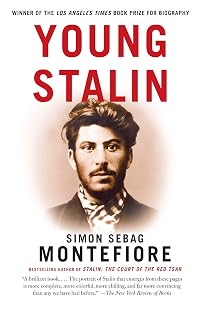
On This Page
Description
The shadowy journey from obscurity to power of the Georgian cobbler's son who became the Red Tsar--the man who, along with Hitler, remains the modern personification of evil: a merciless psychopath who was, as well, a consummate politician, the dynamic world statesman who helped create and industrialize the USSR, outplayed Churchill and Roosevelt, and defeated Hitler? Historian Montefiore tells the story of a charismatic, turbulent boy born into poverty, of doubtful parentage, scarred by his show more upbringing but possessed of unusual talents. Admired as a romantic poet and trained as a priest, he found his true mission as a fanatical revolutionary. A mastermind of bank robbery, protection rackets, arson, piracy and murder, he was equal parts terrorist, intellectual and brigand. The paranoid criminal underworld was Stalin's natural habitat, and murderous banditry and political gangsterism, combined with pitiless ideology, enabled Stalin to dominate the Kremlin--and create the USSR in his flawed image.--From publisher description. show lessTags
Recommendations








Member Recommendations
Member Reviews
After hearing rave reviews of [Stalin: Court of the Red Tsar], I added it to the list, but decided to read his subsequent book [Young Stalin] first for a chronological view. When I saw a copy on a bookstore table, I was immediately drawn to the pictures. I have never seen so many photos of the young Stalin, and they are fascinating. Using material from newly opened archives in Moscow, Tbilisi, and Batumi, as well as those in 20 other cities in nine countries, Montefiore gives a look at the early years of Stalin that no one has been allowed to see. It took the author ten years to do the research, and it shows.
Yet despite being meticulously documented and footnoted, the book reads like a novel. The characters are so unusual and show more captivating and the setting so well evoked that I was drawn into a world I scarcely could imagine. Raffish young men racing through Tbilisi with swords drawn and handmade bombs exploding, robbing banks and sending the money to Lenin to fund the upcoming revolution. A Muslim highwayman smuggling printing presses through the rugged mountains on donkeys, so that the communists could continue to spread their message. Kamo, Stalin's childhood friend and devoted murderer, flamboyant and cocky, surviving intense and prolonged torture to return to Stalin's side, insane but useful. And Stalin, the most intelligent, secretive, and manipulative of them all: throwing himself in graves, escaping pursuit dressed in drag, organizing the most daring and wild plots, causing riots in the prisons whenever he was caught and escaping exile whenever Lenin called. But Stalin was also a published poet, passionate lover, voracious reader, and one-time seminarian. The author pieces together not only the true story of Stalin's actions up to the time he outmaneuvered Trotsky for power in 1917, but the type of boy and young man that Stalin was and the influences that made him that way.
One such influence was the deprivation and family life in which Stalin grew up. Prey to near-death illnesses and accidents, Soso (as his mother called him), was maimed and sickly as a child, and his mother babied him to the extreme. Yet Soso has also a handful, running children's street gangs, and so she also beat him. Stalin remained faithful to her, although she may not have always been faithful to her husband. Beso was so insecure about the rumors surrounding Soso's parentage, that alcoholism and violence turned him mad. Keke relied on the protection of powerful men such as the wealthy Koba Egnatashvili (whose first name Soso used for a while) and the Gori police chief, Damian Davrichewy, who did the young Stalin many favors. There were even rumors about Keke and the local priest who took an unusual interest in the boy's welfare. Montefiore takes all of this uncertainty, violence, and poverty surrounding Stalin's youth and creates a psychological profile of the boy and young man that brings the disparate accounts together and explains many of Stalin's later actions.
I could go on about Stalin's exploits, love affairs, betrayals, and political development, but I don't want to retell the book. I hope I have given you enough to whet your appetite and encourage you to pick up the book for yourself. It's the best book on Stalin that I have read, and I look forward to [Court of the Red Tsar]. show less
Yet despite being meticulously documented and footnoted, the book reads like a novel. The characters are so unusual and show more captivating and the setting so well evoked that I was drawn into a world I scarcely could imagine. Raffish young men racing through Tbilisi with swords drawn and handmade bombs exploding, robbing banks and sending the money to Lenin to fund the upcoming revolution. A Muslim highwayman smuggling printing presses through the rugged mountains on donkeys, so that the communists could continue to spread their message. Kamo, Stalin's childhood friend and devoted murderer, flamboyant and cocky, surviving intense and prolonged torture to return to Stalin's side, insane but useful. And Stalin, the most intelligent, secretive, and manipulative of them all: throwing himself in graves, escaping pursuit dressed in drag, organizing the most daring and wild plots, causing riots in the prisons whenever he was caught and escaping exile whenever Lenin called. But Stalin was also a published poet, passionate lover, voracious reader, and one-time seminarian. The author pieces together not only the true story of Stalin's actions up to the time he outmaneuvered Trotsky for power in 1917, but the type of boy and young man that Stalin was and the influences that made him that way.
One such influence was the deprivation and family life in which Stalin grew up. Prey to near-death illnesses and accidents, Soso (as his mother called him), was maimed and sickly as a child, and his mother babied him to the extreme. Yet Soso has also a handful, running children's street gangs, and so she also beat him. Stalin remained faithful to her, although she may not have always been faithful to her husband. Beso was so insecure about the rumors surrounding Soso's parentage, that alcoholism and violence turned him mad. Keke relied on the protection of powerful men such as the wealthy Koba Egnatashvili (whose first name Soso used for a while) and the Gori police chief, Damian Davrichewy, who did the young Stalin many favors. There were even rumors about Keke and the local priest who took an unusual interest in the boy's welfare. Montefiore takes all of this uncertainty, violence, and poverty surrounding Stalin's youth and creates a psychological profile of the boy and young man that brings the disparate accounts together and explains many of Stalin's later actions.
I could go on about Stalin's exploits, love affairs, betrayals, and political development, but I don't want to retell the book. I hope I have given you enough to whet your appetite and encourage you to pick up the book for yourself. It's the best book on Stalin that I have read, and I look forward to [Court of the Red Tsar]. show less
Hard to fault - brilliantly researched and written with style, Stalin's chaotic life of radicalism, bank robberies, assassinations, Siberian exile, gangland warfare, and rise to prominence amongst the Bolshevik leaders is set out in an informative and even enjoyable way. Fascinating to see Stalin in this period - during these years he was a terrible guy, but still a recognisably human terrible guy. What came next, however, is already visible, waiting to emerge if circumstances allowed it.
This is the best biography I've read in a long time. I didn't know much about Stalin and had only basic knowledge of Russian history before I started, but Montefiore's book leaves me hungry for more.
The book begins with an excellent "hook," describing a sensational bank robbery Stalin perpetrated in Tiflis, Georgia. It's also very well researched, with lots of endnotes and footnotes (but not so many footnotes as to distract from the text). Even better, it's written in such a way that the characters, even the peripheral ones, come alive. I had no idea there were so many colorful characters in the dying Russian Empire! Surprisingly, many passages were excruciatingly funny, such as the description of Stalin's "pet psychopath" Kamo, show more feigning insanity to the point where he actually became insane.
I would HIGHLY recommend this book, even if you're not all that interested in Stalin or Russia. (After all, I wasn't.) show less
The book begins with an excellent "hook," describing a sensational bank robbery Stalin perpetrated in Tiflis, Georgia. It's also very well researched, with lots of endnotes and footnotes (but not so many footnotes as to distract from the text). Even better, it's written in such a way that the characters, even the peripheral ones, come alive. I had no idea there were so many colorful characters in the dying Russian Empire! Surprisingly, many passages were excruciatingly funny, such as the description of Stalin's "pet psychopath" Kamo, show more feigning insanity to the point where he actually became insane.
I would HIGHLY recommend this book, even if you're not all that interested in Stalin or Russia. (After all, I wasn't.) show less
The most remarkable thing about this fascinating biography, which essentially shows how "Soso" Djugashvili became Stalin, is the amazing use Montefiore makes of the incredibly rich resources of recently opened Soviet and especially Georgian and other Caucasian archives. From memoirs recorded(?) by Stalin's mother, to those of the friends of his childhood and his colleagues in his early days as a thug for Bolshevism, these documents reveal much about the young Stalin and his environment, and Montefiore weaves them into a history that reads almost like a novel.
From his earliest years, Stalin exhibited the kind of drive, cunning, contempt for others, sense of his own superiority, and willingness to commit violence, albeit on a smaller show more stage, that stood him is such bad stead when he came to power. He prided himself on his ability to sniff out spies (although, it turns out, he was often woefully wrong) and he was a master of saving his own skin and escaping from dangerous situations. The story of his childhood, with an ambitious (for him) mother abandoned by an alcoholic husband, and his "adoption" by other families who his mother felt could help him get ahead (specifically by going to a seminary for his education) is fascinating, as is his interest in revolutionary ideas and his affinity for thugs and crime. (While he was studying in the seminary, he read a lot and it was a little disconcerting to learn of his enthusiasm for books I also like, including Germinal and Toilers of the Sea.) For a while he helped finance Lenin's work through bank and other robberies in the Georgian region; he and members of other pre-revolutionary groups also basically extorted money from oil barons in the Caucasus to support their activities.
Another interesting aspect of this book was the insight into the effectiveness of the Okhrana, the Tsar's secret police. According to Montefiore, they were one of the best spy services of the era and had double agents very close to the top in the Bolshevik and other parties. Certainly, Stalin was arrested several times and sent into exile, from which he escaped every time except the last time, when he was sent to an extremely remote (and cold) area of Siberia. His experiences there, where he became friendly with some of the local tribespeople, are fascinating. It was at a dinner with fellow Bolshevik exiles in Siberia that Stalin, in a discussion of the greatest pleasures in life, said "My greatest pleasure is to choose one's victim, prepare one's plans minutely, slake an implacable vengeance, and then go to bed. There's nothing sweeter in the world." (p. 295) And Molotov said, "A little piece of Siberia remained lodged in Stalin for the rest of his life." (p. 301)
Stalin was quite the ladies man. While in Siberia, he impregnated (twice) a girl who was initially 13 years old, and he was involved with dozens of women and girls over the years and abandoned them all. Early on, he married, but his wife died soon thereafter, and he ignored their son who remained in Georgia. By the end of this volume, in 1917, he had gotten involved with Nadya Alleiluva, who would become his second wife.
Stalin recognized that Lenin was the key to the revolution and to power, and increasingly sought to stay close to him and help him. Lenin, Stalin's opposite in background, recognized in him a kindred hard-liner and somebody who, with his coterie of thugs, could make certain things happen that his more intellectual hangers-on could not. After the Bolsheviks took over the Winter Palace in October 1917, Stalin and Trotsky were the only people allowed to enter Lenin's office whenever they wanted. The book presents a strong picture of Lenin as well, and makes the case that Leninism and Stalinism were aligned, not that Stalinism was a perversion of Leninism. Lenin is quoted as responding to a proposal by Kamenev and Trotsky that capital punishment in the army be abolished by saying, "What nonsense! How can you have a revolution without shooting people?" (p. 350)
Montefiore also argues that Stalin
"could not have risen to power at any other time in history; it required the synchronicity of man and moment. His unlikely rise as a Georgian who could rule Russia was only made possible by the internationalist character of Marxism. His tyranny was made possible by the beleaguered circumstances of Soviet Russia, the utopian fanaticism of its quasi-religious ideology, the merciless Bolshevik machismo, the slaughterous spirit of the Great War, and Lenin's homicidal vision of a "dictatorship of the proletariat." Stalin would not have been possible if Lenin had not, in the first days of the regime, defeated Kamenev's milder way to create the machinery for so boundless and absolute a power. That was the forum for which Stalin was superbly equipped. Now Stalin could become Stalin." (p. 353)
Finally, a word from Montefiore about his sources.
I have been hugely fortunate in finding new sources, often unpublished or partly unpublished, and barely previously used by historians. Archival sources are more reliable than oral histories, but of course they too have their dangers and must be analysed carefully. But the anti-Stalinist histories often turn out to be just as unreliable.
Many of the archives used in this book, for example, were recorded by official Party historians . . . Therefore, one must be constantly aware that they were recorded under constant pressure to present Stalin in a good light. At all times, one has to be aware of the circumstances and try to penetrate the Bolshevik language to see what the witnesses are really trying to tell us.
Yet those recorded before the Terror in 1937 are often astonishingly frank, tactless, or derogatory about Stalin: a derogatory story about Stalin in an official memoir is almost certainly true. Many of the witnesses were so naive or honest that their memoirs were unusable at the time, or only usable in small sections. Such memoirs were not destroyed, but were simply preserved in the archives. Many were edited, then copied and sent to Stalin's Moscow archive, so there are differences between versions. But the originals usually survived in the local archive." (p. 385)
He goes on, but this gives a flavor of his approach. He also conducted many interviews with descendents of key people. The effort that went into telling this story is remarkable.
This is a compelling and chilling portrait, and I am eager to read Monefiore's sequel, [The Court of the Red Tsar (which he actually wrote first). show less
From his earliest years, Stalin exhibited the kind of drive, cunning, contempt for others, sense of his own superiority, and willingness to commit violence, albeit on a smaller show more stage, that stood him is such bad stead when he came to power. He prided himself on his ability to sniff out spies (although, it turns out, he was often woefully wrong) and he was a master of saving his own skin and escaping from dangerous situations. The story of his childhood, with an ambitious (for him) mother abandoned by an alcoholic husband, and his "adoption" by other families who his mother felt could help him get ahead (specifically by going to a seminary for his education) is fascinating, as is his interest in revolutionary ideas and his affinity for thugs and crime. (While he was studying in the seminary, he read a lot and it was a little disconcerting to learn of his enthusiasm for books I also like, including Germinal and Toilers of the Sea.) For a while he helped finance Lenin's work through bank and other robberies in the Georgian region; he and members of other pre-revolutionary groups also basically extorted money from oil barons in the Caucasus to support their activities.
Another interesting aspect of this book was the insight into the effectiveness of the Okhrana, the Tsar's secret police. According to Montefiore, they were one of the best spy services of the era and had double agents very close to the top in the Bolshevik and other parties. Certainly, Stalin was arrested several times and sent into exile, from which he escaped every time except the last time, when he was sent to an extremely remote (and cold) area of Siberia. His experiences there, where he became friendly with some of the local tribespeople, are fascinating. It was at a dinner with fellow Bolshevik exiles in Siberia that Stalin, in a discussion of the greatest pleasures in life, said "My greatest pleasure is to choose one's victim, prepare one's plans minutely, slake an implacable vengeance, and then go to bed. There's nothing sweeter in the world." (p. 295) And Molotov said, "A little piece of Siberia remained lodged in Stalin for the rest of his life." (p. 301)
Stalin was quite the ladies man. While in Siberia, he impregnated (twice) a girl who was initially 13 years old, and he was involved with dozens of women and girls over the years and abandoned them all. Early on, he married, but his wife died soon thereafter, and he ignored their son who remained in Georgia. By the end of this volume, in 1917, he had gotten involved with Nadya Alleiluva, who would become his second wife.
Stalin recognized that Lenin was the key to the revolution and to power, and increasingly sought to stay close to him and help him. Lenin, Stalin's opposite in background, recognized in him a kindred hard-liner and somebody who, with his coterie of thugs, could make certain things happen that his more intellectual hangers-on could not. After the Bolsheviks took over the Winter Palace in October 1917, Stalin and Trotsky were the only people allowed to enter Lenin's office whenever they wanted. The book presents a strong picture of Lenin as well, and makes the case that Leninism and Stalinism were aligned, not that Stalinism was a perversion of Leninism. Lenin is quoted as responding to a proposal by Kamenev and Trotsky that capital punishment in the army be abolished by saying, "What nonsense! How can you have a revolution without shooting people?" (p. 350)
Montefiore also argues that Stalin
"could not have risen to power at any other time in history; it required the synchronicity of man and moment. His unlikely rise as a Georgian who could rule Russia was only made possible by the internationalist character of Marxism. His tyranny was made possible by the beleaguered circumstances of Soviet Russia, the utopian fanaticism of its quasi-religious ideology, the merciless Bolshevik machismo, the slaughterous spirit of the Great War, and Lenin's homicidal vision of a "dictatorship of the proletariat." Stalin would not have been possible if Lenin had not, in the first days of the regime, defeated Kamenev's milder way to create the machinery for so boundless and absolute a power. That was the forum for which Stalin was superbly equipped. Now Stalin could become Stalin." (p. 353)
Finally, a word from Montefiore about his sources.
I have been hugely fortunate in finding new sources, often unpublished or partly unpublished, and barely previously used by historians. Archival sources are more reliable than oral histories, but of course they too have their dangers and must be analysed carefully. But the anti-Stalinist histories often turn out to be just as unreliable.
Many of the archives used in this book, for example, were recorded by official Party historians . . . Therefore, one must be constantly aware that they were recorded under constant pressure to present Stalin in a good light. At all times, one has to be aware of the circumstances and try to penetrate the Bolshevik language to see what the witnesses are really trying to tell us.
Yet those recorded before the Terror in 1937 are often astonishingly frank, tactless, or derogatory about Stalin: a derogatory story about Stalin in an official memoir is almost certainly true. Many of the witnesses were so naive or honest that their memoirs were unusable at the time, or only usable in small sections. Such memoirs were not destroyed, but were simply preserved in the archives. Many were edited, then copied and sent to Stalin's Moscow archive, so there are differences between versions. But the originals usually survived in the local archive." (p. 385)
He goes on, but this gives a flavor of his approach. He also conducted many interviews with descendents of key people. The effort that went into telling this story is remarkable.
This is a compelling and chilling portrait, and I am eager to read Monefiore's sequel, [The Court of the Red Tsar (which he actually wrote first). show less
Young Stalin reveals not only Stalin's life prior to the Revolution but the milieu of Georgia where he and so many in the Soviet leadership originated. A small number of highly effective Georgians managed to gain control of the vast Russian Empire, much of it is due to Stalin's single-minded drive and criminally large ego. The descriptions of early life in Georgia are fascinating but at some point I became lost in a tangle of incident, place and name as Stalin went underground for 12 years before the revolution. However the constant run-ins with the law, imprisonment and escapes, bank robberies, women (and more women), political intrigue, safe houses, disguises, conspiracies, etc .. leaves the strong impression of a wild life. It would show more make a great novel(s) or TV series. It really highlights how important the period leading up to the Revolution was in determining the USSR, and how the personalities of two men - Stalin and Lenin - made it such a ruthless and homicidal state. show less
This book would have more stars if it weren't so infuriatingly incoherent, jumping about from topic to topic and person to person with little warning or clear direction, leading me to cry "Who the hell are you talking about *now*?!!" several times. The depth of research is staggering, and lays to rest many myths about the man, generated by both his propaganda machine and his detractors. An essential read for students of Stalin, but very irritating.
One of the unexpected consequences of the Soviet Union collapse is the exposure of a reality hidden away in dusty files and failing memories. Simon Senag Montefiore with “The Court of the Red Tsar” and now “Young Stalin”, the Winner of the 2007 Costa Biography Award, reveals the messy realities behind the manipulated legends. Read books in the past, and the “truth” was the betrayal of great Trotsky and Lenin vision of Socialist Russia by the grey mediocrity of a bureaucratic opportunist. As ever was life so simple. In reality, his shadowy Party work was, only known to a few and suppressed after the Revolution to ensure his national role in the Party. Not known by him, Trotsky who wrote well, created in defeat the picture of show more Stalin we know. Stalin was in fact a dangerous but effective mixture of classically trained intellectual, poet, singer, effective organiser, street gangster and conspirator per excellence, who was cruel, ruthless, brave, cold, paranoid, witty, calculating. You could enjoy his company but be swimming with the fishes as he wept with your relatives in the morning.
Simon Senag Montefiore uses unpublished, censored 20’s and 30’s memoires and interviews with surviving eyewitnesses to make clear where the man and the cut of the age clash to create Stalin and the USSR. Soso, short for Joseph, suffered an appalling childhood of a drunkard father and a domineering, suffocating mother. Yet his mother’s various lovers protected him so he gained a middle class intellectual education. He was born and reared in a long vanished Georgian culture where Russians, Persians, semi pagan Mountain tribes, Jews fought, loved and traded. A popular annual festival was the town brawl when any active man from three fought each other to a standstill. It was also a world in which in Georgia, that had held the Ottoman Empire at bay for centuries, fall in to deeply resentful annexation by the Russian Empire a generation earlier. To grasp his early days think of Italians crossed with Spanish gypsies living to a code of honour and revenge that would make the Mafia a bunch of boy scouts.
He rose up the Party by being the man who could rob and steal to bankroll Lenin’s political ambitions as well as organise mass strikes. More importantly, he unlike Trotsky and Lenin was active in Russia with the regular members of the party. As we say now, he could talk the talk and walk the walk. Trotsky was clearly important in the 1917 revolution and in the later civil war but was vain and a snob, a great orator but mistrusted by many activists because of that. Stalin was not a showy speaker but knew how to play the simple plain worker to these crowds. This created adoring followers (many of which he killed in the 30’s) who enabled him to take control of the party when being in the Government had more status.
The book tackles the view that Stalin was a double agent traitor. He was clearly a double agent working on Party orders but examples given of his double-dealing fall flat. In reality, riddled with spies and traitor, the Party was monitored daily by the Tsar’s Secret Police. So Stalin betrayed by a double agent Party cadre spent 4 years in bitter Siberian exile. The traitor when exposed in 1918 shook the party to the core as it was akin to discovering that J.F.K (for our American cousins) or Atlee had been a communist double agent. And, if he could be a traitor so could anyone so paving the way to the show trials of the 30’s.
I must confess I am a sucker for anything about the rise and fall of the Communist Party as a long term Marxist. My interest came from my involvement in the revolutionary Left in the 70s and 80’s where the Trotsky-Stalin battles were still alive and kicking. Fear not American reader, I would clearly have been shot in the first days as one of those Quaker-Papist socialists who babble about the sanctity of human life. One of the few things that Trotsky and Stalin agreed on!. Hence, I have read in and around the ideas and history of this period for many years from the actions of the mule-headed Court, the oppressed peasantry and workers and the struggle of the intellectuals over the 19th century to make the political ideas of the West live in Russia. But the book is well researched and clearly written. It would appeal to anyone trying to understand the period or wanting an insight into a complex man you would be foolish to slight in any way. Yet you can see it was his iron will that made the USSR and caused it eventual failure. show less
Simon Senag Montefiore uses unpublished, censored 20’s and 30’s memoires and interviews with surviving eyewitnesses to make clear where the man and the cut of the age clash to create Stalin and the USSR. Soso, short for Joseph, suffered an appalling childhood of a drunkard father and a domineering, suffocating mother. Yet his mother’s various lovers protected him so he gained a middle class intellectual education. He was born and reared in a long vanished Georgian culture where Russians, Persians, semi pagan Mountain tribes, Jews fought, loved and traded. A popular annual festival was the town brawl when any active man from three fought each other to a standstill. It was also a world in which in Georgia, that had held the Ottoman Empire at bay for centuries, fall in to deeply resentful annexation by the Russian Empire a generation earlier. To grasp his early days think of Italians crossed with Spanish gypsies living to a code of honour and revenge that would make the Mafia a bunch of boy scouts.
He rose up the Party by being the man who could rob and steal to bankroll Lenin’s political ambitions as well as organise mass strikes. More importantly, he unlike Trotsky and Lenin was active in Russia with the regular members of the party. As we say now, he could talk the talk and walk the walk. Trotsky was clearly important in the 1917 revolution and in the later civil war but was vain and a snob, a great orator but mistrusted by many activists because of that. Stalin was not a showy speaker but knew how to play the simple plain worker to these crowds. This created adoring followers (many of which he killed in the 30’s) who enabled him to take control of the party when being in the Government had more status.
The book tackles the view that Stalin was a double agent traitor. He was clearly a double agent working on Party orders but examples given of his double-dealing fall flat. In reality, riddled with spies and traitor, the Party was monitored daily by the Tsar’s Secret Police. So Stalin betrayed by a double agent Party cadre spent 4 years in bitter Siberian exile. The traitor when exposed in 1918 shook the party to the core as it was akin to discovering that J.F.K (for our American cousins) or Atlee had been a communist double agent. And, if he could be a traitor so could anyone so paving the way to the show trials of the 30’s.
I must confess I am a sucker for anything about the rise and fall of the Communist Party as a long term Marxist. My interest came from my involvement in the revolutionary Left in the 70s and 80’s where the Trotsky-Stalin battles were still alive and kicking. Fear not American reader, I would clearly have been shot in the first days as one of those Quaker-Papist socialists who babble about the sanctity of human life. One of the few things that Trotsky and Stalin agreed on!. Hence, I have read in and around the ideas and history of this period for many years from the actions of the mule-headed Court, the oppressed peasantry and workers and the struggle of the intellectuals over the 19th century to make the political ideas of the West live in Russia. But the book is well researched and clearly written. It would appeal to anyone trying to understand the period or wanting an insight into a complex man you would be foolish to slight in any way. Yet you can see it was his iron will that made the USSR and caused it eventual failure. show less
Members
- Recently Added By
Lists

World History
4 works; 1 member
Author Information

62+ Works 12,967 Members
Simon Jonathan Sebag Montefiore was born on June 27, 1965 in London. He is a British historian, award winning author of history books and novels and television presenter. He was educated at Ludgrove School and Harrow School. He read history at Gonville and Caius College, Cambridge where he received his Doctorate of Philosophy (PhD). He won an show more Exhibition to Caius College. He went on to work as a banker, a foreign affairs journalist, and a war correspondent. Montefiore's first book Catherine the Great & Potemkin. Stalin: The Court of the Red Tsar won History Book of the Year at the 2004 British Book Awards. Young Stalin won the LA Times Book Prize for Best Biography, the Costa Book Award, the Bruno Kreisky Award for Political Literature, and Le Grand Prix de la Biographie Politique. Jerusalem: The Biography was a global bestseller and won The Book of the Year Prize from the Jewish Book Council. His latest history is The Romanovs: 1613-1918. He is also the author of the acclaimed novels Sashenka and One Night in Winter. One Night in Winter won the Political Novel of the Year Prize. (Bowker Author Biography) show less
Some Editions
Awards and Honors
Series

Belongs to Publisher Series
Work Relationships
Common Knowledge
- Canonical title
- Young Stalin
- Original title
- Young Stalin
- Original publication date
- 2007 (Alfred A. Knopf, New York) (Alfred A. Knopf, New York)
- People/Characters
- Joseph Stalin; Vladimir Lenin; Kamo
- Important places
- Tbilisi, Georgia; Gori, Georgia; Batumi, Georgia; Baku, Azerbaijan; London, England, UK; Russian Empire
- Important events
- Russian Revolution
- Dedication
- To my darling son Sasha
- First words
- 'All young people are the same' said Stalin, 'so why write... about the young Stalin?'
- Last words
- (Click to show. Warning: May contain spoilers.)[']Such', concluded the young Stalin, 'is the the fate of all megalomaniacs.'
- Blurbers
- Merridale, Catherine; Service, Robert; Beevor, Antony; Conrad, Peter; Sebestyen, Victor; Fraser, Antonia (show all 8); Erdal, Jennie; Binyon, Michael
Classifications
- Genres
- History, Nonfiction, Biography & Memoir, General Nonfiction
- DDC/MDS
- 947.0842092 — History & geography History of Europe Eastern European Counties and Russia Russian & Slavic History by Period 1855- 1917-1953 ; Communist period 1924-1953 (Stalin)
- LCC
- DK268 .S8 .M574 — History of Europe, Asia, Africa and Oceania Russia. Soviet Union. Former Soviet Republics – Poland History of Russia. Soviet Union. Former Soviet Republics History Soviet regime, 1918-1991
- BISAC
Statistics
- Members
- 1,284
- Popularity
- 18,994
- Reviews
- 19
- Rating
- (4.19)
- Languages
- 16 — Danish, Dutch, English, Estonian, Finnish, French, German, Icelandic, Italian, Norwegian (Bokmål), Farsi/Persian, Polish, Portuguese, Russian, Spanish, Swedish
- Media
- Paper, Audiobook, Ebook
- ISBNs
- 48
- ASINs
- 12