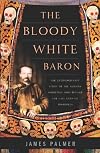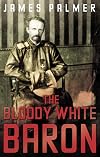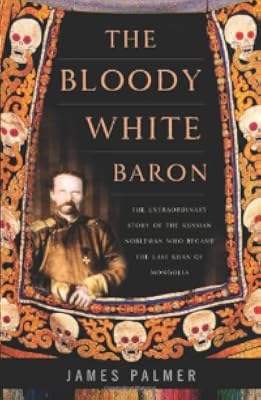
The Bloody White Baron: The Extraordinary Story of the Russian Nobleman Who Became the Last Khan of Mongolia
by James Palmer
On This Page
Description
Historian James Palmer relates the story of meglomaniac Baron Freiherr Roman Nikolai Maximilian von Ungern-Sternberg, an anti-Bolshevik German Russian reactionary who in 1920 led a lethally effective rabble of cavalrymen in a grand but shortlived campaign to unify the Mongul people while at the same time frightening the Russians and slaughtering everyone he suspected of irreligion or of being a Jew.Tags
Recommendations













Member Recommendations

Member Reviews
The subject of this book is a vicious anti-semitic Baltic aristocrat, Baron Ungern-Sternberg, who briefly flared up as a murderous precursor of national socialist ethnic cleansing in Mongolia in the chaos of the post-revolutionary struggle for control of the Russian Empire.
As with the tale of Colonel Despard recently reviewed by us (another marginal figure in another empire at another time), an individual outlier from the norm is an opportunity to weave a story about a particular time and place and permit us to make our own judgements about history.
The comparison with Despard is instructive – the tale of a fundamentally honourable and ‘good’ man out-manouevred by the special interests of a coalescing and rising empire is a fitting show more contrast to a fundamentally ‘evil’ and cruel man trying to cope with the crumbling of a falling empire.
Here, in two books, we have the best of humanity and the worst of it. We see contrasted, in the Despard book, the worst aspects of society when it is in the hands of the calculating few but what happens when society has no rudder in this one.
The often equally murderous but less gratuitously cruel Bolsheviks (though that changes with time in a general deterioration of conduct) at least occasionally appear more disciplined and engaged in their struggle through something other than fear of the lash.
In the never-ending and futile debate about whether traditionalist anti-semitic slaughtering was equal, ‘better’ or worse than Bolshevik class killing and military ruthlessness, this book tends to suggest that Bolshevism was the lesser evil - at least in 1920/1921.
What Palmer does is put Ungern-Sternberg into context as an extreme member of a brutal class of aristocrats and militarists whose treatment of its peasantry was explanation and justification enough for revolution, if not for Bolshevism.
It was fashionable amongst Western liberals in the wake of the Thatcher-Reagan revolution to produce accounts of Bolshevism that were intended to shift it into the camp of ‘pure evil’ (with the implicit intent of making the Atlantic liberal response to it something close to ‘pure good’).
This was simplistic and never tenable. It systematically covered up the ‘crimes’ of Western liberal imperialism and expansion and the destructive effects of capitalism and it offered wholly retrospective views of men and women operating with weak information and trapped by circumstances.
Bolshevism turned into something monstrous and brutal, as did most of its successor movements, before turning into something dull and sclerotic but it arose for a reason, filled a power vacuum for a reason, held the State for a reason and collapsed for a reason.
To moralise a-historically about these stages, especially the attempt to disconnect the second stage from the first and not recognise that the third was not quite so awful as the second (though still pretty grim) is to educate the student poorly.
It should not be a case of exclaiming ‘oh, how awful’ but ‘why so awful’ and what this awfulness teaches us about the human race under conditions of both tyranny and anarchy. The moralising strikes me as an attempt to deny horrible truths about our species by ‘bien-pensant’ liberals.
This story is a case in point because the charge sheet is not only one of viciousness by Ungern-Sternberg (or indeed of the Bolsheviks) but by his lieutenants and – which will surprise many a gentle Californian ‘bien-pensant’ – the poverty stricken Buddhist cultures of the steppe.
Ungern-Sternberg’s ostensible boss in the region, his friend Semenov, was really just a louche pleasure-loving gangster with no interest in ideology or cruelty for its own sake.
A night in Semenov's harem coach must have been fun and it is interesting that our cruel anti-hero seems to have had no interest in sex at all. Beware politicians and soldiers with no interest in sexual play ...
Semenov was the type of the self-seeking opportunistic gangster warlord that emerged as order collapsed (thanks, in great part, to Western incursions) in China and Russia, from Siberia through Manchuria and into China proper, in the early 1920s.
This was what threatened Russia briefly in the early 1990s when the Soviet system collapsed and this should be remembered by Western liberal critics of Putin. There is a history to his re-assertion of order. Ordinary people are never are served by any sudden collapse in state authority.
But, around Ungern-Sternberg, were men of such sadistic cruelty, that they would be fair warning of the type who would emerge again within the SS and the Bolshevik Secret Police, in the security services of the Post-War World and who once existed in the penal and slavery systems of the West.
The excesses of these people, recounted by Palmer (who allows for exaggerations by their captors and those who write history) are supposed, conventionally, to shock us (I won’t reveal their cruelties here) but they should not. This is us – humanity – under certain conditions of power.
This less charitable view of the human condition under conditions of warlord anarchy and war can be matched by a similar view under conditions of poverty. The excesses of Whites and Reds (and there were good men on both sides) come down to a desperate struggle in chaos and poverty for survival.
The book is extremely good on the political reality of Buddhism – feudal, corrupt, murderous, filled with obscurantism, deeply exploitative of the population, opportunistic over the acquisition and maintenance of power.
Buddhism is certainly not unique in this and there were many good and ‘holy’ monks but this practical reality of the role of organised religion under conditions of feudal poverty explains the reasonable claims of Communists to be progressive in their invasions of such countries.
This is not to say that Communist slaughter of the monks and despoliation of their treasures were not extreme acts equal to those of the Taliban at Bamiyan but that there was a long history to these acts that Western liberals would do well to consider as explanation though not justification.
Above all, the ‘fluffy’ approach to Buddhism that extends a serious religious practice that is extremely demanding and has great truths to offer into silly sexual play, romantic idealism around the cuddly Dalai Lama and a cod eco-internationalism could do with some lessons in history.
This book is worth reading alone for opening our eyes to what organised religion often really is all about in very poor societies – maintaining order through a pact with nobles to exploit the population and using surplus capital for ostentatious display to assert their ‘spiritual’ authority.
Mongolia during the extremely short and brutal period of Ungern-Sternberg’s attempt to create the base for a new Mongolian Empire was a cesspit of cruelty, exploitation and obscurantism and the Mongolians, like all peoples, deserved better.
Palmer also shows how Ungern-Sternberg foreshadowed the Nazis in their thinking and this should not be a surprise in the context of the day.
The neurotic ideology of the Baltic Russo-Germans were part of a more general Slavic intellectual irrationalism that resulted in the useful and poisonous ‘Protocols of the Elders of Zion’ but the intellectual climate was not, in Russia, so much one of nationalism as monarchic traditionalism.
This is a complex issue that is not the core subject of the book and should not be essayed here but understanding it involves understanding how modernisation disrupted exploitative agrarian economies in Eastern Europe and Russia and the role that Jews as traders and intellectuals played in that.
Any analysis must take into account the self-identity of an aristocratic class that genuinely considered itself innately rather than contingently superior, much as Western imperialists came to think of themselves as innately superior to people with different coloured skins and cultures.
Palmer is right to present Ungern-Sternberg in Mongolia as, in effect, a testing ground for reaction to modernisation.
National socialist Germany (under Hitler rather than other national socialists) created a perfect opportunity to express the revolt against modernisation in modernising terms as a technologically-based attempt to seize empire in the Western manner and crush the modernisers.
The Baltic German elite, once their world had been crushed and defeated by Communism, became vectors of resentment and revenge against both Bolshevism and Jewry with an ideology of restored aristocracy but for race and Fuhrer rather than failed Tsar.
Like so many dangerous forces within state and empires, they came from the margins and, having failed in one project, merely transferred to another and refined their cruelties into what would later become a system of organised extermination. This is the world of Alfred Rosenberg.
A recommended book not for its ostensible subject – a rather interesting unhinged but nasty and dim-witted minor aristocrat let loose under anarchic conditions – but for what the adventures of such a man tell us about humanity and society as old worlds crumble and new world are born.
We are in the midst of such a period now. An old world is crumbling and a new world is being born and we have to watch out for ourselves as the solutions being offered to us swing between tyranny and anarchy, giving opportunities to men like Ungern-Sternberg to express themselves in blood. show less
As with the tale of Colonel Despard recently reviewed by us (another marginal figure in another empire at another time), an individual outlier from the norm is an opportunity to weave a story about a particular time and place and permit us to make our own judgements about history.
The comparison with Despard is instructive – the tale of a fundamentally honourable and ‘good’ man out-manouevred by the special interests of a coalescing and rising empire is a fitting show more contrast to a fundamentally ‘evil’ and cruel man trying to cope with the crumbling of a falling empire.
Here, in two books, we have the best of humanity and the worst of it. We see contrasted, in the Despard book, the worst aspects of society when it is in the hands of the calculating few but what happens when society has no rudder in this one.
The often equally murderous but less gratuitously cruel Bolsheviks (though that changes with time in a general deterioration of conduct) at least occasionally appear more disciplined and engaged in their struggle through something other than fear of the lash.
In the never-ending and futile debate about whether traditionalist anti-semitic slaughtering was equal, ‘better’ or worse than Bolshevik class killing and military ruthlessness, this book tends to suggest that Bolshevism was the lesser evil - at least in 1920/1921.
What Palmer does is put Ungern-Sternberg into context as an extreme member of a brutal class of aristocrats and militarists whose treatment of its peasantry was explanation and justification enough for revolution, if not for Bolshevism.
It was fashionable amongst Western liberals in the wake of the Thatcher-Reagan revolution to produce accounts of Bolshevism that were intended to shift it into the camp of ‘pure evil’ (with the implicit intent of making the Atlantic liberal response to it something close to ‘pure good’).
This was simplistic and never tenable. It systematically covered up the ‘crimes’ of Western liberal imperialism and expansion and the destructive effects of capitalism and it offered wholly retrospective views of men and women operating with weak information and trapped by circumstances.
Bolshevism turned into something monstrous and brutal, as did most of its successor movements, before turning into something dull and sclerotic but it arose for a reason, filled a power vacuum for a reason, held the State for a reason and collapsed for a reason.
To moralise a-historically about these stages, especially the attempt to disconnect the second stage from the first and not recognise that the third was not quite so awful as the second (though still pretty grim) is to educate the student poorly.
It should not be a case of exclaiming ‘oh, how awful’ but ‘why so awful’ and what this awfulness teaches us about the human race under conditions of both tyranny and anarchy. The moralising strikes me as an attempt to deny horrible truths about our species by ‘bien-pensant’ liberals.
This story is a case in point because the charge sheet is not only one of viciousness by Ungern-Sternberg (or indeed of the Bolsheviks) but by his lieutenants and – which will surprise many a gentle Californian ‘bien-pensant’ – the poverty stricken Buddhist cultures of the steppe.
Ungern-Sternberg’s ostensible boss in the region, his friend Semenov, was really just a louche pleasure-loving gangster with no interest in ideology or cruelty for its own sake.
A night in Semenov's harem coach must have been fun and it is interesting that our cruel anti-hero seems to have had no interest in sex at all. Beware politicians and soldiers with no interest in sexual play ...
Semenov was the type of the self-seeking opportunistic gangster warlord that emerged as order collapsed (thanks, in great part, to Western incursions) in China and Russia, from Siberia through Manchuria and into China proper, in the early 1920s.
This was what threatened Russia briefly in the early 1990s when the Soviet system collapsed and this should be remembered by Western liberal critics of Putin. There is a history to his re-assertion of order. Ordinary people are never are served by any sudden collapse in state authority.
But, around Ungern-Sternberg, were men of such sadistic cruelty, that they would be fair warning of the type who would emerge again within the SS and the Bolshevik Secret Police, in the security services of the Post-War World and who once existed in the penal and slavery systems of the West.
The excesses of these people, recounted by Palmer (who allows for exaggerations by their captors and those who write history) are supposed, conventionally, to shock us (I won’t reveal their cruelties here) but they should not. This is us – humanity – under certain conditions of power.
This less charitable view of the human condition under conditions of warlord anarchy and war can be matched by a similar view under conditions of poverty. The excesses of Whites and Reds (and there were good men on both sides) come down to a desperate struggle in chaos and poverty for survival.
The book is extremely good on the political reality of Buddhism – feudal, corrupt, murderous, filled with obscurantism, deeply exploitative of the population, opportunistic over the acquisition and maintenance of power.
Buddhism is certainly not unique in this and there were many good and ‘holy’ monks but this practical reality of the role of organised religion under conditions of feudal poverty explains the reasonable claims of Communists to be progressive in their invasions of such countries.
This is not to say that Communist slaughter of the monks and despoliation of their treasures were not extreme acts equal to those of the Taliban at Bamiyan but that there was a long history to these acts that Western liberals would do well to consider as explanation though not justification.
Above all, the ‘fluffy’ approach to Buddhism that extends a serious religious practice that is extremely demanding and has great truths to offer into silly sexual play, romantic idealism around the cuddly Dalai Lama and a cod eco-internationalism could do with some lessons in history.
This book is worth reading alone for opening our eyes to what organised religion often really is all about in very poor societies – maintaining order through a pact with nobles to exploit the population and using surplus capital for ostentatious display to assert their ‘spiritual’ authority.
Mongolia during the extremely short and brutal period of Ungern-Sternberg’s attempt to create the base for a new Mongolian Empire was a cesspit of cruelty, exploitation and obscurantism and the Mongolians, like all peoples, deserved better.
Palmer also shows how Ungern-Sternberg foreshadowed the Nazis in their thinking and this should not be a surprise in the context of the day.
The neurotic ideology of the Baltic Russo-Germans were part of a more general Slavic intellectual irrationalism that resulted in the useful and poisonous ‘Protocols of the Elders of Zion’ but the intellectual climate was not, in Russia, so much one of nationalism as monarchic traditionalism.
This is a complex issue that is not the core subject of the book and should not be essayed here but understanding it involves understanding how modernisation disrupted exploitative agrarian economies in Eastern Europe and Russia and the role that Jews as traders and intellectuals played in that.
Any analysis must take into account the self-identity of an aristocratic class that genuinely considered itself innately rather than contingently superior, much as Western imperialists came to think of themselves as innately superior to people with different coloured skins and cultures.
Palmer is right to present Ungern-Sternberg in Mongolia as, in effect, a testing ground for reaction to modernisation.
National socialist Germany (under Hitler rather than other national socialists) created a perfect opportunity to express the revolt against modernisation in modernising terms as a technologically-based attempt to seize empire in the Western manner and crush the modernisers.
The Baltic German elite, once their world had been crushed and defeated by Communism, became vectors of resentment and revenge against both Bolshevism and Jewry with an ideology of restored aristocracy but for race and Fuhrer rather than failed Tsar.
Like so many dangerous forces within state and empires, they came from the margins and, having failed in one project, merely transferred to another and refined their cruelties into what would later become a system of organised extermination. This is the world of Alfred Rosenberg.
A recommended book not for its ostensible subject – a rather interesting unhinged but nasty and dim-witted minor aristocrat let loose under anarchic conditions – but for what the adventures of such a man tell us about humanity and society as old worlds crumble and new world are born.
We are in the midst of such a period now. An old world is crumbling and a new world is being born and we have to watch out for ourselves as the solutions being offered to us swing between tyranny and anarchy, giving opportunities to men like Ungern-Sternberg to express themselves in blood. show less
In 1921, Baron Ungern-Sternberg, convinced by oracles that he had 130 days to live, issued, as the “Incarnated God of War, Khan of grateful Mongolia”, his notorious General Order 15. (Numbered “15” for superstitious reasons. It was actually the first order issued by the paperwork-averse man born Freiherr Roman Nikolai Maximilian von Ungern-Sternberg.)
It stated, among other things: "‘Truth and mercy’ are no longer admissible. Henceforth there can only be ‘truth and merciless hardness.’ The evil which has fallen upon the land, with the object of destroying the divine principle in the human soul, must be extirpated root and branch. Fury against the heads of the revolution, its devoted followers, must know no show more boundaries."
Chilling words, anathema to civilized values. Yet, being of a dark and pessimistic turn of mind, I wonder if we will, under some circumstance in the not-so-distant future, have to ponder its application.
And General Order No. 15 leaves no doubt as to what that “merciless hardness” consisted of for him: "Commissars, Communists, and Jews, together with their families, must be exterminated. Their property must be confiscated."
And there, for me, lies the fascination with the Baron – exponent of dark truths of civilizational survival but for a situation whose exigencies did not clearly make mercy inadmissible.
The Baron was a man of few admirable qualities.
Born in Austria in 1885, the Ungern-Sternberg spent his early life on a family estate in what is now Estonia but then part of the Russian Empire.
He has been called the sort of bully other bullies were afraid of. Palmer drops the bully description but notes his classmates and instructors were terrorized by him. Tall, athletic, unwilling to obey rules and do much studying despite his intelligence, he was a violent, impulsive child. His voice, coming through the record, is “strident, sarcastic, vicious” says Palmer.
He was kicked out of two military academies.
The Russo-Japanese War saved him though he arrived at the front after Russia’s defeat. But he buckled down, learned military routine and discipline – this was war, after all, not school. And he got his first brush with the East and was impressed by the Japanese.
The 1905 Revolution hardened Ungern-Sternberg even more. His family home in Estonia was burned down by revolutionaries.
The Baron did attend a third military academy, the prestigious Paul I Military Academy, and he actually managed to graduate though as a mediocre student.
It was about this time he developed his interest in the occult, mysticism and Buddhism. The early 20th Century was steeped in such things and Russia especially so. One of the many stories about him is that he was clairvoyant and could read minds.
After graduation, Ungern-Sternberg joined a Cossack regiment in the Transbaikal in 1911. It is odd that, for a man with notions of restoring the Russian Empire, he spent most of his adult life on its fringes. The Cossacks were the romanticized, “decently acceptable version of the Mongols” (they were Slavic in heritage, not Asian). Here Ungern developed his love of the cavalry which was to serve him well in a guerrilla context but, ultimately, was woefully inadequate for his coming battle with the Red forces.
Predictably, the Baron didn’t last long among the Cossacks. The record shows numerous accounts of duels and an assault on a local merchant. As Palmer notes, there were probably other assaults on servants and locals deemed, by the aristocratic culture of the Russian Army, not worth mentioning.
In 1913, the Baron was effectively kicked out of the army and went to Mongolia.
It is with the Mongolian material that Palmer’s book is particularly interesting since he has traveled to the country and written about it extensively and comes to the Baron’s story in that context. Palmer manages to convey the bizarre nature of Mongolian Buddhism, definitely not the pacific faith that the Western mind holds Buddhism to be. It is an apocalyptic faith, a thin veneer over native shamanism, that would come to be at the center of Ungern-Sternberg’s syncretic “Yellow Faith”.
Mongolia had only become independent in 1911 when Imperial China collapsed and, throughout Ungern-Sternberg’s story, it was the scene of diplomatic intrigue and violence as the natives contended with Japanese, Chinese, and Russian efforts to control the country. Central to these was the obese, blind, frequently drunk, syphilitic Bogd Khan, head of Mongolian Buddhism. His penchant for exotic Western imports and for despoiling young monks did not blunt a keen mind or frequent resorts to assassination. It was the Bogd Khan who would eventually proclaim the Baron the “God of War”.
In the Great War that was to destroy the Russian Empire, the Baron’s “brutality, impulsiveness, coarseness”, became “his greatest assets”. He was one of the small percentage of Russian troops who escaped the German trap at Tannenberg. He had found his place, became “an exemplar” to other officers and soldiers according to official reports, gained the respect of his men, earned several medals including the Cross of St. George, fourth class (which he wore to the end of his days).
“Life”, he declared, “is the result of war, and society is the instrument of war. … To refuse war means to refuse an epic life.”
In 1914 through 1916, the Baron served in the Carpathians and East Prussia, incurred numerous wounds and was promoted.
But the old Baron’s flaws were still there. One of many stories about this time (and there are very many about the Baron) is that he walked into a café and began firing a gun into the ceiling. Another story (a later Soviet accusation and, like so many stories, unproven) is that he beat a lower-ranking officer. He was put in military prison for two months.
Released in 1917, the Baron was deployed to the Caucasus. It was there he met the future White Cossack Grigori Semenov. Semenov, like Ungern-Sternberg, had also spent time in Mongolia and went on to have a colorful career of his own that included time in the U.S. and charges of “robbery, bigamy, murder, torture, rape and pillage” followed him to his hanging by the Soviets in 1946.
It was during this period, they witnessed one of the 20th centuries forgotten bits of genocide, the killing of Christian Assyrians by the Turks. The event, says Palmer, put in the minds of Semenov and Ungern-Sternberg the idea of recruiting native groups to their cause. While they were unable to save the Assyrians, the idea was more successful in the eastern theater of the Russian Civil War.
By the beginning of 1918, Ungern was in Siberia with the Whites, he seems to have almost single-handedly put down a mutiny of two companies. His sheer aura of brutality and violence was scary even to battle-hardened troops.
All this takes us up to page 95 of Palmer’s account with about 150 more pages detailing the Baron in the Russian Civil War and driving Chinese forces out of Mongolia.
We hear of his weird mysticism and religious world view that combined a Buddhist apocalyptic legend of the King of the World emerging from Shambala to conquer the world, apocalyptic visions from the Christian Books of Daniel and Revelation, and Theosophy. The Yellow Faith would rejuvenate the decadence of Russia with Eastern values. Modernity, represented by communism and the Jews – a whorish religion going back to Babylon, would be expelled. Prince Michael would be placed on the throne. (Michael, Czar Nicholas’ son, had been missing for three years and was already dead. Whether the Baron really believed he was still alive, we don’t know.)
The Baron didn’t care about a man’s faith (except, of course, Jews) or race. It was atheists and communists he hated. One of his few bits of liberality was allowing his men the free opportunity to follow the rites and practices of their faith.
Palmer charts, as much as historical documentation allows, the Baron’s move into Mongolia as a base to continue the struggle after the 1920 Soviet offensive that swept away most of the White forces. There he became a de facto dictator running a regime that had several torture chambers and inventive punishments (a surprising number involving trees), seemingly Ungern-Sternberg’s attempt to recreate some of the hellish punishments depicted in Mongolian Buddhist art.
Few good things can be said about the Baron in this period. Unlike Semenov and most of the other White leaders, he didn’t skim off foreign aid to enrich himself. The Baron led an ascetic life in simple quarters in the Mongolia capitol of Urga. He was a provocative and interesting conversationalist. Several contemporaries reported talking to him though Palmer has his doubts about the veracity of the most famous, Ferdinand Antoni Ossendowski and his account mentioning the Baron, Beasts, Men, and Gods.
Unlike his counterintelligence officer, Colonel Sipailov, he was not a sexual sadist. (Indeed, Palmer says there are no intimations that the Baron ever had sex with anybody in his life – even though he briefly married a “Chinese princess”.) But Baron turned a blind eye to Sipailov’s excesses though he did whip him for drunkenness. A combination of ascetic life, brutality, shared danger, and mysticism, bound – for a while – Ungern-Sternberg’s multi-ethnic troops to him. The Baron was also a more brutal disciplinarian to Whites joining his army, if he had no prior acquaintance with them, than Asian troops. There are several stories where the Baron seems to have uncannily, with just a glance, spotted Red agents in the White refugees who showed up in Mongolia. (Of course, there are also stories where no proof of the accused’s guilt exists.)
But, in 1921, the Reds started to close in. Ungern-Sternberg took his men on a foolish foray into Russia. They were turned back, and, trying to flee to Tibet, the Baron was captured after his men melted away, his brutality and godly charisma eventually no longer enough to keep them around.
After a five-hour trial, the Soviets shot him on September 15, 1921.
Appropriately for a man still remembered in rock songs, art, video games, and novels, stories about his death or even escape started early. One had bullets ricocheting off his Cross of St. George and back at his executioners.
Even today, Palmer says, you can still meet Mongolians who literally regard the White Baron as a god.
You can find plenty of material on the Baron online, but the strength of this book is not in recounting the legends, fact based and purely fictional, about the Baron but the context of his time and particularly the Mongolian background. Palmer provides some maps of the Baron’s White campaigns. However, I didn’t appreciate his tendency to not tag many events with specific dates. show less
It stated, among other things: "‘Truth and mercy’ are no longer admissible. Henceforth there can only be ‘truth and merciless hardness.’ The evil which has fallen upon the land, with the object of destroying the divine principle in the human soul, must be extirpated root and branch. Fury against the heads of the revolution, its devoted followers, must know no show more boundaries."
Chilling words, anathema to civilized values. Yet, being of a dark and pessimistic turn of mind, I wonder if we will, under some circumstance in the not-so-distant future, have to ponder its application.
And General Order No. 15 leaves no doubt as to what that “merciless hardness” consisted of for him: "Commissars, Communists, and Jews, together with their families, must be exterminated. Their property must be confiscated."
And there, for me, lies the fascination with the Baron – exponent of dark truths of civilizational survival but for a situation whose exigencies did not clearly make mercy inadmissible.
The Baron was a man of few admirable qualities.
Born in Austria in 1885, the Ungern-Sternberg spent his early life on a family estate in what is now Estonia but then part of the Russian Empire.
He has been called the sort of bully other bullies were afraid of. Palmer drops the bully description but notes his classmates and instructors were terrorized by him. Tall, athletic, unwilling to obey rules and do much studying despite his intelligence, he was a violent, impulsive child. His voice, coming through the record, is “strident, sarcastic, vicious” says Palmer.
He was kicked out of two military academies.
The Russo-Japanese War saved him though he arrived at the front after Russia’s defeat. But he buckled down, learned military routine and discipline – this was war, after all, not school. And he got his first brush with the East and was impressed by the Japanese.
The 1905 Revolution hardened Ungern-Sternberg even more. His family home in Estonia was burned down by revolutionaries.
The Baron did attend a third military academy, the prestigious Paul I Military Academy, and he actually managed to graduate though as a mediocre student.
It was about this time he developed his interest in the occult, mysticism and Buddhism. The early 20th Century was steeped in such things and Russia especially so. One of the many stories about him is that he was clairvoyant and could read minds.
After graduation, Ungern-Sternberg joined a Cossack regiment in the Transbaikal in 1911. It is odd that, for a man with notions of restoring the Russian Empire, he spent most of his adult life on its fringes. The Cossacks were the romanticized, “decently acceptable version of the Mongols” (they were Slavic in heritage, not Asian). Here Ungern developed his love of the cavalry which was to serve him well in a guerrilla context but, ultimately, was woefully inadequate for his coming battle with the Red forces.
Predictably, the Baron didn’t last long among the Cossacks. The record shows numerous accounts of duels and an assault on a local merchant. As Palmer notes, there were probably other assaults on servants and locals deemed, by the aristocratic culture of the Russian Army, not worth mentioning.
In 1913, the Baron was effectively kicked out of the army and went to Mongolia.
It is with the Mongolian material that Palmer’s book is particularly interesting since he has traveled to the country and written about it extensively and comes to the Baron’s story in that context. Palmer manages to convey the bizarre nature of Mongolian Buddhism, definitely not the pacific faith that the Western mind holds Buddhism to be. It is an apocalyptic faith, a thin veneer over native shamanism, that would come to be at the center of Ungern-Sternberg’s syncretic “Yellow Faith”.
Mongolia had only become independent in 1911 when Imperial China collapsed and, throughout Ungern-Sternberg’s story, it was the scene of diplomatic intrigue and violence as the natives contended with Japanese, Chinese, and Russian efforts to control the country. Central to these was the obese, blind, frequently drunk, syphilitic Bogd Khan, head of Mongolian Buddhism. His penchant for exotic Western imports and for despoiling young monks did not blunt a keen mind or frequent resorts to assassination. It was the Bogd Khan who would eventually proclaim the Baron the “God of War”.
In the Great War that was to destroy the Russian Empire, the Baron’s “brutality, impulsiveness, coarseness”, became “his greatest assets”. He was one of the small percentage of Russian troops who escaped the German trap at Tannenberg. He had found his place, became “an exemplar” to other officers and soldiers according to official reports, gained the respect of his men, earned several medals including the Cross of St. George, fourth class (which he wore to the end of his days).
“Life”, he declared, “is the result of war, and society is the instrument of war. … To refuse war means to refuse an epic life.”
In 1914 through 1916, the Baron served in the Carpathians and East Prussia, incurred numerous wounds and was promoted.
But the old Baron’s flaws were still there. One of many stories about this time (and there are very many about the Baron) is that he walked into a café and began firing a gun into the ceiling. Another story (a later Soviet accusation and, like so many stories, unproven) is that he beat a lower-ranking officer. He was put in military prison for two months.
Released in 1917, the Baron was deployed to the Caucasus. It was there he met the future White Cossack Grigori Semenov. Semenov, like Ungern-Sternberg, had also spent time in Mongolia and went on to have a colorful career of his own that included time in the U.S. and charges of “robbery, bigamy, murder, torture, rape and pillage” followed him to his hanging by the Soviets in 1946.
It was during this period, they witnessed one of the 20th centuries forgotten bits of genocide, the killing of Christian Assyrians by the Turks. The event, says Palmer, put in the minds of Semenov and Ungern-Sternberg the idea of recruiting native groups to their cause. While they were unable to save the Assyrians, the idea was more successful in the eastern theater of the Russian Civil War.
By the beginning of 1918, Ungern was in Siberia with the Whites, he seems to have almost single-handedly put down a mutiny of two companies. His sheer aura of brutality and violence was scary even to battle-hardened troops.
All this takes us up to page 95 of Palmer’s account with about 150 more pages detailing the Baron in the Russian Civil War and driving Chinese forces out of Mongolia.
We hear of his weird mysticism and religious world view that combined a Buddhist apocalyptic legend of the King of the World emerging from Shambala to conquer the world, apocalyptic visions from the Christian Books of Daniel and Revelation, and Theosophy. The Yellow Faith would rejuvenate the decadence of Russia with Eastern values. Modernity, represented by communism and the Jews – a whorish religion going back to Babylon, would be expelled. Prince Michael would be placed on the throne. (Michael, Czar Nicholas’ son, had been missing for three years and was already dead. Whether the Baron really believed he was still alive, we don’t know.)
The Baron didn’t care about a man’s faith (except, of course, Jews) or race. It was atheists and communists he hated. One of his few bits of liberality was allowing his men the free opportunity to follow the rites and practices of their faith.
Palmer charts, as much as historical documentation allows, the Baron’s move into Mongolia as a base to continue the struggle after the 1920 Soviet offensive that swept away most of the White forces. There he became a de facto dictator running a regime that had several torture chambers and inventive punishments (a surprising number involving trees), seemingly Ungern-Sternberg’s attempt to recreate some of the hellish punishments depicted in Mongolian Buddhist art.
Few good things can be said about the Baron in this period. Unlike Semenov and most of the other White leaders, he didn’t skim off foreign aid to enrich himself. The Baron led an ascetic life in simple quarters in the Mongolia capitol of Urga. He was a provocative and interesting conversationalist. Several contemporaries reported talking to him though Palmer has his doubts about the veracity of the most famous, Ferdinand Antoni Ossendowski and his account mentioning the Baron, Beasts, Men, and Gods.
Unlike his counterintelligence officer, Colonel Sipailov, he was not a sexual sadist. (Indeed, Palmer says there are no intimations that the Baron ever had sex with anybody in his life – even though he briefly married a “Chinese princess”.) But Baron turned a blind eye to Sipailov’s excesses though he did whip him for drunkenness. A combination of ascetic life, brutality, shared danger, and mysticism, bound – for a while – Ungern-Sternberg’s multi-ethnic troops to him. The Baron was also a more brutal disciplinarian to Whites joining his army, if he had no prior acquaintance with them, than Asian troops. There are several stories where the Baron seems to have uncannily, with just a glance, spotted Red agents in the White refugees who showed up in Mongolia. (Of course, there are also stories where no proof of the accused’s guilt exists.)
But, in 1921, the Reds started to close in. Ungern-Sternberg took his men on a foolish foray into Russia. They were turned back, and, trying to flee to Tibet, the Baron was captured after his men melted away, his brutality and godly charisma eventually no longer enough to keep them around.
After a five-hour trial, the Soviets shot him on September 15, 1921.
Appropriately for a man still remembered in rock songs, art, video games, and novels, stories about his death or even escape started early. One had bullets ricocheting off his Cross of St. George and back at his executioners.
Even today, Palmer says, you can still meet Mongolians who literally regard the White Baron as a god.
You can find plenty of material on the Baron online, but the strength of this book is not in recounting the legends, fact based and purely fictional, about the Baron but the context of his time and particularly the Mongolian background. Palmer provides some maps of the Baron’s White campaigns. However, I didn’t appreciate his tendency to not tag many events with specific dates. show less
This is the biography of Baron Ungern-Sternberg, an obscure but fascinating and extraordinary man from the annals of early 20th-century history. He has striking similarities to Adolf Hitler: a sadistic and stunningly anti-Semetic madman with delusions of grandeur who was convinced he had been chosen to save the world, who was popular with the people at first and had many military victories, but whose excesses eventually cost him his cause, his country and his life. Ungern, a monarchist who saw Judaism and Bolshevism as the worst of evils, took over Mongolia in the nineteen-teens. He believed white people were decadent and tainted, and it was up to the Asians to save them. He was insanely suspicious of everyone and vicious and creative show more in his punishments of supposed traitors, Jews and Communist sympathizers. Very soon even the Mongolians, whose country he had liberated, got sick of him, and he wound up being captured by the Russians and, having tried to commit suicide and failed, was executed for treason.
This biography is done in a very literary style, often reading like a good novel. In addition to the details of Ungern's life it has a lot of information about Chinese, Russian and Mongolian society during that time period, as well as clearing up some misconceptions about Tibetan Buddhism (it was not the ludicrously peaceful and serene religion the Westerners perceive). The epilogue gives a good summary of what happened in Mongolia after Ungern's death, as well as some speculation as to how things would have gone if he hadn't done what he did.
I would highly recommend this book to people interested in Russian or East Asian history. I can't believe I'd never heard of this guy before; he was quite a character. show less
This biography is done in a very literary style, often reading like a good novel. In addition to the details of Ungern's life it has a lot of information about Chinese, Russian and Mongolian society during that time period, as well as clearing up some misconceptions about Tibetan Buddhism (it was not the ludicrously peaceful and serene religion the Westerners perceive). The epilogue gives a good summary of what happened in Mongolia after Ungern's death, as well as some speculation as to how things would have gone if he hadn't done what he did.
I would highly recommend this book to people interested in Russian or East Asian history. I can't believe I'd never heard of this guy before; he was quite a character. show less
A fascinating story of a thoroughly repellent character who manages to go from being the scion of German-descended nobility in Estonia to being the ruler of Mongolia, during the chaos of the Russian Civil War. The author pulls no punches in describing his protagonist's flaws, but he also credits him properly for his courage and daring, and those qualities which led him to accomplish so much. There are some fascinating insights into the not-at-all peaceful nature of Tibetan Buddhism, too.
The writing is clever: "Western Buddhism resembles Unitiarianism without the harsh dogma."
The introduction discusses the author's research, and more generally, his impressions of the people and the religion of Mongolia. He writes about things which no show more tourist bureau would discuss, but his writing makes me far more interested in seeing the places where these events took place than any tourist brochure could. show less
The writing is clever: "Western Buddhism resembles Unitiarianism without the harsh dogma."
The introduction discusses the author's research, and more generally, his impressions of the people and the religion of Mongolia. He writes about things which no show more tourist bureau would discuss, but his writing makes me far more interested in seeing the places where these events took place than any tourist brochure could. show less
I've been fascinated by this period of Mongolian history ever since I found a musty old copy of Ossendowski's Beasts, Men and Gods in a used bookstore years ago, so I was very happy to find a new look at those times in this book. Finding sources or historical writing on this period is difficult, at least here in the US, since Outer Mongolia almost seems to be a fictitious country in itself. Fortunately, James Palmer has travelled the East and waded through the various scraps and pieces of its history and pulled together a picture of a fascinating, if horrendous, figure who stamped his mark upon the era. Ossendowski's book, while purportedly true, reads like a pulp adventure novel, and his account of Baron Ungern certainly makes a modern show more reader believe that he must have been made up. Not so, of course. The Baron, or Bloody Baron, or Bloody Mad Baron, as he has variously been called, was all too real a person, and his insane, murderous actions were all too common during this period.
There is a perception in the modern West that Buddhism is perhaps unique amongst the world's major faiths in not lending itself to the kinds of wars and conflicts that, for example, Christianity and Islam have been such prominent players in. And while its certainly true that Buddhism has been a relatively peaceful religion, history, and certainly this history, shows how even the dharma can be turned towards violence, and how ethnic divisions, superstitions and unjust conditions can be exploited by cunning leaders to turn even the most peaceful doctrine into a permission for bloody conflict. Ungern was a curious mix of Christian, occultist and mystical Buddhist wannabe, driven by a belief in prophecy and armoring himself with magical charms (who can say they didn't work? He certainly never took a bullet on the battlefield with those charms hanging from his neck). In some ways the template for the kind of Aristocratic European Occultist that would later become such a stock character by way of the Nazis, his life and exploits make for fascinating reading, even if only as a cautionary tale about the kind of beast that wars and prejudice can create out of man.
My only complaint about this book is the lack of photographs. The author describes a number of photos of the Baron at various points in his story, but none of them are included outside of the dust jacket. I hope the publisher can add these in future editions. show less
There is a perception in the modern West that Buddhism is perhaps unique amongst the world's major faiths in not lending itself to the kinds of wars and conflicts that, for example, Christianity and Islam have been such prominent players in. And while its certainly true that Buddhism has been a relatively peaceful religion, history, and certainly this history, shows how even the dharma can be turned towards violence, and how ethnic divisions, superstitions and unjust conditions can be exploited by cunning leaders to turn even the most peaceful doctrine into a permission for bloody conflict. Ungern was a curious mix of Christian, occultist and mystical Buddhist wannabe, driven by a belief in prophecy and armoring himself with magical charms (who can say they didn't work? He certainly never took a bullet on the battlefield with those charms hanging from his neck). In some ways the template for the kind of Aristocratic European Occultist that would later become such a stock character by way of the Nazis, his life and exploits make for fascinating reading, even if only as a cautionary tale about the kind of beast that wars and prejudice can create out of man.
My only complaint about this book is the lack of photographs. The author describes a number of photos of the Baron at various points in his story, but none of them are included outside of the dust jacket. I hope the publisher can add these in future editions. show less
A really quite interesting biography of a Russian that arose in Mongolia in the violent reverberations from white "White" side of the Russian Civil War as doomed, cruel, and tragic proto-fascistic despot warlord betwixt China and the Soviet union. Here in the 1920s he favored the swastika as part of anti-semitic policy and cultivated occult trappings.
Baron Ungern-Sternberg is possibly one of the most vile humans to have ever walked the earth. That said, he makes for very interesting if disturbing reading. I came across this title by accident when researching nonfiction for the classroom on the Russian Revolution. While I don't think this is a title I would use in the classroom as it focuses more on Mongolia and Ungern-Sternberg than the battles between the communists and the royalists. It could be an interesting extension reading for students to undertake on their own. There are a few points in the timeline of the book that I didn't think were quite precise enough, but the important part of the book is less about the actual dates and more about the evil that can be brought to life show more by one person. show less
Members
- Recently Added By
Author Information

4+ Works 460 Members
Awards and Honors
Awards
Series
Belongs to Publisher Series
Die Andere Bibliothek (311)
Common Knowledge
- Canonical title*
- Der blutige weiße Baron: Die Geschichte eines Adeligen, der zum letzten Khan der Mongolei wurde
- Original publication date
- 2008
- People/Characters
- Roman von Ungern-Sternberg; Alexander Kolchak; Grigori Michaelovich Semenov; Bogd Khan; Dimitri Alioshin; Helena Petrovna Blavatsky (show all 17); Antoni Ferdinand Ossendowski; Khorloogiin Choibalsan; Dambiijantsan (Ja Lama); Vladimir Lenin; Nicolas II, Tsar of Russia; Dimitri Petrovich Pershin; Pu Yi, Emperor of China; Damdin Sükhbaatar; Pyotr Nikolayevich Wrangel; Xu Shuzheng; Zhang Zuolin
- Important places
- Mongolia; Ulaanbaatar, Mongolia; Dauria, Russia; Chita, Russia; Hailar District, Inner Mongolia, China; Harbin, China (show all 10); Khovd, Mongolia; Kyakhta, Russia; Manchuria; Binnen-Mongolië, Inner Mongolia, China
- Important events
- Russian Revolution; Russian Civil War; World War I; Russo-Japanese War
- Dedication
- For my mother and father
- First words
- (Introduction) I imagine that he would like to be remembered riding through a horde of terrified revolutionary soldiers, scything them down with his sabre as bullets whizzed around him, passing through his cloak, but never so... (show all) much as scraping him; the warrior-king of Mongolia, receiving reports, tribute and prisoners, like his hero Genghis Khan, in a hastily pitched campaign tent.
(Chapter One) Ungern was born in Graz, Austria, in 1885 to an Estonian father of German blood and a German mother. - Last words
- (Click to show. Warning: May contain spoilers.)It would have pleased him to be known as a protector of Buddhism, deified among those bloody-handed gods.
- Publisher's editor
- Belton, Neil; Volans, Henry
- Blurbers
- Sebag-Montefiore, Simon; Thubron, Colin; Hilton, Isabel; Hughes, Kathryn; Hudson, Robert; Allfree, Claire (show all 7); McGuinness, Max
*Some information comes from Common Knowledge in other languages. Click "Edit" for more information.
Classifications
- Genres
- History, Nonfiction, Biography & Memoir, General Nonfiction
- DDC/MDS
- 947.0841092 — History & geography History of Europe Eastern European Counties and Russia Russian & Slavic History by Period 1855- 1917-1953 ; Communist period 1917-1924 (Kerensky, Lenin) History, geographic treatment, biography Biography
- LCC
- DK254 .U5 .P35 — History of Europe, Asia, Africa and Oceania Russia. Soviet Union. Former Soviet Republics – Poland History of Russia. Soviet Union. Former Soviet Republics History House of Romanov, 1613-1917
- BISAC
Statistics
- Members
- 369
- Popularity
- 84,497
- Reviews
- 11
- Rating
- (3.63)
- Languages
- English, German
- Media
- Paper, Audiobook, Ebook
- ISBNs
- 10
- ASINs
- 9