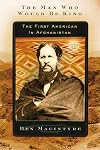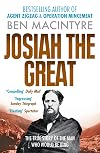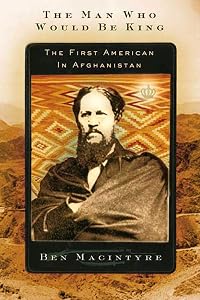
The Man Who Would Be King: The First American in Afghanistan
by Ben Macintyre
On This Page
Description
The Man Who Would Be King is the riveting story that inspired Kipling's classic tale and a John Huston movie In the year 1838, a young adventurer, surrounded by his native troops and mounted on an elephant, raised the American flag on the summit of the Hindu Kush in the mountainous wilds of Afghanistan. He declared himself Prince of Ghor, Lord of the Hazarahs, spiritual and military heir to Alexander the Great. The true story of Josiah Harlan, a Pennsylvania Quaker and the first American show more ever to enter Afghanistan, has never been told before, yet the life and writings of this extraordinary man echo down the centuries, as America finds itself embroiled once more in the land he first explored and described 180 years ago. Soldier, spy, doctor, naturalist, traveler, and writer, Josiah Harlan wanted to be a king, with all the imperialist hubris of his times. In an extraordinary twenty-year journey around Central Asia, he was variously employed as surgeon to the Maharaja of Punjab, revolutionary agent for the exiled Afghan king, and then commander in chief of the Afghan armies. In 1838, he set off in the footsteps of Alexander the Great across the Hindu Kush and forged his own kingdom, only to be ejected from Afghanistan a few months later by the invading British. Using a trove of newly discovered documents and Harlan's own unpublished journals, Ben Macintyre's The Man Who Would Be King tells the astonishing true story of the man who would be the first and last American king. show lessTags
Recommendations








Member Recommendations

Member Reviews
Ben Macintyre's biography of Josiah Marshall, Pennsylvania Quaker turned Afghan adventurer, is an interesting if somewhat uncritical treatment, relying as it does mostly on Marshall's own (and thus presumably biased) accounts of his adventures. Marshall's exploits certainly are worthy of attention, but a bit more perspective on them would have been welcome. A few other small errors marred the book for me too (George Washington did not sign the Declaration of Independence!), but on the whole it's a perfectly acceptable popular history (and the last couple chapters on Marshall's post-Afghanistan life are very well done).
A fascinating bit of imperial history, The Man Who Would Be King traces the true story of Josiah Harlan, a Quaker from Pennsylvania, who in the 1820s journeyed to British India to make his fortune as a military surgeon. Harlan decided he wanted more, and became a self-made player in the Great Game, using his natural talents and self-taught skills in medicine, diplomacy, and warfare, to serve the last great Oriental potentates (Shah Shujah al-Moolk, Amir Dost Mohammed Khan, Maharaja Ranjit Singh) and make his fortune.
Harlan is a fascinating character: a man of great energy and ambition who climbs to power remarkably quickly, in an environment where making a mistake in your choice of friends or words can lead to painful death. Macintyre show more also does a great job depicting the richness of the Afghan courts and their colorful life, as contrasted against the harsh lives of the peasants. In a period when Europe and the US are spinning up an industrial revolution and basics of the modern state, the Afghans as consumed in politics and feuds from an early time; an empire collapsed into warring microstates. Harlan does become King, for barely a few weeks, climbing the ladder of Oriental nobility to rule a small valley on a putative expedition against Uzbek slavers. In the end, Harlan returned to the US, wrote a poorly received book on the British, and died in relative obscurity, but he lived a life that was heroic.
There are parts that I wish were a little clearer, on the geography and politics of the era, but overall this is a fun and colorful examination of strange and forgotten era. show less
Harlan is a fascinating character: a man of great energy and ambition who climbs to power remarkably quickly, in an environment where making a mistake in your choice of friends or words can lead to painful death. Macintyre show more also does a great job depicting the richness of the Afghan courts and their colorful life, as contrasted against the harsh lives of the peasants. In a period when Europe and the US are spinning up an industrial revolution and basics of the modern state, the Afghans as consumed in politics and feuds from an early time; an empire collapsed into warring microstates. Harlan does become King, for barely a few weeks, climbing the ladder of Oriental nobility to rule a small valley on a putative expedition against Uzbek slavers. In the end, Harlan returned to the US, wrote a poorly received book on the British, and died in relative obscurity, but he lived a life that was heroic.
There are parts that I wish were a little clearer, on the geography and politics of the era, but overall this is a fun and colorful examination of strange and forgotten era. show less
A piece of forgotten history made incredibly relevant by the times. But the author wisely avoids the temptation to draw too much from it. Instead, he simply presents the story of a man who throws his Quaker upbringing to the winds to seek fame and fortune in an unknown part of the world. A good retelling of an interesting story.
Ratings
Members
- Recently Added By
Published Reviews
ThingScore 88
The saga of the First Afghan War, one of the greatest disasters ever met by the British army, has been told many times before, and I had vowed to throw any book that told it again away in the bin. But Ben Macintyre has found a wholly original angle on it by turning the spotlight on a mysterious American, Josiah Harlan, whose story briefly crosses other accounts of this period. In doing so, he show more has produced a riveting book and a valuable contribution to Great Game literature. show less
added by simon_carr
Josiah Harlan was a mountain man. That description of an early 19th-century American usually implies some buckskinned fur-seeker loping west to the Rockies just ahead of the covered wagons, but Harlan turned in the opposite direction coming out of the family gate in Chester County, Pennsylvania, in 1820. His noddle was filled with manifest destiny. Not fantasies about crossing the wide show more Missouri and the plains, however, but the exploits of Alexander the Great: he sailed east out of Philadelphia. show less
added by simon_carr
Lists

Best Biographies
216 works; 26 members
Author Information

30+ Works 14,184 Members
Common Knowledge
- Original title
- The Man Who Would Be King: The First American in Afghanistan
- Alternate titles
- Josiah the Great: The True Story of The Man Who Would Be King
- Original publication date
- 2004
- People/Characters
- Josiah Harlan
- Important places
- Afghanistan; India
- Important events
- First Anglo-Afghan War (1839 | 1842)
- First words
- Josiah Harlan's hunt for a crown began with a letter. A grubby, much-handled, unhappy letter, it followed the young American from Philadelphia to Canton, China, and finally to India. The year was 1822 ...
- Last words
- (Click to show. Warning: May contain spoilers.)Among the few possessions found in the doctor's rooms in Market Street, and returned to his widow in Pennsylvania, were a fine golden sword and an ancient ruby engraved with the image of Athena. Alongside these lay a sheaf of yellowing papers, covered in tumbling Persian script, written decades earlier by a holy man in the Hindu Kush: the royal warrants of a dead Afghan prince.
Classifications
Statistics
- Members
- 346
- Popularity
- 91,272
- Reviews
- 3
- Rating
- (3.99)
- Languages
- Dutch, English, German
- Media
- Paper, Ebook
- ISBNs
- 10
- ASINs
- 7