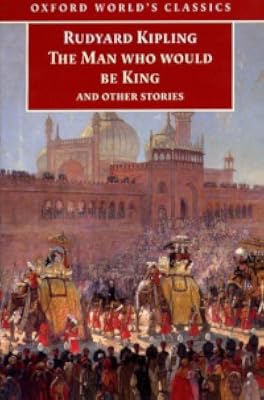
The Man Who Would Be King and Other Stories
by Rudyard Kipling 
On This Page
Description
This anthology of Rudyard Kipling's greatest short stories contains some of the most memorable and popular examples of the genre of which he was undisputed master.Tags
Recommendations



















Member Recommendations
Member Reviews
This fantastic short tale is narrated by an Indian journalist in 19th century India who meets two British adventurers, Daniel Dravot and Peachey Carnehan. Intrigued by their stories, he agrees to help them in a minor errand, but later he regrets this and informs the authorities about them—preventing them from blackmailing a minor rajah. A few months later they reappear at his newspaper office in Lahore, telling him of a plan they have hatched. After years of trying their hands at all manner of things, they have decided that "India is not big enough for them". They plan to go to Kafiristan and set themselves up as kings. Dravot will pass as a native and, armed with twenty rifles, they plan to find a king or chief to help him defeat show more enemies. Once that is done, they will take over for themselves. They ask the narrator for the use of reference books and maps of the area—as a favor, because they are fellow Freemasons, and because he spoiled their blackmail scheme. They also show him a contract they have made between themselves which swears loyalty between the pair and total abstinence from women and alcohol (that last part is hardly believable).
Two years later, on a scorching hot summer night, Carnehan returns to the narrator's office, a broken man, a crippled beggar clad in rags, but he tells an amazing story. He and Dravot had succeeded in becoming kings: traversing treacherous mountains, finding the Kafirs, mustering an army, taking over villages, and dreaming of building a unified nation and even an empire. The Kafirs (pagans, not Muslims) were impressed by the rifles and Dravot's lack of fear of their idols, and acclaimed him as a god, the reincarnation of Alexander the Great. They show a whiter complexion than others of the area ("so hairy and white and fair it was just shaking hands with old friends") implying their ancient lineage to Alexander himself. The Kafirs practiced a form of Masonic ritual, and Dravot's reputation was further enhanced when he showed knowledge of Masonic secrets that only the oldest priest remembered.
Their schemes were foiled, however, when Dravot (against the advice of Carnehan) decided to marry a Kafir girl. Kingship going to his head, he decided he needed a Queen and then royal children. Terrified at marrying a god, the girl bit Dravot when he tried to kiss her during the wedding ceremony. Seeing him bleed, the priests cried you're "Neither God nor Devil but a man!" Most of the Kafirs turned against Dravot and Carnehan. A few of his men remained loyal, but the army defected and the two kings were captured.
For the denouement of this fantastic tale you must read the story yourself, just don't expect a happy ending. show less
Two years later, on a scorching hot summer night, Carnehan returns to the narrator's office, a broken man, a crippled beggar clad in rags, but he tells an amazing story. He and Dravot had succeeded in becoming kings: traversing treacherous mountains, finding the Kafirs, mustering an army, taking over villages, and dreaming of building a unified nation and even an empire. The Kafirs (pagans, not Muslims) were impressed by the rifles and Dravot's lack of fear of their idols, and acclaimed him as a god, the reincarnation of Alexander the Great. They show a whiter complexion than others of the area ("so hairy and white and fair it was just shaking hands with old friends") implying their ancient lineage to Alexander himself. The Kafirs practiced a form of Masonic ritual, and Dravot's reputation was further enhanced when he showed knowledge of Masonic secrets that only the oldest priest remembered.
Their schemes were foiled, however, when Dravot (against the advice of Carnehan) decided to marry a Kafir girl. Kingship going to his head, he decided he needed a Queen and then royal children. Terrified at marrying a god, the girl bit Dravot when he tried to kiss her during the wedding ceremony. Seeing him bleed, the priests cried you're "Neither God nor Devil but a man!" Most of the Kafirs turned against Dravot and Carnehan. A few of his men remained loyal, but the army defected and the two kings were captured.
For the denouement of this fantastic tale you must read the story yourself, just don't expect a happy ending. show less
The best story in this volume is of course the title story, "The Man who would be King." A long time ago, I saw and loved the film version with its incomparable cast, and the story is every bit as good as the film had lead me to anticipate. Like much of Rudyard Kipling, it's able to gently poke fun at the follies of imperialism, which maybe isn't the reaction we postmoderns want, but it's enjoyable all the same. Carnehan and Dravot are two men who've been let down by imperialism-- they went and conquered India, and what did it get them?-- and so they decide to run it for themselves, with the consequences you might anticipate. The way the narrative jumps between distant and personal, sometimes disintegrating, is particularly show more effective. (It helps to imagine Michael Caine reading it.)
Other than Kim, this was my first encounter with Kipling. His body of short fiction is apparently massive; this book brings together just seventeen pieces. (Disappointingly, none of his science fiction is represented.) As in any body of work, some worked for me and some did not. It's a varied body of work; aside from taking place in India, the stories here have very little in common. There are comedies and tragedies, tales of British soldiers and first-person narratives of Indian natives.
One tale of a British soldier, "The Strange Ride of Morrowbie Jukes" might not be science fiction, but it uses tropes that turn up in many a science fiction tale, with a traveler trapped in a land seemingly outside of time. (I am personally thinking of the Star Trek cartoon "The Time Trap" and a Silver Age Green Arrow comic, but I am sure there are better examples.) It was definitely one of the stronger tales here. I didn't always get along with the tales of the British upper crust hanging out in India; skimming back over stories like "A Wayside Comedy" or "The Education of Otis Yeere," I realize that I barely remember what happened. I really wanted to like "With the Main Guard," which is narrated by Three Soldiers alternatingly, but though the narrative device was interesting, the story itself was so-so. On the other hand, "Only a Subaltern" was more fun that I expected going in.
From the Indian perspective, we also get strong stories in "Gemini," a black comedy about a man and his twin brother who disenfranchises him in every way possible, "At Twenty-Two," about a group of mine workers, and "In Flood Time," about a bridge keeper, among others. These stories work in a large part because they immerse the reader in a society that's (probably) not his own; I've read several articles that say Kipling's significance to science fiction is not the science fiction he actually wrote, but rather his worldbuilding techniques, and reading stories like this, I can see that. The techniques that Kipling's uses are ones that any contemporary reader of sf takes for granted. They're often even told from the first person, an immersive move that makes for difficult yet rewarding reading.
The tales that explicitly deal with the intersections between the two worlds are also fascinating. Kipling isn't really for or against colonization, as far as I can tell from reading these stories. It's simply something that's happened, and he deals with its effects. Sometimes these are funny (I love the story of the misguided missionaries in "The Judgment of Dungara") but of course there's a decent amount of tragedy running around too. More usually, a story is both ("On the City Wall," for example.)
Other than the title story, the real standout was "Baa Baa, Black Sheep," a semiautobiographical tale of Kipling's own deprived childhood, separated from his parents and raised by a mentally and verbally abusive aunt. You're completely immersed in the point-of-view of the boy, and it's harrowing and depressing, but oh so very good. Poor kid.
It is, oddly enough, possible to read vast swathes of Victorian literature and never realize that Britain has an empire. You might get the odd mention or subplot, but with just a prologue and epilogue set in India, The Moonstone is already an outlier. It's odd to think that at the same time Kipling was writing these stories, Thomas Hardy is waxing rhapsodic about the English countryside in Wessex Tales. For that different perspective on the Victorian world alone, Kipling is worthwhile, but thankfully he has a depth of insight, too.
Also: he's funny. Best joke is when someone starts to get all philosophical, and someone else cuts her off by saying, essentially, "That's enough, George Eliot." show less
Other than Kim, this was my first encounter with Kipling. His body of short fiction is apparently massive; this book brings together just seventeen pieces. (Disappointingly, none of his science fiction is represented.) As in any body of work, some worked for me and some did not. It's a varied body of work; aside from taking place in India, the stories here have very little in common. There are comedies and tragedies, tales of British soldiers and first-person narratives of Indian natives.
One tale of a British soldier, "The Strange Ride of Morrowbie Jukes" might not be science fiction, but it uses tropes that turn up in many a science fiction tale, with a traveler trapped in a land seemingly outside of time. (I am personally thinking of the Star Trek cartoon "The Time Trap" and a Silver Age Green Arrow comic, but I am sure there are better examples.) It was definitely one of the stronger tales here. I didn't always get along with the tales of the British upper crust hanging out in India; skimming back over stories like "A Wayside Comedy" or "The Education of Otis Yeere," I realize that I barely remember what happened. I really wanted to like "With the Main Guard," which is narrated by Three Soldiers alternatingly, but though the narrative device was interesting, the story itself was so-so. On the other hand, "Only a Subaltern" was more fun that I expected going in.
From the Indian perspective, we also get strong stories in "Gemini," a black comedy about a man and his twin brother who disenfranchises him in every way possible, "At Twenty-Two," about a group of mine workers, and "In Flood Time," about a bridge keeper, among others. These stories work in a large part because they immerse the reader in a society that's (probably) not his own; I've read several articles that say Kipling's significance to science fiction is not the science fiction he actually wrote, but rather his worldbuilding techniques, and reading stories like this, I can see that. The techniques that Kipling's uses are ones that any contemporary reader of sf takes for granted. They're often even told from the first person, an immersive move that makes for difficult yet rewarding reading.
The tales that explicitly deal with the intersections between the two worlds are also fascinating. Kipling isn't really for or against colonization, as far as I can tell from reading these stories. It's simply something that's happened, and he deals with its effects. Sometimes these are funny (I love the story of the misguided missionaries in "The Judgment of Dungara") but of course there's a decent amount of tragedy running around too. More usually, a story is both ("On the City Wall," for example.)
Other than the title story, the real standout was "Baa Baa, Black Sheep," a semiautobiographical tale of Kipling's own deprived childhood, separated from his parents and raised by a mentally and verbally abusive aunt. You're completely immersed in the point-of-view of the boy, and it's harrowing and depressing, but oh so very good. Poor kid.
It is, oddly enough, possible to read vast swathes of Victorian literature and never realize that Britain has an empire. You might get the odd mention or subplot, but with just a prologue and epilogue set in India, The Moonstone is already an outlier. It's odd to think that at the same time Kipling was writing these stories, Thomas Hardy is waxing rhapsodic about the English countryside in Wessex Tales. For that different perspective on the Victorian world alone, Kipling is worthwhile, but thankfully he has a depth of insight, too.
Also: he's funny. Best joke is when someone starts to get all philosophical, and someone else cuts her off by saying, essentially, "That's enough, George Eliot." show less
An impressive collection of short stories from a writer unfairly maligned and unfashionable in our current age. Kipling's writing can be a struggle sometimes, as he has a reliance on dialect, slang and archaic references that will have a lot of readers – including myself – thumbing through the endnotes. But it's worth the effort: the revenge fable 'Dray Wara Yow Dee', the autobiographical 'Baa Baa, Black Sheep' and the atmospheric snapshot 'On the City Wall' are all worth the price of admission alone, and give a keen understanding of Kipling's talent – and that's before you realise he wrote these when he was just twenty-three. This is to say nothing of the titular 'The Man Who Would Be King', one of the finest short stories ever show more written and a vivid parable of imperial hubris. (Readers should check out the excellent 1975 film adaptation, starring Michael Caine and Sean Connery.)
Indeed, it baffles me that Kipling is so derided nowadays, for not only was he a fine writer but the brush he is tarred with is quite inappropriate. Kipling was born in India and grew up there. He spent significant periods of his life there. He knew India and its people better than many of his modern politically-correct critics do, and consequently has more right to comment on it than they do (in 'On the City Wall', he pours scorn on those who come from England, spend a few weeks in India, then go home to write about it (pg. 223); many of his modern critics haven't even done that). He's certainly no racist bigot (in the same story, he says use of the 'n-word' betrays the gross ignorance" of the speaker) and if he was a supporter of Empire, he was certainly no mindless "my country, right or wrong" tub-thumper, as the searching 'The Man Who Would Be King' parable shows.
The problem is, as the Preface to my Oxford World's Classics edition notes, that in serving as a "spokesman" for the imperial age – I would prefer 'commentator' – he has become our "scapegoat" for that era's wrongs. Even leaving aside the arguments about whether Empire was a good or bad thing, it is wrong to dismiss such a fine writer in this way. It is certainly a shame that Kipling is undervalued in the modern literary zeitgeist, for in addition to knowing how to flavour a story his work also has a lot of contemporary relevance. It says a lot for the ignorance and self-satisfaction of our own culture that we find him so disposable." show less
Indeed, it baffles me that Kipling is so derided nowadays, for not only was he a fine writer but the brush he is tarred with is quite inappropriate. Kipling was born in India and grew up there. He spent significant periods of his life there. He knew India and its people better than many of his modern politically-correct critics do, and consequently has more right to comment on it than they do (in 'On the City Wall', he pours scorn on those who come from England, spend a few weeks in India, then go home to write about it (pg. 223); many of his modern critics haven't even done that). He's certainly no racist bigot (in the same story, he says use of the 'n-word' betrays the gross ignorance" of the speaker) and if he was a supporter of Empire, he was certainly no mindless "my country, right or wrong" tub-thumper, as the searching 'The Man Who Would Be King' parable shows.
The problem is, as the Preface to my Oxford World's Classics edition notes, that in serving as a "spokesman" for the imperial age – I would prefer 'commentator' – he has become our "scapegoat" for that era's wrongs. Even leaving aside the arguments about whether Empire was a good or bad thing, it is wrong to dismiss such a fine writer in this way. It is certainly a shame that Kipling is undervalued in the modern literary zeitgeist, for in addition to knowing how to flavour a story his work also has a lot of contemporary relevance. It says a lot for the ignorance and self-satisfaction of our own culture that we find him so disposable." show less
Oxford World's Classic edition 1999
This is a collection of 17 early stories by Rudyard Kipling, most of them written in 1888 while working at his first job as a journalist for an Indian weekly paper. It was these stories that first announced Kiplings arrival to the world and made him famous in England. The Oxford collection puts them in chronological order so one can watch as he matures and experiments with creating a narrative voice. The common thread is entrapment in a bad place, starting with the first story about being caught in a sand pit, to the more subtle but powerful stories about emotional entrapment's in bad relationships, and even colonial entrapment, the last title story, "The Man Who Would Be King", is among his most show more famous. The autobiographical story "Baa Baa, Black Sheep", which describes Kipling's own entrapment between the ages of 5 and 10 in a Dickens-like home for wayward children, is sort of the climax of the book bringing the rest together. It's interesting to see the psychological origin of Kipling's anti-colonialism, his personal quest for freedom from oppression mirrored the struggles of his adopted country.
Considering there were 17 stories, surprisingly there were only 6 that I would want to re-read again, and of those only three stood out as the best: "The Strange Ride of Morrowbie Jukes", "Baa Baa, Black Sheep" and "The Man Who Would Be King". Two stories are notable for their Mark Twain like ability to speak in the local language and manner of the native Indian: "Gemini" and "At Flood Time" and lastly the story "Twenty-Two" is a Zola tribute to Germinal - since its one of my favorite novels and authors I was pleased to come upon it here.
Probably the best thing about reading these stories, most of them now somewhat obscure, is to discover Kipling in the same way others did. He was only 23 when he wrote most of them and his energy and optimism shine through leaving one wanting to see what he comes up with next.
--Review by Stephen Balbach, via CoolReading (c) 2008 cc-by-nd show less
This is a collection of 17 early stories by Rudyard Kipling, most of them written in 1888 while working at his first job as a journalist for an Indian weekly paper. It was these stories that first announced Kiplings arrival to the world and made him famous in England. The Oxford collection puts them in chronological order so one can watch as he matures and experiments with creating a narrative voice. The common thread is entrapment in a bad place, starting with the first story about being caught in a sand pit, to the more subtle but powerful stories about emotional entrapment's in bad relationships, and even colonial entrapment, the last title story, "The Man Who Would Be King", is among his most show more famous. The autobiographical story "Baa Baa, Black Sheep", which describes Kipling's own entrapment between the ages of 5 and 10 in a Dickens-like home for wayward children, is sort of the climax of the book bringing the rest together. It's interesting to see the psychological origin of Kipling's anti-colonialism, his personal quest for freedom from oppression mirrored the struggles of his adopted country.
Considering there were 17 stories, surprisingly there were only 6 that I would want to re-read again, and of those only three stood out as the best: "The Strange Ride of Morrowbie Jukes", "Baa Baa, Black Sheep" and "The Man Who Would Be King". Two stories are notable for their Mark Twain like ability to speak in the local language and manner of the native Indian: "Gemini" and "At Flood Time" and lastly the story "Twenty-Two" is a Zola tribute to Germinal - since its one of my favorite novels and authors I was pleased to come upon it here.
Probably the best thing about reading these stories, most of them now somewhat obscure, is to discover Kipling in the same way others did. He was only 23 when he wrote most of them and his energy and optimism shine through leaving one wanting to see what he comes up with next.
--Review by Stephen Balbach, via CoolReading (c) 2008 cc-by-nd show less
5 ⭐ The Strange Ride of Morrowbie Jukes
At least for this story, Hindus have a custom where, if death lays hold of you, and you are on your way, or at the ghat, to be burned by the river, and if you somehow recover, and seem to be breathing, your mouth and nose are stuffed with mud. If you resist too much, then you are taken to the place of the"living dead." A crater in the sand, in the lower central Indian Desert, inescapable with its three sides of 65° slope, and the fourth side opening on a river and quicksand. In the river, a boat patrols, where anyone trying to escape is shot.
An English engineer, suffering deliriously from fever, rides his horse out with a"hog spear," intending to kill a dog baying at the moon, interrupting his show more rest. The horse takes off like crazy, having not been let out of his stall for days, and after a wild ride, stumbles over the lip of the crater, and horse and rider tumble down the aforementioned slope.
A colony of the"living dead," abominably stinking, is what Jukes discovers living in this forsaken place, where the only thing to be found to eat, is crow, if you can trick it into letting you catch it.
Now what does he do?
3 ⭐ The Phantom Rickshaw
A man seduces another man's wife on the Peninsula and Orientation steamship, going back to India. After he uses her up, he cruelly dropped her. So she haunts him. Oh, that all user-men could in reality be done this way.
His fiancee dumps him after he tells her he is haunted by his ex-girlfriend. He has a breakdown, and while recovering, gets a letter from her. His doctor reads him part of it:
"says that a man who would have behaved to a woman as you did to Mrs wessington ought to kill himself out of sheer pity for his kind."
The sniveling man feels sorry for himself:
"why couldn't Agnes have left me alone? I never did her any harm. It might just as well have been me as agnes. Only I'd never have come back on purpose to kill her. Why can't I be left alone - left alone and happy?"
He wants us to pity him show less
At least for this story, Hindus have a custom where, if death lays hold of you, and you are on your way, or at the ghat, to be burned by the river, and if you somehow recover, and seem to be breathing, your mouth and nose are stuffed with mud. If you resist too much, then you are taken to the place of the"living dead." A crater in the sand, in the lower central Indian Desert, inescapable with its three sides of 65° slope, and the fourth side opening on a river and quicksand. In the river, a boat patrols, where anyone trying to escape is shot.
An English engineer, suffering deliriously from fever, rides his horse out with a"hog spear," intending to kill a dog baying at the moon, interrupting his show more rest. The horse takes off like crazy, having not been let out of his stall for days, and after a wild ride, stumbles over the lip of the crater, and horse and rider tumble down the aforementioned slope.
A colony of the"living dead," abominably stinking, is what Jukes discovers living in this forsaken place, where the only thing to be found to eat, is crow, if you can trick it into letting you catch it.
Now what does he do?
3 ⭐ The Phantom Rickshaw
A man seduces another man's wife on the Peninsula and Orientation steamship, going back to India. After he uses her up, he cruelly dropped her. So she haunts him. Oh, that all user-men could in reality be done this way.
His fiancee dumps him after he tells her he is haunted by his ex-girlfriend. He has a breakdown, and while recovering, gets a letter from her. His doctor reads him part of it:
"says that a man who would have behaved to a woman as you did to Mrs wessington ought to kill himself out of sheer pity for his kind."
The sniveling man feels sorry for himself:
"why couldn't Agnes have left me alone? I never did her any harm. It might just as well have been me as agnes. Only I'd never have come back on purpose to kill her. Why can't I be left alone - left alone and happy?"
He wants us to pity him show less
So I'd never read Kipling, sue me. The Man Who Would be King is one of my fav movies, and I really enjoyed the story, it told the same story, and actually it made me like the movie more, for I could then see that the added bits (it is a short story after all, you have to add something) were done very well in keeping the tone of the original story.
The other short stories in the collection, well I read a few, and I still don't like short stories. They are the fast food of literature. You can fill up your time with them, but you don't really take anything away from it.
The other short stories in the collection, well I read a few, and I still don't like short stories. They are the fast food of literature. You can fill up your time with them, but you don't really take anything away from it.
It's a difficult book for me. I did't - couldn't - read all the short stories here. They are too subtle and written in too complex a language. But what I did read, I did experience an unique writing style worth savouring.
Members
- Recently Added By
Lists

Fiction For Men
142 works; 11 members

In Our Time books
4,934 works; 2 members
Author Information

2,465+ Works 91,107 Members
Kipling, who as a novelist dramatized the ambivalence of the British colonial experience, was born of English parents in Bombay and as a child knew Hindustani better than English. He spent an unhappy period of exile from his parents (and the Indian heat) with a harsh aunt in England, followed by the public schooling that inspired his "Stalky" show more stories. He returned to India at 18 to work on the staff of the Lahore Civil and Military Gazette and rapidly became a prolific writer. His mildly satirical work won him a reputation in England, and he returned there in 1889. Shortly after, his first novel, The Light That Failed (1890) was published, but it was not altogether successful. In the early 1890s, Kipling met and married Caroline Balestier and moved with her to her family's estate in Brattleboro, Vermont. While there he wrote Many Inventions (1893), The Jungle Book (1894-95), and Captains Courageous (1897). He became dissatisfied with life in America, however, and moved back to England, returning to America only when his daughter died of pneumonia. Kipling never again returned to the United States, despite his great popularity there. Short stories form the greater portion of Kipling's work and are of several distinct types. Some of his best are stories of the supernatural, the eerie and unearthly, such as "The Phantom Rickshaw," "The Brushwood Boy," and "They." His tales of gruesome horror include "The Mark of the Beast" and "The Return of Imray." "William the Conqueror" and "The Head of the District" are among his political tales of English rule in India. The "Soldiers Three" group deals with Kipling's three musketeers: an Irishman, a Cockney, and a Yorkshireman. The Anglo-Indian Tales, of social life in Simla, make up the larger part of his first four books. Kipling wrote equally well for children and adults. His best-known children's books are Just So Stories (1902), The Jungle Books (1894-95), and Kim (1901). His short stories, although their understanding of the Indian is often moving, became minor hymns to the glory of Queen Victoria's empire and the civil servants and soldiers who staffed her outposts. Kim, an Irish boy in India who becomes the companion of a Tibetan lama, at length joins the British Secret Service, without, says Wilson, any sense of the betrayal of his friend this actually meant. Nevertheless, Kipling has left a vivid panorama of the India of his day. In 1907, Kipling became England's first Nobel Prize winner in literature and the only nineteenth-century English poet to win the Prize. He won not only on the basis of his short stories, which more closely mirror the ambiguities of the declining Edwardian world than has commonly been recognized, but also on the basis of his tremendous ability as a popular poet. His reputation was first made with Barrack Room Ballads (1892), and in "Recessional" he captured a side of Queen Victoria's final jubilee that no one else dared to address. (Bowker Author Biography) show less
Rudyard Kipling has a Legacy Library. Legacy libraries are the personal libraries of famous readers, entered by LibraryThing members from the Legacy Libraries group.
Series
Belongs to Publisher Series
Common Knowledge
- Canonical title
- The Man Who Would Be King and Other Stories
- First words
- There is no invention about this tale.
- Disambiguation notice
- Oxford World's Classic edition only - please do not combine with other editions as it contains a different selection of stories.
These have all been combined by Title and ISBN despite the odd mention of (Dover Thrift Editi... (show all)on)
Classifications
Statistics
- Members
- 389
- Popularity
- 80,213
- Reviews
- 7
- Rating
- (3.66)
- Languages
- English
- Media
- Paper, Audiobook, Ebook
- ISBNs
- 32
- ASINs
- 2