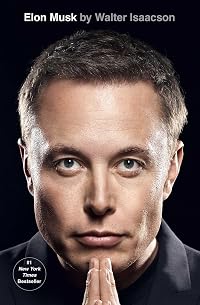
Elon Musk
by Walter Isaacson
On This Page
Description
"From the author of Steve Jobs and other bestselling biographies, this is the astonishingly intimate story of the most fascinating and controversial innovator of our era--a rule-breaking visionary who helped to lead the world into the era of electric vehicles, private space exploration, and artificial intelligence. Oh, and took over Twitter"--Tags
Recommendations

Member Reviews
On a day when Elon Musk, richest man in the world, donates a 'sizeable sum' to Donald Trump's campaign after a bungled assassination attempt, this blockbuster biography may be a 'must-read' to help understand the possible future relationship of capital to politics at the heart of the imperium.
Musk is 'sui generis'. A man with Aspergers who cannot be understood except in the light of his brain structure. He is not normal and he does not mind who knows it. Loathed and admired in equal proportions, few can look on him with equanimity or complete objectivity.
To be fair, Professor Isaacson, despite being alongside Musk for a couple of years and so potentially subject to influence, manages to present a 'warts and all' biography which will show more ensure that admiration will be tempered by an understanding of his risky and often unintentionally cruel behaviour.
Musk is complex. His achievements are undoubted and are based on a peculiar mind-set that places technocratic ambitions for the safety of future humanity at the root of major projects that take phenomenal risks based on a single-minded ruthless ambition.
We have here the man who, inter alia, triggered the EV revolution with Tesla and the space economy with SpaceX, originally led the world in attempting to control AI including the man/machine interface through Neuralink and dictated the terms of the Ukraine war through Starlink.
He contributed to the mass take-up of household solar energy (though this was commercially less successful than most of his enterprises) and his interesting super-liberal view of free speech and interest in a total financial services platform led to his troubled acquisition of Twitter, now X.
This commitment to free speech (which it turned out he imperfectly understood despite his 'genius' much as he had to learn international relations on the hoof in the case of Ukraine) is worth understanding. It is not some abstract ideological interest but pragmatic.
He, I think rightly, understands that problems are only solvable under conditions of vigorous open debate (even if his personality often squashes dissent in his own operations) and that the more complex the problem, the more debate is required.
His caveat is the 'law of physics'. He is a true technocrat. Any problem that can be solved according to the law of physics should be solved and immense risks taken to solve it at that. Politics and human problems are, however, beyond physics and their complexity requires constant struggle.
To get the best outcome in society and politically, he seems to see free speech as an essential tool. Controlled speech results in skewed models of reality run by those who do the controlling. A skewed model of social reality is as bad as ignoring the laws of physics in engineering and materials science.
Musk is also a mass of contradictions evidenced by his own behaviours including a complete disregard of the family lives of the human raw material used in his great projects yes a highly ethical (by his own lights) if sometimes clumsy approach to his complicated private relations.
His private behaviours are his and his family's business but Musk becomes our business when he creates a new economy with social effects and engages in a political world that he massively influences but evidently still imperfectly understands (although no learner could be faster).
His 'genius' lay originally largely in rethinking the commercial base for heavyweight manufacturing for the 'new economy'. He is rightly seen as a 'tech billionaire' given his awareness of the value of the data generated by his inventiveness and how it can be cross-pollinated for profit.
However, what is also clear is that his approach to manufacturing was also ground-breaking both in understanding material science and cost control (taking risks that permitted expensive mistakes in order to learn) and in bringing production back into the shortest possible supply chain process.
The book gives us almost a standard behaviour pattern linked to his personality. First, the idea and using his reputational credit to ensure funding. Then the moment of realisation that to make it work, he has to live and sleep the product - there is a pattern of sleeping on factory and office floors.
If he has to live and sleep the product so does everyone else until the problems are solved and the product is rolling off the line as the best thing the customer can get at the right price and then he moves on to the next project, adopting the same method and burning out everyone around him.
His attitude to people is ruthless but not from malice. He simply does not take into account their 'being' outside their role as agents of his vision of progress. The secret to this probably lies in the influence of the high libertarian and militaristic science fiction that formed him as a boy.
There is story after story in this book (reported fairly by Isaacson) of people part of his 'fun' inner circle at the centre of his project and then literally forgotten once he has moved on. This man forgets even his rages and bullying once he has triggered the action he wants.
So many 'victims' still (an engineers' version of 'Stockholm Syndrome' perhaps) still look on him with awe and respect despite his callous behaviours because working with him was evidently the most intense period of their lives and they know that he and they achieved something significant.
This is why judging the man is difficult. He is not entirely the self-centred robber baron of the gilded age. He does not screw the workers simply to buy Italian statues and high class British aristocratic wives. He really does think his mission is not to make money but to save humanity.
This gives any of us who care about how people are treated in life and the rights of working people some pause for thought because Musk reminds us of a more constrained and more decent Stalin, driving humanity for some greater cause, far from the usual capitalist baron.
The problem is that, forgetting socialist alternatives for the moment, Musk seems to suggest that great things will be achieved through libertarian struggle and risk that will benefit humanity whereas traditional fat cat corporatism tends benefit most the management class and their social lackeys.
Of course, there is a question here whether (in total) auto-electrification taking place years ahead of schedule, the entry of capitalism into space (let alone his passion for humanity reaching Mars) or man/machine interfaces are in fact beneficial to humanity. On that, the jury is out.
A lot of it depends on whether he has judged the world in ways that are credible because Aspergers may mean either that his view of human reality is flawed or perhaps far-seeing. We simply cannot know until what he thinks will happen actually happens or not.
For example, a great deal of his energy is directed into the production of massive new rocketry. This has been triggerede ultimately by his belief that humanity may be doomed because of its own irrational flaws and can only be saved if it is recolonised by human Martians one day.
Similarly, he (and he is not alone in this) sees AI as an existential threat to humanity, a genie let out of the bottle. Neuralink (man/machine interface) is a very deliberate attempt to create a means by which humans can control machines perhaps by becoming hybrid with them.
There is lots of meat to ponder in this book about how science fiction and fantasy shape men's minds, about the mind of the engineer, about risk (Musk is addicted to risk) and about childhood misery and trauma (which have played an undoubted role in shaping the man).
Indeed, Elon Musk is almost a character out of a 1950s science fiction story, one with the standard trope of a driven scientist prepared to sacrifice anything (including people) for the sake of progress and the future. A hero in the literature of the time and a puzzlement to ours.
His 'vision' extends to his private life. Unlike those pressimistic anti-natalists whining about global resources and wanting population reduced, Musk is almost Papal (or national socialist) in his belief in producing children. Children are, to him, an absolute good and he seems caring to his.
And he has a lot of them by traditional means, surrogacy and artificial insemination. Although he clearly cannot give them the attention they probably deserve, they are important to him. Family is pulled into his business dealings as much as any Murdoch ... if they can deliver.
Issacson has produced an exemplary contemporary biography although, of course, it ends in April 2023 and the story continues. It is also divided into two parts with very different characters - the first up to roughly January 2022 is conventional and based on many witness statements.
The second shifts from traditional biography to something closer to journalistic reportage since it based on Isaacson living alongside Musk and his events as they took place. We are taken through the acquisition of Twitter in considerable detail.
The character of the two parts is thus very different. Close observation of Musk gives us a less forgiving picture of the man. Close contact seemed to bring out an awareness in Isaacson of his brutality under pressure as he attempted to deal with people who were not always engineers.
This brings us on to the politics of Elon Musk which are not rigidly ideological as they are with, say, the libertarian Peter Thiel or simply concerned with corporate profit and so a disinterest in society and politics except as consumers, workers and suppliers as with Steve Jobs, say.
His ideology which we have outlined above as a set of technocratic and apocalyptic concerns about humanity is only contingently relate to any current political formation. He could be a Green except that its tendency to anti-natalism and its anti-growth stance are inimical to hm.
He starts out as a fairly standard issue liberal Democrat with low interest in politics. He meets and is unimpressed with Donald Trump. Yet here, in mid-2024, we find that he is committed, it would seem, to the Republican populist cause. The trajectory is partially explained in the book.
Some of it is unclear but we might identify the self interest involved in corporate taxation measures (although he arranged affairs to deliver $11bn of taxes he did not need to, perhaps to show that such grants should be his decision). Probably he perceives them as anti-growth.
Then there is his free speech concern under conditions where it is the liberal-left and centrists, whether in the US or, more recently, the EU, who are trying to control what people say as a precursor to controlling what people do and perhaps what they think.
Then there is his experience of the military-industrial complex which is ambivalent to say the least. He profits immensely from it through SpaceX and Starlink but is also aware of the vested interests he out-manouevred in order to cut space costs by a huge margin.
Ukraine seems to have shaken him to the core. He stepped in to halt the use of Starlink to attack Crimea while being one of the first (with his usual initial political naivete) to support Kiev by supplying Starlink for Ukraine's defence. He genuinely feared escalation to nuclear conflict.
Humanity destroying itself is one of his background concerns and his investments seem designed to create the conditions to avert apocalypse (whether climate change, nuclear apocalypse or out-of control AI) and to ensure human survival (rockets to Mars) in the event it happens.
Whatever he does there is an acute intertwining of self interest and forward-looking ideology. There is no change (he is right on this) without re-invested profits from growth but his commercial interests are still often looked at through the prism of ultimate ideological ends.
There is a fundamental psychology of fear here, almost certainly of the out of control behaviours of the humans he knows he does not understand fully. However, as a high functioning aspie with exceptionally high intelligence he can understand enough to stop it from the abyss.
This may be presumptuous of him. He may not fully understand how humanity is not an engineering problem but a biological one involving the half-hive mind of a species prepared to sacrifice huge numbers of its own kind to save the whole. The obscene cleansing of war need not be terminal.
In other words, humanity will probably survive despite the rational fears of engineers and aspies because it is self-correcting which is what evolution does but with the added advantage of humans being aware of the environment it needs to manipulate in order to survive.
From this perspective, Musk may be over-egging his pudding but, in doing so, he has added to the tools available to the species to improve its condition. He is not killing people doing it, unlike other visionaries and certainly unlike the monsters at the top of our competing States.
Nor would he, it is clear, if he could. He is life-affirmative. His a peacenik as Trump is more inclined to peace than war. It is good for business but also, in Musk's case, for humanity, albeit that he deals with the military-industrial economy out of necessity in order to build his space economy.
What will be interesting will be whether his advances in robotics (Optimus) will end up being used by the imperial military. Frankly, we would expect them to be so because Musk's ethics only seem to go so far and there is no sign that he is not committed to full spectrum American military dominance.
Musk's Tesla Gigafactories (massive factory operations) are to be found in California (which state he increasingly despises), Texas (which he increasingly treats as home), Berlin and China (where the Chinese broke their rule over joint ownership). He is looking at India.
He is a globalist but not of the sinister managerialist and manipulative WEF type. He would probably be in Russia if it was not a political bridge too far and perhaps in Africa, Brazil or Indonesia one day. As a former South African, he appears to think out of the American box.
So, all told, Isaacson is to be congratulated for producing an insightful and seemingly very honest account of this peculiar 'sacre monstre' who is part of the technocratic neo-feudal billionaire revolution and yet distinctive within it. He has presented us with a mass of contradictions.
If Varoufakis is right about capitalism being displaced by a new serfdom in which our existence is subject to data and 'licences' then Musk is the Duke of Norfolk. His autopilot data and the data from Twitter combined with the work at Neuralink and Optimus may yet change our lives radically.
He does not frighten me. The Democrat Party, the American Deep State and the European Union frighten me far more. However, this book tells us that we need to watch this man carefully because what he does is important and not easily understood in Manichean terms. show less
Musk is 'sui generis'. A man with Aspergers who cannot be understood except in the light of his brain structure. He is not normal and he does not mind who knows it. Loathed and admired in equal proportions, few can look on him with equanimity or complete objectivity.
To be fair, Professor Isaacson, despite being alongside Musk for a couple of years and so potentially subject to influence, manages to present a 'warts and all' biography which will show more ensure that admiration will be tempered by an understanding of his risky and often unintentionally cruel behaviour.
Musk is complex. His achievements are undoubted and are based on a peculiar mind-set that places technocratic ambitions for the safety of future humanity at the root of major projects that take phenomenal risks based on a single-minded ruthless ambition.
We have here the man who, inter alia, triggered the EV revolution with Tesla and the space economy with SpaceX, originally led the world in attempting to control AI including the man/machine interface through Neuralink and dictated the terms of the Ukraine war through Starlink.
He contributed to the mass take-up of household solar energy (though this was commercially less successful than most of his enterprises) and his interesting super-liberal view of free speech and interest in a total financial services platform led to his troubled acquisition of Twitter, now X.
This commitment to free speech (which it turned out he imperfectly understood despite his 'genius' much as he had to learn international relations on the hoof in the case of Ukraine) is worth understanding. It is not some abstract ideological interest but pragmatic.
He, I think rightly, understands that problems are only solvable under conditions of vigorous open debate (even if his personality often squashes dissent in his own operations) and that the more complex the problem, the more debate is required.
His caveat is the 'law of physics'. He is a true technocrat. Any problem that can be solved according to the law of physics should be solved and immense risks taken to solve it at that. Politics and human problems are, however, beyond physics and their complexity requires constant struggle.
To get the best outcome in society and politically, he seems to see free speech as an essential tool. Controlled speech results in skewed models of reality run by those who do the controlling. A skewed model of social reality is as bad as ignoring the laws of physics in engineering and materials science.
Musk is also a mass of contradictions evidenced by his own behaviours including a complete disregard of the family lives of the human raw material used in his great projects yes a highly ethical (by his own lights) if sometimes clumsy approach to his complicated private relations.
His private behaviours are his and his family's business but Musk becomes our business when he creates a new economy with social effects and engages in a political world that he massively influences but evidently still imperfectly understands (although no learner could be faster).
His 'genius' lay originally largely in rethinking the commercial base for heavyweight manufacturing for the 'new economy'. He is rightly seen as a 'tech billionaire' given his awareness of the value of the data generated by his inventiveness and how it can be cross-pollinated for profit.
However, what is also clear is that his approach to manufacturing was also ground-breaking both in understanding material science and cost control (taking risks that permitted expensive mistakes in order to learn) and in bringing production back into the shortest possible supply chain process.
The book gives us almost a standard behaviour pattern linked to his personality. First, the idea and using his reputational credit to ensure funding. Then the moment of realisation that to make it work, he has to live and sleep the product - there is a pattern of sleeping on factory and office floors.
If he has to live and sleep the product so does everyone else until the problems are solved and the product is rolling off the line as the best thing the customer can get at the right price and then he moves on to the next project, adopting the same method and burning out everyone around him.
His attitude to people is ruthless but not from malice. He simply does not take into account their 'being' outside their role as agents of his vision of progress. The secret to this probably lies in the influence of the high libertarian and militaristic science fiction that formed him as a boy.
There is story after story in this book (reported fairly by Isaacson) of people part of his 'fun' inner circle at the centre of his project and then literally forgotten once he has moved on. This man forgets even his rages and bullying once he has triggered the action he wants.
So many 'victims' still (an engineers' version of 'Stockholm Syndrome' perhaps) still look on him with awe and respect despite his callous behaviours because working with him was evidently the most intense period of their lives and they know that he and they achieved something significant.
This is why judging the man is difficult. He is not entirely the self-centred robber baron of the gilded age. He does not screw the workers simply to buy Italian statues and high class British aristocratic wives. He really does think his mission is not to make money but to save humanity.
This gives any of us who care about how people are treated in life and the rights of working people some pause for thought because Musk reminds us of a more constrained and more decent Stalin, driving humanity for some greater cause, far from the usual capitalist baron.
The problem is that, forgetting socialist alternatives for the moment, Musk seems to suggest that great things will be achieved through libertarian struggle and risk that will benefit humanity whereas traditional fat cat corporatism tends benefit most the management class and their social lackeys.
Of course, there is a question here whether (in total) auto-electrification taking place years ahead of schedule, the entry of capitalism into space (let alone his passion for humanity reaching Mars) or man/machine interfaces are in fact beneficial to humanity. On that, the jury is out.
A lot of it depends on whether he has judged the world in ways that are credible because Aspergers may mean either that his view of human reality is flawed or perhaps far-seeing. We simply cannot know until what he thinks will happen actually happens or not.
For example, a great deal of his energy is directed into the production of massive new rocketry. This has been triggerede ultimately by his belief that humanity may be doomed because of its own irrational flaws and can only be saved if it is recolonised by human Martians one day.
Similarly, he (and he is not alone in this) sees AI as an existential threat to humanity, a genie let out of the bottle. Neuralink (man/machine interface) is a very deliberate attempt to create a means by which humans can control machines perhaps by becoming hybrid with them.
There is lots of meat to ponder in this book about how science fiction and fantasy shape men's minds, about the mind of the engineer, about risk (Musk is addicted to risk) and about childhood misery and trauma (which have played an undoubted role in shaping the man).
Indeed, Elon Musk is almost a character out of a 1950s science fiction story, one with the standard trope of a driven scientist prepared to sacrifice anything (including people) for the sake of progress and the future. A hero in the literature of the time and a puzzlement to ours.
His 'vision' extends to his private life. Unlike those pressimistic anti-natalists whining about global resources and wanting population reduced, Musk is almost Papal (or national socialist) in his belief in producing children. Children are, to him, an absolute good and he seems caring to his.
And he has a lot of them by traditional means, surrogacy and artificial insemination. Although he clearly cannot give them the attention they probably deserve, they are important to him. Family is pulled into his business dealings as much as any Murdoch ... if they can deliver.
Issacson has produced an exemplary contemporary biography although, of course, it ends in April 2023 and the story continues. It is also divided into two parts with very different characters - the first up to roughly January 2022 is conventional and based on many witness statements.
The second shifts from traditional biography to something closer to journalistic reportage since it based on Isaacson living alongside Musk and his events as they took place. We are taken through the acquisition of Twitter in considerable detail.
The character of the two parts is thus very different. Close observation of Musk gives us a less forgiving picture of the man. Close contact seemed to bring out an awareness in Isaacson of his brutality under pressure as he attempted to deal with people who were not always engineers.
This brings us on to the politics of Elon Musk which are not rigidly ideological as they are with, say, the libertarian Peter Thiel or simply concerned with corporate profit and so a disinterest in society and politics except as consumers, workers and suppliers as with Steve Jobs, say.
His ideology which we have outlined above as a set of technocratic and apocalyptic concerns about humanity is only contingently relate to any current political formation. He could be a Green except that its tendency to anti-natalism and its anti-growth stance are inimical to hm.
He starts out as a fairly standard issue liberal Democrat with low interest in politics. He meets and is unimpressed with Donald Trump. Yet here, in mid-2024, we find that he is committed, it would seem, to the Republican populist cause. The trajectory is partially explained in the book.
Some of it is unclear but we might identify the self interest involved in corporate taxation measures (although he arranged affairs to deliver $11bn of taxes he did not need to, perhaps to show that such grants should be his decision). Probably he perceives them as anti-growth.
Then there is his free speech concern under conditions where it is the liberal-left and centrists, whether in the US or, more recently, the EU, who are trying to control what people say as a precursor to controlling what people do and perhaps what they think.
Then there is his experience of the military-industrial complex which is ambivalent to say the least. He profits immensely from it through SpaceX and Starlink but is also aware of the vested interests he out-manouevred in order to cut space costs by a huge margin.
Ukraine seems to have shaken him to the core. He stepped in to halt the use of Starlink to attack Crimea while being one of the first (with his usual initial political naivete) to support Kiev by supplying Starlink for Ukraine's defence. He genuinely feared escalation to nuclear conflict.
Humanity destroying itself is one of his background concerns and his investments seem designed to create the conditions to avert apocalypse (whether climate change, nuclear apocalypse or out-of control AI) and to ensure human survival (rockets to Mars) in the event it happens.
Whatever he does there is an acute intertwining of self interest and forward-looking ideology. There is no change (he is right on this) without re-invested profits from growth but his commercial interests are still often looked at through the prism of ultimate ideological ends.
There is a fundamental psychology of fear here, almost certainly of the out of control behaviours of the humans he knows he does not understand fully. However, as a high functioning aspie with exceptionally high intelligence he can understand enough to stop it from the abyss.
This may be presumptuous of him. He may not fully understand how humanity is not an engineering problem but a biological one involving the half-hive mind of a species prepared to sacrifice huge numbers of its own kind to save the whole. The obscene cleansing of war need not be terminal.
In other words, humanity will probably survive despite the rational fears of engineers and aspies because it is self-correcting which is what evolution does but with the added advantage of humans being aware of the environment it needs to manipulate in order to survive.
From this perspective, Musk may be over-egging his pudding but, in doing so, he has added to the tools available to the species to improve its condition. He is not killing people doing it, unlike other visionaries and certainly unlike the monsters at the top of our competing States.
Nor would he, it is clear, if he could. He is life-affirmative. His a peacenik as Trump is more inclined to peace than war. It is good for business but also, in Musk's case, for humanity, albeit that he deals with the military-industrial economy out of necessity in order to build his space economy.
What will be interesting will be whether his advances in robotics (Optimus) will end up being used by the imperial military. Frankly, we would expect them to be so because Musk's ethics only seem to go so far and there is no sign that he is not committed to full spectrum American military dominance.
Musk's Tesla Gigafactories (massive factory operations) are to be found in California (which state he increasingly despises), Texas (which he increasingly treats as home), Berlin and China (where the Chinese broke their rule over joint ownership). He is looking at India.
He is a globalist but not of the sinister managerialist and manipulative WEF type. He would probably be in Russia if it was not a political bridge too far and perhaps in Africa, Brazil or Indonesia one day. As a former South African, he appears to think out of the American box.
So, all told, Isaacson is to be congratulated for producing an insightful and seemingly very honest account of this peculiar 'sacre monstre' who is part of the technocratic neo-feudal billionaire revolution and yet distinctive within it. He has presented us with a mass of contradictions.
If Varoufakis is right about capitalism being displaced by a new serfdom in which our existence is subject to data and 'licences' then Musk is the Duke of Norfolk. His autopilot data and the data from Twitter combined with the work at Neuralink and Optimus may yet change our lives radically.
He does not frighten me. The Democrat Party, the American Deep State and the European Union frighten me far more. However, this book tells us that we need to watch this man carefully because what he does is important and not easily understood in Manichean terms. show less
Even though Elon Musk is a controversial person now more than ever, I enjoy learning about people and understanding their unique lives. Walter Isaacson’s writings are particularly esteemed, and I eagerly purchased his book, “Elon Musk,” upon its release in 2023. However, like many of my book purchases, it took me some time to get around to reading it. Elon Musk is renowned for his impulsive decisions and thoughtless comments. Given the political drama that has unfolded in 2025, I believe this is the opportune moment to read this book.
Isaacson’s book beautifully captures the intricate life of Elon Musk. Through meticulous research and two years of observation and interaction, he interviewed Musk’s closest associates, both show more personally and professionally. The inclusion of photographs at the beginning of each chapter is a valuable addition, providing visual context and helping readers connect with the characters and their surroundings.
The book was written in a captivating, intriguing, and easily understandable manner. Although I’m not well-versed in rockets and robots, Isaacson presented technical information in a way that was both comprehensible and engaging. I was particularly impressed that the book covered events that occurred well into 2023, the year it was published.
Reading this biography has been incredibly enlightening. I discovered aspects of Musk that I admire and gained insights into why he can be challenging to work with. It was insightful to learn about his upbringing, which primarily involved abuse from his father and bullying at school and within his community. Understanding his personality and how his relationship with his father shaped his life sheds light on his behavior and impulsive decisions. Musk is an avid reader and a voracious seeker of knowledge. Regarding his companies, I admire his willingness and eagerness to learn and apply new knowledge firsthand. Unlike traditional management roles, he actively participates in the trenches, building and creating. I appreciate his drive to use his products to benefit humanity. He genuinely cares about improving the world. Now, I understand Musk’s obsession with sending people to Mars. While I may not have the desire to move to Mars, I now understand his motivation.
Elon Musk is undoubtedly a challenging person to work with. He demands the same level of intensity from his employees as he puts forth, which creates an unhealthy work-life balance. Many employees find themselves leaving after periods of extreme exertion and neglecting their family time. Musk’s impulsiveness and tendency to thrive on intense drama further complicate matters. Additionally, his Asperger’s syndrome may contribute to his lack of empathy and compassion for others.
It’s quite intriguing that Musk didn’t favor Trump during his first presidency. I’m curious to understand what factors led to a shift in his opinion of Trump. The book provides valuable insights into the reasons behind his transition from aligning with Democrats to Republicans. I’ve noticed striking parallels between Musk’s takeover of Twitter and the subsequent changes in the federal government.
In conclusion, two individuals whom Isaacson interviewed offered insightful conclusions about Musk that resonated with me. Bill Gates remarked, “You can feel whatever you want about Elon's behavior, but there is no one in our time who has done more to push the bounds of science and innovation than he has.” Yoel Roth, a Twitter employee who played a crucial role in helping Musk acclimate to the company, shared his perspective, saying, “People want me to say I hate him, but it's much more complicated, which, I suppose, is what makes him interesting. He's a bit of an idealist, right? He has a set of grand visions, whether it's multi-planetary humanity or renewable energy and even free speech. And he has constructed for himself a moral and ethical universe that is focused on the delivery of those big goals. I think that makes it hard to villainize him.”
I have photos and additional information that I'm unable to include here. It can all be found on my blog, in the link below.
A Book And A Dog show less
Isaacson’s book beautifully captures the intricate life of Elon Musk. Through meticulous research and two years of observation and interaction, he interviewed Musk’s closest associates, both show more personally and professionally. The inclusion of photographs at the beginning of each chapter is a valuable addition, providing visual context and helping readers connect with the characters and their surroundings.
The book was written in a captivating, intriguing, and easily understandable manner. Although I’m not well-versed in rockets and robots, Isaacson presented technical information in a way that was both comprehensible and engaging. I was particularly impressed that the book covered events that occurred well into 2023, the year it was published.
Reading this biography has been incredibly enlightening. I discovered aspects of Musk that I admire and gained insights into why he can be challenging to work with. It was insightful to learn about his upbringing, which primarily involved abuse from his father and bullying at school and within his community. Understanding his personality and how his relationship with his father shaped his life sheds light on his behavior and impulsive decisions. Musk is an avid reader and a voracious seeker of knowledge. Regarding his companies, I admire his willingness and eagerness to learn and apply new knowledge firsthand. Unlike traditional management roles, he actively participates in the trenches, building and creating. I appreciate his drive to use his products to benefit humanity. He genuinely cares about improving the world. Now, I understand Musk’s obsession with sending people to Mars. While I may not have the desire to move to Mars, I now understand his motivation.
Elon Musk is undoubtedly a challenging person to work with. He demands the same level of intensity from his employees as he puts forth, which creates an unhealthy work-life balance. Many employees find themselves leaving after periods of extreme exertion and neglecting their family time. Musk’s impulsiveness and tendency to thrive on intense drama further complicate matters. Additionally, his Asperger’s syndrome may contribute to his lack of empathy and compassion for others.
It’s quite intriguing that Musk didn’t favor Trump during his first presidency. I’m curious to understand what factors led to a shift in his opinion of Trump. The book provides valuable insights into the reasons behind his transition from aligning with Democrats to Republicans. I’ve noticed striking parallels between Musk’s takeover of Twitter and the subsequent changes in the federal government.
In conclusion, two individuals whom Isaacson interviewed offered insightful conclusions about Musk that resonated with me. Bill Gates remarked, “You can feel whatever you want about Elon's behavior, but there is no one in our time who has done more to push the bounds of science and innovation than he has.” Yoel Roth, a Twitter employee who played a crucial role in helping Musk acclimate to the company, shared his perspective, saying, “People want me to say I hate him, but it's much more complicated, which, I suppose, is what makes him interesting. He's a bit of an idealist, right? He has a set of grand visions, whether it's multi-planetary humanity or renewable energy and even free speech. And he has constructed for himself a moral and ethical universe that is focused on the delivery of those big goals. I think that makes it hard to villainize him.”
I have photos and additional information that I'm unable to include here. It can all be found on my blog, in the link below.
A Book And A Dog show less
Great googly-moogly does this man have a favourite child!
There are times when Elon’s side of the story invokes some genuine empathy, especially about his family. Other times the book comes off as a desperate attempt to recover pieces of a crumbling public image.
Most times, he just comes off as an arse.
The author does a great job of folding in a bit of every Musk production, from Paypal to Neuralink. The Boring Company was scarcely mentioned, which makes me wonder if ol’ Musky is still a bit tender on the topic. Tesla is also handled very delicately since he’s in deep legal shenanigans with shareholders even as I write this review. SpaceX represents a large proportion of Musk’s professional recollections, and his many romantic show more dramas take up much of the personal.
Isaacson’s biography cuts shockingly close to the present day, making it a surprisingly illuminating glance into the Twitter takeover. I found myself pausing frequently to compare the book’s recollection of events with journalists’ articles. As you probably suspect, there are discrepancies.
Intentional or not, the most interesting part of the book is watching Musk slowly slide from an idealistic (if abrasive) tech pioneer to an emotional and reactive sycophant. Isaacson is sure to highlight the exact moments Elon’s political opinions begin taking over his professional life. His complicated political values, and his borderline delusional commitment to them, take up much of the latter third of the book. If you’re in this read exclusively for rocketry, you’re going to find yourself bored.
There are many places I feel Isaacson was more honest than Elon would probably have liked, and many moments that I feel Elon had meddled with. Such is life when the subject of the biography is still alive.
In the end, I think this work treads a delicate line, and everyone except the most hardline haters and fanboys will find it fascinating. show less
There are times when Elon’s side of the story invokes some genuine empathy, especially about his family. Other times the book comes off as a desperate attempt to recover pieces of a crumbling public image.
Most times, he just comes off as an arse.
The author does a great job of folding in a bit of every Musk production, from Paypal to Neuralink. The Boring Company was scarcely mentioned, which makes me wonder if ol’ Musky is still a bit tender on the topic. Tesla is also handled very delicately since he’s in deep legal shenanigans with shareholders even as I write this review. SpaceX represents a large proportion of Musk’s professional recollections, and his many romantic show more dramas take up much of the personal.
Isaacson’s biography cuts shockingly close to the present day, making it a surprisingly illuminating glance into the Twitter takeover. I found myself pausing frequently to compare the book’s recollection of events with journalists’ articles. As you probably suspect, there are discrepancies.
Intentional or not, the most interesting part of the book is watching Musk slowly slide from an idealistic (if abrasive) tech pioneer to an emotional and reactive sycophant. Isaacson is sure to highlight the exact moments Elon’s political opinions begin taking over his professional life. His complicated political values, and his borderline delusional commitment to them, take up much of the latter third of the book. If you’re in this read exclusively for rocketry, you’re going to find yourself bored.
There are many places I feel Isaacson was more honest than Elon would probably have liked, and many moments that I feel Elon had meddled with. Such is life when the subject of the biography is still alive.
In the end, I think this work treads a delicate line, and everyone except the most hardline haters and fanboys will find it fascinating. show less
[4.25] My inner-voice taunted me as I proceeded to check out this bulky biography. “Do you really want to invest the time to read more than 600 pages about Elon Musk?” Candidly, I wasn’t sure. As many of my reviews have noted, any tome that exceeds 400 pages has to be exceptional to keep my attention. Isaacson passed the test with flying colors. Certainly, my lifelong interest in all-things-business was undoubtedly a factor. I was fascinated by Isaacson’s deep-dives into the inner workings of Tesla, Space X, Neuralink and the company that was once known as Twitter. A value added feature was learning stuff about a Musk-inspired company I had never even heard of before: The Boring Company. This meticulously researched biography is show more anything but boring. Musk’s quirky and multidimensional persona kept this saga moving at an impressive clip. My only minor criticism is that there were numerous passages that spurred me to wonder if the biographer may have become a bit too “chummy” with his subject. As a lifelong journalist, I’ve always believed in the importance of some level of detachment between the journalist and the source. I can understand why some readers have wondered aloud whether Isaacson’s two-year encounter with Musk may have steered him off the path of impartiality. This is certainly not to imply that the biographer gave short shrift to any of Musk’s glaring flaws. But there are several sections that feel a bit like the biographer became a friend or sympathetic therapist. show less
The author Walter Isaacson told the Wall Street Journal that Musk vowed to surprise him with the degree of transparency he would be allowed as he shadowed his subject for two years (see Acknowledgements at the back.) He never had the impression that Musk was sugar-coating his behaviour for a witness. This seems like as fair a path to objectivity, but it is worth bearing in mind as you read that almost every one of the author's previous subjects provided the wonderful convenience of being deceased.
This was my first time reading the biography of a fellow Gen-Xer. Elon Musk distinguished himself early with his ambition and audacity. Imagine securing a student summer job by cold-calling a high level bank executive and requesting a luncheon. show more He was an early adapter of the internet and "caught the wave", living on a shoestring to score some early wins with his talents that made him a millionaire before he was thirty. Perhaps the most remarkable moment in this entire book is that he didn't retire and end his story there.
Isaacson does not shy away from portraying the downside of Musk's character. Musk is a far cry from a people person, something rooted in his psyche from a rough and tumble childhood but also a factor of his undiagnosed Aspergers. He has an incredible ability to focus, and the envious characteristic of not prioritizing making dollars ahead of achieving his goals, backed by an extreme confidence in his ability to find required money for his ventures one way or another when need be thanks to a good eye for monetization opportunities. By 2009, when Space X and Tesla got onto firmer ground, he was well established as someone whose financial success you did not want to bet against in the long term.
The biography of a man who takes on risk will always offer the greatest stories, and there are a few of those here such as when Elon offers to demonstrate what his car can do when he floors it, or his rules for building rockets that left NASA in his dust. They can be entertaining and disturbing at the same time, citing disregard for the consequences of his actions.
While short chapters makes the reading easier, sometimes this approach can't bring the whole picture together of a moment in time or even stay completely chronological. I'm sorry more time wasn't spent exploring Musk's formative years. Other than family there's very little perspective from adults who knew him as a child or struggling student; could none of them be found? There were points where I wanted to stop the narrative and ask questions. Why did social life suddenly begin to matter to Musk at the time when he was selecting a university? When did he come up with the concept for Ad Astra, the private school he founded for family and friends, and how does it differ from the public system? It doesn't even rate an index entry (see Chapter 56, page 344.)
An unannounced shift in style and tone occurs about halfway through the book, after which Isaacson is present in Musk's story. This latter half is much slower, devoted to just the past three years. The impression given by this strange time dilation is of a life that has recently snowballed. One of the factors excusing it is the huge broadening of Musk's interests after Space X and Tesla were on their feet: self-driving cars, artificial intelligence, neural networks, neural links, solar energy, underground tunnellling, Starlink, Starship, humanoid robots, etc. The other is the more public face that Musk began to present: the public appearances, the statements and tweets up to time of publication.
Twitter dominates the book's last quarter. The intent here is probably (and again, it's not distinguished or spelled out) to offer it up as a case study of how Musk operates by delving into the minutiae, but it's unfortunate that this has to be the example Isaacson witnessed and can best report on. Twitter is the least interesting venture that Musk has involved himself in, being outside of the science and innovation sphere. Both its most interesting and troubling aspect is his hack-and-slash approach to HR, turning the company from a dream work site into a pit of despair for even its hardiest hangers-on. This pairs with the details of his personal life that demonstrate Elon will never be mistaken for a "people person".
Musk presents himself, though never in so many words, as a hero working for the good of the world. But he more closely resembles a cartoon villain in at least one significant respect: you cannot be one of his sidekicks and feel comfortable in the seat. At least a reader of this biography is spared the bother of remembering most of their names. This cannot be the definitive biography on Elon Musk to settle the good/evil question (edit: it ends, for example, before his participation in Trump's 2024 campaign). The subject himself must become history for a more complete picture that can place the correct emphasis where it belongs, conveying an even tone and approach from cover to cover. But, depending on your age, this may be the best one about Musk you're going to read. show less
This was my first time reading the biography of a fellow Gen-Xer. Elon Musk distinguished himself early with his ambition and audacity. Imagine securing a student summer job by cold-calling a high level bank executive and requesting a luncheon. show more He was an early adapter of the internet and "caught the wave", living on a shoestring to score some early wins with his talents that made him a millionaire before he was thirty. Perhaps the most remarkable moment in this entire book is that he didn't retire and end his story there.
Isaacson does not shy away from portraying the downside of Musk's character. Musk is a far cry from a people person, something rooted in his psyche from a rough and tumble childhood but also a factor of his undiagnosed Aspergers. He has an incredible ability to focus, and the envious characteristic of not prioritizing making dollars ahead of achieving his goals, backed by an extreme confidence in his ability to find required money for his ventures one way or another when need be thanks to a good eye for monetization opportunities. By 2009, when Space X and Tesla got onto firmer ground, he was well established as someone whose financial success you did not want to bet against in the long term.
The biography of a man who takes on risk will always offer the greatest stories, and there are a few of those here such as when Elon offers to demonstrate what his car can do when he floors it, or his rules for building rockets that left NASA in his dust. They can be entertaining and disturbing at the same time, citing disregard for the consequences of his actions.
While short chapters makes the reading easier, sometimes this approach can't bring the whole picture together of a moment in time or even stay completely chronological. I'm sorry more time wasn't spent exploring Musk's formative years. Other than family there's very little perspective from adults who knew him as a child or struggling student; could none of them be found? There were points where I wanted to stop the narrative and ask questions. Why did social life suddenly begin to matter to Musk at the time when he was selecting a university? When did he come up with the concept for Ad Astra, the private school he founded for family and friends, and how does it differ from the public system? It doesn't even rate an index entry (see Chapter 56, page 344.)
An unannounced shift in style and tone occurs about halfway through the book, after which Isaacson is present in Musk's story. This latter half is much slower, devoted to just the past three years. The impression given by this strange time dilation is of a life that has recently snowballed. One of the factors excusing it is the huge broadening of Musk's interests after Space X and Tesla were on their feet: self-driving cars, artificial intelligence, neural networks, neural links, solar energy, underground tunnellling, Starlink, Starship, humanoid robots, etc. The other is the more public face that Musk began to present: the public appearances, the statements and tweets up to time of publication.
Twitter dominates the book's last quarter. The intent here is probably (and again, it's not distinguished or spelled out) to offer it up as a case study of how Musk operates by delving into the minutiae, but it's unfortunate that this has to be the example Isaacson witnessed and can best report on. Twitter is the least interesting venture that Musk has involved himself in, being outside of the science and innovation sphere. Both its most interesting and troubling aspect is his hack-and-slash approach to HR, turning the company from a dream work site into a pit of despair for even its hardiest hangers-on. This pairs with the details of his personal life that demonstrate Elon will never be mistaken for a "people person".
Musk presents himself, though never in so many words, as a hero working for the good of the world. But he more closely resembles a cartoon villain in at least one significant respect: you cannot be one of his sidekicks and feel comfortable in the seat. At least a reader of this biography is spared the bother of remembering most of their names. This cannot be the definitive biography on Elon Musk to settle the good/evil question (edit: it ends, for example, before his participation in Trump's 2024 campaign). The subject himself must become history for a more complete picture that can place the correct emphasis where it belongs, conveying an even tone and approach from cover to cover. But, depending on your age, this may be the best one about Musk you're going to read. show less
I’ve read a number of the author’s biographies over the years and have been pleased with most of them. His biography of Steven Jobs was outstanding. It stands to reason that a biography of Elon Musk, in many ways similar to Jobs, would be equally compelling.
As the author points out, while Jobs and Musk share many personality similarities, and have both been wildly successful in building enormous, society-changing companies, they are different in one key respect. Jobs was almost exclusively an idea man and a marketer, while Musk is more of an engineering and production savant.
Musk has been said to suffer from Asperger’s Syndrome, and his wild mood swings and almost total lack of empathy may support this diagnosis, but whatever the show more reason, he comes across as a pretty miserable human being.
Without question, the companies he has developed, chief (though not exclusively) among them Tesla and SpaceX, have transformed major market segments, largely, if not exclusively owing to his personal force of will, and the ruthless manner he has treated his subordinates. The robber barons of the early 20th century pale by comparison.
The writing style used by the author in this work differs greatly from his previous work, and from any other biography I have read. There are numerous (70) “chapters”, of very short length, which are further broken up into roughly one page “subchapters” with subject headings. This makes for a very choppy reading experience, but I can’t say it is not effective.
A good biography is largely driven by the subject, and in Steve Jobs and Elon Musk, Isaacson chose two fascinating subjects. It can be argued that Isaacson was a little premature in going to press, as much of Musk’s work is “in progress”. SpaceX steadily advances and his success with X remains in question. His work in the Trump administration came too late to be included, which is a shame, because it would make a fascinating story. show less
As the author points out, while Jobs and Musk share many personality similarities, and have both been wildly successful in building enormous, society-changing companies, they are different in one key respect. Jobs was almost exclusively an idea man and a marketer, while Musk is more of an engineering and production savant.
Musk has been said to suffer from Asperger’s Syndrome, and his wild mood swings and almost total lack of empathy may support this diagnosis, but whatever the show more reason, he comes across as a pretty miserable human being.
Without question, the companies he has developed, chief (though not exclusively) among them Tesla and SpaceX, have transformed major market segments, largely, if not exclusively owing to his personal force of will, and the ruthless manner he has treated his subordinates. The robber barons of the early 20th century pale by comparison.
The writing style used by the author in this work differs greatly from his previous work, and from any other biography I have read. There are numerous (70) “chapters”, of very short length, which are further broken up into roughly one page “subchapters” with subject headings. This makes for a very choppy reading experience, but I can’t say it is not effective.
A good biography is largely driven by the subject, and in Steve Jobs and Elon Musk, Isaacson chose two fascinating subjects. It can be argued that Isaacson was a little premature in going to press, as much of Musk’s work is “in progress”. SpaceX steadily advances and his success with X remains in question. His work in the Trump administration came too late to be included, which is a shame, because it would make a fascinating story. show less
Elon Musk is a fascinating person. Mr. Isaacson has given us a portrait of his genius, temperament, achievements, and relationships.
I like the way the book provided a deep dive into the inner workings of Mr. Musk's companies: Tesla, SpaceX and his early days at Twitter. He is so driven and expects everyone around him to be totally devoted to their jobs. He is a difficult boss who can also be inspirational. He has an extremely high tolerance for risk that can make it difficult to work for him. But look at what he's achieved!
This book had a different tone from most of the other works by Mr. Isaacson that I've read. It is the second of his books about living people that I've read (the other being Code Breaker) and I was surprised that the show more author inserted himself in the latter part of the book. I was also disappointed that the book wasn't always chronological, which had me wondering where the subject was in his personal life while various work challenges were presenting themselves (or being created by Mr. Musk).
In spite of that, Mr. Isaacson has done his usual great job of bringing a well researched, multidimensional subject to the reader in an inspiring way.
p.s. I loved Maye Musk, Elon's mother. She is an inspiration herself! show less
I like the way the book provided a deep dive into the inner workings of Mr. Musk's companies: Tesla, SpaceX and his early days at Twitter. He is so driven and expects everyone around him to be totally devoted to their jobs. He is a difficult boss who can also be inspirational. He has an extremely high tolerance for risk that can make it difficult to work for him. But look at what he's achieved!
This book had a different tone from most of the other works by Mr. Isaacson that I've read. It is the second of his books about living people that I've read (the other being Code Breaker) and I was surprised that the show more author inserted himself in the latter part of the book. I was also disappointed that the book wasn't always chronological, which had me wondering where the subject was in his personal life while various work challenges were presenting themselves (or being created by Mr. Musk).
In spite of that, Mr. Isaacson has done his usual great job of bringing a well researched, multidimensional subject to the reader in an inspiring way.
p.s. I loved Maye Musk, Elon's mother. She is an inspiration herself! show less
Members
- Recently Added By
Lists

LoanStars | Adult List: September 2023
10 works; 1 member

Goodreads Choice Award 2023
26 works; 1 member

Books Read in 2024
4,727 works; 128 members

If Books Could Kill Podcast
52 works; 1 member
Author Information

Walter Isaacson was born on May 20, 1952 in New Orleans, Louisiana. He received a B. A. in history and literature from Harvard College. He then attended the University of Oxford, where he was a Rhodes Scholar at Pembroke College and read philosophy, politics, and economics. He began his career in journalism at The Sunday Times of London and then show more the New Orleans Times-Picayune/States-Item. He joined TIME in 1978 and served as a political correspondent, national editor and editor of new media before becoming the magazine's editor in 1996. He became Chairman and CEO of CNN in 2001, and then president and CEO of the Aspen Institute in 2003. He has written numerous books including American Sketches, Einstein: His Life and Universe, Benjamin Franklin: An American Life, Kissinger: A Biography, Steve Jobs, and The Innovators: How a Group of Hackers, Geniuses, and Geeks Created the Digital Revolution. He is the co-author, with Evan Thomas, of The Wise Men: Six Friends and the World They Made. (Bowker Author Biography) show less
Some Editions
Awards and Honors
Awards
Distinctions
Common Knowledge
- Canonical title*
- 馬斯克傳:唯一不設限、全公開傳記
- Original publication date
- 2023-12-09
- People/Characters
- Elon Musk; Maye Musk; Kimbal Musk; Grimes; X Ai A-Xii Musk
- Epigraph
- To anyone I've offended, I just want to say, I reinvented electric cars and I'm sending people to Mars in a rocket ship. Did you think I was also going to be a chill, normal dude? --Elon Musk, Saturday Night Life, May 8, 2021
The people who are crazy enough to think they can change the world are the ones who do. --Steve Jobs - First words
- As a kid growing up in South Africa, Elon Musk knew pain and learned how to survive it.
“I took the body and blood of Christ, which is weird when you're a kid,” he says. “I said, ‘What the hell is this? Is this a weird metaphor for cannibalism?'“
All requirements should be treated as recommendations, he repeatedly instructed. The only immutable ones were those decreed by the laws of physics. - Last words
- (Click to show. Warning: May contain spoilers.)Crazy enough to think they can change the world.
- Original language
- English
*Some information comes from Common Knowledge in other languages. Click "Edit" for more information.
Classifications
- Genres
- Biography & Memoir, Technology, Business, General Nonfiction, Nonfiction
- DDC/MDS
- 338.092 — Society, government, & culture Economics Production Biography And History Biography
- LCC
- HC102.5 .M88 .I83 — Social sciences Economic history and conditions Economic history and conditions By region or country
- BISAC
Statistics
- Members
- 1,150
- Popularity
- 21,936
- Reviews
- 27
- Rating
- (4.19)
- Languages
- 15 — Danish, Dutch, English, Finnish, French, German, Hungarian, Italian, Korean, Polish, Portuguese, Spanish, Swedish, Turkish, Chinese, traditional
- Media
- Paper, Audiobook, Ebook
- ISBNs
- 42
- ASINs
- 8